"This update to APM Introduction to Programme Management brings new insights as to what programme management is all about. It is an 'easy read' for the top executives, for those relatively new to programme management who have a thirst for knowledge and for the project management community who should, and need to, understand how their project management skills play into the 'bigger picture'."Sir John ArmittMore than a decade after its release, this substantial refresh of APM Introduction to Programme Management brings practitioners up-to-date with the latest developments in the discipline.As well as the fundamental principles – what a programme is, how it works and how to review progress - the guide also explores the changing environment in which programmes exist, their relationship to the strategic context of organisations as well as 'new' frameworks and ways of working.APM Introduction to Programme Management 2nd edition is one of APM's core introductory texts. Written by experienced practitioners from APM's Programme Management Specific Interest Group (SIG), it is recommended reading for anyone joining a programme team – or those who want to know how to interact with the programme.
eBook - ePub
APM Introduction to Programme Management 2nd edition
- English
- ePUB (mobile friendly)
- Available on iOS & Android
eBook - ePub
APM Introduction to Programme Management 2nd edition
About this book
Information
1
Programmes and programme management
1.1 What is a programme?
APM Body of Knowledge1 defines a programme as: “A group of related projects and change management activities that together achieve beneficial change for an organisation.”
Programmes are about making lasting change in a controlled manner, so to understand programmes we first need to understand change and change management. APM Body of Knowledge1 states that “change management is a structured approach to moving an organisation from the current state to the desired future state’. This recognises that the conversion of outputs into outcomes and benefits invariably requires some form of business or societal change. Implicit in this is the importance of engaging and influencing the individuals (stakeholders) involved. People will respond to change in various ways, and resistance to change is a natural phenomenon. Managing change in a structured and controlled manner, and in a way that promotes open dialogue with stakeholders is essential if the benefits in a business case are to be realised.
The growing scale of change, the need to respond quickly to changing business environments and the impact of new technologies has led many organisations to adopt programmes as the means of achieving organisational and strategic change. Programmes are temporary management structures designed to help organisations to achieve specific objectives.
The successful delivery of change relies on a systematic approach that manages the relationships, dependencies and interfaces across the organisation. This is integral to the successful delivery of change and the benefits expected to be delivered during the change and onwards once delivered. Change occurs across multiple projects, and may incorporate business-as-usual activities within the programme scope, and this needs to be coordinated to ensure success. Thus a programme2 of change is required, and this needs to be managed to support strategic direction and benefits realisation.
1.1.1 Features of a programme
Programmes may vary in size, type and structure, and how they are applied; however, programmes generally display a similar set of characteristics, as follows:
- Their purpose is to deliver the capability to make strategic, significant or step changes to organisations, or to an organisation’s business activities, or to an environment that an organisation is seeking to support – normally referred to as, or measured by, benefits.3
- The need for significant improvement will be consistent with the organisation’s strategy, and programmes will help to deliver elements of that strategy.
- The realisation of the desired benefits will be achieved only through the coordination and successful completion of a number of component projects and, frequently, their incorporation into business-as-usual.
- Different parts of an organisation or differing organisations may be affected by the programme.
- The overall measure of success will be determined by the actual delivery of the expected benefits, which frequently involves the use of capabilities or facilities created by the programme in an on-going, ‘business-as-usual’ manner.
APM Body of Knowledge states that “programmes invariably involve significant change. This needs to be coordinated across multiple projects and business-as-usual units”. This need to manage and coordinate a programme will be discussed in Section 2.
1.1.2 Types of programme
As the mechanisms by which organisations deliver their strategies, programmes are as varied as the organisations that initiate them and the strategies they seek to fulfil. There are many types of programme of change, for example related to information technology (such as rolling out a new technology platform), organisational change (such as during a merger of two organisations or an internal restructure), civil engineering (such as opening a new road) or product development (such as introducing a new mobile phone to the market).
Programmes of change are applied across different industry sectors, including government, telecommunications, finance, transport, energy, manufacturing, defence and utilities, to name a few. As such, programme management as a change delivery mechanism is now in widespread use, although maturity levels in different sectors and different organisational types will vary.
Programmes can also be thought of as business change or transformation programmes, in that they seek to change some aspect of an organisation, or even the organisation itself.
1.1.3 Other interpretations and uses of the term ‘programme’
The term ‘programme’ can mean different things to different people. Programmes come in all shapes and sizes, and the term ‘programme’ is applied to many different structures. Thus its use and meaning can vary widely across industry sectors and business cultures.
For example, in the construction industry ‘programme’ often refers to the timetable of activities that must be completed (the schedule), whilst ‘programme management’ can refer to the process of integrating separate project schedules. As an example, on a large engineering project there may be several contractors, each managing a range of subcontractors – all of whom will produce their own separate schedules of work, referred to as ‘programmes’ – and the integration of these many schedules into a coherent master schedule would be called ‘programme management’.
Also in the construction, utilities and heavy engineering industries the term ‘programme management’ is often used by contracting organisations to refer to a portfolio of projects that benefit from a consistent or integrated form of management. These projects typically result in deliverables created by a contractor for a client organisation in exchange for payment, and therefore the contractor has a limited interest and influence over the delivery of benefits.
1.2 What is programme management?
APM Body of Knowledge defines programme management as “the coordinated management of projects and change management activities to achieve beneficial change”.
Although we focus on the APM Body of Knowledge definition in this publication, it is worth noting that other definitions of programme management are available from bodies such as AXELOS (https://www.axelos.com/best-practice-solutions/msp).
Because programmes are the method by which change is delivered in pursuit of strategic objectives, programme management provides a management interface between those responsible for deciding strategy and those responsible for managing the component projects and other activities. Programmes deliver improvement and change that will successfully achieve the desired outcomes, thus establishing the environment for generating benefits aligned to the organisation’s objectives within the organisation’s cultural and economic environment.
Typical programme management responsibilities include:
- selecting, initiating and monitoring the component projects that make up the programmes, including defining the scope of individual projects;
- progressively developing and re-validating a sound business case;
- managing the expectations of key stakeholders and engaging their support;
- managing risks associated with the internal and external environments;
- coordination between component projects and synchronisation of dependencies;
- managing programme change, such as cancelling projects or changing the scope of projects in reaction to changes in the organisation’s strategy or environment;
- coordination of business-as-usual activities where they fall within the defined scope of the programme;
- identifying, supporting, measuring, monitoring and managing the realisation of benefits.
In summary, programme management provides a layer of management, above that of the component project management teams, focused on defining, integrating and coordinating the projects to maximise the value of the combined deliverables of the component projects into fully usable capabilities that may be used to deliver the desired benefits and to realise strategic objectives.
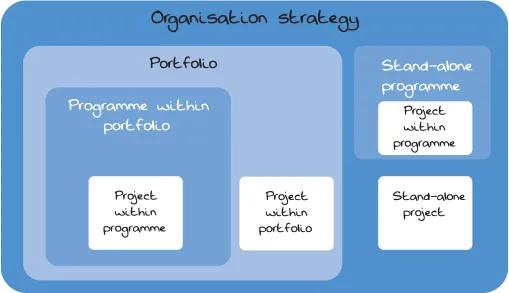
Figure 1.1 Programmes in relation to organisational strategy, portfolios and projects (adapted from APM Body of Knowledge 6th edition)
For completeness, Figure 1.1 above shows the relationship between programme management, project management and portfolio management. The latter are defined as follows (definitions from APM Body of Knowledge):
- Project management is the application of processes, methods, knowledge, skills and experience to achieve the project objectives.
- Portfolio management is the selection, prioritisation and control of an organisation’s projects and programmes in line with its strategic objectives and capacity to deliver. The goal is to balance change initiatives and business-as-usual while optimising return on investment.
1.3 Programme management and strategic direction
Strategic planning and setting the direction for an organisation is fundamentally different from operational management. Senior managers and executives deal with uncertainty and ambiguity as they set strategic direction, and then adapt this to address changes and challenges in the environment the organisation is operating in and its direction of travel. Whereas, at a project level, project managers operate with clarity of purpose, for example around cost, timescale and quality targets as defined by the single project...
Table of contents
- Copyright Page
- Contents
- List of figures and tables
- Foreword
- Acknowledgements
- Introduction and purpose of guide
- Programme management – an overview
- 1. Programmes and programme management
- 2. The programme life cycle
- 3. Programme assessment
- Glossary
- References
- Index
- Back Cover
Trusted by 375,005 students
Access to over 1.5 million titles for a fair monthly price.
Study more efficiently using our study tools.
Frequently asked questions
Yes, you can cancel anytime from the Subscription tab in your account settings on the Perlego website. Your subscription will stay active until the end of your current billing period. Learn how to cancel your subscription
No, books cannot be downloaded as external files, such as PDFs, for use outside of Perlego. However, you can download books within the Perlego app for offline reading on mobile or tablet. Learn how to download books offline
Perlego offers two plans: Essential and Complete
- Essential is ideal for learners and professionals who enjoy exploring a wide range of subjects. Access the Essential Library with 800,000+ trusted titles and best-sellers across business, personal growth, and the humanities. Includes unlimited reading time and Standard Read Aloud voice.
- Complete: Perfect for advanced learners and researchers needing full, unrestricted access. Unlock 1.5M+ books across hundreds of subjects, including academic and specialized titles. The Complete Plan also includes advanced features like Premium Read Aloud and Research Assistant.
We are an online textbook subscription service, where you can get access to an entire online library for less than the price of a single book per month. With over 1.5 million books across 990+ topics, we’ve got you covered! Learn about our mission
Look out for the read-aloud symbol on your next book to see if you can listen to it. The read-aloud tool reads text aloud for you, highlighting the text as it is being read. You can pause it, speed it up and slow it down. Learn more about Read Aloud
Yes! You can use the Perlego app on both iOS and Android devices to read anytime, anywhere — even offline. Perfect for commutes or when you’re on the go.
Please note we cannot support devices running on iOS 13 and Android 7 or earlier. Learn more about using the app
Please note we cannot support devices running on iOS 13 and Android 7 or earlier. Learn more about using the app
Yes, you can access APM Introduction to Programme Management 2nd edition by Association for Project Management (APM) in PDF and/or ePUB format, as well as other popular books in Business & Project Management. We have over 1.5 million books available in our catalogue for you to explore.