- 246 pages
- English
- ePUB (mobile friendly)
- Available on iOS & Android
eBook - ePub
The Modern Steel House
About this book
This book provides a comprehensive survey of Modern Movement houses constructed with steel frames. Arranged chronologically and thematically, it traces the development over the last seventy years of steel houses in Europe, Australia and the United States, with special reference to London, Paris, Sydney and Los Angeles and to the work elsewhere of Mies van der Rohe, Philip Johnson and Jean Prouve. Examples of steel houses from around the world demonstrate that steel structures can provide a better quality of life within a cleaner, lighter home environment.
Information
Part 1: The Modem Steel House 1929-1939
1.0
Chapter 1: Two Modern Steel Houses
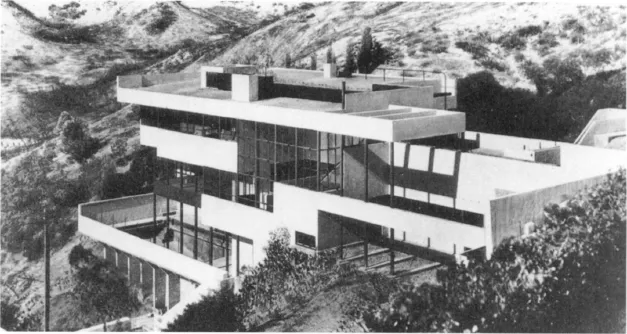
1.1 & 1.2 Richard Neutra, Lovell Health House, Los Angeles, California, 1929
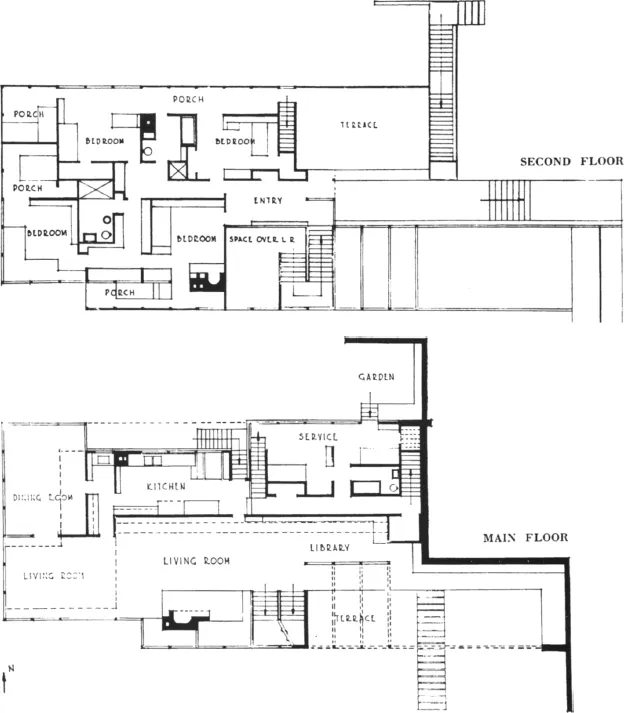
These illustrations originally appeared in Modem Architecture (1932)
The Lovell Health House
In May 1927 Richard Neutra had begun to work on the design of a “Steel, Glass, & Shot Concrete Residence, Los Angeles”.1 This was to be the Health House, (Figure 1.1) built for Dr Philip Lovell at the top end of Dundee Drive in the Hollywood Hills. Rudolph Schindler had already built a Modern, health-conscious, concrete house for Leah and Philip Lovell out of town at Newport Beach and a cabin for them in the mountains. But the site for the projected town house was both prominent and precipitous, and Schindler had failed to convince the Lovells of the reliability of his architecture: the new beach house flooded in the rainy season and the mountain cabin collapsed under snow. Lovell could have commissioned a historicist Spanish Colonial Revival design from his friend Fred Manhoff, but he wanted something Modern and in Richard Neutra he recognised a fellow-spirit. Here was an architect who would build him a Modern house out of modern materials for a modern lifestyle in a modern country.2
If Neutra saw the way forward through the benefits of production-line manufacturing, Philip Lovell was equally advanced in his thinking. Lovell was a medical doctor who wrote an enormously popular health column called “Care of the Body” in the Los Angeles Times Sunday Magazine. Between almost Victorian advertisments offering patent cures for ruptures and sagging, flabby chins, he extolled to his readers a healthier life-style, “believing firmly then and now that only in Natural forces lies men’s happiness – i.e. we needed and wanted sun, air, harmony of lines, and the ability to do many healthy things which I advocated, such as outdoors sleep, nude sunbathing, a pool that was never to be chlorinated, light, air, sunshine, clean lines.”3
The Health House was to be an exemplar of the healthy lifestyle. Located high in the hills, above the thick air of the city, it was to be crisp, elegant and white. It was to shine like a beacon and hover like a bird. There was to be a sense of openness about the house. The solidity of the roof line was to dematerialize floor by floor to the lowest level of the swimming pool where there were to be no enclosing walls. Throughout the elevations, the frame read clearly, suggesting that the gunite, the sprayed-on concrete, was little more than a thin wrapper. Internally, the steelwork was less apparent, but its presence was everywhere suggested: the sweeping horizontals, the demanding cantilevers, the suspended balconies and sleeping porches, the thinness of line. None of this could have been achieved with a concrete or timber frame, let alone in load-bearing masonry. Rooms flowed into rooms, interior and exterior became indistinguishable. When the building was illustrated in the catalogue of the 1932 Museum of Modern Art’s Modern Architecture exhibition, (Figure 1.2) no door swings were shown on the plan and thus the barrier between indoors and outdoors became quite ambiguous. This was how Philip Lovell intended it.
As the house grew on the hillside, Lovell kept his readers informed of its progress. This house, he told them, would “introduce a modern type of architecture and establish it firmly within California, where new and individualistic architecture is necessary”.4 But Lovell himself was not his only publicist. On 14 December 1929 Jack Lewis, of the Hollywood Daily Citizen wrote, “The HEALTHHOUSE [sic] … is a further monument to steel construction, executed to one eighth of an inch in exactness, and the result of two years’ careful research and design by Richard J. Neutra, foremost leader of the international movement of new architecture”.5 In his column in the next day’s Los Angeles Times Sunday Magazine, Lovell extended “an invitation for all Care of the Body readers” to visit the house. The accompanying illustration was captioned “Dr Lovell Home of Health”.6 The house was open all that day and the next Saturday and Sunday, and thousands of people came.7 Neutra was on hand, at 3.00pm each day, to show them around.
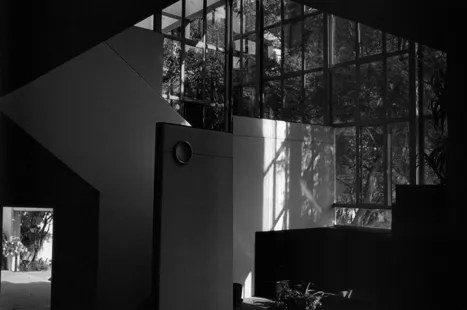
Indeed, the amount of attention he had given the house was extraordinary. For both economy and accuracy Neutra had decided to be his own contractor. As Dione his widow recalled: “I remember that Richard could not take a general contractor because then the price would have been 20 per cent more. So he decided that he had to be the contractor and he interviewed at least 70 (of the) craftsmen in order to enthuse them and make them interested and I think he succeeded. So he had the crew who was [sic] really interested and enthusiastic.”8 Nevertheless, Neutra personally checked every one of the thousand pre-punched bolt holes and shop-cut coverplates of the steel frame.9 His evident pleasure in the end result can be understood from a letter he wrote to an old friend in late 1929: “That I succeeded in such short order with the steel-skeleton Health House, which was, as a whole, in its philosophy and in many features, so highly unorthodox, seems almost incredible now. It was, in fact, a strange, unheard-of apparition to be conceived in the general scene of 1929… It was all a very novel ‘thoroughbred’ of integrated design, a never-contracted-for type of construction.”10 (Figure 1.3)
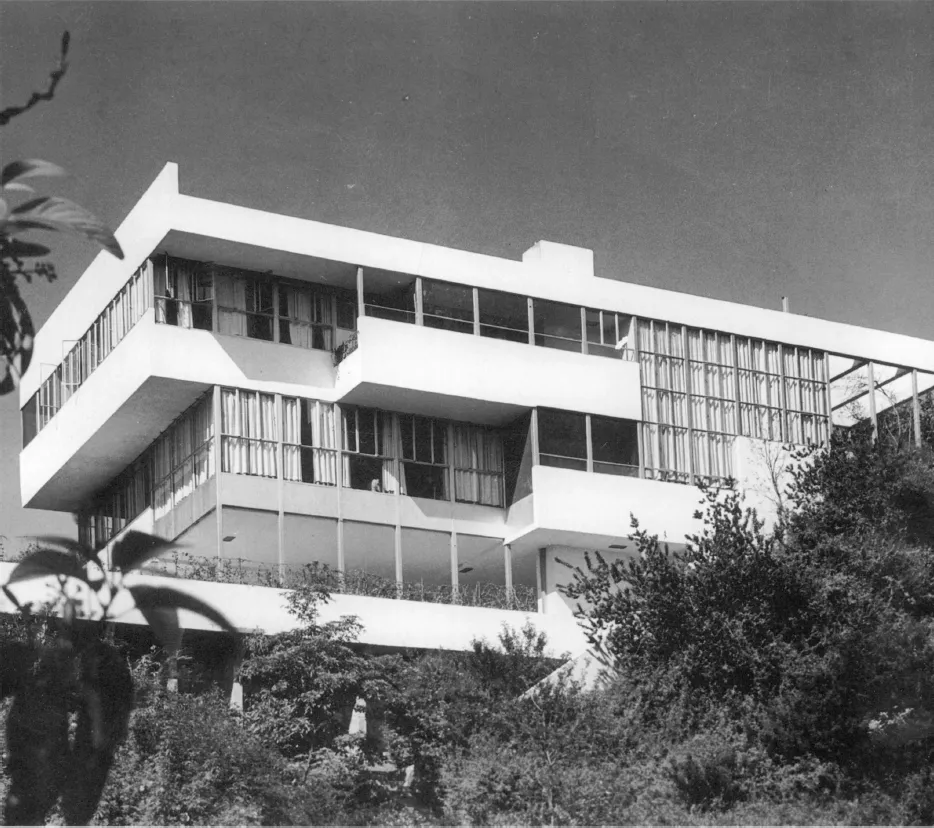
1.3 Richard Neutra, Lovell Health House, Los Angeles, California, 1929
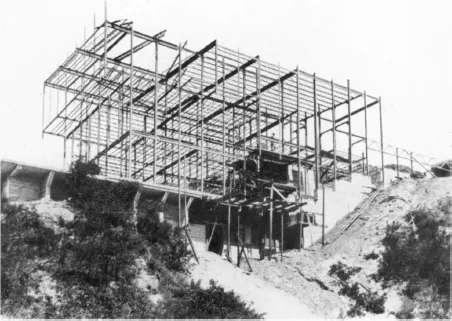
1.4 Richard Neutra, Lovell Health House, Los Angeles, California, 1929
The steel frame (Figure 1.4), which extended up through three storeys with an accuracy to about ⅛in. (3mm), was assembled in 40 working hours. It was arranged on a 5ft. ½in. (1537mm) square grid, with 4in. (100mm) H-section steel columns specified and located around the periphery and along some internal partition walls. The spans between were met with 4in., 8in. and 10in. (100mm, 200mm and 250mm) I-section beams, a variety of L-section beams, and with open-web joists. Where the columns were not tall enough they were doubled up, as Pierre Chareau was doing at the Maison de Verre in Paris, and on-site connections were made with ⅜in. (9mm) cover plates and ⅝in. (15mm) bolts. Elsewhere, there were “shop connections wherever possible”.11 It was a complex building and an awkward site, and the structure was hardly straightforward. Nevertheless Neutra did not overdesign: although it is difficult today to recalculate the sizes of the steel members needed, the strength of modern steel being so much better, it is likely that he designed to an allowable stress of 18,800 p.s.i., which would have been close to the limit.12
The clarity of the final form belied the complexity of the frame. In a pamphlet entitled “Built to Live In”, prepared in 1931 to promote the forthcoming Museum of Modern Art’s Modern Architecture exhibition, Philip Johnson wrote: “Modern architecture is based on planning. The architect builds to keep the plan inviolate. He does not allow a traditional style to interfere with the logic of his original interior arrangement. His façade reflects the plan. The needs of the building determine the exterior and interior design.”13 Facing this statement was a photograph of the newly-completed Lovell Health House.
At the far end of the long top-floor entrance terrace, located almost in the middle of the building, was the open-well staircase which formed the fulcrum around which the spaces revolved. From the front door and small entry hall the stairs wound down to the living room on one side, with the dining room and the canyon beyond, and, on the other side, the library and exercise lawn. They then wound down again to the bellevue and the open swimming pool at the lowest level. Thus, in a way, the visitor was dropped into the centre of the building from above. It is interesting to compare this plan with that of the Sternefeld House (Figure 1.5) built in Charlottenburg, Berlin, in 1923-4, and credited to Erich Mendelsohn, for whom Neutra had worked from October 1921 until he sailed for America in...
Table of contents
- Cover
- Dedication
- Half Title
- Title Page
- Copyright Page
- Table of Contents
- Preface
- Introduction
- Part 1: The Modern Steel House 1929-1939
- Part 2: The Modern Steel House in America
- Part 3: The Modern Steel House in Europe and Australia
- Part 4: Four Responses
- Acknowledgements
- List of interviews
- Sources
- Index
- Illustration credits
Trusted by 375,005 students
Access to over 1.5 million titles for a fair monthly price.
Study more efficiently using our study tools.
Frequently asked questions
Yes, you can cancel anytime from the Subscription tab in your account settings on the Perlego website. Your subscription will stay active until the end of your current billing period. Learn how to cancel your subscription
No, books cannot be downloaded as external files, such as PDFs, for use outside of Perlego. However, you can download books within the Perlego app for offline reading on mobile or tablet. Learn how to download books offline
Perlego offers two plans: Essential and Complete
- Essential is ideal for learners and professionals who enjoy exploring a wide range of subjects. Access the Essential Library with 800,000+ trusted titles and best-sellers across business, personal growth, and the humanities. Includes unlimited reading time and Standard Read Aloud voice.
- Complete: Perfect for advanced learners and researchers needing full, unrestricted access. Unlock 1.5M+ books across hundreds of subjects, including academic and specialized titles. The Complete Plan also includes advanced features like Premium Read Aloud and Research Assistant.
We are an online textbook subscription service, where you can get access to an entire online library for less than the price of a single book per month. With over 1.5 million books across 990+ topics, we’ve got you covered! Learn about our mission
Look out for the read-aloud symbol on your next book to see if you can listen to it. The read-aloud tool reads text aloud for you, highlighting the text as it is being read. You can pause it, speed it up and slow it down. Learn more about Read Aloud
Yes! You can use the Perlego app on both iOS and Android devices to read anytime, anywhere — even offline. Perfect for commutes or when you’re on the go.
Please note we cannot support devices running on iOS 13 and Android 7 or earlier. Learn more about using the app
Please note we cannot support devices running on iOS 13 and Android 7 or earlier. Learn more about using the app
Yes, you can access The Modern Steel House by Neil Jackson in PDF and/or ePUB format, as well as other popular books in Architecture & Architecture General. We have over 1.5 million books available in our catalogue for you to explore.