eBook - ePub
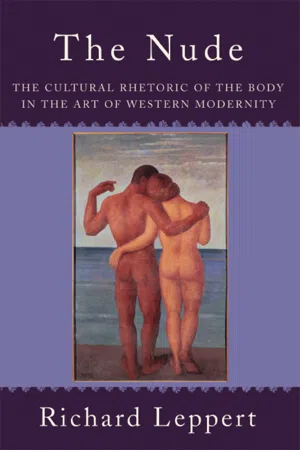
The Nude
The Cultural Rhetoric of the Body in the Art of Western Modernity
- 336 pages
- English
- ePUB (mobile friendly)
- Available on iOS & Android
eBook - ePub
About this book
The Nude explores some of the principal ways that paintings of the nude function in the conflicted terrain of culture and society in Europe and America from the fifteenth through twentieth centuries, as set against questions about human sexuality that emerge around differences of class, gender, age, and race. Author Richard Leppert relates the visual history of how the naked body intersects with the foundational characteristics of what it is to be human, measured against a range of basic emotions (happiness, delight, and desire; fear, anxiety, and abjection) and read in the context of changing social and cultural realities. The bodies comprising the Western nude are variously pleasured or tormented, ecstatic or bored, pleased or horrified. In short, as this volume amply demonstrates, the nude in Western art is a terrain on whose surface is written a summation of Western history: its glory but also its degradation.
Information
CHAPTER ONE
Introduction
The State of Being without Clothes—in Art
It is lost on no one that a significant portion of our conscious and unconscious understandings of ourselves and of our immediate world is framed by the imagery of advertising, both in the medium of print and on television. This imagery urges what sort of bodies to have or to desire—or to build (even the seeming natural given of our fleshly frames is terrain for future construction)—our sense of self, our belief systems, our individuality, and our status as social beings; what clothes to wear, or car to drive, which political party to vote for, and so forth.
Outlining the Territory
We understand several fundamental things about the advertising image. The information it provides is not unbiased or neutral (buy this instead of that and you’ll be happier, better for it, more successful). It specifically exists to get us to do something we might otherwise not do. It promises future happiness, but by trying to make us dissatisfied with our past and, especially, with our present. And even when we recognize the fictions upon which advertising’s pleas depend for their success, we commonly find ourselves being sucked in by the very possibility of the narrative—thus the appeal to men of coolness, group identity (lots of buddies), athleticism, and inordinate sexiness to women, and the like; and the appeal to women of beauty, being loved, and, above all, of inordinate sexiness to men, and so forth. We understand—certainly once we have spent our money—that the promise remains just that. But despite our resistance and growing cynicism, we remain to one degree or another caught in the light of what we see: what we are shown.
Images show us a world, but not the world. Images are not the things shown, but representations thereof: re-presentations. Indeed, what images represent may otherwise not exist in reality and instead be confined to the realm of imagination, wish, dream, or fantasy. And yet, of course, any image literally exists as an object within the world that it some way engages. When we look at images, whether photographs, films, videos, or paintings, what we see is the product of human consciousness, itself part and parcel of culture and history. That is, images are not mined, like ore; they are constructed for the purpose of performing some function within a given society and its culture.
This is a book about paintings (mostly) produced during the broad expanse of time that marks historical modernity, from the early Renaissance to the present. The images discussed are Western, from Europe and the Americas, the earliest dated c. 1427 and the most recent 1992, with emphasis on representational art, rather than abstract. The story narrates the body without clothes: the nude.
In particular, I am keen to understand some of the ways that paintings of naked human beings function within the conflicting realms of power that operate throughout any social formation, especially those surrounding differences of class, gender, and race. I am interested in the representation of the naked body as a sight—and sometimes as a spectacle—that is, as an object of display and intense interest upon which the viewer obsessively gazes. The represented bodies will be those of both sexes at all ages and from different races and social classes. Both secular and sacred subjects are included. Some bodies represented will be seen as pleasured, others as tormented. Throughout this encounter I shall question art’s relation to the abstract realms of happiness, desire, fear, and anxiety, understood less as individual, private emotions and more as responses to social and cultural conditions.
Seeing and the Social Practice of Making Sense
An underlying and fundamental theme governing this book is that all meaning—thus including the meanings of paintings— results from social practices that are in a constant state of flux and are under challenge by people holding diverse, often conflicting, interests. Art-making and its consumption (viewing) are social practices. But in order to consider how paintings have functioned—the jobs they have been assigned to perform—it is crucial to understand that visual representation operates with the specificity of the medium of painting—just as literature is specifically different from television, film, and music. Each of these media is richly expressive and communicative, and each is practiced according its own set of principles. That is, the means by which visual art says something to us is in part unique to visual art, and that specificity must be both respected and investigated if we have any hope of sorting out how art works on us. Accordingly, another of my concerns is to address the question of how representations go about representing.
Sight is the principal means through which we learn to maneuver in time and space. Sight is a device for recognition, prediction, and confirmation: This person is mother, and not a stranger. (Her identity is seen before her name is recognized, and long before it can be spoken.) We also understand that seeing is not a simple matter of biology and physics, not a question about light waves’ action on the retina. Seeing is very much about the mind and thought processes. The moment I invoke thought, the complexity of seeing increases exponentially, for I have introduced language into the equation—and not mere recognition, as with the basic identity bond between infants and parents prior to language acquisition.
Here again representation enters. The function of language, itself the manifestation of cognition, is to represent in repeatable, abstract signs (morphemes) and sounds (phonemes) what comes to us by means of our various senses, sight principal among them. (Without our senses language is impossible. To be sure, we can get along quite well without one or more of our senses, but not without all of them—which would end life itself.) Restricting ourselves to the sense of sight, what we make of it depends in part on thought, just as thought depends on language: again, representation. We cannot escape the web of representational devices; they are what allow us to make our way in the world.1
However, it is all too easy, and utterly false, to imply that paintings are simply nonverbal substitutes for what might otherwise be expressed or communicated in words—ironically, the vast body of writing about art confirms nothing more than that words often fail miserably to account for the communicative and expressive power of images. Paintings are products of human consciousness—thought and feeling—transformed through the physical act of painting into something visible—but silent, and usually devoid of words (relatively few paintings include texts that the viewer can read). Images are less visual translations of what might otherwise be said (in words) than they are visual transformations of a certain awareness of the world. Conscious (and unconscious) awareness of a given situation, to be sure, has ties in language, but language is only the most obvious (and not the only) means by which people attempt to make sense of their reality. Were that not so there is little cause to explain the existence of either images or, for that matter, music. Further, paintings are not simply assertions about the world; they are as much interrogatives, inquiries, and explorations. Images do not so much tell us anything, as make available—by making visible in a certain way—a realm of possibilities and probabilities, some of which are difficult to state in words.
Seeing to Know/Knowing to See
It makes no sense to think about a painting as though it were “a delivery van, conveying meaning to the customer.”2 Viewers do not wait for a painting’s meanings to arrive prepackaged. Viewers are active participants in determining meaning. In order to see (that is, to perceive), I have to know something. At the most basic level this requires that I recognize what it is I am looking at, though mere recognition takes me but a short distance. Thus the ancient Roman scholar Pliny: “The mind is the real instrument of sight and observation, the eyes act as a sort of vessel receiving and transmitting the visible portion of the consciousness.”3
It is easily understood that seeing requires certain skills that are in part historically and culturally specific. What is there for me to see involves me: my own knowledge, beliefs, investments, interests, desires, and pleasures. Having acquired consciousness, I never approach an image as a tabula rasa—“the innocent eye is a myth”4—I come always already knowing, believing, wanting, and so forth, to whatever degree. Further, I know that the image’s maker, like me, approaches the wood panel or canvas with knowledge, belief, investment, interest, and desire. Still further, artists historically most often worked directly for someone or something else—a patron, and later, an art market— wherefrom other, and not likely always parallel knowledges, interests, and so on emanate.
Thus: “Every image embodies a way of seeing.”5 Or better: every image embodies historically, socially, and culturally specific, competing, and contradictory ways of seeing. Precisely on that account, the contents of images are not simple substitutes for words, because they call upon so much more than words. Pictures call out not only to the mind but also to the body (consider the immediate physical impact of erotic images), to thought but also to emotion, and so forth. The French novelist Émile Zola commented that art works are “a corner of nature seen through a temperament.”6 Zola’s remark acknowledges that artists do not operate as mere conduits moving information from point A to point B like electrical lines. Instead, artists transform their material. But the value of Zola’s insight is limited by the fact that he tacitly reduces art to the isolated psychology of the individual artist, without acknowledging that artistic consciousness itself is formed within the boundaries of history, society, and culture. Further, it is perhaps ironic that what we label individuality— however we may imagine and treasure it—is endlessly duplicated in any given society. To cite a mundane example, the limits to individuality are evident in newspaper personal ads; despite efforts to make each message appear unique, the net result is often a striking, perhaps depressing, sameness.
Limits of Engagement
In writing about art, I seek to engage some paintings in a sort of metaphoric dialogic process in which their “speaking out” to me, their function of giving visibility to something, elicits from me a response, an engagement. In the process, I hope that my readers will become engaged in the process as well. My intent is to make visible certain possibilities of meanings relative to certain images. Recognizing that art, as representation, is by nature inherently always interested, and not objective, in what it makes available for me to see or to be shown, I respond in kind. That is, I recognize, and explicitly acknowledge, my own interests. Still, the reader must remember that these interests are not coterminous with the “everything” of art—but neither are they trivial.
It is critical to emphasize that all this will be partial, incomplete, impermanent, and for that matter maybe wrong, but not disinterested. What I seek to do is in fact all that can be done. “Artworks are not like broadcasting devices perpetually sending out the same signal or set of signals: The construal of meaning is dynamically constructive for both user and maker; it is a ceaseless production galvanized by objects in historically and socially specific circumstances.”7 To talk about an image is not to decode it, and having once broken its code to be done with it, the final meaning having been established and reduced to words. To talk about an image is, in the end, an attempt to relate oneself to it and to the sight it represents. The image is a place to see what we can see, a site of exploration, a place to travel, and like all sites worthy of a visit, worth returning to because there is always more to see. Art history is “a place to see seeing”;8 no more than any other site, it is assuredly not a place to see the end of seeing. As a signifying practice, it is a beginning without end, just as my own activity as an author of a book about images is an incomplete representation—about representations.9
To summarize: My particular interest in visual art lies in equal measure with the adjective, the visual, and the noun it modifies, the art. What is essential about visual art is that it is first and foremost art (i.e., artifice) and, as it were, incidentally visual. The importance of vision to visual art is not the physiological phenomenon of seeing (animals see; they do not make art) but in the perceiving, which of course is governed by the eyes in conjunction with the brain (conscious and unconscious thought) and indeed with the entire human organism (the body) in its perceived relation to external reality.10 I am interested in how and why art functions as representation, in how and why people, objects, places, and events are made to appear in art; and in the means by which images attempt to call out to me.11
What’s Nude?
In painting, nude or naked: what to call it? What are the stakes of the difference? A generation ago, Sir Kenneth Clark, in his monumental study of nudity and nakedness in art, suggested some principles for defining the boundary between the two categories of being without clothes. Nakedness, he said, describes a state of being without clothes; nudity by contrast is a category of artistic representation. The former, he argued, “implies some sort of embarrassment” most people feel from being deprived of clothes, the latter “carries, in educated usage, no uncomfortable overtone. The vagu...
Table of contents
- Cover
- Half Title
- Title Page
- Copyright Page
- Contents
- Illustrations
- Acknowledgments
- Chapter One Introduction: The State of Being without Clothes—in Art
- Chapter Two Representing the Young Innocence, Nakedness, and the Adult Imaginary
- Chapter Three The Female Nude: Surfaces of Desire
- Chapter Four The Male Nude Identity and Denial
- Chapter Five Afterword
- Notes
- Works Cited
- Index
Trusted by 375,005 students
Access to over 1.5 million titles for a fair monthly price.
Study more efficiently using our study tools.
Frequently asked questions
Yes, you can cancel anytime from the Subscription tab in your account settings on the Perlego website. Your subscription will stay active until the end of your current billing period. Learn how to cancel your subscription
No, books cannot be downloaded as external files, such as PDFs, for use outside of Perlego. However, you can download books within the Perlego app for offline reading on mobile or tablet. Learn how to download books offline
We are an online textbook subscription service, where you can get access to an entire online library for less than the price of a single book per month. With over 1.5 million books across 990+ topics, we’ve got you covered! Learn about our mission
Look out for the read-aloud symbol on your next book to see if you can listen to it. The read-aloud tool reads text aloud for you, highlighting the text as it is being read. You can pause it, speed it up and slow it down. Learn more about Read Aloud
Yes! You can use the Perlego app on both iOS and Android devices to read anytime, anywhere — even offline. Perfect for commutes or when you’re on the go.
Please note we cannot support devices running on iOS 13 and Android 7 or earlier. Learn more about using the app
Please note we cannot support devices running on iOS 13 and Android 7 or earlier. Learn more about using the app
Yes, you can access The Nude by Richard Leppert in PDF and/or ePUB format, as well as other popular books in Art & Art General. We have over 1.5 million books available in our catalogue for you to explore.