- 144 pages
- English
- ePUB (mobile friendly)
- Available on iOS & Android
eBook - ePub
About this book
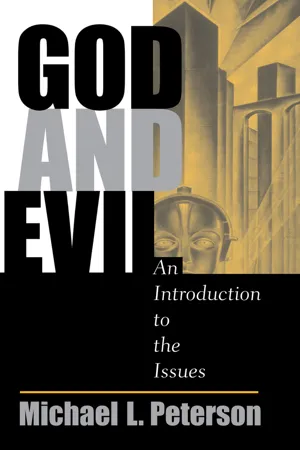
This concise, well-structured survey examines the problem of evil in the context of the philosophy of religion. The main problem of evil consists in reconciling belief in a just and loving God with the evil and suffering in the world. Michael Peterson frames this issue by working through questions such as the following: What is the relation of rational belief to religious faith? What different conceptual moves are possible on either side of the issue? What responses have important thinkers advanced and which seem most promising? Is it possible to maintain religious commitment in light of evil? The author relies on the helpful distinction between moral and natural evil to clarify our understanding of the different aspects of the problem as well as avenues for response. Thus, the reader of this book gains not only an intellectual grasp of the debate over God and evil in professional philosophy but also the personal benefit of thinking through one of the most important issues in human life. }This concise, well-structured survey examines the problem of evil in the context of the philosophy of religion. One of the core topics in that field, the problem of evil is an enduring challenge that Western philosophers have pondered for almost two thousand years. The main problem of evil consists in reconciling belief in a just and loving God with the evil and suffering in the world. Michael Peterson frames this issue by working through questions such as the following: What is the relation of rational belief to religious faith? What different conceptual moves are possible on either side of the issue? What responses have important thinkers advanced and which seem most promising? Is it possible to maintain religious commitment in light of evil? Peterson relies on the helpful distinction between moral and natural evil to clarify our understanding of the different aspects of the problem as well as avenues for response. The overall format of the text rests on classifying various types of argument from evil: the logical, the probabilistic, the evidential, and the existential arguments. Each type of argument has its own strategy which both theists and nontheists must recognize and develop. Giving both theistic and nontheistic perspectives fair representation, the text works through the issues of whether evil shows theistic belief to be inconsistent, improbable, discredited by the evidence, or threatened by personal crisis.Peterson explains how defensive strategies are particularly geared for responding to the logical and probabilistic arguments from evil while theodicy is an appropriate response to the evidential argument. Theodicy has traditionally been understood as the attempt to justify belief in a God who is all-powerful and all-good in light of evil. The text discusses the theodicies of Augustine, Leibniz, Hick, and Whitehead as enlightening examples of theodicy. This discussion allows Peterson to identify and evaluate a rather dominant theme in most theodicies: that evil can be justified by designating a greater good. In the end, Peterson even explores how certain types of theodicy, based on specifically Christian renditions of theism, might provide a basis for addressing the existential problem of evil. The reader of this book gains not only an intellectual grasp of the debate over God and evil in professional philosophy but also the personal benefit of thinking through one of the most important issues in human life. }
Information
1
The Problem of Evil and Its Place in Philosophy of Religion
Something is dreadfully' wrong with our world. An earthquake kills hundreds in Peru. A pancreatic cancer patient suffers prolonged, excruciating pain and dies. A pit bull attacks a two-year-old child, angrily ripping his flesh and killing him. Countless multitudes suffer the ravages of war in Somalia. A crazed cult leader pushes eighty-five people to their deaths in Waco, Texas. Millions starve and die in North Korea as famine ravages the land. Horrible things of all kinds happen in our world—and that has been the story since the dawn of civilization. Today's news media thrive on things that are wrong in the world, on bad things that happen to people every day. Television parades vivid images of war, murder, devastation, and suffering before our eyes. Newspapers report rape, abuse, mayhem, and disaster.
Evil in Human Existence
In June 1991, Time magazine asked the question, "Why?"—"Why does evil happen?"1 In the cover essay, journalist Lance Morrow reviews the multitude of evils that haunt our consciousness—from Hitler's Auschwitz to Saddam Hussein's invasion of Kuwait, from KKK hangings of black men in pre-civil rights Mississippi to the AIDS epidemic. Right there in a popular magazine. Morrow raises age-old questions in an article starkly titled "Evil." Is evil an entity? Or is evil the immoral and inhumane actions of persons? What about bad and hurtful things that are out of our control, such as disease, floods, and mental illness? Is nature responsible? Why does evil seem so fascinating and alluring to the human mind while good seems so uninteresting and boring? Does evil serve some purpose, or does it just happen? Why has the human race not seemed able to understand evil, to conquer it, to shut it out?
Thoughtful people raise penetrating questions about evil and seek to understand what it reveals about the human condition. In a feature article in the New York Times Magazine, Ron Rosenbaum seeks to probe the meaning of evil. The cover of the magazine reads "Evil's Back," and Rosenbaum's article inside carries the title "Staring into the Heart of the Heart of Darkness." Rosenbaum's piece sets the stage by recounting how Susan Smith of Buffalo, South Carolina, murdered her two young sons. He rehearses the facts that a whole nation now knows all too well: Susan Smith drowned her two little boys by strapping them into the child safety seats in her Mazda and sending the car rolling down an embankment into John D. Long Lake. She then manufactured an "ordeal" to deflect attention from her crime. Playing on racial prejudice, she claimed that an African American car jacker had kidnapped her two children, and she pled desperately on television for a search for the car jacker and the children. Yet, within nine days, she confessed to killing three-year-old Michael and fourteen-month-old Alex.
Rosenbaum observes that one local tabloid called Smith's action an "evil deed." What is impressive about this pronouncement is that the secular news media would make it. In a day when electronic and printed media typically prefer to assume a "relativity of values"— avoiding difficult issues about morality, theology, the meaning of life, and our place in the cosmos—it was blurted out. There it was. Something was actually declared "evil"—pure, unadulterated, unmistakable evil—by the press. Now all the hard questions are laid on the table and have to be faced: What is evil? Why do humans have the seemingly vast capacity to harm others? If there is a good God, why does he permit innocent people to suffer?2
There is something about the Susan Smith case that evokes our harshest moral judgments and gets us asking all of those hard questions. Rosenbaum cannily observes that "the great tabloid stories are the ones that raise theological questions." Yet he quickly acknowledges that we cannot talk about evil—or about good, for that mat ter—without some definitions. Those definitions lead us to larger theories about the origin and existence of evil in our midst, and those theories lead us to even larger conceptions of the meaning of life and the nature of whatever Supreme Being might exist.3
Although our age is acutely conscious of the widespread existence of evil in human life, past ages have certainly been aware of its profound significance. Almost no other theme recurs in great literature more often than that of humanity's capability for evil. In ancient Greek tragedy, for example, the tragic hero is a person of noble status and lofty aspirations who is eventually undone because of a profound character flaw, known as hubris (pride). All of the tragic hero's other virtues become disjointed as his flaw subtly ruins his life. Russian author Fyodor Dostoevsky treats scornfully the comforting notion that humans are always rational and good. In a famous passage from The Brothers Kammuzov, Dostoevsky protests such wild optimism about humankind: "I can't endure that a man of lofty mind and heart begins with the ideal of the Madonna and ends with the ideal of Sodom. What's still more awful is that a man with the ideal of Sodom in his soul does not renounce the ideal of the Madonna, and his heart may be on fire with that ideal, genuinely on fire, just as in the days of youth and innocence."4 Our human inability to live up to our own high ideals is a perpetual puzzlement.
The paradoxical depravity and perversity of humanity are treated quite poignantly in Dr. Jekyll and Mr. Hyde. Robert Louis Stevenson's frightening fable records how the decent Dr. Jekyll came under the power of a transforming drug: "It severed in me those provinces of good and ill which divide and compound man's dual nature. I was in no sense a hypocrite; both sides of me were in dead earnest; I was no more myself when I laid aside restraint and plunged in shame, than when I labored, in the eye of day, at the furtherance of knowledge or the relief of sorrow and suffering."5
As time went on, the thought of evil represented in the person of Mr. Hyde no longer filled Jekyll with terror: "I sat in the sun on a bench; the animal within me licking the chops of memory; the spiritual side a little drowsed, promising subsequent penitence, but not yet moved to begin. I began to be aware of the temper of my thoughts, a greater boldness, a contempt of danger, a solution of the bonds of obligation."6
The apelike creature had diabolically gained control of Jekyll:
This was the shocking thing; that the slime of the pit seemed to utter cries and voices; that the amorphous dust gesticulated and sinned; that what was dead, and had no shape, should usurp the offices of life. And this again, that the insurgent horror was knit to him closer than a wife, closer than an eye; lay caged in his flesh, where he heard it mutter and felt it struggle to be born; and at every hour of weakness, and in the confidence of slumber prevailed against him, and cieposed him out of life.7
Dr. Jekyll confesses the terrible truth that he is radically both natures: "It was the curse of mankind that ... in the agonized womb of consciousness these polar twins should be continuously struggling."8
Paul, the early Christian evangelist, recognizes the war within himself: "I do not understand my own actions. For I do not do what I want, but I do the very thing I hate. ... I can will what is right, but I cannot do it. For I do not do the good I want, but the evil I do not want is what I do."9 In a similar vein, St. Augustine recounts his unhappy predicament in his Confessions'. "I was bound, not with another's irons, but by my own iron will. My will the enemy held, and thence had made a chain for me, and bound me."10 This personal aspect of evil most closely coincides with what the Judeo-Christian Scriptures describe as "sin."
Once we recognize the existence of something that can reasonably be called personal evil, we must then also recognize that it has collective as well as individual dimensions. Organized crime syndicates, militant emerging nations, oppressive social structures, and profit-crazed multinational corporations are, in a real sense, the social extensions of personal evil. On both individual and corporate levels, one of the saddest features of human evil is its strange admixture with good or apparent good. Marriages are wrecked for lack of mutual understanding, educational communities are undermined by disagreement about how to pursue common ideals, political parties are thrown into disarray by excessive ambition, and nations are ripped apart by struggles for power.
Although we are perplexed by humanity's capacity tor evil, even the best of us are sometimes hurt and even crushed by the impersonal forces of the universe. These forces know nothing of human agendas or purposes and tend to thwart all that we hold dear. Herman Melville deals with this theme in Moby Dick. Captain Ahab of the Pequod, forty years a whaler in the first half of the last century, sets out from Nantucket on what appears to be a long whaling cruise. Little does anyone know that Ahab's journey is not seaman's business but a quest for the meaning of life. Ahab had lost a leg in an earlier encounter with Moby Dick, a great white whale, then the terror of the seas, and is now bent on destroying it. The captain is obsessed with the meaning of human existence in the face of overwhelming natural forces. Ironically, the whale is white, a color often taken to symbolize what is sacred and holy; but the whale is fearsome and hostile to human values and, in the end, triumphant. Ishmael, the ship's only survivor, claims that in losing his life Ahab discovered its meaning.11 The modern world knows all too well that this disturbing picture of life—life being ruined and finally snuffed out by forces beyond its control—is a realistic one.
There is no denying that persons often fall victim to psychological and physical forces beyond their control. But quite apart from how these forces affect human interests, they certainly cause much pain and death within nature itself. As Alfred Lord Tennyson reminds us, nature is "red in tooth and claw" Survival of the fittest is built into the mechanism of animate nature. Few animals are free from attack by stronger animals or from suffering and death due to shifts in their environment. Although animals do not possess the higher self-consciousness of humans, they still obviously feel pain and endure suffering. Thoughtful people find it very puzzling that the world should work in such a way as to maim, torture, and destroy large proportions of these subhuman creatures.
At the end of any catalog of ills that plague the world comes death. All things eventually die. But death is a particularly acute problem for the human species because we humans sense that our existence has value and worth, that our agendas have merit, that we deserve to go on living and building our lives. And yet death stands as the final enemy, the last evil we must face; it puts an end not only to our doing and undergoing further evils but also to our pursuing our most cherished dreams. Thus, death is radically foreign to all that is within us. Ludwig Wittgenstein observes: "Death is not an event in life: we do not live to experience death."12 Death is the end of life. H. F. Lovell Cocks writes that the termination of one's own personal existence is the "great human repression, the universal 'complex.' Dying is the reality that [persons] dare not face, and to escape which [they] summon all [their] re sources."13 Those who have thought long and hard about the human condition know that death is arguably the most fearsome of all evils.
After pondering evil in the world, we may be tempted to echo the sentiment in the chorus of T. S. Eliot's Murder in the Cathedral:
Here is no continuing city, here
is no abiding stay.
Ill the wind, ill the time, uncertain
the profit, certain the danger.
is no abiding stay.
Ill the wind, ill the time, uncertain
the profit, certain the danger.
O late late late, late is the time,
too late, and rotten the year;
Evil the wind, an...
too late, and rotten the year;
Evil the wind, an...
Table of contents
- Cover
- Half Title
- Title
- Copyright
- Dedication
- Contents
- Preface
- 1 The Problem of Evil and Its Place in Philosophy of Religion
- 2 The Logical Problem of Evil
- 3 The Function of Defense
- 4 The Probabilistic Problem of Evil
- 5 The Problem of Gratuitous Evil
- 6 The Task of Theodicy
- 7 The Existential Problem of Evil
- Index
Trusted by 375,005 students
Access to over 1.5 million titles for a fair monthly price.
Study more efficiently using our study tools.
Frequently asked questions
Yes, you can cancel anytime from the Subscription tab in your account settings on the Perlego website. Your subscription will stay active until the end of your current billing period. Learn how to cancel your subscription
No, books cannot be downloaded as external files, such as PDFs, for use outside of Perlego. However, you can download books within the Perlego app for offline reading on mobile or tablet. Learn how to download books offline
Perlego offers two plans: Essential and Complete
- Essential is ideal for learners and professionals who enjoy exploring a wide range of subjects. Access the Essential Library with 800,000+ trusted titles and best-sellers across business, personal growth, and the humanities. Includes unlimited reading time and Standard Read Aloud voice.
- Complete: Perfect for advanced learners and researchers needing full, unrestricted access. Unlock 1.5M+ books across hundreds of subjects, including academic and specialized titles. The Complete Plan also includes advanced features like Premium Read Aloud and Research Assistant.
We are an online textbook subscription service, where you can get access to an entire online library for less than the price of a single book per month. With over 1.5 million books across 990+ topics, we’ve got you covered! Learn about our mission
Look out for the read-aloud symbol on your next book to see if you can listen to it. The read-aloud tool reads text aloud for you, highlighting the text as it is being read. You can pause it, speed it up and slow it down. Learn more about Read Aloud
Yes! You can use the Perlego app on both iOS and Android devices to read anytime, anywhere — even offline. Perfect for commutes or when you’re on the go.
Please note we cannot support devices running on iOS 13 and Android 7 or earlier. Learn more about using the app
Please note we cannot support devices running on iOS 13 and Android 7 or earlier. Learn more about using the app
Yes, you can access God And Evil by Michael L Peterson in PDF and/or ePUB format, as well as other popular books in Theology & Religion & Philosophy History & Theory. We have over 1.5 million books available in our catalogue for you to explore.