- 256 pages
- English
- ePUB (mobile friendly)
- Available on iOS & Android
eBook - ePub
About this book
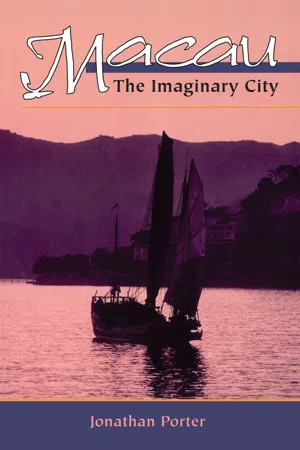
"For many people who have encountered it, Macau makes a deep impression on the imagination, as if the city were not entirely real or, rather, not of the real world. Macau often seems dreamlike, as though it were sustained by the effort of some powerful imagination." In this evocative essay on the cultural and social history of a unique and fragile city, Jonathan Porter examines Macau as an enduring but ever-changing threshold between East and West. Founded by the Portuguese in 1557, Macau emerged as a vibrant commercial and cultural hub in the early seventeenth century. The city then gradually evolved, flourishing first as a Eurasian community in the eighteenth century and then as an increasingly Chinese city in the nineteenth century. Macau became a modern manufacturing center in the late twentieth century and is now destined for reversion to the People's Republic of China in 1999. The city was the meeting ground for many cultures, but central to this fascinating story is the encounter between an expansive, seaborne Portuguese empire and the introspective, closed world of imperial China. Unlike the other great colonial port cities of Asia, Macau did not provide natural access to the hinterland, and this geographical and historical isolation has fostered a unique balance of cultural influences that survives to this day. Poised on the periphery of two worlds, an isolated but global crossroads, Macau is a unique cultural and social melange that illuminates crucial issues of cross-cultural exchange in world history. Establishing Portugal and China as distinct cultural archetypes, Porter then examines the subsequent encounters of East and West in Macau from the sixteenth to the twentieth century. Avoiding the traditional linear chronological approach, Porter instead looks at a series of images from the city's history and culture, including its place in the geographical context of the South China coast; the architecture of Macau, which reflects the memories of its historical passages; the variety of people who crossed the threshold of Macau; the material culture of everyday life; and the spiritual topography resulting from the encounters of popular religious movements in Macau. Jonathan Porter concludes his literary journey by reflecting on the character and meaning of the many cultural and social influences that have met and mingled in Macau. His words and photographs eloquently capture the essence of a place that seems too ephemeral to be real, too captivating to be anything but an imaginary city.
Information
Notes
Abbreviations Used in the Notes
| AMJL | Yin Guangren and Zhang Rulin, comps., Aomen jilue. |
| CR | Bridgman, Elijah Coleman, and S. Wells Williams, eds., The Chinese Repository. |
| DMB | L. Carrington Goodrich and Chaoying Fang, eds., Dictionary of Ming Biography |
| GDXY | Qu Dajun, Guangdong xinyu. |
| MS | Zhang Tingyu et al., eds., Mingshi. |
| PTY | Jie Zi, ed., Putayao qinzhan Aomen shilue. |
| QCYSDG | Qingchao yeshi daguan. |
Introduction
1. Italo Calvino, Invisible Cities (San Diego: Harcourt Brace Jovanovich, 1972), 69.
2. Eugene Victor Walter, Place-ways: A Theory of the Human Environment (Chapel Hill: University of North Carolina Press, 1988), 204.
3. See John E. Wills Jr., Embassies and Illusions: Dutch and Portuguese Envoys to K'ang-hsi, 1666-1687 (Cambridge, Mass.: Harvard University Press, 1984), for a discussion of political approaches to China through Macau in the seventeenth century.
4. See, for examples, C. R. Boxer, The Great Ship from Arnacon: Annals of Macao and the Old Japan Trade, 1555-1640 (Lisbon: Centro de Estudos Historicos Ultra-marinos, 1959); George Bryan Souza, The Survival of Empire: Portuguese Trade and Society in China and the South China Sea, 1630-1754 (Cambridge: Cambridge University Press, 1986); T'ien-tse Chang, Sino-Portuguese Trade from 1514 to 1644: A Synthesis of Portuguese and Chinese Sources (Leyden: E. J. Brill, 1934); Michael Greenberg, British Trade and the Opening of China, 1800-1842 (Cambridge: Cambridge University Press, 1951); John King Fairbank, Trade and Diplomacy on the China Coast: The Opening of the Treaty Ports, 1842-1854 (Stanford: Stanford University Press, 1969); and Maurice Collis, Foreign Mud: The Opium Imbroglio at Canton in the 1830's & the Anglo-Chinese War (New York: W. W. Norton, 1968). The last is a popular account.
5. See George H. Dunne, Generation of Giants: The Story of the Jesuits in China in the Last Decades of the Ming Dynasty (Notre Dame, Ind.: University of Notre Dame Press, 1962), and Arnold H. Rowbotham, Missionary and Mandarin: The Jesuits at the Court of China (Berkeley: University of California Press, 1942).
6. For a collective effort of this kind, see Dilip K. Basu, ed., The Rise and Growth of the Colonial Port Cities in Asia (Berkeley: Center for South and Southeast Asia Studies, University of California at Berkeley, 1985). This volume does not include a treatment of Macau. See also Rhoads Murphey, "Traditionalism and Colonialism: Changing Urban Roles in Asia "Journal of Asian Studies 29, no. 1 (November 1969), 67-84. On the typology of cities, see Max Weber, "The Nature of the City" (pp. 23-46), and Robert Redfield and Milton Singer, "The Cultural Role of Cities" (pp. 206-233), in Richard Sennett, ed., Classic Essays on the Culture of Cities (New York: Appleton-Century-Crofts, 1969).
7. Several more or less comprehensive histories of Macau already exist: C. A. Montalto de Jesus, Historic Macao (Hong Kong; Oxford University Press, 1984); C. R. Boxer, Fidalgos in the Far East, 1550-1770 (Hong Kong: Oxford University Press, 1968); Austin Coates, A Macao Narrative (Hong Kong: Heinemann, 1978); and Cesar Guillen-Nuñez, Macau (Hong Kong: Oxford University Press, 1984). No work of which I am aware seeks to treat Macau from a cultural and social point of view over its more than four centuries of existence.
8. See Philip D. Curtin, Cross-Cultural Trade in World History (Cambridge: Cambridge University Press, 1984), 127-135.
9. See K. N. Chaudhuri, Trade and Civilization in the Indian Ocean: An Economic History from the Rise of Islam to 1750 (Cambridge: Cambridge University Press, 1985), chaps. 5 and 8; Murphey, "Traditionalism and Colonialism," 70-74.
10. Jonathan Porter, "The Transformation of Macau," in Pacific Affairs 66, no. 1 (Spring 1993), 19. Cf. Murphey, "Traditionalism and Colonialism," 73-75.
11. James N. Anderson and Walter T. Vorster, "In Search of Melaka's Hinterlands: Beyond the Entrepôt," in Basu, ed., The Rise and Growth of the Colonial Port Cities, 1-6; Janet L. Abu-Lughod, Before European Hegemony: The World System A.D. 1250-1350 (New York: Oxford University Press, 1989), 309-312; Curtin, Cross-Cultural Trade, 129-131; Chaudhuri, Trade and Civilization, 112.
12. Anderson and Vorster, "In Search of Melaka's Hinterlands"; Abu-Lughod, Before European Hegemony, 312.
13. Curtin, Cross-Cultural Trade, 166, 240-241.
14. Abu-Lughod, Before European Hegemony, 311.
15. Curtin, Cross-Cultural Trade, 242.
16. Rhoads Murphey, Shanghai: Key to Modern China (Cambridge, Mass.: Harvard University Press. 1953).
17. Walter, Place-ways, 111.
18. Redfield and Singer, "The Cultural Role of Cities." Redfield and Singer distinguishes two contrasting cultural roles of cities, the orthogenetic and the heterogenetic. These roles describe the differing character of the cultural change in different types of cities. The orthogenetic city "is the place where religious, philosophical and literary specialists reflect, synthesize and create out of the traditional material new arrangements and developments that are felt by the people to be the outgrowths of the old" (p. 213). The heterogenetic city "is a place of conflict of differing traditions, a center of heresy, heterodoxy and dissent, of interruption and destruction of ancient tradition, of rootlessness and anomie" (p. 213). All cities are some combination of both types, and the combination may change with time. Macau would seem to belong largely to the heterogenetic type.
19. In addition to the usual secondary studies and writings on Macau, the documentary and textual foundation of this study comprises not only works in Portuguese and English but also Chinese sources, including memoirs, descriptions, observations, and accounts by Chinese and European visitors.
20. Calvino, Invisible Cities, 67-68.
Chapter One
1. Luis Vaz de Camões, Os Lisiadas, Reis Brazil, ed. (Lisbon: Editorial Minerva, 1964), canto I, stanza 1.
2. Confucius, The Great Learning.
3. Of Henry's gathering of talent, one schol...
Table of contents
- Cover
- Half Title
- Title
- Copyright
- Contents
- List of Illustrations
- Acknowledgments
- Preface
- introduction The Imaginary City Departures
- one Two Worlds Origins: Portugal and China
- two Boundaries On the Periphery
- three Memories The Architecture of History
- four Transitions Crossing the Threshold
- five Moments The Culture of Everyday Life
- six Images Spiritual Topography
- conclusion Illusions Epilogue
- Notes
- Bibliography
- About the Book and Author
- Index
Trusted by 375,005 students
Access to over 1.5 million titles for a fair monthly price.
Study more efficiently using our study tools.
Frequently asked questions
Yes, you can cancel anytime from the Subscription tab in your account settings on the Perlego website. Your subscription will stay active until the end of your current billing period. Learn how to cancel your subscription
No, books cannot be downloaded as external files, such as PDFs, for use outside of Perlego. However, you can download books within the Perlego app for offline reading on mobile or tablet. Learn how to download books offline
Perlego offers two plans: Essential and Complete
- Essential is ideal for learners and professionals who enjoy exploring a wide range of subjects. Access the Essential Library with 800,000+ trusted titles and best-sellers across business, personal growth, and the humanities. Includes unlimited reading time and Standard Read Aloud voice.
- Complete: Perfect for advanced learners and researchers needing full, unrestricted access. Unlock 1.5M+ books across hundreds of subjects, including academic and specialized titles. The Complete Plan also includes advanced features like Premium Read Aloud and Research Assistant.
We are an online textbook subscription service, where you can get access to an entire online library for less than the price of a single book per month. With over 1.5 million books across 990+ topics, we’ve got you covered! Learn about our mission
Look out for the read-aloud symbol on your next book to see if you can listen to it. The read-aloud tool reads text aloud for you, highlighting the text as it is being read. You can pause it, speed it up and slow it down. Learn more about Read Aloud
Yes! You can use the Perlego app on both iOS and Android devices to read anytime, anywhere — even offline. Perfect for commutes or when you’re on the go.
Please note we cannot support devices running on iOS 13 and Android 7 or earlier. Learn more about using the app
Please note we cannot support devices running on iOS 13 and Android 7 or earlier. Learn more about using the app
Yes, you can access Macau by Jonathan Porter in PDF and/or ePUB format, as well as other popular books in Histoire & Histoire de la Chine. We have over 1.5 million books available in our catalogue for you to explore.