eBook - ePub
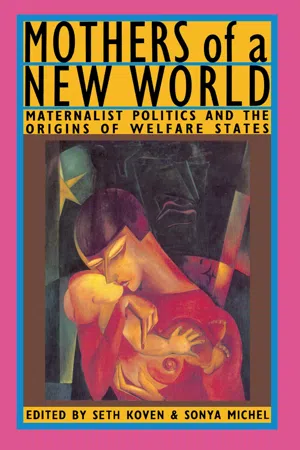
Mothers of a New World
Maternalist Politics and the Origins of Welfare States
- 462 pages
- English
- ePUB (mobile friendly)
- Available on iOS & Android
eBook - ePub
Mothers of a New World
Maternalist Politics and the Origins of Welfare States
About this book
Historians of Australia, Germany, Great Britain, Sweden and the United States provide a sweeping view of the scope of women's work and make comparisons across societies and over time.
1 The Historical Foundations of Women's Power in the Creation of the American Welfare State, 1830-1930
DOI: 10.4324/9781315021164-1
One of the most exciting features of the new stream of scholarship on women and the creation of the American welfare state during what has been called the "watershed" of American history between 1880 and 1920 has been its tendency to draw large conclusions about the relationship between the political activism of white middle-class women and that of other social groups. For example, through comparisons of white and black women welfare activists, Linda Gordon and Eileen Boris have demonstrated the significance of race as a factor structuring women's reform opportunities. Reform efforts by black and white women rarely overlapped, partly due to racist beliefs that excluded black women from white women's organizations, partly due to the crippling effects of black disfranchisement, partly due to the concentration of African Americans in the South, where ninety percent lived in 1890. Between 1890 and 1920, most white women focused their reform activism on the effects of industrialization in the north, usually implementing programs that required the cooperation of municipal, state, or federal governments. Since black workers, male and female alike, were excluded from industrial work until World War I, and since African Americans generally did not have access to state remedies for social problems either in the North or the South, black women reformers followed a different path, pursuing voluntary activity exclusively, and expressing more concern over issues affecting life in the rural South, especially lynching. Not until the 1920s, and then in the South rather than the North, did white and black women social reformers begin to work together.1 So the story of white women's reform activism is a race-specific story in which their access to the resources of the state expressed their relatively privileged position in a race-segregated society.
This essay examines other features of American life that help us explain the power that middle-class women exercised in the white polity between 1890 and 1920 as they channeled the resources of the state in new directions. Some historians have offered critical assessments of their efforts, pointing to the limitations of their moral vision and their social methods. Some have praised them. All have agreed that women were central to the process by which the American social contract was recast and state and federal governments assumed greater responsibility for human welfare.2
Intriguing questions about this process remain unresolved, however. We can describe it better than we can explain it. To an extent unequaled elsewhere, middle-class American women were crucial and central to the responses state and federal governments made to social pressures created by massive immigration and rapid industrialization and urbanization.3 Nowhere else did protective labor legislation focus so extensively on women workers, and nowhere else were women so extensively involved in its enactment. Nowhere else did women reformers design and administer a major government bureau responsible for the health and welfare of the nation's infants and children. Every national polity developed its own version of what became known in the 1940s as "the welfare state." Why in the United States was so much of the path to the welfare state blazed by middle-class women?
This essay offers a simple answer to that question. Women's activism was crucial because it served as a surrogate for working-class social-welfare activism. For complex historical reasons that derived partly from the political culture of middle-class women, partly from American political culture generally, women were able to provide systematic and sustained grass-roots support for social-welfare programs at a time when the working-class beneficiaries of those programs could lend only sporadic support.4 Of course not all middle-class women participated in this effort. Middle-class women were an extremely diverse group. Some were uninterested in legislation benefiting working people, some were eventually persuaded to support such statutes, and some led the way in campaigns for "industrial democracy," This essay focuses on that vanguard and the women who provided it with grass-roots sustenance.5
In their analyses of the prominence of American women in social-welfare provisions, historians have emphasized the gendered qualities of their efforts, characterizing their achievements and their methods as "maternalist."6 In many ways that term rings true, but it does not go far enough. It fails to capture the class struggle that shaped the creation of the American welfare state, and the role middle-class women played in that struggle. Using gender as a substitute for class strategies, women championed more than motherhood. True, their agenda advanced middle-class notions of gender and family relations, focusing as it did on bettering the lives of women and children. True, their leaders tended to benefit personally from the reform upsurge of 1890-1920, moving as they did into new jobs and positions of power that they themselves created. Yet their story embraces more than motherhood and self-interest. Responding to horrific conditions spawned by industrialization—conditions that threatened to poison middle-class as well as working-class life—large numbers of middle-class women sought to improve the welfare of working people generally. Work (and its obverse—unemployment) set the framework within which they viewed social problems and posed solutions. Family life and motherhood were part, but only part, of that framework.
Deindustrialization in the 1980s and 1990s has generated some of the same social traumas that attended industrialization in the 1880s and 1890s. Civil disorder, massive immigration, urban transformation, poverty, homelessness, and an intractable political malaise characterize both periods. Yet beginning in the 1880s, growing in the 1890s, and flourishing between 1900 and 1915, prodigious political mobilization by middle-class women formed the largest coalitions that broke through the malaise and restructured American social and political priorities at the municipal, state, and federal levels. How and why they did so are questions that require a multitude of answers. This essay uses broad strokes to sketch the chief variables involved in that restructuring, some of which remain part of our political culture today.
Welfare and Work: Two Sides of the Same Coin
"Welfare" carries quite different connotations today than it did when the word first entered into common usage in the 1920s.7 Today "welfare" refers primarily to single mothers who receive Aid to Families with Dependent Children through the program that built "mothers' pensions" into the Social Security Act in 1935. That program, instituted by a combination of male-dominated state "relief" programs and women's political culture, initially benefited chiefly "deserving" widows, but it expanded significantly in the mid-1960s in response to protests raised by the National Welfare Rights Organization against the exclusion of black, divorced, and unmarried mothers.8 In the 1980s AFDC became the chief problematic feature of American "welfare" policy. Even though federal and state governments maintained many programs designed to assist those in need or to help them remain or become self-supporting, including agricultural subsidies and student loans as well as compensation for large investors in failed savings and loan institutions, current debate about "welfare" focuses on AFDC.9
Those who laid the foundations for the "welfare state" between 1880 and 1920 had a different perspective. For them, workers, not mothers, formed the chief focus of social legislation. Contemporary debate about how to alleviate social problems arising from industrialization revolved around wage-earning men, women, and children. "Mothers' pension" plans were one of the least-contested consequences of a larger policy debate about the regulation of the modern workplace and the intervention of the state in relation between capital and labor.10 Then, as now in the United States, the relatively unregulated workplace produced much higher rates of injuries and deaths than were common elsewhere.11 In tracing the origins of the American welfare state, feminist scholars have focused on the antecedents of AFDC or "mothers' pensions," but. they have often overlooked the larger context within which mothers' pensions emerged—the large population of widows and orphans created by industrial injuries. "Make fewer widows!" one leading woman reformer declared when asked for her opinion on mothers' pensions.12 Her harsh but realistic reply shows us that there is more to the story of the emerging American welfare state than the "maternalism" that historians have called its chief characteristic.
Therefore, if in studying the origins of social-welfare policies before 1935 we confine our inquiry to the antecedents of AFDC or mothers' pensions, we miss a crucially important feature of the emerging welfare state as it was seen by those who helped create it. Their concerns about the problematic features of the industrial workplace were expressed in the unemployment benefits incorporated within the Social Security Act and the two other major New Deal statutes by which Congress hoped to promote social stability in the mid-1930s: the National Labor Relations Act (1935), which protected the rights of workers and union organizers and created mechanisms for mediating labor disputes; and the Fair Labor Standards Act (1938), which limited the legal length of the working day to eight hours, established a national minimum wage, and set minimum standards of job safety and health. This New Deal legislation, flawed as it was in design and implementation, culminated forty years of struggle by women and men concerned about the oppressive potential of the industrial workplace.13
In the 1920s 'welfare legislation was a protean term that conveyed different meanings to different people, but above all it implied labor legislation. The term gained currency among women activists in 1922 during the struggle between opponents and advocates of the proposed Equal Rights Amendment to the U.S. Constitution. At that moment "welfare legislation" became part of reform discourse precisely because it evoked the welfare of wage earners as well as other forms of social protection.
Early in 1922 the exact wording of the Equal Rights Amendment had not yet been determined; its supporters and opponents were locked in a debate over whether the strategy of so sweeping an assertion of sexual equality would nullify all gender-specific legislation that women reformers and women's organizations had fought so hard to implement between 1890 and 1920. Leaders on both sides of the debate were forced to summarize their positions.
Opposing the amendment, Florence Kelley, fiery general secretary of the National Consumers' League (NCL), issued a pamphlet, "Twenty Questions about the Proposed Equal Rights Amendment," in which she listed recent social legislation that the amendment threatened, including labor legislation for women. "What safeguards will wage-earning women have to compensate the disadvantages which they everywhere tend to suffer in competing with men—i.e., longer hours and lower wages?" Kelley asked. Also threatened were mothers' pensions: "The laws providing for widows' pensions are clearly discriminations in favor of women." The amendment also imperiled pathbreaking maternal health legislation. "Will the amendment destroy the Sheppard-Towner Act . . . for the Promotion of the Welfare and Hygiene and Maternity and Infancy?" In the same vein she asked "What will become of the dower rights that women now have in many states?"14
Kelley's list combined quite diverse entities. Relics of the preindustrial era, "dower rights" were oldest. Women's hour and wage legislation, beginning in Massachusetts in 1874, and mothers' pensions, first launched in Illinois in 1911, represented more recent efforts to remedy some of the negative effects of industrialization. Even newer, more innovative, and representing the high point of the achievements of women's political activism, the 1921 Sheppard-Towner Act allocated federal funds for the purpose of reducing the nation's high rates of infant and maternal mortality, which exceeded those of almost every European country.15
On the other side of the debate, responding to these protestations, amendment supporters in the National Woman's party (NWP) lumped these diverse laws together under the heading "welfare legislation." Alice Paul, NWP president, wrote to a supporter in the summer of 1921: "Our amendment is not yet in shape for introduction, that is, it has not yet been approved by certain people who are interested in welfare legislation."16 Journalists reporting on the debate and lawyers advising each side followed Paul's linguistic lead. In February 1922 a New York Times story treated protective labor legislation and "welfare legislation" as interchangeable concepts, writing that "advocates of welfare legislation met with little opposition at a hearing today on the Minimum Wage Commission bill."17 Even those who opposed the amendment began to use "welfare legislation," as a convenient catchphrase for all social legislation benefiting girls and women. Freda Kirchwey, associate editor of The Nation, told Florence Kelley that she was pressuring the NWP on the question "Why do they not include a reservation making it clear that their amendment does not apply to welfare legislation?"18
Nevertheless, Florence Kelley of the National Consumers League and Ethel Smith, head of the Women's Trade Union League, never used or even commented on the term "welfare legislation." They shunned the term because, even at this early date, it had acquired a paternalist tinge. Rather than the rights of working people or the well-being of the whole society, by 1920 "welfare invoked paternalistic management policies that acknowledged workers' needs but did not contribute to workers' empowerment. For example, an 1899 book studying "employers' welfare institutions" called them "a dividend to labor," saluting the capitalist-dominated marketplace rather than notions of social justice.19 In 1908 the business-dominated National Civic Federation set up a Women's Department, which grew out of the Federation's "Welfare Department." Members of the Women's Department "hunted for welfare work" when they visited stores, hotels, and factories. To them that term meant "lunch-rooms, restrooms, and proper dressing rooms."20
Kelley and Smith believed that society owed more substantial protections to women—especially hours and wage legislation. Women needed protective laws to help them overcome the disabilities arising from their unequal...
Table of contents
- Cover Page
- Half Title Page
- Title Page
- Copyright Page
- Dedication
- Table of Contents
- Acknowledgments
- Introduction: “Mother Worlds”—Seth Koven and Sonya Michel
- 1 The Historical Foundations of Women’s Power in the Creation of the American Welfare State, 1830–1930—Kathryn Kish Sklar
- 2 Borderlands: Women, Voluntary Action, and Child Welfare in Britain, 1840 to 1914—Seth Koven
- 3 Social Mothers: The Bourgeois Women’s Movement and German Welfare-State Formation, 1890–1929—Christoph Sachβe
- 4 Woman’s Work and the Early Welfare State in Germany: Legislators, Bureaucrats, and Clients before the First World War—Jean H. Quataert
- 5 Depopulation and Race Suicide: Maternalism and Pronatalist Ideologies in France and the United States—Alisa Klaus
- 6 The Power of Motherhood: Black and White Activist Women Redefine the “Political”—Eileen Boris
- 7 Catholicism, Feminism, and the Politics of the Family during the Late Third Republic—Susan Pedersen
- 8 The Limits of Maternalism: Policies toward American Wage-Earning Mothers during the Progressive Era—Sonya Michel
- 9 “My Work Came Out of Agony and Grief”: Mothers and the Making of the Sheppard-Towner Act—Molly Ladd-Taylor
- 10 Women in the British Labour Party and the Construction of State Welfare, 1906–1939—Pat Thane
- 11 A Revolution in the Family: The Challenge and Contradictions of Maternal Citizenship in Australia—Marilyn Lake
- 12 Feminist Strategies and Gendered Discourses in Welfare States: Married Women’s Right to Work in the United States and Sweden—Barbara Hobson
- Index
- Contributors
Trusted by 375,005 students
Access to over 1.5 million titles for a fair monthly price.
Study more efficiently using our study tools.
Frequently asked questions
Yes, you can cancel anytime from the Subscription tab in your account settings on the Perlego website. Your subscription will stay active until the end of your current billing period. Learn how to cancel your subscription
No, books cannot be downloaded as external files, such as PDFs, for use outside of Perlego. However, you can download books within the Perlego app for offline reading on mobile or tablet. Learn how to download books offline
Perlego offers two plans: Essential and Complete
- Essential is ideal for learners and professionals who enjoy exploring a wide range of subjects. Access the Essential Library with 800,000+ trusted titles and best-sellers across business, personal growth, and the humanities. Includes unlimited reading time and Standard Read Aloud voice.
- Complete: Perfect for advanced learners and researchers needing full, unrestricted access. Unlock 1.5M+ books across hundreds of subjects, including academic and specialized titles. The Complete Plan also includes advanced features like Premium Read Aloud and Research Assistant.
We are an online textbook subscription service, where you can get access to an entire online library for less than the price of a single book per month. With over 1.5 million books across 990+ topics, we’ve got you covered! Learn about our mission
Look out for the read-aloud symbol on your next book to see if you can listen to it. The read-aloud tool reads text aloud for you, highlighting the text as it is being read. You can pause it, speed it up and slow it down. Learn more about Read Aloud
Yes! You can use the Perlego app on both iOS and Android devices to read anytime, anywhere — even offline. Perfect for commutes or when you’re on the go.
Please note we cannot support devices running on iOS 13 and Android 7 or earlier. Learn more about using the app
Please note we cannot support devices running on iOS 13 and Android 7 or earlier. Learn more about using the app
Yes, you can access Mothers of a New World by Seth Koven,Sonya Michel in PDF and/or ePUB format, as well as other popular books in History & Social History. We have over 1.5 million books available in our catalogue for you to explore.