- 300 pages
- English
- ePUB (mobile friendly)
- Available on iOS & Android
eBook - ePub
About this book
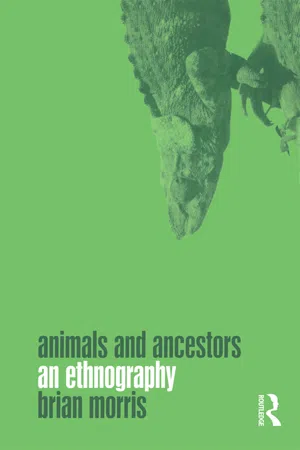
Ever since the emergence of human culture, people and animals have co-existed in close proximity. Humans have always recognized both their kinship with animals and their fundamental differences, as animals have always been a threat to humans' well-being. The relationship, therefore, has been complex, intimate, reciprocal, personal, and -- crucially -- ambivalent. It is hardly surprising that animals evoke strong emotions in humans, both positive and negative. This companion volume to Morris' important earlier work, The Power of Animals, is a sustained investigation of the Malawi people's sacramental attitude to animals, particularly the role that animals play in life-cycle rituals, their relationship to the divinity and to spirits of the dead. How people relate to and use animals speaks volumes about their culture and beliefs. This book overturns the ingrained prejudice within much ethnographic work, which has often dismissed the pivotal role animals play in culture, and shows that personhood, religion, and a wide range of rituals are informed by, and even dependent upon, human-animal relations.
Information
1
Introduction
Others have reproached me with my style … They fear lest a page that is read without fatigue should not always be the expression of the truth. Were I to take their word for it, we are profound only on condition of being obscure.
Jean-Henri Fabre, Souvenirs Entomologiques
Prologue
This book explores the role of animals in the rituals and religious life of the matrilineal people of Malawi. It forms a sequel and a companion volume to my study The Power of Animals (1998), which focused on the historical dialectic to be found in Malawi between subsistence agriculture focused around a group of matrilineally related women, and the hunting of animals by men. In that study I describe the hunting traditions to be found in Malawi, the folk classification of animals, and the important part that animals play in oral traditions, and as food (meat) and medicine. I attempted to show the multiple ways in which Malawian people relate to animals - pragmatic, intellectual, realist, aesthetic, social and symbolic. This present study focuses on their sacramental attitude to animals, particularly the role that animals play in life cycle rituals, and the relationship of animals to the divinity and the spirits (mizimu) of the ancestors. The two books together aim to affirm the crucial importance of animals in the social and cultural life of Malawian people. It thus counters the mistaken impression that many postmodern anthropologists have, namely that animals are just not worth bothering about as they are a ‘topic of marginal interest’ (as one scholar put it) to anthropologists.
This introductory chapter aims to provide some of the background material relevant to the study, and discusses the theoretical perspective that informs the study, the social setting, animal/human relationships in an historical context, and my approach to the study, concluding with an outline of its content.
Theoretical Perspectives
Anthropology, despite its diversity, has a certain unity of purpose and vision. It is unique among the human sciences in both putting an emphasis and value on cultural difference, thus offering a cultural critique of Westem capitalism and its culture, as well as emphasizing people’s shared humanity, thus enlarging our sense of moral community and placing humans squarely ‘within nature’. As a discipline anthropology has therefore always placed itself at the ‘interface’ between the natural sciences and the humanities.
Within anthropology three research traditions have prominence. The first is an interpretative tradition which draws on the important writings of the neo-Kantians Dilthey and Boas. It is represented by cultural anthropology, interpretative sociology and postmodemism. This tradition links anthropology to the humanities, puts a focal emphasis on culture (defined as local ‘structures of meaning’) and treats social life as if it were a text to be interpreted. A fundamental stress is thus put on hermeneutics. In privileging language and symbolism at extremes this interpretative or literary tradition leads to textualism, and to a form of cultural idealism that not only denies the reality of the material world but advocates an extreme cultural (or linguistic) determinism. Geertz (1973) is often seen as a prototype of this tradition.
The second tradition is a sociological tradition which essentially derives from Comte and Durkheim. This tradition models itself on the natural sciences, takes an empiricist perspective, and puts an important emphasis on society as an autonomous realm of being. The emphasis therefore is on ‘social structure’ (as a network of social relations) that is independent of human subjectivity; epistemologically society is conceived as a thing (organism). Represented by Durkheimian sociology and social anthropology this tradition, at extremes, leads to a crude positivism, denying the importance of both cultural and subjective meanings. It thus reifies the social, and tends to advocate an extreme sociological determinism, one that repudiates psychology entirely. It therefore, like the interpretative tradition, plays down or denies human agency and the biological dimension to human life. Radcliffe-Brown (1952) with his conception of a ‘natural science of society’ is often taken as an exemplar of this tradition.
The third tradition in a sense mediates between the interpretative and sociological traditions, and advocates a historical or evolutionary approach to social life. It draws its inspiration from Darwin and Morgan and such historical sociologists as Marx and Weber, and puts a focal emphasis on social life as an evolutionary or historical process. Although, unlike the other traditions it acknowledges the crucial dialectic between social structures and human agency, at extremes this tradition downplays cultural meanings and the diversity of human cultures, and tends towards advocating a universal teleology, cultural evolution being interpreted in orthogenetic rather than in historical terms. Steward (1977) and Wolf (1982) may be described as following this historical tradition (Morris, 1987, 1991, Burofsky, 1994).
Sadly, in recent years, given the increasingly arrogant and intolerant rhetoric of postmodernist anthropologists (who seem to repudiate empirical science entirely and to equate all knowledge with power) and the equally dismissive attitude some positivist anthropologists have towards hermeneutics (Tyler, 1986; Gellner, 1995) a ‘wide chasm’ seems to have emerged between these various traditions (Burofsky, 1994: 3). I have elsewhere offered my own reflections on this sad state of affairs. Contrary to the nihilistic ethos of postmodemism I have also affirmed the salience of a realist ontology, and the crucial importance of upholding such conceptions as truth and representation, human agency and empirical knowledge (Morris, 1997). For in an important sense anthropology, as I conceive it, needs to draw on, and to affirm certain crucial insights and perspectives, from all these three traditions. For human life is inherently social and meaningful, as well as being ‘enmeshed’ or ‘rooted’ in the material world. An understanding of human social life therefore entails both hermeneutic understanding (humanism) as well as explanations in terms of causal mechanisms and historical understanding (naturalism). Anthropological analysis must therefore combine both hermeneutics and naturalism, and avoid the one-sided emphasis either on hermeneutics -which in its extreme form, ‘textualism’, denies any empirical science -or on naturalism, which in its extreme form, as crude positivism, oblates or downplays cultural meanings and human values. As Jackson writes: ‘people cannot be reduced to texts any more than they can be reduced to objects’ (1989: 184). But in acknowledging a naturalistic perspective, and the psychic, moral and epistemological unity of humankind (Brown 1991), this does not imply the ‘destruction’ of the concrete, the cultural particular, or the historical, nor does it imply that peoples behaviour is the same everywhere - as Hollinger seems to believe (1994: 67). Unity, difference and singularity are all dimensions of the world, and of human life. Cultural and social phenomena thus has to be understood by combining interpretative understanding, causal analysis and historical reason (Collier, 1994: 163–70, Morris, 1997: 335–6). This is the theoretical perspective that informs the present study.
As the present study is largely focused on Malawian ritual practices and cultural representations, and as my own earlier comparative studies have been woefully misunderstood as ‘ahistorical’, the suggestion being that I conceive of cultures as ‘timeless’ entities, floating, it seems, completely unattached to their social and ecological moorings (White, 1998) (which is of course nonsense!) some discussion needs to be devoted to the concepts of ‘society’, ‘culture’ and ‘nature’. For I hold it important to retain these concepts, and the ontological distinctions, they entail.
But I must say that in all my comparative writings (1987, 1991, 1994) I have always taken it for granted that students and colleagues alike were aware that cultural phenomena, like everything else in the universe, including elephants and the ideas of individual scholars, were diverse and continually changing and thus of a historical nature. Having some historical sensibility they therefore did not need some pretentious academic telling them what is patently self-evident. Thus I do not hold, and do not wish to convey in this study, the idea that cultural representations and schemas- at whatever level of analysis - are ‘timeless’ entities - homogenous, unchanging and rigidly demarcated - or that they are completely detached from people or social moorings, or indeed from the material world.
It is however important to recognize that even to think at all, as John MacMurray reflects, is to discriminate, that is to make some kind of distinction between entities in the world (1957: 92). But making a distinction does not necessarily entail the setting up of a radical dualism, any more than identifying a real unity (elephant, person, society, women, culture, humanity, olive grove) implies an essentialism that ignores the diversity within the category, its ‘dividual’ character, to employ a current fashionable but rather vacuous term. No two elephants are the same, and as Assiter has written; the use of the general category ‘women’, for example, does not preclude a recognition of historical and cultural diversity, for diversity within a category, is only recognizable on condition that the concept of ‘woman’ is identified (1996: 22). And the same goes for all other general categories - reason, history, society, humanity, truth - that post-modernists rubbish as ‘monadic entities’. The passion for ‘difference’, and ‘fragmentation’ often indicates a complete indifference to unity and dialectics. All concepts are relational; all relations imply things, actual entities that are constituted through relations; all difference entails at the same time a unity, just as all entities (individuals) are at the same time dividual. Whitehead long, long ago (1929) stressed the essential relatedness of all things. Even elephants are not rigidly bounded.
In making certain distinctions in this study, specifically between animals and humans, sex and gender, human agency and social structures, social relations (society) and cultural meaning systems (culture), it must be understood that these paired concepts are not to be interpreted in dualistic fashion, but as dialectically related - i.e. inter-dependent. Thus I advocate, even if only implicitly in this study, neither a radical dualistic ontology, nor do I give epistemological primacy to one side of the dichotomy (relation), even though certain entities, as emergent levels, may not have ontological priority. Thus I reject any form of reductive materialism, such that, for example, gender is reduced to biological sex, or culture is seen as simply a reflection or epiphenomenon or ‘derivative’ of social practices (cf. Samuel, 1990: 39). Nor do I advocate the opposite strategy and give priority to cultural meanings - reducing human life to an ‘effect’ of culture, discourses or language, or of social structures. Nor do I imply an ‘identity’ between these terms, and thus suggest collapsing the distinctions into some wooly abstraction like ‘lived experience’ or ‘mode of being-in-the-world’. Nor, finally, do I see the need to repudiate the concepts of ‘humanity’, ‘society’, ‘nature’ and ‘culture’ entirely, as suggested by some postmodernist scholars. Even the ubiquitous dichotomy culture/nature is not without its analytical utility. Culture- Popper’s (1992) ‘world three’ - may be defined rather broadly, and relates to the shared meanings, practices and symbols of a human community, and which unlike nature, are not self-subsisting, but are dependent upon human activity. Like Chris Knight I feel that this distinction (not dualism) ‘stands for something real, I like this distinction and intend to respect it’ (1991: 11). A distinction between nature and culture can thus be acknowledged while at the same time recognizing that ‘culture is deeply rooted in biology’ (Wilson, 1997: 126), and that these concepts do not have any direct equivalence in the Malawian context.
That Western concepts do not exactly match those of other cultures is only to be expected, for as Michael Lambek writes ‘it is only from an objectivist perspective that one would ever have expected them to’ (1998: 122). All human cultures it would seem make some distinction between cultural and natural phenomena, between consciousness and the body, and between humans and animals, even if these distinctions do not exactly match (why on earth should they) those of western culture, and are not interpreted in dualistic fashion as in Cartesian metaphysics. Although Signe Howell (1996) critiques Cartesian dualism - a ‘familiar western schemata’ - as if Western thought and Cartesian metaphysics were synonomous and nothing of any intellectual importance has happened since 1650- and seems to deny the culture/nature distinction, she writes that ‘the jungle in its totality as a material and spiritual world is … cultural space, not natural’ (1996: 132). This statement presupposes a distinction between material and spiritual, and between culture and nature. And although she writes that human beings are not set uniquely apart from other beings, and that the Chewong do not distinguish between plants and animals, she continually affirms ‘species-bound identities’ and writes of transformations between humans, animals and spirits, which would assume that ontological distinctions are in fact being made. Howell’s account is typical of many post-modernist scholars who advocate a cultural idealist and cultural determinist perspective, and which in their emphasis on culture and cosmology, oblates nature and biology entirely (see my critique 1997). Although making a great play of being ‘anti-dualist’ setting up a radical dualism between Western culture (equated with Cartesian metaphysics) and the culture of ‘aboriginal’ people is equally unhelpful. Needless to say the concept of ‘cosmos’ is just as much a Western category as that of nature or culture.
The same kind of esotericism is evident in the writings of Philippe Descola (1996) for he sets up a dichotomy between animism - defined as a mode of thought which ‘endows natural beings with human dispositions and social attributes’ (religion) and totemism (symbolism) - both of which are identified with Amazonian ‘tribes’, and naturalism which is identified with ‘us’ - i.e. European ethnographers or culture. Both Cartesian dualistic metaphysics and the reductive theories of the socio-biologists are then misleadingly identified with naturalism. But all these three ‘modes of identification’ (as he describes them) are evident in all human communities. Repudiating the concepts of ‘culture’ and ‘nature’ because Cartesians have used them in dualistic fashion is as unhelpful and unnecessary as repudiating the concept of ‘time’ because Newton interpreted it as an ‘absolute’.
Humans are intrinsically social and relational beings. They are not disembodied egos nor asocial organisms. Social scientists have recognized and emphasized this for more than a century. It is certainly not the recent discovery of postmodernist scholars. But how one defines the ‘mark’ of the social is, it appears, a rather contentious issue (Greenwood, 1997). What has to be recognized is that social life exists, as Robert Hinde suggests, on several different levels. At the most basic level it may be defined as social interaction, as a behavioural regularity among two or more organisms (Wallace, 1997). Thus sociality is a matter of degree, and found throughout the animal kingdom, humans, as evolved apes, being perhaps among the more sociable of animals. Social interaction can therefore take place between humans and other social mammals. At this level, as Lloyd Sandelands has perceptively written, society is something that is felt, and manifested through bodily gestures. Society, he writes, is known to us through the body as feeling, and everywhere affirmed through gesture and ritual.
We feel society in a thousand quotidian acts - of handshake, hug, kiss, embrace, dance, wave, a returned smile or gaze. (Sandelands 1997: 142)
Thus we can interact socially not only with dogs, but with people whose culture and language is completely alien to us.
At another level, and with regard to another definition of the social, it may be described as interpersonal behaviour. This is how social life tends to be interpreted by methodological individualists (Hayek, Homans, Ayn Rand), who deny the reality of social structures or social collectives. For such scholars social life consists of patterns of aggregate behaviour that are stable over time. As Collins put it:
Social patterns, institutions and organisations are only abstractions from the behaviour of individuals. (1981: 989)
Although interpersonal relationships are important, this approach denies the objective existence of such entities as states, ethnic groups, social classes and other social forms, and reduces social structures (and cultural schemas) to the social interactions and dispositions of individual humans. Although this approach is salutary in emphasizing human agency, its limitations have been stressed by numerous scholars (Porpora, 1989; Archer, 1995: 34–46).
Methodological individualism in fact now has recently been given a new lease of life among anthropologists. Cognisant of the fact that societies are not homogenous or rigidly bounded (Marx and an earlier generation of anthropologists never assumed that they were) and that social action is embedded in an ecological context (again Marx et al. never thought otherwise), such anthropologists, as noted earlier, have repudiated the concept of ‘society’ entirely (cf Barth, 1992). They thus join forces with Ayn Rand (and her devotee Margaret Thatcher) in declaring that there is no such entity as ‘society’.
A third level of social existence is that of social structures, defined as patterns of enduring relationships between people. As Marx wrote:
Society does not consist of individuals, but expresses the sum of the relations within which individuals stand … to be a slave, to be a citizen are social characteristics, relations between human beings. A human being as such is not a slave. He is a slave in and through society. (1973: 265)
But there has been a theoretical tendency within the social sciences, usually described as collectivism or holism, which has been prone to treat social structure as law like regularities among social facts, and t...
Table of contents
- Cover
- Half Title
- Title Page
- Copyright Page
- Dedication Page
- Contents
- Preface
- 1 Introduction
- 2 Animals, Humans and Personhood
- 3 Rituals of Childbirth and Womanhood
- 4 Boys’ Initiation and the Nyau Fraternities
- 5 God and the Rain Deities
- 6 The Ancestral Spirits
- Glossary
- Bibliography
- Index
Trusted by 375,005 students
Access to over 1.5 million titles for a fair monthly price.
Study more efficiently using our study tools.
Frequently asked questions
Yes, you can cancel anytime from the Subscription tab in your account settings on the Perlego website. Your subscription will stay active until the end of your current billing period. Learn how to cancel your subscription
No, books cannot be downloaded as external files, such as PDFs, for use outside of Perlego. However, you can download books within the Perlego app for offline reading on mobile or tablet. Learn how to download books offline
Perlego offers two plans: Essential and Complete
- Essential is ideal for learners and professionals who enjoy exploring a wide range of subjects. Access the Essential Library with 800,000+ trusted titles and best-sellers across business, personal growth, and the humanities. Includes unlimited reading time and Standard Read Aloud voice.
- Complete: Perfect for advanced learners and researchers needing full, unrestricted access. Unlock 1.5M+ books across hundreds of subjects, including academic and specialized titles. The Complete Plan also includes advanced features like Premium Read Aloud and Research Assistant.
We are an online textbook subscription service, where you can get access to an entire online library for less than the price of a single book per month. With over 1.5 million books across 990+ topics, we’ve got you covered! Learn about our mission
Look out for the read-aloud symbol on your next book to see if you can listen to it. The read-aloud tool reads text aloud for you, highlighting the text as it is being read. You can pause it, speed it up and slow it down. Learn more about Read Aloud
Yes! You can use the Perlego app on both iOS and Android devices to read anytime, anywhere — even offline. Perfect for commutes or when you’re on the go.
Please note we cannot support devices running on iOS 13 and Android 7 or earlier. Learn more about using the app
Please note we cannot support devices running on iOS 13 and Android 7 or earlier. Learn more about using the app
Yes, you can access Animals and Ancestors by Brian Morris in PDF and/or ePUB format, as well as other popular books in Social Sciences & Anthropology. We have over 1.5 million books available in our catalogue for you to explore.