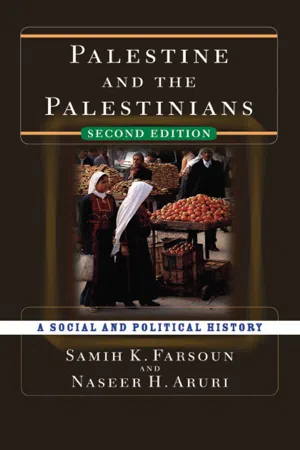
Palestine and the Palestinians is a sweeping social, economic, ideological, and political history of the Palestinian people, from antiquity to the Road Map to Peace. This second edition is thoroughly revised and updated, including entirely new chapters on the most current issues confronting Palestine today, including: Palestinians in Israel; the Oslo Accords and the Second Intifada; Palestinian refugees and the right to return; Jerusalem; the diplomatic "peace process" and two-state/single-state solutions.
eBook - ePub
Palestine and the Palestinians
A Social and Political History
- 490 pages
- English
- ePUB (mobile friendly)
- Available on iOS & Android
eBook - ePub
1
The Question of Palestine and the Palestinians
Palestine is a small territory, and the Palestinians—the indigenous Arab people of Palestine—are a relatively small population, numbering nine million in 2005. Yet the Palestinian problem has loomed large on the international scene for nearly sixty years, with tangled roots over a century old. Since 1948, the Arab-Israeli conflict has been punctuated by a major war nearly every decade and countless invasions, incursions, clashes, and skirmishes, producing regional and global tensions and even threatening world peace during the cold war. Indeed, since the advent of the nuclear age, the only known nuclear war alert was issued by the United States during the fourth major Israeli-Arab war, the October War of 1973.
The question of Palestine and the Palestinians continues to be central in international affairs, as the United States, China and the Pacific Rim, and the European Union (EU) compete for economic domination in the emerging new world order. The hegemony of industrial and postindustrial societies depends upon oil, a commodity entangled in the volatile conflict over Palestine. The 1973 Arab oil embargo, a result of the Arab-Israeli war of that year, is a potent reminder of the political and economic linkages of the issue, as is the 1991 Gulf War and the invasion of Iraq in 2003. Reportedly, debates inside the George W. Bush administration in the United States concerning the invasion of Iraq centered importantly on resolution of the Palestine conflict before the invasion of Iraq or on whether the invasion of Iraq and regime change there would facilitate solving the Palestine question. Those who argued the latter, the pro-Israel neocons especially inside the Pentagon and the White House, won the day. Middle Eastern oil, which consists of the largest reserves and productive capacity on earth, and the derivative “military hardware” market are a lucrative prize for contemporary rival economic powers. As Simon Bromley argued, control of world oil has been pivotal in the US post–World War II global hegemony.1 Thus the problem of Palestine has been a hidden side of the global political economy.
Palestine Within the Arab Context
Significant as it is in the international context, the question of Palestine is far more critical in the Middle East and Arab regions. In their history, culture, politics, and religion, Palestine and the Palestinians have long been an integral part of the Arab and Islamic worlds. For centuries, the country and the people have been the geographical and social bridge connecting the Mashreq (the Arab east) to Egypt and the Maghreb (the Arab west, or North Africa). Palestinians are related by kinship, economic, religious, and political ties to the people of Lebanon and Syria to the north, Jordan and Iraq to the east, Saudi Arabia to the southeast, and Egypt to the southwest. Since the destruction of Palestine in 1948 and the forceful dispossession and dispersal of most of its people into the surrounding Arab states, the Palestinian question has influenced the political and economic dynamics of the eastern Arab world, including, of course, matters involving oil. It has been a formative issue not only in relation to conflicts between states in the region but also between contending political groups and between regimes and the people within many states. The cause of Palestine became central to both the secular (nationalist, radical) and the religious political and ideological movements buffeting the region.
One of the most powerful ideological concerns regarding Palestine involves religion. Islam holds Palestine sacred; the Qur’an refers to the country as al-Ard al-Muqaddasah (the Holy Land). al-Khalil (Hebron) and al-Quds (Jerusalem) are sacred cities. The Ibrahimi Mosque in al-Khalil is the site of the grave of the prophet Abraham (Ibrahim, in Arabic). al-Quds is the site of al-Haram al-Sharif (the Noble Sanctuary) upon the high plateau inside the Old City of Jerusalem, called Temple Mount in the Jewish tradition, the third holiest shrine of Islam, after Mecca and Medina. The Noble Sanctuary includes al-Masjed al-Aqsa and the Qubbat al-Sakhra (Dome of the Rock) mosques. It is from the Dome of the Rock during the night of al-Isra’ and al-Mi’raj that the prophet Muhammad miraculously ascended to heaven upon the winged stallion al-Buraq. al-Quds and al-Ard al-Muqaddasah of Filastin (Palestine) are powerful symbols of identity for Muslim individuals and the entire Islamic umma, the nation or community of believers. al-Ard al-Muqaddasah is part of the Muslim umma lands as much as it is part of Arab patrimony. Islamic fundamentalists, traditional-ists, and modernizers do not waver from this perception.
The significance of al-Quds and Palestine to Muslim Arabs should not be construed as less important than its importance to Christian Arabs, who are an integral part of the Arab and Islamic worlds. For Christian Arabs, no less than for Christians the world over, Jerusalem, Bethlehem, Nazareth, and the rest of Palestine are holy and central to their belief system. In the modern history of the region, Christian Arabs were leaders in the Arab cultural renaissance, the struggle for Palestine, and the movement to free the Arab world from European domination.2 The founders of two of the most important pan-Arab political movements in the post–World War II period—George Habash, a Palestinian who launched the Movement of Arab Nationalists, and Michel ‘Aflaq, a Syrian who established the Ba‘ath Party—are Christians, as are many leaders and activists of several other influential political groups throughout the Arab Mashreq. In short, Palestine and its people, both Muslims and Christians, are interwoven into the complex human social, cultural, and political network of the region.
In modern times, until the 1980s, Arab nationalism mobilized the Arab peoples. Developed among the elites in the Mashreq, Arab nationalism became the rallying ideology in the effort to win independence, which began in the latter period of Ottoman Turkish rule, in the second half of the nineteenth century. At war with the Ottomans during World War I, the British, and to a lesser extent the French, encouraged Arab nationalists to launch a revolt against the Ottoman Turks, to help defeat their armies, and to liberate Arab lands from four hundred years of Ottoman dominion. Through deception and collusion, however, the British and French undermined efforts to establish an independent Arab kingdom in the Mashreq areas liberated from the Turks. After the Allied victory, the British and the French, with the approval of the League of Nations (the organization they founded and controlled), divided the Arab Mashreq into a group of small states according to their own interests, without any indigenous economic or political rationale. The French created modern Syria and Lebanon, and the British created modern Iraq, Jordan, and Palestine as separate independent states.
Most threatening for Palestine and the Palestinians and other Arabs was the 1917 Balfour Declaration by the British government, which promised the European Zionists a Jewish homeland in Palestine (see Appendix 2).3 Zionism was from the start a Western colonialist project, and Arab nationalists opposed both Zionism and Western imperialism. Arab nationalists of the 1950s and 1960s viewed the emergence of Israel as a direct threat and a tool of Western, by then principally US, imperialism to divide, dominate, and exploit the Arabs. Similarly, the politically renascent Muslim revivalists of the last three decades of the twentieth century considered Zionism, Israel, and Western (especially US) hegemony in the region as a threat to Islam and the Islamic community. Many politically active Muslims believe that Western and Israeli hegemony in the region must be resisted resolutely.
Since World War I, especially after 1948, Palestine stood as the emotional and ideological symbol of both secular Arab nationalism and political Islam, embodying concern for kin people and fellow believers as well as resentment against foreign domination. The threats of Zionism and Israel and the struggle against them have historically resonated among all sectors of the Palestinian and Arab populations: Muslim and Christian; religious and secular; modern and traditional; rural and urban; elite and mass; bourgeois, worker, and peasant. Thus the Palestine question has been a powerful domestic issue in Mashreq Arab states and among the pan-Arab and Islamic movements since the turn of the twentieth century.
Before 1948 the peoples and governments of the Mashreq strongly supported the beleaguered Palestinians in conflict with the British mandate authorities and European Zionist Jewish settlers. The Palestinian revolt of 1936–1939 against the British mandate profoundly affected the opinions of Arab intellectuals, politicians, activists, and youths in surrounding countries. Local military officers in Syria, Egypt, and later Iraq justified the takeovers of the established civil governments in part because of the 1948 defeat of the Palestinians at the hands of Israel. These officers argued that the loss of Palestine was due to the negligence, corruption, and treachery of the monarchical governments.4 The Palestine question and the threat of Israel provided these new, modernizing military rulers of the 1950s and 1960s with the ideological legitimacy to acquire and exercise full control over their nascent states, under the banner of ma‘arakat al-massir (the battle of destiny)—the confrontation with both Israel and its European and US supporters. For these regimes, the Palestine question was the focus of national solidarity and consensus, the liberation of Palestine justifying the dramatic changes in the traditional social, economic, and political order.5
The defeat of the Arab nationalist states by Israel in six days in the June 1967 War discredited these regimes and ushered in another period of internal change. Palestine and Palestinian rights were reduced to secondary (if not rhetorical) status as Arab states redefined the Arab-Israeli conflict as the struggle to regain only the territories that Israel began to occupy in 1967. This redefinition was codified in the Arab states’ acceptance of UN Security Council Resolution 242, which confirmed the inadmissibility of the acquisition of territory by force and the withdrawal of Israel from Arab territory in return for peace but referred to Palestine and the Palestinians only indirectly as refugees. By 1973, regional Arab political leadership had shifted to the more conservative oil-exporting states (particularly Saudi Arabia), as did the national Arab responsibility for Palestine.6 The cause of Palestine served the rulers of the oil states by appeasing popular sentiment.
The oil-exporting states of the Arabian Peninsula supported the Palestinian cause (and the PLO) financially and diplomatically in all international forums, including the United Nations. During the 1970s, the level of Arab support grew as Arab control of oil and financial power increased. By 1981, at the high point of Arab oil power, King Fahd of Saudi Arabia spearheaded an Arab League plan for the political settlement of the Palestine question and the Arab-Israeli conflict: recognition of Israel in return for establishment of a Palestinian state in the West Bank and Gaza. This plan was ignored by both Israel and the United States.
After the June 1967 War, however, Palestinian guerrilla organizations emerged and engaged in armed struggle against Israel; under the umbrella of the PLO, they linked together the exiled Palestinian communities and, to an extent, those under Israeli occupation. Through the PLO, Palestinians regained control of their cause from the guardianship of the other Arab states. But the growth and power of the guerrilla organizations politically destabilized the countries in which the Palestinian refugees had significant presence, particularly Jordan and Lebanon. The reason was, in part, the disruption of the domestic balance of political power and, in part, the punitive Israeli attacks, which the host governments tried to avoid by controlling Palestinian activity.7
Nonetheless, until the 1991 Gulf War, the Palestinian cause continued to provide legitimacy for Arab leaders (and ongoing strong sentiment among the varied Arab populations). The authenticity of their regimes was measured by their lip service or active commitment to Palestine and the Palestinians. President Anwar Sadat of Egypt, for example, justified his stunning trip to Jerusalem in 1977 and the 1979 Israeli-Egyptian peace treaty by claiming that they would not only bring peace between Arabs and Israelis but also solve the problem of Palestine. Similarly, in the name of serving the cause of Palestine, the Syrian government in 1976 sent troops to Lebanon to contain the militarily ascendant Palestinian guerrillas and their secular nationalist and leftist Lebanese allies. In 1986 King Hussein of Jordan said his involvement in the “peace process” initiated by the United States was intended only to help achieve a political settlement of the question of Palestine. In 1986 King Hassan of Morocco, in an extraordinary move, met with the Israeli prime minister, Shimon Peres, to explore, as the king stated, advancing Arab (League) demands regarding Palestinian rights. Similarly, negotiating and signing a peace treaty with Israel was partly justified by Jordan under the late King Hussein as a step in the process of solving the Palestine question.
Except among oppositional movements of political Islam and secular Arab nationalists and leftists, the ideological importance of the Palestinian cause in domestic Arab politics receded sharply as a result of the PLO’s affiliation with Iraq during the 1991 Gulf War. Even popular support for Palestine and the Palestinians among the Arab host populations declined. The expulsion of over 350,000 Palestinian civilians from Kuwait after it was liberated from Iraqi occupation did not create a political crisis for that regime or major reverberations in pan-Arab politics. In short, the political capital and goodwill afforded to the PLO within most official Arab circles was largely spent by 1991. The oil-exporting states ostracized and ceased providing funds to the PLO. The 1991 Gulf War therefore left the organization politically and diplomatically isolated and financially weakened.
Although Israelis and the Western media, intellectuals, and politicians may charge Arab politicians and their opponent...
Table of contents
- Cover
- Half Title
- Title Page
- Copyright Page
- Dedication Page
- Contents
- List of Tables and Maps
- Preface and Acknowledgments: Second Edition
- Preface and Acknowledgments: First Edition
- List of Acronyms
- 1 The Question of Palestine and the Palestinians
- 2 Before al-Nakbah: The Modern Social History of Palestine
- 3 The Road to al-Nakbah: The Palestine Mandate, 1917–1948
- 4 After al-Nakbah: The Palestinian Diaspora, 1948–1993
- 5 After al-Nakbah: The Palestinians in Israel, 1948–2000
- 6 The Rise and Fall of the Palestinian National Liberation Movement, 1948–1993
- 7 Palestinian Resistance to Israeli Occupation: The First Intifada
- 8 The PLO-Israel Oslo Accords: Structure and Dynamics
- 9 The Structural Flaws of Oslo and Camp David II, and the Second Intifada
- 10 Palestinian Refugees and Their Right of Return
- 11 Jerusalem
- 12 From Camp David to the Road Map: The “Disengagement” from the Peace Process
- 13 Whither the Palestinians?
- 1 UN Security Council Resolution 242, November 22, 1967
- 2 The Balfour Declaration
- 3 McMahon-Hussein Correspondence, 1915–1916
- 4 Excerpts from the Report of the King-Crane Commission, August 18, 1919
- 5 UN General Assembly Resolution 181 on the Future Government of Palestine, November 29, 1947 (The Partition Plan)
- 6 UN General Assembly Resolution 194, December 11, 1948 (The Right of Return)
- 7 UN General Assembly Resolution 3236, November 22, 1974
- 8 UN Security Council Resolution 338, October 22, 1973
- 9 Excerpts from the Declaration of Palestinian Independence, November 15, 1988
- 10 The Stockholm Statement, December 7, 1988
- 11 The Palestinian Peace Initiative, December 13, 1988
- 12 UN Security Council Resolution 298 on Jerusalem, September 25, 1971
- 13 Article 27 of the Charter of the Islamic Resistance Movement (Hamas)
- Glossary
- Selected Bibliography
- Index
Trusted by 375,005 students
Access to over 1.5 million titles for a fair monthly price.
Study more efficiently using our study tools.
Frequently asked questions
Yes, you can cancel anytime from the Subscription tab in your account settings on the Perlego website. Your subscription will stay active until the end of your current billing period. Learn how to cancel your subscription
No, books cannot be downloaded as external files, such as PDFs, for use outside of Perlego. However, you can download books within the Perlego app for offline reading on mobile or tablet. Learn how to download books offline
Perlego offers two plans: Essential and Complete
- Essential is ideal for learners and professionals who enjoy exploring a wide range of subjects. Access the Essential Library with 800,000+ trusted titles and best-sellers across business, personal growth, and the humanities. Includes unlimited reading time and Standard Read Aloud voice.
- Complete: Perfect for advanced learners and researchers needing full, unrestricted access. Unlock 1.5M+ books across hundreds of subjects, including academic and specialized titles. The Complete Plan also includes advanced features like Premium Read Aloud and Research Assistant.
We are an online textbook subscription service, where you can get access to an entire online library for less than the price of a single book per month. With over 1.5 million books across 990+ topics, we’ve got you covered! Learn about our mission
Look out for the read-aloud symbol on your next book to see if you can listen to it. The read-aloud tool reads text aloud for you, highlighting the text as it is being read. You can pause it, speed it up and slow it down. Learn more about Read Aloud
Yes! You can use the Perlego app on both iOS and Android devices to read anytime, anywhere — even offline. Perfect for commutes or when you’re on the go.
Please note we cannot support devices running on iOS 13 and Android 7 or earlier. Learn more about using the app
Please note we cannot support devices running on iOS 13 and Android 7 or earlier. Learn more about using the app
Yes, you can access Palestine and the Palestinians by Samih K. Farsoun,Naseer Aruri in PDF and/or ePUB format, as well as other popular books in History & Middle Eastern History. We have over 1.5 million books available in our catalogue for you to explore.