- 255 pages
- English
- ePUB (mobile friendly)
- Available on iOS & Android
eBook - ePub
About this book
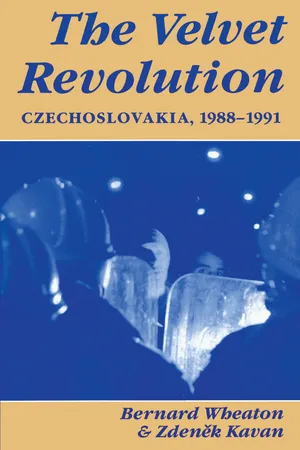
The vivid portratal of the "Velvet Revolution" describes the dramatic social and political changes that heralded the downfall of the Communist leadership in Czechoslavakia. Bernard Wheaton, one of the few Western observers in the country during the nonviolent change of government in November 1989, and Zdenek Kavan, himself a Czech, interweave firsthand description with interviews of student leaders, press accounts, and scholarly analysis of the historical antecedents of the revolution to bring the extraordinary events of 1989 to life. The authors also trace the evolution of change in Czechoslovakia, weighing the importance of the May 1990 elections and assessing political and social prospects for the future. The narrative is enriched with political cartoons and photographs.
Part One
The Long Decay of the Communist System in Czechoslovakia
1
Normalization and Soviet Foreign Policy: Brezhnev to Gorbachev
The Soviet invasion of Czechoslovakia in August 1968 ended the optimum chance for a fundamental reform of a socialist regime and started the long process of the decay of communism that was to culminate in the Velvet Revolution just over two decades later. It dashed the hopes of a substantial section of the population, whose active involvement in public affairs had reflected a revitalization of their beliefs in both socialism and democracy. The main purpose of the reforms in 1968 was to revitalize socialism in its political and social dimensions by bringing in democracy and, in the economic field, market principles. The reformist program of the Communist party of Czechoslovakia (CPC), the Action Program of April 1968, was the culmination of a series of studies and reflections on the crisis in the socialist system throughout the 1960s. This program was based more or less on an influential study published by Radovan Richter under the auspices of the Czechoslovak Academy of Sciences that concentrated on the issue of how a socialist society should cope with the new conditions of the so-called scientific and technological revolution. In particular, it emphasized an increased role for the individual. Hence:
Far more is expected of individual activity . . . and the growth of the individual acquires a wider social significance. Hitherto . . . individual initiative has been curbed by a mass of directives. We now face the necessity of supplementing economic instruments with sociopolitical and anthropological instruments that will shape the contours of human life, evoke new wants, model the structure of man's motivation, while enlarging and not interfering with freedom of choice, in fact relying on a system of opportunities and potentialities in human development. An urgent task in this field, in which scientific and technological advance can make an especially hopeful contribution, is to bring into operation a variety of ways in which the individual can share in directing all controllable processes of contemporary civilization and to do away with some of the restricting, dehumanizing effects of the traditional industrial system.1
The Action Program sought to reestablish democracy not by the introduction of political pluralism but by the revitalization of the elective organs of the state, guaranteeing a full range of human rights (including, in particular, freedom of expression), while restructuring the leading role of the party. The CPC no longer intended to maintain itself by the monopolistic concentration of power in its own hands but by constantly winning over the people. This new stress on public support led directly to the abolition of censorship and the freeing of the public discourse from political controls, a process that helped generate various civic initiatives, including organizations of a political and social nature beyond the direction of the party In effect, this development contradicted the notion of the leading role of the party as expounded and practiced by the Soviet Communist party and ultimately clashed with the Soviet view of what constituted socialism. This was the most significant factor in the Soviet decision to intervene.
Alexander Dubček's subsequent and enforced acceptance of the Moscow Protocols—an agreement between Soviet and Czechoslovak leaders to station troops in Czechoslovakia indefinitely—amounted to the legitimation of the Soviet invasion. It marked the acquiescence of the Czechoslovak government in a process that began with the gradual abandonment of the reforms worked out in 1968 and ultimately led to a period of full-blown "normalization." Insofar as the Velvet Revolution was the working out of public reaction to the normalized regime in changed international conditions, in this chapter we consider certain of its internal and external aspects that contributed to the crises leading to the subsequent undermining of Communist rule.
The first steps in the abolition of the gains brought about by the Prague Spring were taken with the surreptitious introduction of measures to reassert control over the media and to facilitate the abandonment or dilution of reforms. The manner of retreat from reform was an essential part of the strategy that aimed at preventing the open mobilization of public support for the preservation of reform. Though Dubček gave an assurance that the policies of 1968 would not be abandoned,2 the Moscow Protocols effectively impelled the leadership to cancel the April Action Program on which many were based. Other reforms relating to federalization, however, were not abolished. Such conciliations, along with the temporary continuation of rehabilitation procedures and the drafting of the Enterprise Bill and a law for a system of workers councils, were an attempt to attract public attention away from the major reversals that froze out the Prague Spring. The central elements in the reform of the Communist party of Czechoslovakia and the decisions of the Vysočany Congress3 of the party were declared void. Political pluralism was thwarted by the banning, largely at the instigation of the Soviets, of organizations such as KAN and K231.4 The removal of the heads of television and radio was followed up after what party heads considered a decent interval by the abrogation of the law abolishing censorship in September 1969. Informal guidelines for publications had already been drawn up in January 1969, complementing various forms of direct pressure on journals and magazines. The abandonment of reforms went largely uncontested as the continued presence of Dubček at the head of the party helped reconcile, not to say pacify, the public to an acceptance of this eventuality. This held true, though in a shakier fashion, even at times when the emotional temperature of the population was raised by such events as the removal, under Soviet pressure, of the popular chairman of the National Assembly, the radical reformer Josef Smrkovský, early in 1969, the threat of a general strike, and, especially, the public suicide of the student Jan Palach in protest against the Soviet invasion. In April 1969, Dubček himself fell victim to the advance of normalization when he was removed from his post as first secretary of the party.5 Nevertheless his having formally, if only nominally, helped initiate the normalizing process played a part in delegitimizing reform communism as a long-term proposition.
The apparent ambivalence surrounding the continued presence in office of Dubček and his colleagues, which amounted to the performance of a play designed to deceive the public, has long aroused controversy. Milan Šimečka, for example, rejects the view that their presence was essential in the attempt to rescue something from the wreckage of the reforms, which Smrkovský suggests in his memoirs. Šimečka believes it a part of Communist tradition and notes:
The art of leaving gracefully has never been the strongest suit of Communist politicians. Perhaps it is because real socialism never allows its politicians to leave with honor . . . and nobody has ever been very enthusiastic in wanting to be dumped on the rubbish heap of history. . . . Their slow retreat made them experience the bitterness, drop by drop. It was a long and probably pointless agony. Like everybody else, I was simply a spectator at this game, but like everybody, I was left with a feeling of embarrassment, moral disgust, and shame. Many people thereafter formed a permanent and unshakable conviction that politics was a filthy business. This sad spectacle has had a profound influence on the origin of mass apathy and in the choice of private preoccupation with personal well-being bought by formal agreement toward the civil power, though with the illusion of decency within the realm of private existence.6
This statement, which seems a fitting epitaph to the Dubček government, also hints at conditions contributing significantly to lasting public disillusion with Communist reformers, which virtually ensured that they would never be given a second chance. Indeed, this was borne out by events twenty years later in November 1989.
The Features of Normalization
The process of normalization introduced in 1969 was completed in its broad outlines by 1971. Though changes were made over the following years, its main features remained more or less constant. The protagonists of the new regime regarded the reforms associated with the Prague Spring as amounting to a counterrevolution that therefore justified Soviet intervention as a necessary act of socialist internationalism. Needless to say, this was in outright conflict with public feeling. The post-Dubček Czechoslovak government hence had no legitimacy and was underpinned by the force and threat of force whose most conspicuous embodiment was the permanent presence of Soviet troops. Yet the use of internal security forces and other instruments of state power also helped ensure civil compliance. The complete negation of the reforms of 1968 went beyond the political and applied equally to the economy. It was expressed in the move back to recentralization and was sweetened by modest economic growth supporting a reasonable and slightly improved standard of living.
The normalized regime rested on three main foundations. The first related to the purge of all major social and economic institutions, including the CPC itself, enabling the party leadership to reimpose central control and thereby reverse the trend to pluralization initiated in 1967. The system was maintained by the continuous threat or actual application of punishment for nonconformist behavior. The second element of normalization was strict control over the spread of ideas, involving a purge of all institutions engaged in the dissemination of knowledge and culture and especially of those, mainly the media, that provided the framework for public discourse. The media in fact became a mouthpiece for the regime, publicly proclaiming an ideology that though largely empty of meaning, helped to institutionalize and ritualize agreement and public acts of compliance for the purpose of justifying the developments of normalization. The reacquisition of centralized control over the economy provided the third pillar on which the regime's power rested. This involved a rollback of reforms, modest performance goals regarding the planned economy, and the evolution of a tendency to ignore major structural economic weaknesses in favor of dealing with short-term economic problems.
By the Fourteenth Congress of the CPC in 1971, the purge of leaders and all party members at every level involved in the reforms had been completed. The hard-line leadership elected at the congress established the complexion of the primary organs of the party, which remained more or less unaltered for the subsequent two decades. The purges did not abate, however, but continued throughout the 1970s. Though estimates vary, roughly half a million members, or one-third of the party, either resigned, were expelled, or were "deleted."7 Of these, about 65,000 to 70,000 represented expulsions. However, it should be added that this did not represent an attack only on leading reformers in the party but also on the economy, for those affected often held prominent managerial positions in the institutions of state administration, especially in commerce. To cite only a single example from many, the director of the prestigious fine art publisher Odeon was dismissed and his position given to a card-carrying ex-waiter. The punitive economic and social sanctions, very often associated with loss of suitable employment, visited on those driven from the party could not fail to stir up bitter, if private, resentment that was added to the incipient apathy. This was soon reflected in attempts to emigrate to the West. When successful, these escapes prompted another round of sanctions directed at the relatives and immediate family of the departed; when not, they triggered the similar practice of informal punishment and, not infrequently, a custodial sentence. The period characterized by the "cleansing" of the party was followed by a recruitment drive, and by the end of 1977, the loss had essentially been made good with the admission of 400,000 new members. Despite the odium in which the public held the CPC, this was clearly a response of a careerist character to the party's establishment of a norm involving a strict ceiling on job opportunities for non-party members.
The purge of the institutions of knowledge was in some ways the most deleterious for society as a whole in that its stranglehold on education and the arts resulted in a "cultural desert," as the intelligentsia later described it, The regime found itself unable to control artists' associations and accordingly disbanded them, founding new artists' unions in their place. As the price of publication, writers were required to publicly disavow the events of the Prague Spring, which also became a condition of membership in the union. Refusal brought registration on a blacklist that not only made publication impossible but also served as the pretext for the disappearance of all previous works from public libraries and other institutions. Some of the best-known contemporary Czech writers, such as Václav Havel, Milan Kundera, and Ludvík Vaculík, were thereby erased from the literary scene. The control the CPC exercised over the media allowed no latitude whatever for the presentation of alternative views, and the public discourse that had burgeoned in 1968 was crushed into a lifeless and unmitigated monotony.
The universities, research institutes, and the entire educational spectrum of Czechoslovak society suffered in much the same way. The appointment of an extreme hard-liner as minister of education brought about the wholesale dismissal of academic and administrative staff who had been active or shown sympathy with reform communism. The education minister's campaign even involved the circulation of questionnaires requiring detailed information on the activities of both faculty and students in 1968 and 1969.8 The purges went beyond their immediate targets insofar as they also touched the families of those directly affected. The normalized regime did not regard dismissal from employment or notice to quit accommodation as sufficient punishment but also exacted retribution from, for instance, the children of targets, who were not infrequently barred from secondary and higher education. Ensuring compliance by using relatives as pawns in a game of blackmail became an established method of dealing with all opponents of the regime. The effects of this policy on Czech culture and education rapidly became visible not only in the profound decline in standards but also in the scale and social composition of illegal emigration. The number of such emigrants has been estimated at 170,000,9 which, in that it was drawn largely from the intelligentsia, amounted to a significant brain drain.
The purges in effect laid down general principles for establishing centralized control and social conformity. Within a few years of the suppressed revolution of 1956 in Hungary, the regime of Janoš Kadar felt confident enough to liberalize and substantially widen its framework of tolerance operating on the basis of the slogan, "He who is not against us is with us." The Czechoslovak government, in contrast, remained rigid and intolerant. Although Gustav Husák, Dubček's successor as first secretary of the CPC, repeatedly hinted at liberalization, all opponents of the regime, defined as much in terms of cultural as political nonconformity and including groups in the youth counterculture, became the subject of police attention. Interrogations, house searches, phone tapping, the interception of private correspondence, unlawful detention, and eventually arrests, trials, and imprisonment were added to the social sanctions available to the security forces in one way or another. Though the value of labor, and especially manual labor, was everywhere extolled by the regime, a favored form of coercion was to set recalcitrant members of the intelligentsia to work as unskilled laborers. Members of the Communist establishment obviously regarded this as degrading—further illustration of the emptiness of the government's official propaganda, which was entirely at odds with what the leaders believed.
Public Compliance
The public reaction was reflected in a mood of disillusionment and retreat into the private sphere (usually the family), as captured in the contemporary term inner emigration. An apt if symbolic example of this state of affairs was the preoccupation with country cottages. These modest, mainly wooden structures represented not simply temporary flight from city life in which urban pressures were exacerbated by the relentless confrontation with the ideological, but also a target for the meaningful investment of the work ethic that the public conspicuously failed to deliver in its economic performance during the week. The mushrooming of these "cottage reservations" attests to the debilitating effect of official ideology. On a more prosaic level, it also suggests widespread support for small-scale corruption in conditions of official scarcity of building materials.
The ideology of the normalized regime, though devoid of content, attempted more or less successfully to involve everyone in the system. Ritualized conformity with public ideology, often achieved under pain of social sanction, drew the individual into helping reproduce the system, thereby lending some credence to the regime. It enabled people in effect to collaborate in their own oppression. Havel has illustrated how this ideology operated. He uses the example of a greengrocer's putting up in his shop window a slogan—such as "Workers of the World, Unite!"— that does not represent his opinion. Havel explains his action as being in keeping with tradition and likewise as a hedge against trouble with the authorities. Putting up the sign is a token of compliance with the regime's demand for conformity, the real meaning of the act. The content of the slogan is unimportant; the greengrocer can refrain from contemplating its real significance. At the same time, this and similar ritualized acts of allegiance helped strengthen the regime and generalized a particular behavior pattern. Departure from this approved conduct was rare and treated as deviancy.10
The ideology of "actually existing socialism," as the normalized regime described itself, removed the developmental aspect of the concept of socialism and contradicted the Marxist notion of the withering away of the state. It was designed to underpin the central role of the state and provide some degree of crude legitimacy for the system. In practice, the public did not accept the doctrine at all, though insofar as they engaged formally in the rituals of the system, they conducted themselves publicly as if they did. This "as-if game," as it has been described,11 involved those preaching the doctrine behaving "as if the ideological kingdom of real socialism existed in 'what we have here and now', as if they had in all earnestness convinced the nation of its existence; the nation behaves as if it believed it, as if it were convinced that it lived in accordance with this ideologically-real socialism. This 'as-if' is a silent agreement between the two partners."12 Both sides benefited from this arrangement. The regime gained the nation's compliance with the rules it had laid down; in return, the people did not have to behave in the way the ideology prescribed. For instance, they were not required to work hard, a blind-eye was turned to their pilfering and stealing, and free rein was given to the exploitation of patronage, which became more or less endemic. This state of affairs generated a monumental moral corruption that left few untouched. The game of pretend and pretense was nicely captured in one of the slogans of the revolution in ...
Table of contents
- Cover
- Half Title
- Title
- Copyright
- Contents
- List of Illustrations
- Acknowledgments
- A Rough Guide to the Pronunciation of Czech and Slovak
- List of Acronyms
- PART ONE THE LONG DECAY OF THE COMMUNIST SYSTEM IN CZECHOSLOVAKIA
- PART TWO THE NOVEMBER REVOLUTION
- PART THREE THE FOUNDATIONS OF THE POST-COMMUNIST STATE
- Appendix A: The Voice of the Street—Slogans of the Revolution
- Appendix B: Documents of the Revolution
- Appendix C: Public Opinion During the Revolution
- Appendix D: Václav Havel—A Biographical Cameo
- Notes
- Selected Bibliography
- About the Book and Authors
- Index
Trusted by 375,005 students
Access to over 1.5 million titles for a fair monthly price.
Study more efficiently using our study tools.
Frequently asked questions
Yes, you can cancel anytime from the Subscription tab in your account settings on the Perlego website. Your subscription will stay active until the end of your current billing period. Learn how to cancel your subscription
No, books cannot be downloaded as external files, such as PDFs, for use outside of Perlego. However, you can download books within the Perlego app for offline reading on mobile or tablet. Learn how to download books offline
Perlego offers two plans: Essential and Complete
- Essential is ideal for learners and professionals who enjoy exploring a wide range of subjects. Access the Essential Library with 800,000+ trusted titles and best-sellers across business, personal growth, and the humanities. Includes unlimited reading time and Standard Read Aloud voice.
- Complete: Perfect for advanced learners and researchers needing full, unrestricted access. Unlock 1.5M+ books across hundreds of subjects, including academic and specialized titles. The Complete Plan also includes advanced features like Premium Read Aloud and Research Assistant.
We are an online textbook subscription service, where you can get access to an entire online library for less than the price of a single book per month. With over 1.5 million books across 990+ topics, we’ve got you covered! Learn about our mission
Look out for the read-aloud symbol on your next book to see if you can listen to it. The read-aloud tool reads text aloud for you, highlighting the text as it is being read. You can pause it, speed it up and slow it down. Learn more about Read Aloud
Yes! You can use the Perlego app on both iOS and Android devices to read anytime, anywhere — even offline. Perfect for commutes or when you’re on the go.
Please note we cannot support devices running on iOS 13 and Android 7 or earlier. Learn more about using the app
Please note we cannot support devices running on iOS 13 and Android 7 or earlier. Learn more about using the app
Yes, you can access The Velvet Revolution by Bernard Wheaton,Zdenek Kavan in PDF and/or ePUB format, as well as other popular books in History & Eastern European History. We have over 1.5 million books available in our catalogue for you to explore.