Governments in all advanced industrial societies are involved in an endless struggle of how to 'square the welfare circle', as demand for public services rises due to demographic, social and labour market foctors. Government ability to finance this rising tide of public service demand is constrained by economic and, at times, ideological factors but failure to make welfare provision has adverse electoral consequeces. This is not an issue which is likely to go away. Social Policy Towards 2000 examines the issues and factors affecting the welfare state and by comparing the proposals of the three main UK political parties for the welfare system for the remaining part of the decade, offers a prospective analysis of the future of welfare.
eBook - ePub
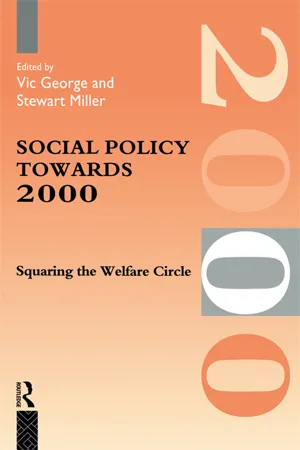
Social Policy Towards 2000
Squaring the Welfare Circle
- 264 pages
- English
- ePUB (mobile friendly)
- Available on iOS & Android
eBook - ePub
About this book
Information
Chapter 1
Squaring the welfare circle
Governments in all advanced industrial societies today are engaged in an intensifying struggle: first, to meet the increasing public demand for high quality welfare provision; second, to meet the simultaneous public demand for limiting levels of taxation; third, to maintain and raise rates of economic growth; and fourth, to maintain and improve their electoral chances. It is this difficult balancing act that the phrase ‘squaring the welfare circle’ describes. The welfare circle is public service provision and the welfare square is public service finance. Mathematicians today take the thoroughly modern view that no formula can be found for perfectly squaring the physical circle and that this is a fact of life with which we must all live. It is a conclusion that social scientists pondering over ways of squaring the welfare circle may find slightly disheartening, even though it should not prevent them from looking for ways that get pretty close to it.
This chapter examines how the debate on squaring the welfare circle has evolved in Britain, bearing in mind that this was not a dominant preoccupation among either politicians or social scientists in the 1940s when the Labour government reforms created the post-war welfare state. Since this is not merely a British dilemma, references are made to how some other industrial societies have tried to cope with the problem.
The post-war welfare state in Britain was based on very considerable political consensus which reflected agreement between the major political parties in three main areas. First, the government had both the capacity and the duty to manage the economy in such a way as to increase economic growth and to maintain full employment. Second, the government could and should engage in a wide variety of interventions designed to improve the quality of life. Third, the government had both the resources and the responsibility to provide a range of universalist social services available to all, free at the point of use, as a substantial contribution to ensuring a basic and rising standard of living for all its citizens. An open but regulated market and a coherent package of social provision complemented each other to the benefit of both economic growth and social protection. It was a political consensus that reflected both the public mood and the nature of British society of that time.
It was this blend of Keynesian economics and Beveridgean social concern that gave the welfare state its strong political legitimacy and popular appeal. This is not to suggest that there were no party political differences in the details of policy programmes or that there were no dissenting voices from both the left and the right. It is the dissent from the right, however, that concerns us most here, because it was this that eventually became a mainstream critique of the universalist welfare state. At the theoretical level, before it was even realised, Hayek denounced the universalist welfare state as ‘the road to serfdom’, the route away from both economic growth and personal freedom. Substantial central government planning and provision, he asserted, necessarily result in political dictatorship as they concentrate too much power in the hands of the government and render its leaders increasingly intolerant of opposing groups. Democratic central planning on a large scale was, to him, a contradiction in terms. Only ‘a policy of freedom for the individual’ could reverse the trend towards collectivism and authoritarianism that was so evident in Europe in the 1930s and 1940s (Hayek 1944: 178). At the political and industrial level, there were also misgivings about the implications of universal social provision on the economy. No less a figure than Winston Churchill, influenced by Hayek’s thesis, warned his wartime cabinet colleagues against the financial burden of the Beveridge Report proposals and the ‘false hopes and visions of Utopia and Eldorado’ engendered by the report (Churchill, in Jones et al. 1978: 48). A group of Conservative MPs signed a letter in 1944 protesting against the collectivist trend of government legislation: ‘Bill after Bill is being introduced, or envisaged, which involves compulsion and loss of personal Freedom’ (Greenleaf 1983: 310). Similarly, the President of the Federation of British Industries urged the Labour government in 1947 ‘not to rush their programme and to place production and prosperity above party plans and policies’ (Rogow and Shore 1955: 13).
Opposition to the universalist welfare state became more conceptual and policy specific during the late 1950s and 1960s. A great deal of this critical literature emerged from the Institute of Economic Affairs. One of its earliest papers by Lees in 1961 laid out many of the arguments that would appear in later literature from the new right. Concentrating on the NHS, Lees argued that medical care was ‘not markedly different’ from the goods that people bought in the private market and there was, therefore, no good reason why it should not be provided by the private market. Indeed, it was the best way to open the NHS to ‘consumer choice’, to make it more efficient and rid it of its fundamental weaknesses – ‘the dominance of political decisions, the absence of built-in forces making for improvement and the removal of the test of the market’ (Lees 1961: 78).
Conservative politicians with ministerial experience began in the 1960s to question the government’s expanding role in economic and social affairs. Enoch Powell, with the experience of an ex-Minister of Health, came to the conclusion that the method of funding the NHS was at the bottom of many of the ills of the service. It ‘endows everyone providing as well as using it with a vested interest in denigrating it’ in an effort to extract even more funds from the central government (Powell 1966: 16). A couple of years later he widened his attack on the welfare state by putting the blame for the economic problems of the country substantially on the rise in public expenditure. ‘On any view, the margin by which public expenditure has overshot the growth of the national income is the major cause of the disastrous financial events of the last four years, which still pursue us: internal inflation, external devaluation, and foreign indebtedness’ (Powell 1970: 111). Thus by the early 1970s the anti-welfare state lobby was well established in Britain even though it commanded very little academic, political or public support. The material base for the spread of new right ideas was still unfavourable. Ideas do not take hold in a socio-economic vacuum: social and economic conditions must be such as to lend credence to new ideas before they are widely accepted, taken on board by governments and generally replace previous orthodoxies. Before we discuss these changes, it is useful to look briefly at the left-wing critique of the welfare state during this period.
The discovery that the extensive – and expensive – welfare system established under the post-war settlement had not substantially reduced wealth and income inequalities (Titmuss 1962) and had not even abolished subsistence poverty (Abel-Smith and Townsend 1965) was at once a blow to optimists of the left and a cause of tension among those of differing views on the state’s ability to deal effectively with these problems in a capitalist society. Fabian socialists remained inherently optimistic about the potential of capitalism for reform and gradual improvement while many Marxists denied such potential and maintained their suspicion that post-war reform was fundamentally a smokescreen and a sop (Miliband 1969). Whatever the misgivings, however, the critical left argued not for the reduction but for the expansion of the welfare state as well as for more vertically redistributive forms of taxation.
These criticisms from the right and left remained marginal until material changes in society in general and in people’s living standards in particular became strong enough to enable a more widespread acceptance of new ideas. Unfortunately for the left, material changes favoured the ideas of the right. Three main societal changes had been gradually taking place throughout the 1950s and 1960s which separately and together began to present a serious challenge to the universalist social service welfare state. The first sprang from the increasing economic affluence that the country experienced through these two decades. Rising standards of living – increasingly taken for granted – meant rising aspirations in both the economic and social fields. People formed expectations of the social services that outstripped service performance. They began to draw comparisons between the ‘quality of service’ they received in the private market and that received when using the social services – and they found these services wanting, both in the physical standards they experienced and in the way they were treated by professionals providing the services. The second main trend was the decline in the relative economic performance of the country. Rates of economic growth, of profitability and of investment were falling, while rates of unemployment and inflation were gradually rising, and rates of taxation inevitably moved upwards to provide the funds for the welfare state. Thus rising public aspirations and hence demands on the public services were accompanied by enhanced economic difficulties in the way of meeting them. Third, the diversification of the occupational structure meant that the country was no longer merely a two- or three-class society. Conflicts of economic interest increasingly manifested themselves among the various subgroups making up the various classes. Both taxation rates and social policy provision affected these various subgroups differently, with the result that the support of some of them for the universalist welfare state weakened considerably. All these changes produced a climate that was favourable for the flourishing of the new right ideology which had hitherto remained dormant. There was, however, no inevitability about this. If the left had modified its policies to take account of the societal changes and attitudes towards welfare, it might have been able to preserve the long-standing political consensus on the welfare state.
Indeed, by the early 1970s major political figures in the Labour Party were beginning to voice their concerns on how to square the welfare circle. Their commitment to the universal welfare state remained as strong as ever, but their faith in the ability of governments to square the welfare circle was shaken by their experience as ministers in the Labour governments of the 1960s.
It was Crosland who first acknowledged the unenviable task of governments trying to finance expanding welfare services during periods of low economic growth. By 1969, the United Kingdom ranked third in the OECD – after the Netherlands and Sweden – in terms of public expenditure as a proportion of GDP. Writing in the very early 1970s, he warned of the inflationary dangers involved in financing expanding public services through constantly rising rates of taxation. Only increased rates of economic growth could sustain high levels of public expenditure and preserve public support for the welfare state. Moreover, high rates of economic growth were indispensable to the creation of a socialist society. They were not sufficient in themselves but, he argued, ‘in a democracy low or zero growth wholly excludes the possibility’ (Crosland 1974: 74). With disarming honesty, he admitted that the Labour Party did not have ‘some panacea for crisis-free growth which was mysteriously hidden from both the previous Labour and the present Tory Governments’ (1974: 58). Two years later, and now in government, he made his now famous statement that ‘The party is over’ (Crosland 1982: 295). Unless and until rates of economic growth improved, the harsh reality was that growth in public expenditure was impossible. This call to financial prudence gradually became part of Labour government thinking so that the two main parties in the country began to converge on this issue in later years.
It was within this new economic and political climate that social scientists of the right and left began to develop their new pessimistic scenarios of the future of the welfare state. Two seminal articles of 1975 sketched out elements which were to be central to the new right account of the welfare state crisis in Britain. Both reached the same conclusion: that the welfare state was expected to perform so many functions and to provide so many services that it could not cope, and could not carry on any longer in such a condition. The first article, by Samuel Brittan, saw the causes of this crisis in the competitive nature of democratic systems. In a parliamentary democracy, competing interest groups exert pressure on political parties which vie with each other for election and re-election, with the result that there is ‘a systemic upward bias to expectations’ (Brittan 1975: 141). Thus a continuous expansion of government services and functions takes place without enough thought being given to the ill consequences of this process.
Anthony King, in the other key article, presented the ‘overload’ of government as the result of structural factors related to the increased industrialisation, urbanisation, and indeed internationalisation, of British society. What happens at work, for example, has implications for people’s lives at home, in the market-place and elsewhere. Urbanisation creates both possibilities and problems which affect people’s lives in many diverse and complex ways. Thus governments which decide to act in one area find themselves forced by this interaction to enter others too. But the more governments take on, the less they can deliver, for so many problems turn out to be beyond their capacity. They do not possess the resources or the knowledge to tackle many of the problems forced on them. One of the possible consequences of this ‘overloading’ of governments was public loss of faith in parliamentary democracy. As King put it:
Although no-one has produced a plausible scenario for the collapse of the British system of government the fact that people are talking about the possibility at all is in itself significant, and certainly we seem likely in the mid or late 1970s to face the sort of ‘crisis of the regime’ that Britain has not known since 1832, possibly not since the seventeenth century.
(King 1975: 294–5)
Thus for both Brittan and King the crisis was primarily a political issue of credibility and legitimation not only for individual governments but for the democratic system itself. The only solution was a reduction in government activities – and promises – but both Brittan and King saw this as being very difficult to bring about because of the systemic nature of the causes of crisis. Their proposals, therefore, were limited to appeals to the politicians, to the mass media and to others to scale down the demands made on governments.
It was, however, the writings of economists consciously identifying themselves with the economic liberal tradition that proved more immediately telling for the future development of the welfare state. In the mid-1970s, Bacon and Eltis placed the blame – as did Powell before them – for what was to them the crucial decline of the manufacturing sector of the British economy, firmly and squarely on the rise in public expenditure and public employment. The de-industrialisation thesis, as it came to be known, proved very influential because its promotion almost coincided with the recession of the late 1970s. It was a simplistic and largely erroneous explanation for a complex problem but it rang true to those who were anxious to reduce public expenditure on political, industrial and other grounds. Public expenditure, it was argued, led to a reduction of profits and investment and to a rise in wages and taxes; it tipped the balance of industrial relations in favour of the trade unions; and it undermined work and savings incentives. Above all, ‘successive governments have allowed large numbers of workers to move out of industry and into various service occupations’ where they mostly consume but do not produce (Bacon and Eltis 1976: 221). Britain’s public sector expanded at the expense of the manufacturing sector and a radical change was needed to reverse the downward spiral in the country’s fortunes: reduce the level of public expenditure and public employment and, at a stroke, make more funds and labour available for deployment in the manufacturing sector. This was clearly an attractive analysis for rightist politicians seeking to distance themselves not only from Labour but from the whole ‘disastrous’ history of post-war public sector growth. As early as 1975, Margaret Thatcher, the new leader of the Conservative Party, had stressed that the public sector was in competition with the private not only for revenue and capital but also for labour: ‘Every man switched away from industry and into Government will reduce the productive sector and increase the burden on it at the same time’ (Cooke 1989: 12).
Thus the right-wing critique of the welfare state came to combine the economic with the political. Its message was that the political and economic crisis of the country could be solved through a reduction in public expenditure, public employment and public provision. The public services were seen as a drain on the political and economic strength of the country. A reversal of post-war welfare expansionism would at once reduce personal reliance on the state; cut taxes; undermine the strength of the trade unions and thus their ability to obtain unrealistic wage rises; and improve profitability, growth rates and general economic prosperity. The welfare circle would be squared. There would be short-term difficulties and problems but in the longer term the country would learn to live within its means and prosper. Although these ideas had been expressed before, they rang more true now for they appeared to make more sense of economic realities. They made more sense of Friedman’s dictum 25 years earlier that ‘one cannot be both an egalitarian and a liberal’ (Friedman 1962: 195).
Writing at the same time as the overload theorists, O’Connor and Habermas provided a Marxian critique of advanced welfare capitalism. Fundamentally, their argument was that the state in capitalist societies was forced to provide two types of services: those which made the capitalist system more efficient and profitable – education, roads, research, and so on – and those which improved the political acceptability of the system among the masses – social security benefits, and the like. Both types were necessary to the survival of the capitalist system. In carrying out these services, however, the state had to resort to increased spending which it found more and more difficult to finance, since it was not the state itself but the capitalist class which was benefiting directly from the increased profitability resulting from these expensive interventions. In O’Connor’s terms, the ‘fiscal crisis’ of the state was a structural phenomenon inherent in all welfare capitalist societies. It could not be solved within the capitalist institutional order: if the state reduced its expenditure it would make the system either less profitable or less politically acceptable or both. In his opinion, ‘the only lasting solution to the crisis is socialism’ (O’Connor 1973: 221). Only the socialisation of the means of production could solve the fiscal crisis because the state would then collect the profits to pay for its services. Habermas adopted a similar line but was less inclined to dismiss the ability of governments to cope somehow with their deep-rooted problems. The capitalist state would attempt to resolve the crisis through a variety of ad hoc measures – some reductions in public expenditure, promotion of private services, increased resort to authoritarian measures, and so on (Habermas 1975: 75). In the final analysis, however, Habermas concluded that the welfare circle could not be squared within a capitalist welfare society, because public pressure for greater participation in and consumption of public services was irreversible in democratic societies.
Thus the Marxist ‘state contradiction’ and the right-wing ‘overloading’ theories agreed on the basic features of the fiscal and legitimation crisis but disagreed on its causes and remedies. Moreover, they were both very pessimistic that a solution to the crisis was possible. It was left to writers of the centre to strike a more balanced, or perhaps less alarmist, note. Such writers acknowledged that welfare states in all advanced capitalist societies faced problems of legitimacy but asserted that these did not constitute an overloading or a fiscal or legitimation crisis. Their main focus of concern was the relationship between the economy and public service provision. So long as rates of economic growth were healthy enough to finance growing demands for public provision, as was the case in the 1950s and 1960s, all was well. When this was not possible, as was the case in the late 1970s when the economic recession engulfed the whole world, governments had a difficult task in rationing resources. Writing in 1979, Rose and Peters expressed this well when they proclaimed that ‘the greatest challenge facing the governors of every western country today is the maintenance of political authority in the face of economic difficulties’ (Rose and Peters 1979: 6). They hastened to add, however, that ‘to suggest that a country with economic difficulties could become ungovernable is literally to talk nonsense’ (1979: 6). Governments had the difficult task of finding the right balance between public services provision and taxation rates. The public were right to expect services as of right as well as tolerable taxation rates. It was the duty of governments to find the politically acceptable balance between the two. It was difficult but both necessary and possible. Thus references to ‘legitimation crisis’ and ‘ungovernability’ were exaggerations and governments could, with prudence and judicious adhocery, steer their way through the troubled waters. Despite this calmer analysis, it was the concepts of ‘overloading’ and ‘fiscal crisis’ that seemed to have exerted more influence on party politi...
Table of contents
- Cover
- Half Title
- Title Page
- Copyright Page
- Contents
- List of tables
- List of contributors
- Introduction
- 1 Squaring the welfare circle
- 2 The Thatcherite attempt to square the circle
- 3 The welfare circle towards 2000: General trends
- 4 Employment: Welfare, work and politics
- 5 Social security: The cost of persistent poverty
- 6 Education: National success and individual opportunity
- 7 Health services: Pressure, growth and conflict
- 8 The personal social services: The politics of care
- 9 Housing: Need, equity, ownership and the economy
- 10 2000 and beyond: A residual or a citizens’ welfare state?
- Bibliography
- Index
Trusted by 375,005 students
Access to over 1.5 million titles for a fair monthly price.
Study more efficiently using our study tools.
Frequently asked questions
Yes, you can cancel anytime from the Subscription tab in your account settings on the Perlego website. Your subscription will stay active until the end of your current billing period. Learn how to cancel your subscription
No, books cannot be downloaded as external files, such as PDFs, for use outside of Perlego. However, you can download books within the Perlego app for offline reading on mobile or tablet. Learn how to download books offline
Perlego offers two plans: Essential and Complete
- Essential is ideal for learners and professionals who enjoy exploring a wide range of subjects. Access the Essential Library with 800,000+ trusted titles and best-sellers across business, personal growth, and the humanities. Includes unlimited reading time and Standard Read Aloud voice.
- Complete: Perfect for advanced learners and researchers needing full, unrestricted access. Unlock 1.5M+ books across hundreds of subjects, including academic and specialized titles. The Complete Plan also includes advanced features like Premium Read Aloud and Research Assistant.
We are an online textbook subscription service, where you can get access to an entire online library for less than the price of a single book per month. With over 1.5 million books across 990+ topics, we’ve got you covered! Learn about our mission
Look out for the read-aloud symbol on your next book to see if you can listen to it. The read-aloud tool reads text aloud for you, highlighting the text as it is being read. You can pause it, speed it up and slow it down. Learn more about Read Aloud
Yes! You can use the Perlego app on both iOS and Android devices to read anytime, anywhere — even offline. Perfect for commutes or when you’re on the go.
Please note we cannot support devices running on iOS 13 and Android 7 or earlier. Learn more about using the app
Please note we cannot support devices running on iOS 13 and Android 7 or earlier. Learn more about using the app
Yes, you can access Social Policy Towards 2000 by Prof Vic George,Vic George,Stewart Miller in PDF and/or ePUB format, as well as other popular books in Politics & International Relations & Health Care Delivery. We have over 1.5 million books available in our catalogue for you to explore.