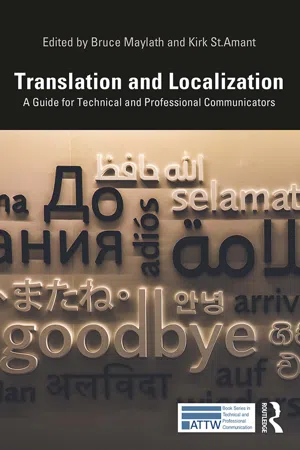
Detailed yet accessible, Translation and Localization brings together the research and insights of veteran practicing translators to offer comprehensive guidance for technical communicators. The volume begins with the fundamentals of translation before leading readers through the process of preparing technical documents for translation. It then presents the broader area of localization, again beginning with its key competencies. Concluding chapters examine the state of the field as computers take on more translation and localization work. Featuring real-life scenarios and a broad range of experienced voices, this is an invaluable resource for technical and professional communicators looking to expand into international markets.
eBook - ePub
Translation and Localization
A Guide for Technical and Professional Communicators
- 256 pages
- English
- ePUB (mobile friendly)
- Available on iOS & Android
eBook - ePub
Translation and Localization
A Guide for Technical and Professional Communicators
About this book
Information
PART I
Translation
AREA 1
CENTRAL CONCEPTS
1
AN OVERVIEW OF THE MAIN ISSUES OF TRANSLATION
Introduction
Translation helps transcend language barriers and interact with people in different countries. The word “translation,” however, is a general label for many activities and products. Broadly speaking, “translation,” in the words of Bellos (2011) is “a two-headed beast”; without an article (“a[n],” “the”), it names “the process by which ‘a translation’ comes to exist,” but with an article, it names “a product—any work translated from some other language” (21). “Translation” thus refers to
- the process of transferring meaning from an original text written in a source language to another language according to the specific socio-cultural context of that language and
- the product resulting from that process: the target (i.e., final, translated) text that should address the socio-cultural context of the intended audience reading in the target language.
The word “translation” can also refer to other activities and products based on criteria such as the following:
- Medium: Written, oral, audiovisual, etc.
- Mode: Conversion of a text from one language to another including
- intralingual translation: within the same language,
- interlingual translation: between different languages, and
- intersemiotic translation: between different verbal/non-verbal systems such as from a novel to the medium of film
- Direction: Conversion of a text from or into the translator’s mother tongue or language of habitual use
- Tools: Technologies used to help with translation (e.g., computer-assisted translation, machine translation, terminology-management systems etc.)
- Type: Kind of text to be translated (e.g., literary, legal, technical, political, etc., and, within such categories, genres such as journal article, science textbook, newspaper editorial, etc.)
- Completeness: Degree of completeness of the finished translation (e.g., translation of an entire text, parts of a text, summaries of a text, etc.)
These are aspects that technical communicators need to consider when preparing texts for translation.
This chapter focuses on technical translation,1 a sub-type of specialized translation involving “technology based” texts—or texts produced by technical communicators and relating to technological subjects. In this case, technical information is translated to share it in a different language and with a new audience. To achieve this objective, information should be easily accessible in terms of comprehensibility, clarity, and speed of delivery (see Byrne 2006, 11).
By overviewing central concepts, processes, and practices in translation, this chapter can help acquaint technical communicators with the main issues of translation and the factors and constraints affecting it. To help technical communicators better understand such practices, the chapter has been organized into the following sections:
- “What is Technical Translation?” explains technical, scientific, and specialized translation for individuals new to such topics.
- “The Process of Translation” describes translation through three main stages of the translation process.
- “Translating Technical Texts: Problems and Strategies” explores common problems encountered by translators and the strategies often used to address them effectively.
- “Quality in Technical Translation” presents parameters for evaluating the quality of a technical translation, and it describes the translation process in terms of a translation workflow.
- “Training and Accreditation of Translators” describes training translators to achieve the needed mix of competences and skills.
Each section thus introduces technical communicators to the key translation processes, practices, and approaches and provides them with the understanding essential to working more effectively with translators and translation.
What Is Technical Translation?
In technical translation, the medium involved is usually written text, and translators are typically asked to translate whole documents, not just portions of them. The direction of the translation (i.e., the movement of a text from one language to another) is generally from a second language the translator learned (L2) into the translator’s native language or language of habitual use (L1). The idea of individuals translating into their L1 is important, for one knows the nuances of her or his L1 needed to avoid “interference”—that is, repeating language patterns that are atypical of the target language (e.g., selecting the best idiomatic expression for conveying an idea). An example of such a situation in English is the expression social dinner—the result of interference from the Italian noun phrase cena sociale. The term needed to convey the same idea to English users is “conference dinner.”
Despite the traditional rule that translators should always translate into their L1, translating into the translator’s L2 is becoming increasingly common as a result of the growing use of technologies in the translation process. Such situations are particularly the case when the translator has a very specialized subject-matter expertise and the translation is revised by a native speaker (e.g., having a reviser or, indeed, the translator herself review marketing materials translated into that translator’s L2 via a machine/software). Such a scenario has become much more acceptable thanks to the introduction of translation technology (see Svoboda’s chapter in this volume).
Style and Register
In technical translation, the texts to be translated can be broadly categorized according to their subject matter as “technology based.” Taken on its own, however, subject matter is not sufficient to help translators produce target-language texts that are virtually identical to, and therefore as informative as, texts produced by technical writers in that same language. To do this, they also need to acquire the relevant “style,” loosely defined by Byrne (2006) as “the way we write things, the words we choose and the way we construct sentences” (4).
Language use is governed by different norms and conventions in different situations requiring different author/addressee relationships (peer-to-peer, popularizing, promotional, instructive, etc.). This relationship between language and the immediate situation in which it will be used means that technical translators need to acquire the different “registers” (e.g., formal, colloquial, institutional, etc.) in the target language in order to “package” textual material along patterns familiar to the target reader (Baker 2011, 123). For example, nobody would use the same register to describe a device or tool in both a newspaper entry and an article in a professional journal. So, translators must know
- the subject matter of the text to be translated,
- the context in which the translated text will appear (e.g., journal article, instruction manual, textbook, report, etc.), and
- the translation’s main communicative purpose (expository, argumentative, instructional, etc.).
This information is useful in helping translators understand the style and the specific register of the technical language used in both the source (original) and the target (translated) text. This knowledge enables translators to choose the translation strategies needed to overcome translation problems they might encounter during their task (Hatim and Munday 2004, 74).
Technical vs. Scientific vs. Specialized Translation
Technical translation is not the same as scientific translation, for “science produces ideas about how the world works, whereas the ideas in technology result in usable objects” (Wolpert 2002, 969). Scientific texts deal with pure scientific knowledge; their aims are to describe, classify, discuss, explain, conclude, and justify. Technological texts focus on subjects based on applied knowledge from the natural sciences. The main function of such technological texts is utilitarian: to help someone do something.
Writing about science and technology can vary in terms of subject matter, purpose, and type of language. In a standard situation of peer-to-peer writing, the language of science is quite formal, abstract, and conceptually difficult, because it packs information into short phrases. Conversely, the language of technology is generally more concrete, referring, as it does, to products and processes in the external world. It is also more colloquial and conceptually easier, because it contains less information in more space (Byrne 2006, 7–10). An example illustrating such differences is “glass crack growth rate is associated with applied stress magnitude” vs. “glass cracks more quickly the harder you press it” (Halliday 2004, 196). The condensed meaning of the highly structured and abstract scientific language of the first statement has been “unpacked” into the easier and more concrete standard language of the second.
Finally, the collective expression specialized translation is used for technical, scientific, and legal-administrative translation (i.e., legal text used within businesses, organizations, and governments). Specialized translation comprises most of the world’s annual translation output, and it is by far the most significant employer of translators (Byrne 2006, 2). According to recent data, in the European Union the highest demand for translation services is concentrated in the legal, life sciences, and financial content areas, with high-tech industries ranking lower (LTC 2016, 1). The lower ranking of technical translation, however, somewhat clashes with Olohan’s (2016) claim that technical translation is an “activity [that] is flourishing in today’s global economy and information society, in which there is strong demand for product specifications, instruction leaflets, user guides, etc., in many languages, as well as for the localization of software applications” (246). Even more strikingly, Byrne (2006, 2) estimated that technical translation, including only technological texts (i.e., excluding legal, business, financial, etc. texts), accounted for as much as 90% of the world’s total translation output each year.
The Process of Translation
The process of translation refers to the cumulative process involving “what happens linguistically and cognitively as the translator works on the translation” (Hatim and Munday 2004, 346). Three basic stages of the translation activity lead to the translated text. These stages are
- analysis of the source-language text,
- transfer of the source text into the target language, and
- revision of the translation.
This section examines each of these stages in more detail so that technical communicators can better understand each stage of the overall translation process.
Analysis of the Source-Language Text
In the first stage, the translator analyzes the source-language text (meaning, register, terminology, etc.) for two reasons. The first is to gain a complete understanding of the text to be translated. The second is to select a general approach that will guide the translator’s choices at the various levels of the text. Achieving this second goal depends on gaining an accurate understanding of the purpose of the translation and the needs of the target readers (acquired from the so-called “translation brief”—see Durban 2011).
The reading that the translator does at this stage needs to be extremely careful. Unlike when other individuals read the same text, translators identify weak spots in the original text—areas where clarification is needed. This process allows one to improve the text even in the source language. This step helps translators serve as technical communicators’ best reviewers and proofreaders.
Transfer into the Target Language
The second stage involves the transfer or reformulation of the ideas from the source text into the target language. At this stage, trained translators solve translation problems that they encounter by applying appropriate strategies that they have been taught. Such problems refer to the translatability of the source text and typically include the following:
- Linguistic problems relating to the wording of the specific text to be translated, such as terminological problems linked to the translator’s (lack of) knowledge of the specific technical terminology used in the text
- Pragmatic and cultural problems linked to the different audience an...
Table of contents
- Cover
- Half Title
- Series Page
- Title Page
- Copyright Page
- Dedication
- Table of Contents
- Contributors
- Acknowledgements
- Series Editor Foreword
- Foreword
- Preface: Handling Technical and Professional Communication for Audiences of All Languages
- Introduction: The Dynamics of—and Need to Understand—Translation and Localization in Technical Communication
- Part I Translation
- Area 1: Central Concepts
- Area 2: Writing and Content Creation
- Part II Localization
- Area 3: Fundamentals, Contexts, and Content
- Part III Horizons
- Area 4: Computing and Commerce
- Glossary
- Index
Trusted by 375,005 students
Access to over 1.5 million titles for a fair monthly price.
Study more efficiently using our study tools.
Frequently asked questions
Yes, you can cancel anytime from the Subscription tab in your account settings on the Perlego website. Your subscription will stay active until the end of your current billing period. Learn how to cancel your subscription
No, books cannot be downloaded as external files, such as PDFs, for use outside of Perlego. However, you can download books within the Perlego app for offline reading on mobile or tablet. Learn how to download books offline
Perlego offers two plans: Essential and Complete
- Essential is ideal for learners and professionals who enjoy exploring a wide range of subjects. Access the Essential Library with 800,000+ trusted titles and best-sellers across business, personal growth, and the humanities. Includes unlimited reading time and Standard Read Aloud voice.
- Complete: Perfect for advanced learners and researchers needing full, unrestricted access. Unlock 1.5M+ books across hundreds of subjects, including academic and specialized titles. The Complete Plan also includes advanced features like Premium Read Aloud and Research Assistant.
We are an online textbook subscription service, where you can get access to an entire online library for less than the price of a single book per month. With over 1.5 million books across 990+ topics, we’ve got you covered! Learn about our mission
Look out for the read-aloud symbol on your next book to see if you can listen to it. The read-aloud tool reads text aloud for you, highlighting the text as it is being read. You can pause it, speed it up and slow it down. Learn more about Read Aloud
Yes! You can use the Perlego app on both iOS and Android devices to read anytime, anywhere — even offline. Perfect for commutes or when you’re on the go.
Please note we cannot support devices running on iOS 13 and Android 7 or earlier. Learn more about using the app
Please note we cannot support devices running on iOS 13 and Android 7 or earlier. Learn more about using the app
Yes, you can access Translation and Localization by Bruce Maylath, Kirk St.Amant, Bruce Maylath,Kirk St.Amant in PDF and/or ePUB format, as well as other popular books in Languages & Linguistics & Natural Language Processing. We have over 1.5 million books available in our catalogue for you to explore.