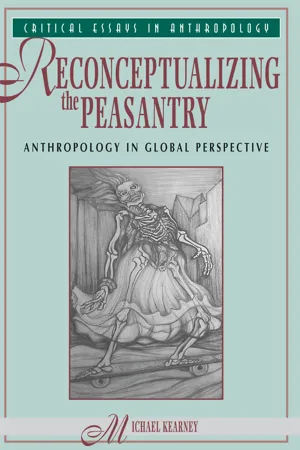
The concept of ?peasant? has been constructed from residual images of pre-industrial European and colonial rural society. Spurred by Romantic sensibilities and modern nationalist imaginations, the images the word peasant brings to mind are anachronisms that do not reflect the ways in which rural people live today. In this path-breaking book, Michael Kearney shows how the concept has been outdistanced by contemporary history. He situates the peasantry within the current social context of the transnational and post?Cold War nation-state and clears the way for alternative theoretical views.Reconceptualizing the Peasantry looks at rural society in general and considers the problematic distinction between rural and urban. Most definitions of and debates about peasants have focused on their presumed social, economic, cultural, and political characteristics, but Kearney articulates the way in which peasants define themselves in a rapidly changing world. In the process, he develops ethnographic and political forms of representation that correspond to contemporary postpeasant identities. Moving beyond a reconsideration of peasantry, the book situates anthropology in global context, showing how the discipline reconstructs itself and its subjects according to changing circumstances.
- 224 pages
- English
- ePUB (mobile friendly)
- Available on iOS & Android
eBook - ePub
About this book
Information
Chapter 1
San Jerónimo: A Peasant Community?
My first major fieldwork effort was conducted in the state of Oaxaca in southern Mexico in the 1960s in Ixtepeji, a Zapotec "town of peasant farmers" (Kearney 1972:4). This fieldwork was done in the classic mode in the sense that I dropped into Ixtepeji from outside and saw it locally largely from the inside out, as a more or less self-contained community.1 The structure of my initial fieldwork in the Mixtec town of San Jeronimo was, however, rather different. In the late 1970s I came to know men from the town in Riverside, California, where they were working as orange pickers. I arranged for one of these men to take me and my colleagues and former students James Stuart and Roberto Perez to San Jerónimo with him. We thus arrived in San Jerónimo in 1978 already sensitized to the importance of migration to search for cash income for its inhabitants.
When I first began to work in San Jerónimo in 1978, it appeared to be the epitome of a traditional peasant community. Spatially, San Jerónimo is remote, indeed isolated, lying at the end of a dirt road in the Mixteca region of Oaxaca in southern Mexico. The road is often impassable in the rainy season. If ethnographers were to parachute into San Jerónimo Progreso, it would be as if they had entered a prototypical 'peasant' community of highland Mesoamerica, for here the daily round is the stuff of the classic ethnography of 'peasant society.' And indeed, one could write a volume on the 'peasant' society, culture, and economy of San Jerónimo. All of the characteristics of peasant economics, society, and culture are there. All households have access to farmland that is communally owned by the town, and most households also have some de facto private land they also work. Almost all production is for auto consumption and is produced with simple technology powered by human and animal energy. In addition to self-employment, agricultural production is carried out within a complex set of social and economic relationships that include labor exchange, varieties of sharecropping, and hired labor. And in nearby towns a few large landowners absorb some labor of small holders by means of feudal-like relationships.
A rich ceremonial life in the town celebrates its collective symbols and is financed within a general set of economic relations, including bride price, that defy the logic of market production and exchange. These relations are transacted in a dialect of the Mixtec language—the language of everyday life—unique to the town. Embedded in the language is an extensive body of ethnoscience concerning botany, biology, health, human nature, and so. Faces of people from different households throughout the town have family resemblances with one another, no doubt as a result of many generations of endogamy within the community. The language, customs, and social identity thus all map onto a corresponding dense web of kinship such that it is possible to trace complex multiple kinship relationships between any two members of the community.
These, then, are certain irrefutable objective characteristics of San Jerónimo that are eminently 'peasant.' An ethnographer from the sky would have no trouble filling notebooks documenting expressions of a corresponding 'peasant culture and mentality.' Non-Western forms of thinking and knowledge guide daily life, and indeed the general 'culture' of the community is markedly distinct from the 'modern' national culture of contemporary, 'educated' urban Mexico. Thus, in sum there is ample reason to refer to San Jerónimo using the Mexican term patria chica, "small republic," which connotes a self-contained social, cultural, and economic universe—a conception that is echoed in Wolf's (1957) "closed corporate peasant community."2
Viewed locally, San Jerónimo was in all apparent respects a prototypical Mesoamerican peasant community, except that we arrived there with a growing appreciation of the importance of wage labor in its economy. The base of the diet—that is, of biological reproduction—in San Jerónimo is corn and beans. Therefore, one of the first research tasks we undertook was to assess local agricultural production to better understand the relationship between peasant farming and cash income in the overall economy of the town. Our initial findings were surprising: Only about 20 percent of the town's corn and beans, the staples of the diet, was supplied by local peasant production. The shortfall was made up by the purchase of imported corn and beans. With virtually no appreciable local sources of cash income, the only alternative to starvation for the great majority of the town's households was and still is to send migrants and immigrants out in search of cash income that can be remitted to purchase imported corn and beans. This is an old pattern. The oldest residents remember going with their parents as children to cut sugar cane in Vera Cruz on the Gulf coast. Then in the 1950s, when large agro-export operations—especially tomato production—were developed in the state of Sinaloa on Mexico's northwest coast, people from San Jerónimo began to migrate there as seasonal farmworkers, a pattern that was later extended into the San Quintín valley of Baja California and, as noted earlier, into California.3
In the 1970s and early 1980s, migrants from San Jerónimo were heavily involved as field hands in commercial agriculture in northern Mexico and California. Accordingly, our initial interpretations of the economy of San Jerónimo were made in terms of dependency theory (Stuart and Kearney 1981) and articulation theory (Kearney 1986a).4 However, continued fieldwork with the community took me to an ever widening range of sites as migrants spread into increasingly diverse economic activities in Mexico and California. The formation of enclaves of people from San Jerónimo in California and in shantytowns of Mexican border cities facilitated their movement into self-employment, especially in urban informal economies, as well as their access to forms of public assistance (Bade 1993, 1994; Kearney 1986a; Mines and Kearney 1982). These multiple sources of income, in addition to wage labor and subsistence farming, began to cast doubt on the adequacy of articulation theory to model such increasing complexity of reproduction. However, at the same time it was apparent that San Jerónimo was maintained as a seemingly "traditional" community precisely because of the high degree to which migrants from the town penetrated into distant and diverse socioeconomic niches elsewhere in Mexico and in California. Transnational patterns of production and consumption were supporting a seemingly traditional society that in fact was in many ways fairly modern.
This ethnographic complexity, in which San Jerónimo was neither remaining traditional nor modernizing in the usual sense of those terms, led to consideration of the town as a transnational community (Kearney and Nagengast 1989; see Chapter 5). In the technical sense of the usual product ionist criteria, the community of San Jerónimo is only about 20 percent 'peasant.' Its other 80 percent of income-generating activities is divided mostly between informal activities and wage labor. Now to the degree that the people of San Jeronimo are proletarians, they are unusual proletarians in that although they work mainly in modern corporate industries, they maintain and indeed have elaborated such seemingly traditional practices as a complex communal ceremonial cycle, the bride price, an intense communal solidarity vis-à-vis neighboring Mixtec towns and the Mexican government, and their own indigenous language. Clearly, to consider San Jerónimo as just a peasant town provides an impoverished description of its complexity. Furthermore, concentration on productionist aspects of the town's reproduction would severely slight the importance of local and global social and symbolic influences on the total reproduction of the community.
But how does San Jerónimo fit into the greater society? It is when we seriously begin to examine this question that characterizing San Jerónimo as a peasant community becomes even more questionable. As we trace the threads of this local fabric of a seemingly traditional society, economy, and culture, they take us to the edge of the community and beyond. We can follow these threads by examining the experience of typical members of what we soon come to realize is a greater San Jerónimo. I will discuss a man named Lencho Martínez, a woman named Rufina Vásquez, and two young people, a brother and sister, Eliseo and Lucrecia Mendoza.5 The question that concerns us here is their objective identities: Are they, by formal criteria, peasants? In later chapters I take up the issue of the subjective identities of peasants, their sense of who and what they are—in a word, their social consciousness. Do they think, feel, and behave in conformity with anthropological theory of peasants? But I begin with the first question and with Lencho.
Lencho Martinez, a Peasant Man?
Two of the primary components of the definition of peasants is that they engage in self-directed subsistence agricultural production and that they exist in relations of political and economic inequality with nonpeasants, such that the economic value that originates from peasant production is transferred from the peasants to nonpeasants. Both of these criteria apply to Lencho, but in his case, as with that of the entire town, the ratio of peasant to nonpeasant production is fairly low. Furthermore, the circuits in which Lencho's peasant and nonpeasant income circulate are complex and blur the distinction between these two ideal spheres. With respect to peasant farming, Lencho works land of his own and also some his mother-in-law owns. He and his family and animals consume all they produce, which provides only about a quarter of their food needs.
In the 1970s Lencho made numerous crossings into California with other men from San Jeronimo to seek work picking oranges. At that time they were reluctant to attempt crossing from Tijuana through the gauntlet of the Border Patrol, crooked Mexican police, and robbers that prey on "illegals" in the most heavily trafficked international border crossing in the world.6 Instead they would go east along the border past the town of Tecate and walk into the back country of San Diego, where after three or four days they would emerge from the mountains on roads where they could be picked up by labor contractors (or this anthropologist).
Now in his late forties, Lencho feels he is too old for heavy farmwork in California. Presently, he and his family have a second home in a Mixtec enclave near Ensenada in Baja California, where he works as a mason and his wife and grandchildren sell handicrafts to tourists.
He and his family split their time between their two homes. When Lencho is in San Jeronimo, in addition to farming he also builds houses for other circular migrants, who pay him mostly in dollars they have earned in California (some years ago Lencho built his own house with dollars he earned in the North). Such construction has transformed the architecture of San Jeronimo in recent years, as circular migrants have replaced their older adobe and pole and thatch houses with ones made of cement block.
Lencho occasionally needs extra cash, which he borrows from moneylender Macario Calderon. Macario, like other local moneylenders, serves in effect as a banker for the community, but he makes loans at usurious rates of interest. Macario uses his profits to buy merchandise in the nearest city for resale in his small store in the town at greatly marked-up prices to a more or less captive clientele, He also turns a profit on corn produced in San Jerónimo by buying it cheaply and selling it dearly; he further profits by importing corn and other commodities into the town for resale to local people, who pay him with dollars earned in California. Macario and the other small businesspeople in the community have trucks and charge other residents for rides and for hauling.
Part of the definition of peasants is that they render their economic surplus to nonpeasants. But in the case of San Jerónimo, most surplus accumulated from its citizens takes the form of surplus value accumulated through wage labor at sites far from San Jerónimo. Also, as can be seen in Lencho's case, complex circuits of economic flow and accumulation exist within the greater transnational extension of San Jerónimo.7
Lencho is not one of the principales—a loose group of senior and well-respected men who form a de facto town council that guides and validates the political, economic, and ceremonial actions taken by the town officials, who are elected to municipal offices as specified by Mexican federal law. But he does have an intense interest in, and gains deep satisfaction from, participating in village politics.
Lencho's wite speaks only Mixtec, and he speaks Spanish poorly. He cannot read but usually has access to television and other electronic media. In terms of cultural tastes, while working Lencho listens to Mexican ranchera (country) music, but on special ceremonial occasions he most appreciates Oaxacan village brass band music. His daily food preferences are the staples and dishes of the San Jerónimo diet, although he also enjoys hamburgers and other fast foods.
Rufina Vásquez, a Peasant Woman?
Rufina was born in San Jerónimo in 1963 and did not learn to speak Spanish until she married at age fifteen and began to accompany her husband and his brothers to pick tomatoes in Sinaloa. By 1980 they were spending a lot of time with relatives in the Mixtec shantytown enclave in Colonia Obrera of Tijuana, which was a base from which they crossed the border to pick oranges in southern and central California. Her first child was born in 1981 in a county hospital in Ventura, California. After she left the hospital, her husband cut canes along the bank of the Santa Paula River and built a nihi (a sweat bath), in which she took a series of postpartum curings with the help of one of her co-madres. Following these treatments, she again accompanied her husband in the orange groves.
By the time their second child was born in 1983, they had built a house in the Mixtec colonia Nogales, Sonora. There Rufina, along with other women of San Jeronimo, sold handicrafts on the streets to tourists visiting this border city By 1988 her husband had acquired a used van, and they began to drive to different cities in Arizona and southern California, where Rufina sold handicrafts in the parking lots of shopping centers. Within a few years, in addition to handicrafts made by Mixtec artisans, she was buying small manufactured items wholesale and reselling them in parking lots. In 1995 she moved out of the informal sector by applying for a business license and renting space in a storefront boutique run by a Japanese American woman. Her children are trilingual in Spanish, Mixtec, and English.
Rufina's father-in-law is the patriarch of her husband s family. He is a principal of San Jerónimo and possesses several hectares of farmable land there, considerably more than the average of about half a hectare (Stuart and Kearney 1981). Rufina's husband and his brothers and sisters will inherit this land, and each year some of them return to help their father plant, cultivate, and harvest it.
In recent years Rufina and her husband have saved enough money to build a rather substantial house in San Jerónimo. They are actively involved in the political and ceremonial life of the community and recently spent several thousand dollars as mayordomos (sponsors) of the town's annual festival in honor of its patron saint, San Jerónimo.
Eliseo and Lucrecia Mendoza, Peasabt Youth?
Eliseo and Lucrecia are brother and sister. Eliseo was born in a Mixtec enclave in Tijuana in 1981 when his parents were taking a respite from picking oranges and other tree crops in central California. After his mother had completed her series of sweat baths, the family engaged a coyote (a border crossing guide) from San Jeronimo to take them back into California so they could return to orange picking. At that time they were living in a small shed behind the house of a labor contractor that they shared with sixteen other men and boys from San Jerónimo.
When Eliseo was two years old his parents were picking tomatoes in San Quintín, in Baja California, and were living in a sheet-metal cubicle in a labor camp that they shared with two other families.8 One night an oil lamp fell on Eliseo and severely burned his legs to the point that he required reconstructive surgery, which was done four years later....
Table of contents
- Cover
- Half Title
- Title
- Dedication
- Copyright
- Contents
- List of Figures
- Preface
- Introduction
- Chapter 1. San Jerónimo: A Peasant Community?
- Chapter 2. Kinds of Others in the History of Anthropology
- Chapter 3. Peasants and the Antinomies of the Modern Nation-State
- Chapter 4. Romantic Reactions to Modernist Peasant Studies
- Chapter 5. Beyond Peasant Studies: Changing Social Fields of Identity and Theory
- Chapter 7. From Modes of Production to Consumption of Modes: Class, Value, Power, and Resistance
- Chapter 8. 'Peasants' and the New Politics of Representation
- Bibliography
- About the Book and Author
- Index
Trusted by 375,005 students
Access to over 1.5 million titles for a fair monthly price.
Study more efficiently using our study tools.
Frequently asked questions
Yes, you can cancel anytime from the Subscription tab in your account settings on the Perlego website. Your subscription will stay active until the end of your current billing period. Learn how to cancel your subscription
No, books cannot be downloaded as external files, such as PDFs, for use outside of Perlego. However, you can download books within the Perlego app for offline reading on mobile or tablet. Learn how to download books offline
Perlego offers two plans: Essential and Complete
- Essential is ideal for learners and professionals who enjoy exploring a wide range of subjects. Access the Essential Library with 800,000+ trusted titles and best-sellers across business, personal growth, and the humanities. Includes unlimited reading time and Standard Read Aloud voice.
- Complete: Perfect for advanced learners and researchers needing full, unrestricted access. Unlock 1.5M+ books across hundreds of subjects, including academic and specialized titles. The Complete Plan also includes advanced features like Premium Read Aloud and Research Assistant.
We are an online textbook subscription service, where you can get access to an entire online library for less than the price of a single book per month. With over 1.5 million books across 990+ topics, we’ve got you covered! Learn about our mission
Look out for the read-aloud symbol on your next book to see if you can listen to it. The read-aloud tool reads text aloud for you, highlighting the text as it is being read. You can pause it, speed it up and slow it down. Learn more about Read Aloud
Yes! You can use the Perlego app on both iOS and Android devices to read anytime, anywhere — even offline. Perfect for commutes or when you’re on the go.
Please note we cannot support devices running on iOS 13 and Android 7 or earlier. Learn more about using the app
Please note we cannot support devices running on iOS 13 and Android 7 or earlier. Learn more about using the app
Yes, you can access Reconceptualizing The Peasantry by Michael Kearney in PDF and/or ePUB format, as well as other popular books in Social Sciences & Colonialism & Post-Colonialism. We have over 1.5 million books available in our catalogue for you to explore.