eBook - ePub
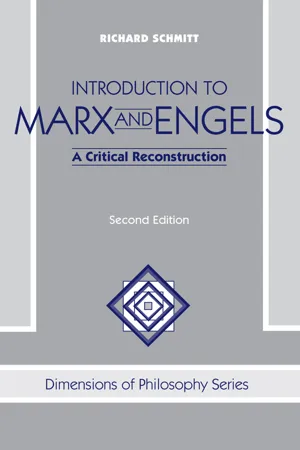
Introduction To Marx And Engels
A Critical Reconstruction, Second Edition
- 240 pages
- English
- ePUB (mobile friendly)
- Available on iOS & Android
eBook - ePub
About this book
0-8133-1250-7 Beyond Separateness : the Social Nature of Human Beings--Their Autonomy, Knowledge, and Power 0-8133-3283-4 Introduction to Marx and Engels : a Critical Reconstruction, Second Edition
Trusted by 375,005 students
Access to over 1.5 million titles for a fair monthly price.
Study more efficiently using our study tools.
Information
1
Human Nature
THERE ARE A NUMBER OF different ways to gain entry into the theories of Marx and Engels. I will begin with their view of human nature—the question of what differentiates human beings from animals. Although that question is not often discussed, assumptions about human nature underlie a number of widely held economic and political theories.
Adam Smith was the first great theorist of capitalism and of the institutions we refer to as the “free market.” He explained the existence of the free market by reference to a human “propensity to truck and barter.”1 The existence of the free market is the effect of human nature that makes us always ready to trade and exchange goods (“truck”). This explanation has interesting consequences: If we live in a market society because we have certain human traits that we share with all other human beings, we can be confident there will be a free market until human nature changes. We can then reject, with similar confidence, any claims that capitalism can come to an end or can be replaced with a different economic system. Similarly, as we look back over history, we see that however different the economy of hunters and gatherers appears to be from modern capitalism, they must be the same in important respects because human nature is no different today from what it was then. We share with hunter-gatherers our common human nature and thus the “propensity to truck and barter.” Smith asserts that free-market institutions are an essential aspect of all human societies because they result from universal human traits. That claim rests on a particular conception of human nature.
Capitalism is often defended as being particularly well suited to human nature. It is thought to be the preferred economic system because human beings are acquisitive; they always want more; they are “greedy.” Others claim that human beings are competitive or that they are usually only interested in benefiting themselves and those closest to them. These claims about human nature are not only used to explain why capitalism exists at all but also to argue that capitalism is good or better suited to human nature than other economic systems.
In more restricted forms, appeals to human nature are used to defend social stratification: We say that the traditional position of women is justified because women have certain unchangeable characteristics: They are weak; they are emotional; they are better caretakers than men, who are aggressive and competitive. Similarly sweeping claims are often made about persons of color to justify their greater rates of poverty, low-wage jobs, and high rates of incarceration. Here the appeal is not to alleged facts about the nature of all human beings but only of some important groups of human beings. But the central structure of all these arguments is the same. Certain institutions are explained and justified by reference to a set of traits that some or all human beings are said to possess regardless of the particular society in which they live: Men cannot help lording it over women, and women’s nature just fits them for their position. White people, it is claimed, are indeed superior to persons of color because white human nature is different from the nature of persons of color.
In similar ways the appeal to human nature justifies political institutions: Thomas Jefferson, one of the great theorists in the liberal tradition, rested important features of the American political system on the claim that all human beings have innate rights. (Animals are presumably different—they do not have rights.) Other liberal theorists have made similar claims, saying that human beings possess rights by their very nature. Those rights in turn determine what a good form of government is: Democracy respects human rights; dictatorship does not. Hence democracy is good and dictatorship is not. The basis of that claim is, once again, a conception of human nature.
In the eighteenth century, in the writings of John Locke, Thomas Jefferson, and Thomas Paine, the appeal to human nature, with its innate rights, provided an argument for more democratic institutions and for freeing commerce from government supervision. In the nineteenth century many socialists argued against capitalism by asserting that human beings are by nature cooperative. In our time portrayals of human nature tend to justify social and economic conditions as they are. Arguments regarding human nature have been used to defend the status quo as well as to attack it.
Marx and Engels on Human Nature
Marx and Engels had no use for conservative arguments that purport to show that the world as it is now is as it ought to be because it conforms to human nature. Nor did they want to press for change by appealing to claims about universal human nature as did the great eighteenth-century political and economic theorists. They refused to get involved in arguments about whether human beings are by nature cooperative or competitive or whether greed or generosity is the more powerful motive because they were extremely skeptical about such broad assertions about the essential traits of all human beings, past, present, and future. As evidence, most people who make such claims point to the people they know. But that does not suffice to establish generalizations about human beings in different places and in different periods of history. We need to compare the behaviors, the values, the socially approved practices of human beings across time in order to form some reliable generalizations about human nature.
But once we consult history, we see that our predecessors did have very different traits and lead very different lives from ours, that indeed “all history is nothing but a continuous transformation of human nature.”2 The claims that particular authors made about all human nature are at best true only in their own culture. There are very few if any human traits that belong to all human beings at all times and places.
But history shows us more. The changes in human life and personality have been closely connected with the ways in which people produced the means necessary for their continued existence. As groups, tribes, and nations developed new ways of feeding, housing, and perpetuating themselves, their ways of being and their “natures” changed. History not only documents those changes but also shows that human beings have an important hand in bringing them about.
Men can be distinguished from animals by consciousness, by religion or anything else you like. They themselves begin to distinguish themselves from animals as soon as they begin to produce their means of subsistence (GI, T 150).3
Traditionally, philosophers have taken consciousness or religion to define the essence of human beings. These are the unchanging characteristics of human nature that supposedly differentiate us from animals. Marx and Engels, by contrast, chose as essential the fact that humans produce. But if we read beyond the passage quoted, we begin to see that this choice has rather unusual implications:
By producing their means of subsistence men are indirectly producing their actual material life. The way in which men produce their means of subsistence … is a definite form of activity of these individuals, a definite form of expressing their life.… As individuals express their life, so they are. (GI, T 150)
This paragraph goes through a number of steps:
1. In producing the particular goods that a group needs, its members produce the particular ways in which they go about meeting their material needs; they produce “their actual material life.” Thus, for example, people who farm not only create farm products but also determine their worklife to be that of farmers.
2. But this worklife determines their entire way of life. Farmers are different from urban dwellers not only in that they farm rather than working in offices or factories; they are different in all sorts of other ways. Country life as a whole is different from city life and breeds different people than does city life. The pace of life in the country is slower, and the people who live there tend to be relatively conservative and resist change. The pace in the city is more frenetic; urban dwellers are likelier to welcome change and are less rooted.
3. People who live differently are different people: “As individuals express their life, so they are.” So it makes no sense to claim that all human beings are greedy or competitive, for people who live in situations where people regularly compete with each other will turn out to be competitive. People living in societies organized around different customs will turn out to be different.
Elsewhere Marx connects kind of personality to kind of technology. In a famous aphorism he asserts that “the handmill gives you the society with the feudal lord; the steam-mill, society with the industrial capitalist” (Marx, 1963, 109). Different technologies demand different sorts of social organizations. Societies with low productivity where all work is done by hand tend to be societies where people manage to meet their minimum needs without producing much of a surplus. Trade and markets are not central to such societies because there is very little left over to trade after each family has met its minimum needs. In such societies the people who live off the work and products of others must resort to force to take from others what they produce.
In feudal society, for example, the kings, princes, and knights used force to get products from the peasants and coerced them to work to maintain the kings and nobles. In a capitalist society, in contrast, the availability of machinery (“the steam-mill”) raises the level of productivity. Because people produce more than a subsistence minimum, there is need for trade and markets. The powerful in a capitalist society do not use naked force to get what they want; they use commercial mechanisms. A successful feudal lord needs to be a particular kind of person, a skilled fighter who values honor and bravery. Such qualities were important to feudal lords because for them war was a primary occupation. What is more, war was of a particular kind, involving hand-to-hand combat with sword and shield—not shooting missiles at an unseen enemy miles away. Hand-to-hand combat requires a certain kind of courage. Capitalists, too, must be risk takers who need a certain kind of courage, but this courage is different from the raw physical courage of the feudal lord. “Honor” is a word not much in use today because it no longer counts for much. Instead we talk about “credibility.” Being honorable does not matter in the commercial world as long as people think they can trust you. The appearance of trustworthiness is more important than actually being honorable and trustworthy. Thus various levels of technology are at the root of various kinds of societies and call for various types of personalities and systems of values.
Without doubt Marx’s aphorism oversimplifies the connections between technology and social orders and their dominant personality types, but the basic claim is worth taking seriously: In different societies with different levels of technology and therefore contrasting forms of social organization, people have diverse values and think very differently about what sorts of individuals they want to or ought to be.4
Early in his work, in his “Theses on Feuerbach,” Marx wrote that
the human essence is no abstraction inherent in each single individual. In its reality it is the ensemble of the social relations. (T 145)
This passage is usually understood as denying that there is any such thing as a universal human nature. Marx is said to have rejected the concept of an overarching human nature. But that, of course, does not make any sense. In the discussions I have quoted in this chapter, Marx repeatedly distinguishes between animals and human beings and makes any number of claims about human nature. Marx and Engels do not deny that there are continuities in human development or that if we describe human traits broadly enough we may find some that belong to all human beings. They are even willing to say that what distinguishes human beings from animals is their ability to determine what it means to be a human being. The method of historical comparison that Marx and Engels advocated for studying the history of human nature does make use of some generalizations about human beings. Human beings, for instance, have needs, and their actions are in part driven by these needs. But of course these needs vary from society to society. Human beings plan and think, but how they go about doing that depends upon the culture in which they live. Insisting on the variability of human nature as well as on human self-creation does not foreclose the possibility that there may be some universal features of human beings.5 But by comparing human beings in different historical periods, we see that what are usually thought to be universal traits are specific characteristics that belong only to persons in a limited span of human history.6
Private interest is itself already interest shaped by a society. It can only be attained under conditions laid down by the society and with means the society provides. (G, 74)
The upshot of these observations is that human beings not only produce things but they produce themselves as well, and as people produce their livelihoods in different ways, so they make themselves into different people. People are endlessly different from one another, although they are all humans. Their differences are not fortuitous; they result from processes under human control and are produced by these human beings themselves. As a consequence, claims about universal human nature, about traits possessed by all human beings in all cultures, are not likely to be true. If there is a universal human essence, it is not at all clear what it consists of. Hence we must be skeptical of political arguments meant to show that some particular economic, social, or political system is the best because it is best suited to universal human nature.
It is far from clear what the process of human self-production looks like. Several chapters of this book will be required to explicate this conception. We will need to see that human beings do not make themselves into who they are individually but only in large groups. We will also need to see that the process of human self-creation is only rarely a conscious one. Instead, it results from individual and group actions undertaken for purposes other than creating a particular form of human society and the sorts of people that make such a society flourish. Finally, we shall see that the effect of human beings on their social environment is reciprocal; the environment also affects human beings in important ways.
Species Being
From these reflections emerges a concept of human nature that Marx summarizes by saying that humans are “species beings”:
Human beings are species beings, not only because in practice and in theory they adopt the species as their object … but also because they treat themselves as the actual, living species.… The animal is immediately identical with it...
Table of contents
- Cover
- Half Title
- Title Page
- Copyright Page
- Table of Contents
- Preface to the Second Edition
- Abbreviated References
- Introduction
- 1 Human Nture
- 2 Against Individualism
- 3 History
- 4 The Dialectic
- 5 Historical Materialism
- 6 Materialism and Idealism
- 7 Ideology
- 8 Capitalism
- 9 Capitalism and Exploitation
- 10 Alienation
- 11 The Future of Capitalism and Its Failures
- 12 What Are Classes?
- 13 Class Struggles
- 14 The State
- 15 Utopian and Scientific Socialism
- 16 Socialism
- Bibliography
- About the Book and Author
- Index
Frequently asked questions
Yes, you can cancel anytime from the Subscription tab in your account settings on the Perlego website. Your subscription will stay active until the end of your current billing period. Learn how to cancel your subscription
No, books cannot be downloaded as external files, such as PDFs, for use outside of Perlego. However, you can download books within the Perlego app for offline reading on mobile or tablet. Learn how to download books offline
Perlego offers two plans: Essential and Complete
- Essential is ideal for learners and professionals who enjoy exploring a wide range of subjects. Access the Essential Library with 800,000+ trusted titles and best-sellers across business, personal growth, and the humanities. Includes unlimited reading time and Standard Read Aloud voice.
- Complete: Perfect for advanced learners and researchers needing full, unrestricted access. Unlock 1.5M+ books across hundreds of subjects, including academic and specialized titles. The Complete Plan also includes advanced features like Premium Read Aloud and Research Assistant.
We are an online textbook subscription service, where you can get access to an entire online library for less than the price of a single book per month. With over 1.5 million books across 990+ topics, we’ve got you covered! Learn about our mission
Look out for the read-aloud symbol on your next book to see if you can listen to it. The read-aloud tool reads text aloud for you, highlighting the text as it is being read. You can pause it, speed it up and slow it down. Learn more about Read Aloud
Yes! You can use the Perlego app on both iOS and Android devices to read anytime, anywhere — even offline. Perfect for commutes or when you’re on the go.
Please note we cannot support devices running on iOS 13 and Android 7 or earlier. Learn more about using the app
Please note we cannot support devices running on iOS 13 and Android 7 or earlier. Learn more about using the app
Yes, you can access Introduction To Marx And Engels by Richard Schmitt in PDF and/or ePUB format, as well as other popular books in Politics & International Relations & Political Philosophy. We have over 1.5 million books available in our catalogue for you to explore.