- 256 pages
- English
- ePUB (mobile friendly)
- Available on iOS & Android
eBook - ePub
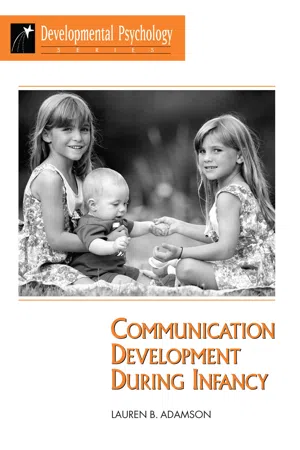
Communication Development During Infancy
About this book
This book considers communication development during the first 18 months of life of infants and summarizes the extensive literature about early parent—infant interactions. It is intended for professionals in speech language pathology and pediatrics.
Information
CHAPTER
1
The Communicating Infant
An Historical Introduction
Chapter Outline
- The Confused Infant
- The Competent Infant
- Methodological Contributions
- Heuristic Theories
- Piaget’s Sensorimotor Infant
- Expanding the Piagetian Sphere
- The Communicating Infant
- The Empirical Study of Early Communication Development
- About This Book
For the past two decades, developmental psychologists have joined with colleagues from disciplines as diverse as anthropology, ethology, linguistics, pediatrics, psychiatry, and speech–language pathology to study early communication development. Together they catalog how infants express themselves, and they speculate about how infants understand our messages. They ponder the significance of such seemingly simple acts as a newborn infant’s selective attention to her mother’s voice, a 10-month-old baby’s glance at his father before crawling toward a novel object, and a toddler’s attempt to gain attention by touching a friend’s toy. They convene at international conferences to discuss infant crying, and publish articles to document the nuances of speech perception, the emergence of pointing, and the use of first words. They write review articles and book chapters summarizing the extensive literature about early parent–infant interactions. In short, by almost any index of academic enthusiasm, scientists now consider communication development during the first 18 months of life an electrifying topic.
In this first chapter, we focus primarily on the reasons why scientists currently find communicating infants so compelling. To explain their fascination, it is useful to examine the history of how developmental psychologists have regarded communicating infants. This longer view will establish two important points. First, the facts about early communication capture scientific interest only when they are placed within a theoretical sphere. Second, the theoretical spheres of developmental psychology—like those of all sciences—are more like soap bubbles than like steel orbs. That is, as they rise (as science progresses), some spheres expand, while others contract or even burst. And, as the following brief historical account will demonstrate, sometimes spheres may join together, bringing previously separate contents into a startlingly new configuration.
The Confused Infant
The intensive study of early communication development is of recent vintage. Earlier scholars, of course, knew about infants’ cries, smiles and coos, and babbles and gestures. Moreover, these familiar phenomena were introduced into the scientific record at psychology’s beginnings. For example, Charles Darwin (1877) devoted an entire section in his celebrated “Biographical Sketch of an Infant” to specific observations of the development of communicative means. Both Arnold Gesell (1945) and Nancy Bayley (1969), creators of two of the first widely used standardized tests of infant development, included several items related to communication. Periodically, an insightful developmentalist like the psychoanalyst René Spitz (1957) would write eloquently about the theoretical significance of nonverbal acts such as the 2-month-old’s smile and 15-month-old’s head shake ‘no’. But primarily, the roots of today’s interest in infant communication taper out rapidly, reducing to a rare reference by the early 1960s.
There are several related reasons why developmental psychologists have tended to ignore infants’ communicative acts. For one, these acts’ very familiarity may have led to their being overlooked. As the path-breaking Gestalt psychologist Wolfgang Köhler (1940) once noted in his essay entitled “Ways of Psychology,” people often find it difficult “to wonder” and “to be startled” when they study a familiar phenomenon. Yet Köhler, like the ancient Greeks, thought this was “the primary condition that leads to inquiry” because “in a realm where hardly any occurrence is ever quite new, few questions about the genesis of things are likely to be asked” (pp. 6–7). Thus, given scientists’ tendency to want to explore frontiers for new facts, they often fail to probe for “hidden facts” in areas close to home.
A second reason why the study of infant communication has such a short history is that infants have traditionally been cast in a marginal role in psychological theories. All too often an unelaborated image of infants was presented to serve as a preface to a grand theory of adult functioning. Such images can be a powerful deterrent to research, so much so that Robert Emde, a prominent student of Spitz, once chided his fellow child psychiatrists for ignoring “day-to-day reality” to cling to “theoreticomorphic myths” in which “that baby is like my theory” (Emde & Robinson, 1979, p. 98).
Usually, these myths have been about what infants cannot do. Indeed, the very term infant is derived from the Latin for without speech. One type of myth depicts unorganized infants who begin development without ways of structuring their activities. Consider, for example, William James’s famous claim that newborns are “assailed by eyes, ears, nose, skin, and entrails at once” and so feel all is “one great blooming, buzzing confusion” (1890, Vol. 1, p. 488). Young infants are in such a state, according to James, because they are not yet able to attend selectively to some sensations and to ignore others. A second sort of myth contains disengaged infants who lack the basic capacity to be aware of their environment. A classic version of this myth can be traced to Sigmund Freud (1958/1911), who suggests that very young infants hallucinate satisfying objects.
The Competent Infant
Understandably, images of unorganized and unaware young infants did little to entice scientists to take a closer look. Nevertheless, during the early 1960s, unprecedented curiosity arose about the beginnings of human development. In part, this interest was prompted by extensive technological and societal changes. For example, medical advances dramatically increased the survival rate of critically ill and premature newborns, raising new questions about how biological insults might affect the course of early development. Educators, increasingly concerned about the effects of poverty on learning, raised difficult questions about the outcome of early experiences. Parents, seeking to reform childbirth procedures and facing a growing need for alternative childcare, asked for more information about newborns’ experiences and first relationships.
In addition, psychologists were propelled toward infants by forces deep within their discipline. A new theoretical mood (or Zeitgeist)— often identified as the Cognitive Revolution—was sweeping the human sciences (see Baars, 1986, for personal accounts). At the heart of this movement is a desire to understand the inner processes hidden behind behavior. Within this movement, infants were seen as [with]holders of crucial information about fundamental or primary human experiences.
As soon as researchers began to question them, infants started to give surprising answers. Contrary to the theoreticomorphic myths about newborns, these infants appeared strikingly competent. Emde and Robinson (1979), in an extensive review of research on newborns, remarked that researchers had essentially started to study “a new species” who was “active, stimulus-seeking, and creative in the ways he begins to construct his world” (p. 74). Far from being unorganized, infants’ actions right from birth seem to be patterned, predictable, and above all, functional.
This astonishing characterization of competency gained rapid currency. By the early 1970s, enough excellent work was available to compile a volume of over 1300 pages, The Competent Infant. Here, hundreds of fascinating studies were abstracted in celebration of an infant who “from his earliest days . . . is an active, perceiving, learning, and information-organizing individual” (Stone, Smith, & Murphy, 1973, p. 4).
Methodological Contributions
It is unusual for a new field of study to be fruitful so quickly. In large measure, such abundant productivity was made possible by adopting sophisticated research methods from closely related areas. For example, experimental psychologists had already developed a rich store of procedures for studying perception, learning, and memory in nonhuman animals which could be modified to suit young infants’ response capacities. For example, Robert Fantz (1958) transformed a simple two-choice stimuli paradigm into an elegantly simple technique for probing young infants’ preferences. In this paradigm, infants inform us which of two stimuli they prefer (such as two pictures of a human face, one with the features in their proper place and one with scrambled features) by consistently looking longer at one picture than at the other.
The power of techniques like Fantz’s is that they provide a standardized way to ask nonverbal infants an endless stream of questions. Each researcher does not need to puzzle anew over how to communicate with infants to get a clear answer. Moreover, researchers gain confidence that they are interpreting infants’ answers correctly when they use a technique refined by repeated use, and they gain even more confidence when two such techniques converge toward the same answer.
Ethology, the biological discipline devoted to the study of animal behavior, which was founded in the 1940s by Konrad Lorenz and Niko Tinbergen, also provided a wealth of inspiration. Ethologists argued forcefully that the function of behavior patterns might best be understood if animals are observed in their natural settings. Furthermore, they provided compelling support for their position, offering plausible explanations for behavior patterns as diverse as the mating rituals of the male three-spined stickleback (Tinbergen, 1951) and the mother-following efforts (or imprinting) of greylag goslings (Lorenz, 1970/1935). In the 1960s, the psychoanalytically trained psychiatrist John Bowlby (1969) argued persuasively that the ethologists’ perspective might help us understand how human infants develop attachment relationships with their caregivers, and he inspired many researchers (e.g., Ainsworth, 1967; Wolff, 1966) to document what transpires between human caregivers and infants in everyday contexts.
Heuristic Theories
Sophisticated research methods did much to stimulate the gathering of new facts about infants. But new facts, even about infants behaving in ways that were previously thought impossible, soon lose their luster unless they find a theoretical sphere. Developmental psychologists have long held as their primary goal the understanding of the process of human development. This understanding entails not only the description of what is (i.e., the facts of systematic change) but also an explanation of why the facts are as they are. Thus, a theory that explains development is a crucial part of the scientific process.
If a theory is a good one, it does more than extend facts into the realm of explanation. It also inspires the search for new information. It anticipates the empirical world, acting as a heuristic device that guides the investigator into interesting territory. Central to a theoretical heuristic are both the compelling questions it raises about phenomena and the general image it paints of what lies ahead.
Of course, not all theories are equally heuristic. Some may steer people away from exploration; others may initiate a voyage that takes an unexpected turn. Within the area of developmental psychology, Jean Piaget’s theory of cognitive development is a superb example of a heuristic theory that has led researchers into uncharted waters. Moreover, Piaget’s theory was one of the (many would say, the) primary motivations for the new interest in infants’ cognition that swept psychology in the 1960s.
From an historian’s point of view, it is interesting to note the chronology of events here. Works about infants constitute a small, albeit very important, part of Piaget’s published corpus, which started in 1907 with a paper about an albino sparrow and grew unabated until his death in 1980 (see Chapman, 1988, for a detailed and incisive intellectual biography). Piaget’s primary research on infancy was based on observations of his own three children. These were collected in the late 1920s to early 1930s and presented in three books originally published in French between 1936 and 1945. Yet, although he was recognized as an international scholar by the end of the 1930s, his trilogy about infants was not translated into English until the 1950s and early 1960s. Moreover, it was not until 1963, with the publication of John Flavell’s detailed overview of Piaget’s work, that many developmental psychologists became aware of their scope and richness. (For an excellent, brief introduction to Piaget’s child psychology, see Ginsburg and Opper, 1988).
Piaget’s Sensorimotor Infant
Initially, developmental psychologists who read Piaget’s work on infancy were most impressed by the hidden facts of infancy he described. His observations included astonishing details about the emergence of specific behavior patterns such as the development of visually guided reaching at around 4 months of age (see pp. 157–165 in The Origins of Intelligence in Childhood, 1963/1936) as well as startling examples of young infants acting as if objects do not exist if they are not currently being sensed (see the first chapter of The Construction of Reality in the Child, 1954/1937).
Such dramatic findings gradually lured developmental psychologists to examine the grand theory of cognitive development that had led to Piaget’s amazing discoveries. They soon learned that Piaget’s main interest in infancy stemmed from his idea that the origins of human intelligence lay in organized, adaptive sensorimotor actions, not in symbols (which he thought emerged late in the second year of life) or in logical reasoning (which he thought was first evident only years after birth). Moreover, his research questions were those of a genetic epistemologist (a biologist/philosopher who studies the development of knowledge) rather than of a traditional child psychologist: As infants interact with the environment, how do they organize their actions? How does this organization change so that their actions become increasingly adaptive? As this organization changes, how too does an infant’s understanding of reality—of objects, space, time, and causality—change? Further, how does the capacity to represent (literally, re-present) action—to use symbols to stand for or signify actions—emerge over the course of infancy?
In answering these questions, Piaget made three claims that deeply challenged traditional myths of unorganized and disengaged young infants. Piaget’s first claim was that human infants—like all living organisms—are capable of organized acts that they actively regulate in order to adapt to their environment. In the case of human newborns, these acts are qualitatively different from the adaptive acts of adults or even of 2-month-olds or 2-year-olds. Nevertheless, these early action patterns, which Piaget called reflex schemes, are well-suited to development. As a newborn interacts with her environment, her current actions closely resemble her previous actions. But, because the circumstance of each occasion is never quite like that of prior occasions and because the infant actively tries to adapt her schemes to suit the occasion, slight change occurs each time a scheme is used. The infant gradually develops more adaptive ways to interact with the environment through this process of the self-regulation of actions.
Piaget illustrated this claim with detailed observations (1963/1936, pp. 25–27, Obs. 2–6). For example, he recorded that his son, Laurent, sucked his fingers immediately after birth and that as soon as his mouth contacted his mother’s nipple, he began to suck. Moreover, he noted that Laurent practiced sucking without anything in his mouth just for the sake of sucking, and that he modified his sucking pattern so that he could suck on novel objects such as his pillow and Piaget’s finger. Piaget also illustrated how creative modifications of a scheme might form qualitatively new action patterns. For example, he provided extensive examples to demonstrate how, during the second and third months of life, Laurent and his two siblings each altered the sucking reflex scheme to develop a repertoire of acquired sucking habits that included tongue protrusion, saliva bubbling, and lip smacking.
Piaget’s second claim was that as infants gradually change the organization of their actions, they also gradually develop the capacity for intelligent action. To Piaget, intelligence lies not only in specific actions but also in the way different actions are related to each other and to objects in the environment. To Piaget, intentionality, the abi...
Table of contents
- Cover
- Half Title
- Title Page
- Copyright Page
- Dedication
- Preface
- 1 The Communicating Infant An Historical Introduction
- 2 Theoretical Foundations for the Study of Communication Development
- 3 A Scientific Stance toward Infants
- 4 Shared Attentiveness
- 5 Interpersonal Engagement
- 6 Joint Object Involvement
- 7 The Emergence of the Symbolic Code
Trusted by 375,005 students
Access to over 1.5 million titles for a fair monthly price.
Study more efficiently using our study tools.
Frequently asked questions
Yes, you can cancel anytime from the Subscription tab in your account settings on the Perlego website. Your subscription will stay active until the end of your current billing period. Learn how to cancel your subscription
No, books cannot be downloaded as external files, such as PDFs, for use outside of Perlego. However, you can download books within the Perlego app for offline reading on mobile or tablet. Learn how to download books offline
Perlego offers two plans: Essential and Complete
- Essential is ideal for learners and professionals who enjoy exploring a wide range of subjects. Access the Essential Library with 800,000+ trusted titles and best-sellers across business, personal growth, and the humanities. Includes unlimited reading time and Standard Read Aloud voice.
- Complete: Perfect for advanced learners and researchers needing full, unrestricted access. Unlock 1.5M+ books across hundreds of subjects, including academic and specialized titles. The Complete Plan also includes advanced features like Premium Read Aloud and Research Assistant.
We are an online textbook subscription service, where you can get access to an entire online library for less than the price of a single book per month. With over 1.5 million books across 990+ topics, we’ve got you covered! Learn about our mission
Look out for the read-aloud symbol on your next book to see if you can listen to it. The read-aloud tool reads text aloud for you, highlighting the text as it is being read. You can pause it, speed it up and slow it down. Learn more about Read Aloud
Yes! You can use the Perlego app on both iOS and Android devices to read anytime, anywhere — even offline. Perfect for commutes or when you’re on the go.
Please note we cannot support devices running on iOS 13 and Android 7 or earlier. Learn more about using the app
Please note we cannot support devices running on iOS 13 and Android 7 or earlier. Learn more about using the app
Yes, you can access Communication Development During Infancy by Lauren B Adamson in PDF and/or ePUB format, as well as other popular books in Psychology & Audiology & Speech Pathology. We have over 1.5 million books available in our catalogue for you to explore.