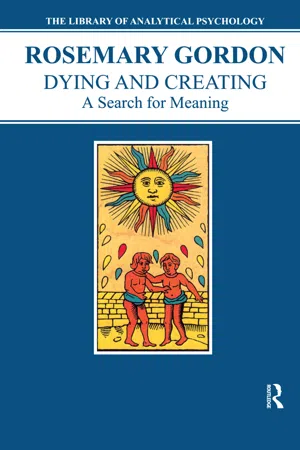
Dying and creating or, could we put it the other way round, creating and dying? Rosemary Gordon has chosen the first, the challenging title and the one that stimulates the reader to find out how they inter-relate. There are essential links between the facts and the concepts. C. G. Jung devoted much attention to the psychology of death, re-birth and transformation: the author acknowledges her debt to him, to his creative spirit and to the depth of his understanding. As she is a working analytical psychologist, much of the material in her. But she is also a theorist: the human and the academic come together.Many Westerners in the course of their daily lives conceal their fears of death and so they deprive themselves of the possibility of getting into touch with the hidden sources of creativeness. Patients in analysis communicate some of their deepest feelings and thoughts about preparing for death, and grieving, and dying.
- 200 pages
- English
- ePUB (mobile friendly)
- Available on iOS & Android
eBook - ePub
About this book
Information
PART I
CHAPTER 1
Social attitudes to death: a brief survey
‘Whoever rightly understands and celebrates death at the same time magnifies life.’R. M. Rilke
All my personal experience lends weight to the assumption that death is intimately relevant to all psychological growth. A person’s relationship to death, the intensity of his attraction to it, his fear of it, the type of defence built up against conscious awareness of it, the symbolic meaning given to it, all these greatly affect and shape the personality both of an individual and of a culture.
Thus man’s greatest achievements, as well as his worst crimes, seem to be, at least in part, an expression of the way he handles his knowledge of the existence of death and it is plausible to believe that only those who can look death squarely in the face can really live a meaningful life.
Several years ago, Arthur Koestler gave voice to this very realisation in a broadcast when he said:
Take the word ‘death’ out of your vocabulary and the great works of literature become meaningless; take that awareness away and the cathedrals collapse, the pyramids vanish into the sand, the great organs become silent.
Even a relatively simple people like the Kasai of East Africa were expressing such awareness when they used to say:
Without magic, illness, knives, arrows, wars and death, life would be just a matter of eating, drinking, sleeping and defecating. Life would be no good without death.
It is, of course, quite true that without death, the death of individuals or even of whole species, there could be no biological change and therefore no evolution of species. Nor is there really any logic in the assumption that man should have been supplied with an innate readiness to live, and with an innate readiness to procreate, and yet be left adrift in his confrontation with that third basic biological process which is to cease to live—that is, to die. Psychological growth, development and the general self-fulfilment of a person seems inconceivable without conscious acknowledgment of the fact of death. In particular the capacity to symbolise—without which all experience is doomed to be without meaning and significance—is likely to remain fallow and undeveloped unless a man live his life consciously aware of death. I hope to give weight to these thoughts in the course of this book.
My interest in this whole problem was aroused first of all not by any personal bereavement, or through contact with people who were actually dying, but as a result of listening to the men and women with whom I sat and to whom I listened in my consulting room. I have tried to listen to them with what I hope is a more or less ‘free-floating attention’. Freud has enjoined such free-floating attention on all analysts, believing that they should offer to their patients that same capacity to listen without conscious prejudgment, criticisms and direction that they themselves demand of their patients’ ‘free association’.
My surprise at this general concern with death is perhaps itself worthy of comment. After all, death is the most certain event in all our lives. It is surely quite unlikely that a person can ever shirk awareness of it for any length of time unless, as I have already hinted, he can relinquish and surrender that gift that marks him as distinctly human: the gift of consciousness of self.
My surprise at the ubiquity in analyses of a concern with death probably reveals how much I had shared in the cultural assumptions and attitudes of my time. For until quite recently modern man had come to regard death as, at best, a regrettable inconvenience, or the result of human inefficiency; at the worst as an obscenity and an outrage. The men of science of our time have had every intention of breaking its pervasive power sooner or later. Thus many of them devote themselves to the task of exploring the possibility of extending life beyond its present span; if possible, indefinitely.
Admittedly, others are engaged in devising ever more efficient means of damaging and destroying life. Such people are perhaps trying to contain their anxiety by putting upon themselves the magic mantle of death, a defensive manœuvre that I shall describe in greater depth when I discuss some aspects of individual psychopathology.
Nevertheless, for at least half a century death has been the most tabooed subject in the Western world—much more so than sex. Geoffrey Gorer, the English anthropologist, has drawn attention to it in an article, ‘The pornography of death’, which he had published in Encounter in 1955. He described there the sense of being isolated and ignored that a person experiences who has suffered the death of a near relative. For the absence of all mourning ritual, and of culturally accepted forms of relationship between the mourner and the rest of the community, had created such general unease and embarrassment that avoidance had become for many the only way out of the dilemma. A particularly interesting study of the psychological literature—or rather the scarcity of the psychological literature—on death was published in 1966 in the journal Human Relations, by Mary Williams, an analytical psychologist in London. Having made a thorough survey of ‘psychological abstracts’ between the years 1931 and 1961, she discovered that the total number of contributions on the theme of death, suicide and murder in 1961 was only a little higher than it had been in 1931, and this in spite of the fact that by 1961 there was a far greater number of workers in the field and a greatly increased volume of psychological literature. This led her to conclude that
… the universal fact of death remained a relatively tabooed subject in Western culture and had, therefore, all the power of a repressed content, seeking a channel of expression.
We may indeed have to examine with greater diligence Kenneth Clark’s suggestion that concern with eternity is an important part of every viable civilisation, a suggestion that I have found re-echoed recently in John Dunne’s extremely interesting book, The city of the gods, in which he writes that:
It might well be that the stability of Egyptian culture, its persistence for better than two millenia, its ability to recover twice from the kind of downfall that destroyed other civilisations, is not unrelated to the fact that the Egyptian could face death squarely and face it with good hope and had no need to repress the thought of death in order to be happy.
From time to time Western man has dared to turn his face from the fact of death in order to contemplate a life without it. The stories of Dr Faustus or of the Wandering Jew spring to mind; and so does Jonathan Swift’s Gulliver’s travels. In one of his travels Gulliver meets the Struldbrugs, the Immortals, and is told that:
whenever they see a funeral, they lament and repine that others are gone to a harbour of rest to which they themselves never can hope to arrive.
And that ‘because of the dreadful prospect of never dying’ they are described as
not only opinionate, peevish, covetous, morose, vain and talkative, but also incapable of friendship and dead to all natural affection.
Indeed, the King of the Luggnaggians teasingly suggests to Gulliver that he should send a couple of Struldbrugs to his own country to arm his people ‘against the fear of death’.
In our own time the French writer, Simone de Beauvoir, has in her novel Tous les hommes sont mortels once more attempted to explore this theme. The twentieth-century writer can no longer rely on the devil and his pact in order to explain the pain and the hurt of him who cannot die. Rather this pain, this despair, is now recognised as the intrinsic and inevitable component of the fate of a person doomed to live for ever. The hero in de Beauvoir’s book is a man who loses, as the centuries pass by, all capacity to see, to taste, to laugh, to cry, to search, to be surprised—all experiences that, as I shall try to show later on, are essential to the process of creation. Instead, everything becomes for him flat, dull, monotonous; and he becomes a ‘no-person’, neither mean nor generous, neither brave nor cowardly, neither good nor bad. For if time stretches indefinitely then there can be no measure and no meaning. For then there is only:
always the same past, the same experience, the same reasonable thought, the same boredom. A thousand years, ten thousand years. I can never take leave of myself (p. 229).
And so he is alone. Envious of mortals upon whose lives he tries from time to time to graft his own, he becomes himself envied by those he envies. There can be no pity between him and them; all bonds, all mutuality, all possibility of communication is irrevocably broken once they have discovered his secret. Thus the freedom from death has turned into the curse of an immortality that renders all life vacuous and empty.
I think that Simone de Beauvoir has here described, with great insight, feeling and sophistication, the inner experience of an immortal man. She seems to have little doubt that pain and despair are inevitable components of the fate of a person who cannot die. The world of the immortal man into which Simone de Beauvoir draws us strikes me as remarkably similar to that of the schizoid person who, having attempted to opt out of time, has then lost all sense of time’s shape and its human dimension. And so he too is haunted by a sense of isolation, of lostness, of meaninglessness, which then makes him feel like a sleepwalker, like a shadow, stumbling along in a world of men, untouching and untouchable. As Jung has put it in Symbols of transformation:
The neurotic who tries to wriggle out of the necessity of living wins nothing and only burdens himself with a constant foretaste of aging and dying.
I cannot believe that it is only a literary or aesthetic disapproval that accounts for the fact that this particular novel is so little known, for it confirms my own experience that any description of the fearsome and terrifying aspects of immortality tends to meet with surprise, incomprehension and disbelief; as if such awesome possibility is hardly ever contemplated, as if preoccupation with the threat of certain death—sooner or later in our lives—drives from our minds all recognition of the horror of a life without it.
But I had unsought-for confirmation of this fact when a patient, who had been in analysis with me for a long time, and whose horror of and preoccupation with death had haunted her life and cast a deep shadow over it, told me one day that she had just learned of the death of a young colleague—from leukaemia. This news immediately re-evoked apprehension, and hypochondriacal fears re-emerged. Curious, but also somewhat impatient, and disconcerted by the relentlessness of her fear of death, I asked her: ‘How would you feel if you knew you could live for ever?’ She looked at me—aghast—and just whispered: ‘Exhausted’. Then after a while she remarked, almost truculently, ‘They ought to play a Requiem not after a person has died, but while he is dying … it would make the transition easier … I thought about this last night when I listened to a Handel concert.’ When she discovered that my sympathy and apparent agreement made her truculence unnecessary, she relaxed visibly, and suddenly death seemed to assume a less ominous face for her.
What then, one might ask, has brought about the neglect and the actual avoidance of the theme of death during the first half of this century? Any attempt to answer this question must inevitably remain speculative, but three social phenomena seem to me to have played an important part.
First, there is the rapid and miraculous development of the physical and biological sciences and the consequent expansion of technology. Light without a visible fire; sounds and images heard and seen at a great distance from their source of origin; the control of diseases hitherto regarded as uncheckable and often accepted as the scourges of an inscrutable deity. These and many other thousands of new wonders won by man through his own effort to understand, to control and to bend to his will and to his needs the forces of the universe in which he finds himself—all this has led him to dream that death also can be conquered. And so doctors and the general public, as I have already mentioned, came to share the illusion that death is, after all, merely the result of medical inefficiency, that it can, and should, be avoidable and actually eliminated in the foreseeable future. Suffering, hardship, hurt and loss, it has been assumed, will sooner or later be things of the past. And so science, the offspring of magic, continued to adhere to the objectives and to the ethos of its progenitor; it just carried it several steps further forward.
Secondly, there is the fact of the dramatic reduction of the family unit. The extended family, which included grandparents, uncles, aunts and cousins, has now shrunk to the small unit of parents and their children. Add to this the increase in social mobility and the housing of people in huge, anonymous, urban clusters, which deprive the individual of a meaningful neighbourhood group, and you get a society made up of people who have very few emotional ties linking them to each other. The rarity of such emotional ties then diminishes a person’s possibility of being moved and affected by the loss of any one of them; and he is then unlikely to get involved in mourning rituals. Alienation from the actual experience of losing someone known and cared about is further increased by the fact that dying takes place nowadays in the physically and emotionally sterilised atmosphere of a hospital or a clinic. This makes it even more unreal and not quite imaginable. How much the person in the Western, urban, industrialised world is shielded becomes clear when one talks to or analyses older people, or those from less fragmented societies; many of them seem to have encountered death early in their lives, and often.
The third factor, as I see it, is the decline and the erosion of the religions and traditional faiths, those clusters of beliefs and attitudes that the culture groups used to provide for their members, so that they felt more prepared to act and to react when faced with grief, disaster and death. The modern doctor has rarely been willing to assume a task that has up to now been shouldered by the priest. His science and his preoccupation with his medical techniques have seemed to him to be his natural, indeed his only legitimate response.
During the last few years, however, the theme of death has suddenly re-emerged out of its tabooed position—in the popular press, on radio and television and in scientific writings. What has happened?
The first and outstanding fact is that the honeymoon between man and science is over. One of the turning points appears to have been the development of the H-bomb. Mary Williams, in the survey I have mentioned, did in fact discover what she called ‘an explosion of interest in death’ in the late 1950s; she attributes this to the ‘threat of total annihilation raised by the H-bomb and the atmospheric tests on both sides’. The presence of the H-bomb seems to have forced people to realise that death can indeed once more cover the earth with giant strides, that genocide is a real possibility in our own lifetime, and that science is, after all, a whore who will lie as readily with murder and death as with health and life.
And, although the actual process of dying has been shut away in our hospitals, and although the old—those most likely to encounter death in the very near future—have been banished to ‘homes’ and ‘sunset villages’, yet death remains the treasured scoop of the newsman, who is for ever invading our homes, clamouring for our attention, telling his tales of wars, of violence and of accidents all over the front pages of newspapers, and over radio and television. Thus, though the direct and sensuous acquaintance with death has become rare, we continue to be reminded of its existence.
Furthermore—and this is perhaps the most important factor—we can no longer ignore the fact that, in spite of all scientific and technological progress, in spite of increased material welfare and the various benevolent attempts at servicing and social engineering, active death-seeking continues, whether in the form of suicide or murder, whether private or collective. Awareness of this fact is perhaps one of the reasons why an ever-increasing number of people are driven to take a new look at mankind in general and at themselves in particular, to delve more deeply into their inner world and to explore with greater care and diligence the nature and the intensity of the force...
Table of contents
- Cover
- Half Title
- Title Page
- Copyright Page
- Dedication
- Table of Contents
- Editoral introduction
- Introduction
- Part I
- Part II
- Part III
- Postcript
- References
- Glossary
- Index
Trusted by 375,005 students
Access to over 1.5 million titles for a fair monthly price.
Study more efficiently using our study tools.
Frequently asked questions
Yes, you can cancel anytime from the Subscription tab in your account settings on the Perlego website. Your subscription will stay active until the end of your current billing period. Learn how to cancel your subscription
No, books cannot be downloaded as external files, such as PDFs, for use outside of Perlego. However, you can download books within the Perlego app for offline reading on mobile or tablet. Learn how to download books offline
We are an online textbook subscription service, where you can get access to an entire online library for less than the price of a single book per month. With over 1.5 million books across 990+ topics, we’ve got you covered! Learn about our mission
Look out for the read-aloud symbol on your next book to see if you can listen to it. The read-aloud tool reads text aloud for you, highlighting the text as it is being read. You can pause it, speed it up and slow it down. Learn more about Read Aloud
Yes! You can use the Perlego app on both iOS and Android devices to read anytime, anywhere — even offline. Perfect for commutes or when you’re on the go.
Please note we cannot support devices running on iOS 13 and Android 7 or earlier. Learn more about using the app
Please note we cannot support devices running on iOS 13 and Android 7 or earlier. Learn more about using the app
Yes, you can access Dying and Creating by Rosemary Gordon in PDF and/or ePUB format, as well as other popular books in Psychology & History & Theory in Psychology. We have over 1.5 million books available in our catalogue for you to explore.