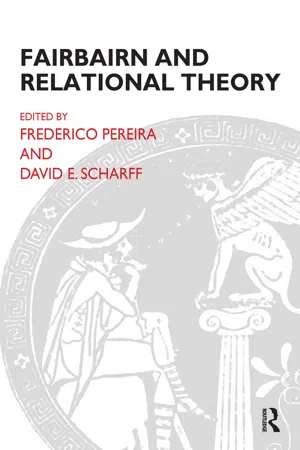
The richness of Fairbairn's work is demonstrated in a series of essays offering a unique exploration of the application of his concepts to diverse areas ranging from philosophy to psychopathology. This volume opens with an examination of the origins and relevance of Fairbairn's ideas and subsequently turns to the application of his theory to the study of depression, hysteria, and to the field of liason psychiatry. Fairbairn's ideas are further applied to the study of dreams and aesthetics in two original essays. The book concludes with a delineation of the future of his contribution to contemporary theories of object relations and to the emergence of a new psychoanalytic paradigm.
eBook - ePub
Fairbairn and Relational Theory
- 290 pages
- English
- ePUB (mobile friendly)
- Available on iOS & Android
eBook - ePub
Fairbairn and Relational Theory
About this book
Information
Part I
The Origins and Relevance of Fairbairn's Contribution
Chapter One
A contemporary exploration of the contributions of W. R. D. Fairbairn
Otto F. Kernberg
The central importance that object relations theory has acquired in contemporary psychoanalytic thinking naturally draws our attention to the contributions of W. Ronald Fairbairn (1954b). Fairbairn first proposed an object relations theory as a basic structural model for the normal as well as pathological development of the psychic apparatus—a model that relates psychoanalytic theory in practical yet sophisticated ways to psychoanalytic practice along a broad spectrum of psychopathology. It is fair to say that Fairbairn has been the most radical proponent of an object relations theory model. This model, in my view, together with that developed independently by Edith Jacobson (1964), constitutes the most important basis for an integrated contemporary psychoanalytic frame. The introduction into Fairbairn's model of John Sutherland's (1963, 1965) concept of affects as the basic link between self and object representations has significantly enriched as well as made more explicit a central aspect of Fairbairn's theories. I consider my own proposed definition of object relations theories—namely, any psychoanalytic model based upon the internalization of dyadic units of self arid object representations linked by a particular affect state as basic building blocks of the tripartite structure—a definition that is inspired by Fairbairn's original work (Kernberg, 1984,1992).
While Fairbairn's most important contributions were made in the 1940s and 1950s, it would seem fair to say that significant attention to his work only emerged in this country and throughout much of the international psychoanalytic community outside Great Britain in the 1980s and 1990s. Although Fairbairn's ideas were extremely influential in the approach of the British Independent Group (formerly the "Middle Group"), appreciation of his work was more impeded by the intellectual and ideological barriers separating the ego psychological and the British Schools than was the case with Balint, Winnicott, and Melanie Klein. On hindsight, it is striking that the extraordinary parallelism of the contributions to psychoanalytic object relations theory of Ronald Fairbairn in Scotland and Edith Jacobson in the United States was not perceived by the psychoanalytic community at the time of their original publication.
In my view, Fairbairn's contributions to object relations theory constitute a fundamental bridge between the psychoanalytic theory of early development and the crystallization of psychic structures on the one hand, and a sophisticated contemporary theory of psychoanalytic technique spanning the entire spectrum from the psychoanalytic psychotherapy of psychosis to standard psychoanalysis of neurotic personality organization on the other.
I have attempted to summarize briefly Fairbairn's contributions in earlier work (Kernberg, 1980, chapter 4), and I will limit myself here to outlining and exploring what I consider his main contributions to contemporary psychoanalytic theory and technique.
A major contribution is summarized in Fairbairn's (1963b) statement that libido is object-seeking, implying that libidinal drive and object investment cannot be considered as separate. The search for libidinal pleasure coincides with the search for gratifying relations with the primary object, and, from a developmental perspective, the pleasure principle and the reality principle start out as being one. While thus reformulating Freud's theory of the libidinal drive, Fairbairn rejected the concept of an aggressive drive, regarding aggression as a secondary development derived from the frustration of libidinal needs.
From a structural viewpoint, however, Fairbairn considered the internalization of a frustrating, "bad" object as an essential mechanism to maintain the relationship with an object both needed and frustrating, experienced as both good and bad, so that the development of aggressively invested internalized objects parallels that of internalized objects invested with libido. Thus, from a clinical standpoint, Fairbairn considered aggression as unavoidable and, in fact, as contributing in a central way to the internalization of object relations and as motivating the development of the splitting of the internalized object into a libidinal object, an anti-libidinal object, and an ideal object. The latter represents the gratifying, accepted aspects of the object, shorn of the object's libidinally exciting and "anti-libidinally" frustrating aggressive aspects. The splitting of the originally internalized total object gives rise to a corresponding division of the originally pristine ego into the libidinal ego, the "anti-libidinal" ego, and the central ego—the latter corresponding to the aspect of the ego relating to the accepted, ideal object. Thus both libido and aggression are indissolubly linked to their investments in libidinal and antilibidinal internalized objects and their corresponding ego aspects. These dyadic libidinal and aggressive structures constitute the "building blocks" of the psychic apparatus: they are dynamic structures, not simply fantasies.
If we change Fairbairn's terms from "ego aspects" to "self aspects" (an eminently reasonable translation of the meaning he attributed to the split aspects of the ego), and the term "internal objects" into "object representations", we are left with the original formulation that the internalization of object relations occurs in the form of dyadic internalization of object representations and self representations. Thus, libidinal internalized object relations imply the simultaneous and parallel investment of a libidinal object representation and a libidinal self representation, while aggressive internalized object relations are constituted by the corresponding aggressively invested object and self representations.
Fairbairn was the first psychoanalytic theoretician to formulate the understanding that all internalizations are internalizations of an object relation, so that the process of identification is identification of the self not simply with an object, but with the relationship between self and object. The most important clinical consequence of that discovery is the potential for reactivation of the past internalized object relation in the transference, with a re-projection of the object representation onto the analyst while the patient enacts the corresponding self representation, or the reciprocal projection of the self representation while the patient enacts the corresponding object representation. This process, whose recognition is absolutely essential to the psychoanalytic approach to patients with borderline personality organization as well as to that of all patients during severe regression in the transference, was first conceptualized by Fairbairn.
In my view, the most important addition to Fairbairn's formulation was John Sutherland's (1979) idea that the libidinal or aggressive investment of the relationship between self and object representation consisted of the libidinal or aggressive affect activated in their interaction. The drive was represented by a corresponding affect disposition, so that the essential unit of internalized object relations was a self representation linked with an object representation by the corresponding affect.
Working completely independently within an ego psychological perspective strongly influenced by the work of Hartmann, Kris, and Loewenstein, Edith Jacobson arrived at similar conclusions in her seminal book on The Self and the Object World (1954). Bowlby's work on attachment (1969) established the linkage of Fairbairn's theory of the essential nature of libidinal object seeking with the direct observation of infant behaviour and opened the road to the study of attachment behaviour in mammals, particularly primates—a most powerful bridge between contemporary anthropology and psychoanalytic theory.
My own formulation of drives as the hierarchically supra-ordinate integration of libidinal and aggressive affects pointed to the centrality of the affects of rage, hatred, and envy within the aggressive drive, and elation and sexual excitement on the libidinal side. This formulation linked psychoanalytic drive theory with the psychobiology of affects and with the disposition to affective investment of object relations as a primary psychic phenomenon. From a developmental perspective, I have proposed that the internalization of object relations according to the models proposed by Fairbairn and Jacobson gradually crystallizes into the tripartite structure, while the integration of the corresponding libidinal and aggressive affect dispositions embedded in this internalized object relations matrix originates the hierarchically supraordinate aggressive and libidinal drives (Kernberg, 1992).
Fairbairn's formulation of the "moral defence" in the formation of the superego, and the consequences of its exploration in the course of psychoanalytic treatment, is a major contribution. Fair-bairn placed the ideal object in a dynamic relationship with the central ego and thus separated the persecutory aspects of early superego formation (the antilibidinal object and the corresponding, antilibidinal ego) from the ego ideal. His notion of the antilibidinal ego and its dynamically related antilibidinal self or "internal saboteur" conceptually correspond to the punishing, prohibitive aspects of Freud's (1923b) superego and to the early superego precursors that had been described by Melanie Klein (1935, 1940). In fact, Klein's observations regarding the earliest superego development clearly influenced Fairbairn's formulations, while his descriptions of early splits in the pristine ego and the schizoid position (1940) motivated Melanie Klein (1946) to change her formulation of the paranoid position into that of the paranoid-schizoid position.
Fairbairn proposed that the frustrating aspects of the primary object, split off in the form of the antilibidinal object, sequester one segment of the ego that maintains its attachment to the frustrating but needed antilibidinal object and, in fact, attempt to dominate the rest of the ego as agents, so to speak, of the antilibidinal object. The term "internal saboteur" coined by Fairbairn to signal that function of this sequestered, anti-libidinal part of the ego opens, for the first time in psychoanalytic literature, the understanding of a fundamental mechanism involved in superego functioning and masochistic pathology in the broadest sense.
Why does such a savage collusion develop between the punishing antilibidinal object and the submissive, punishment-seeking internal saboteur? And why is such enormous power invested in the internal saboteur as to affect the rest of the individual's ego functioning? Fairbairn responded to these questions with the observation of the parental objects perceived, at points of maximal frustration, as sadistic persecutors, and the infant's desperate need to orient himself in a world controlled by such persecution. Fair-bairn suggested that it is preferable to be a sinner in the world of a cruel God than to live in the world ruled by the Devil. In other words, the sadistic transformation of the needed object (be it because of the actual sadism of the parental objects or the projected aggressive affects derived from their frustrating effects on the infant, or a combination of both) makes it essential for the infant to create an internal order to ensure survival under such circumstances. To rationalize in some primitive way the behaviour of the sadistic object and to attempt to submit to it as a way of restoring a safe dependency on the sadistic yet needed object are the motives enacted by the internal saboteur. The "moral defence" consists in taking on the bad qualities of the needed object in order to preserve the dependent relationship with it: the patient becomes a "sinner" relating to a cruel but idealized moralistic object.
This formulation explains the nature of the sadistic control the primitive superego exerts over the ego, and the powerful masochistic tendencies related to early superego crystallization. Fair bairn pointed to the paradoxical consequences of psychoanalytic resolution of superego pressures and unconscious guilt. The dissolution of the advanced structure of the superego would activate the underlying, primitive antilibidinal object and ego in the transference, in the form of a re-projection of that "bad" object onto the analyst, and the activation in the patient of the internal saboteur to maintain and strengthen that particular relationship (Fairbairn, 1943). Simultaneously, the exciting libidinal relationship as well as the central ego-ideal object relationship would be completely split off and potentially endangered with destruction by the overwhelming, primitive, all-bad relationship in the transference.
This formulation applies particularly to patients with severe psychopathology, such as cases with a history of severe physical and sexual abuse, where the internalization of a relationship between the patient's perpetrating object and victimized self determines an unconscious dyadic identification with both victim and perpetrator that is enacted in the transference with rapid role reversals. The transference developments of these patients are dominated by the activation of sadomasochistic transferences, in which analyst and patient exchange the roles of victim and perpetrator under the effect of projective identification and related primitive defences operations (Kernberg, 1994).
Under optimal conditions, in less severe cases, the reactivation of primitive superego precursors typically manifests itself in the emergence of paranoid features in the transference at advanced stages of psychoanalytic treatment. In the worst cases, sadomasochistic transferences may dominate the treatment from early on, and, even more destructively, the internal saboteur—that is, the part of the patient's self identified with the sadistic object—may attempt to destroy the relationship with the analyst as an object in external reality by relentless efforts to undermine, corrupt, and castrate the good object and the relationship with it. As I have pointed out in earlier work (Kernberg, 1992), when psychopathic transferences are dominant, their analysis takes precedence over the analysis of paranoid defences; these, in turn, as Melanie Klein (1950) pointed out, require working through for depressive mechanisms to emerge dominantiy in the advanced part of psychoanalytic treatment.
Reflecting on Fairbairn's contributions from the standpoint of contemporary scientific developments within psychoanalysis as well as in other related sciences, the essential nature of affective investment in early object relations as a basic motivational system in human beings seems evident. From the viewpoint of the interface between psychoanalysis and the biological sciences, I believe that the consideration of libidinally invested and aggressively invested early internalized object relations makes eminent sense. The extended dependency of the infant mammal on parental care has fostered the philogenetically recent biological system of affects as primary motivation and a system of communication, organizing the infant's total world experience and the caregiver's awareness of the infant's needs. Contemporary anthropological research on patterns of affiliation and sexual behaviour in mammals points to the basic biological mechanisms that protect the gene pool as a major motivation for males' aggressive competition for access to females and females' choice of the fittest males both for impregnation and for protection of the early mother-infant relationship. Darwinian fitness, at the level of primates, no longer refers to simple brutal force, but to the capacity for social affiliation and the ability to protect the early mother-infant relationship. In the animal kingdom, the fundamental instincts refer to feeding, to fight and flight as part of the aggressive competition among males, defending of territory, and shared protection of the young, as well as ruthless killing of predators, rivals, and even the infants produced by rivals, and to mating, the primary activity geared to perpetuate and expand the gene pool.
At the level of the human species, Freud's seminal discoveries signalling the replacement of biological instincts by psychological drives as intrapsychic motivational systems that organize the dynamic Unconscious or the id culminate in the formulation of libido as the sexual drive and the death drive as the aggressive drive. That both drive systems are intrinsically and indissolubly linked to internalized object relations was already implicit in Freud's (1923b) proposal that the core of the ego is constituted by abandoned object relations, and it was further elaborated by the conceptions of Fairbairn, Melanie Klein, and Jacobson.
The primitive defensive mechanisms centring around splitting described by Fairbairn and Melanie Klein organized the dynamic Unconscious into idealized and persecutory internalized object relations, the gradual development and integration of which determines, at the same time, the crystallization of the tripartite structure. That libido and the aggressive drive develop in parallel on the basis of the respective integration of libidinal and aggressive affects was already foreshadowed by Freud's discovery of the intrinsic relationship between sexual and early affiliative affects in his analysis of developmental stages of the libido. The structural models of Fairbairn, Klein, and Jacobson made it possible to relate the mechanisms of condensation and displacement—that is, the basic mobility of affective charges—to the respective crystallization of libidinal, aggressive, and combined internalized object relations.
Freud's (1915d) statement that the only thing we know about drives are affects and representations can now be translated into the statement that drives are manifested in the affective investment of self and object representations. That drives develop in parallel to the structural integration of their corresponding internalized object relations has been formulated explicitly in the theoretical approaches of Laplanche (1987) and myself (Kernberg, 1992). A contemporary psychoanalytic view of drives, as perhaps most significantly contributed by Melanie Klein (1952a, 1957) and Laplanche, conceives of them as affectively charged unconscious fantasies that involve desired and feared relations between the self and internalized objects, and I have described the combination of self representation and object representation under the frame of a dominant peak affect state as the basic unit of unconscious fantasy (Kernberg, 1992).
In my view, the gradual integration of the all good, idealized, pleasurable affective experiences with mother with the erotic implication of the unconscious meanings injected in the form of mother's "enigmatic" messages (Laplanche, 1987) will constitute libido as a drive, in the same way as the integration of all painful, terrifying, rageful affective experiences with the unconscious meanings injected in the respective interactions will constitute the death drive. Fairbairn, paradoxically, while reserving the concept of drive only for libido and not for aggression, described, at the same time, the corresponding structural integration of aggression as a major motivational system.
I believe that to consider libido as primary and aggression as secondary denies both the evolutionary evidence stemming from biology and anthropology and the fact that biological dispositions to erotic activation that require actual object relationships to become effective parallels the biological disposition to aggressive responses that also require particular object-related stimuli to become effective. Thus, both libido and aggression are either "secondary" to the activation of object relations under varying affectively dominated circumstances, or else both are "primary" in terms of a biological disposition on the...
Table of contents
- Cover
- Half Title
- Title
- Copyright
- Dedication
- Contents
- ACKNOWLEDGEMENTS
- ABOUT THE EDITORS AND CONTRIBUTORS
- Introduction
- PART I The origins and relevance of Fairbairn's contribution
- PART II Fairbairn's theory applied
- PART III Dreams and aesthetics
- PART IV The future of Fairbairn's contribution
- REFERENCES
- INDEX
Trusted by 375,005 students
Access to over 1.5 million titles for a fair monthly price.
Study more efficiently using our study tools.
Frequently asked questions
Yes, you can cancel anytime from the Subscription tab in your account settings on the Perlego website. Your subscription will stay active until the end of your current billing period. Learn how to cancel your subscription
No, books cannot be downloaded as external files, such as PDFs, for use outside of Perlego. However, you can download books within the Perlego app for offline reading on mobile or tablet. Learn how to download books offline
Perlego offers two plans: Essential and Complete
- Essential is ideal for learners and professionals who enjoy exploring a wide range of subjects. Access the Essential Library with 800,000+ trusted titles and best-sellers across business, personal growth, and the humanities. Includes unlimited reading time and Standard Read Aloud voice.
- Complete: Perfect for advanced learners and researchers needing full, unrestricted access. Unlock 1.5M+ books across hundreds of subjects, including academic and specialized titles. The Complete Plan also includes advanced features like Premium Read Aloud and Research Assistant.
We are an online textbook subscription service, where you can get access to an entire online library for less than the price of a single book per month. With over 1.5 million books across 990+ topics, we’ve got you covered! Learn about our mission
Look out for the read-aloud symbol on your next book to see if you can listen to it. The read-aloud tool reads text aloud for you, highlighting the text as it is being read. You can pause it, speed it up and slow it down. Learn more about Read Aloud
Yes! You can use the Perlego app on both iOS and Android devices to read anytime, anywhere — even offline. Perfect for commutes or when you’re on the go.
Please note we cannot support devices running on iOS 13 and Android 7 or earlier. Learn more about using the app
Please note we cannot support devices running on iOS 13 and Android 7 or earlier. Learn more about using the app
Yes, you can access Fairbairn and Relational Theory by Frederico Pereira, David E. Scharff, Frederico Pereira,David E. Scharff in PDF and/or ePUB format, as well as other popular books in Psychology & History & Theory in Psychology. We have over 1.5 million books available in our catalogue for you to explore.