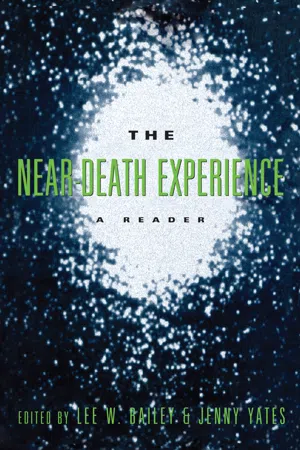
The Near Death Experience: A Reader is the most comprehensive collection of NDE cases and interpretations ever assembled. This book encompasses a broad range of disciplines: psychological researchers discuss cognitive models and Jungian theories of meaningful archetypal phenomena; the biological perspectivedescribes how brains near death may produce soothing endorphins, optical illusions, and convincing hallucinations. Philosophers present empirical analyses and images in archetypal theories, and the symbolic language of comparative phenomenological theories. Christian, Jewish and Mormon responses to NDEs outline the religious perspective, and the mystical and spiritual interpretations of NDEs are also explored.
I am convinced the NDEers do get a glimpse of the beyond.
Raymond A. Moody, Ph.D., M.D., is the grandfather of the twentieth-century study of near-death experiences. He was bold enough to undertake the scholarly study of this phenomenon despite widespread scepticism. As he explained in his first book, now a classic, Life After Life (1975), Moody initially collected 150 cases of people who had died and come back, and identified the typical elements of a near-death experience: 1. the ineffability of the experience, 2. hearing the news of your own death, 3. feelings of great peace and quiet, 4. some type of noise or music, 5. a dark tunnel, 6. rising up out-of-body, 7. meeting others who have already died, 8. the incredible Being of Light, 9. a rapid review of ones life, 10. reaching a border or limit beyond which one cannot return to life, 11. coming back to life, 12. finding it difficult to tell others who often refuse to believe, 13. the transforming effect on one s spirituality and values, and 14. loss of the fear of death. This book has been translated into 26 languages and is being read from South America and Europe to Asia.
Subsequently Moody wrote several other books, including The Light Beyond (1988), which we excerpt here. He continues to explore the many factual and interpretive questions that have emerged in the expanding discussion of NDEs. Does he believe that NDEs prove life after death? At first Moody was cautious and neutral on this question. But by 1988 he had become more definite. No, NDEs do not scientifically prove life after death, he now says. But, following what Pascal called the “reason of the heart” Moody believes that these experiences do open a passageway to another reality. Always pressing forward the frontiers of thought, he is currently exploring visionary reunions with the dead, without undergoing death, in his remarkable “Theatre of the Mind.” This is described in his book Reunions: Visionary Encounters with Departed Loved Ones.
Raymond A. Moody, Jr., M.D., Ph.D., is a psychiatrist and philosopher who studied at the University of Virginia and now does research, writes, speaks, and trains other professionals. He is the author of Life After Life (1975), Reflections on Life After Life (1977), The Light Beyond (1988), and Reunions (1993).
The Light Beyond
The Experience of Almost Dying
What happens when people die? That is probably mankind's most often asked and perplexing question. Do we simply cease to live, with nothing but our mortal remains to mark our time on earth? Are we resurrected later by a Supreme Being only if we have good marks in the Book of Life? Do we come back as animals, as the Hindus believe, or perhaps as different people generations later?
We are no closer to answering the basic question of the afterlife now than we were thousands of years ago when it was first pondered by ancient man. But there are many ordinary people who have been to the brink of death and reported miraculous glimpses of a world beyond, a world that glows with love and understanding that can be reached only by an exciting trip through a tunnel or passageway
This world is attended by deceased relatives bathed in glorious light and ruled by a Supreme Being who guides the new arrival through a review of his life before sending him back to live longer on earth.
Upon return, the persons who “died” are never the same. They embrace life to its fullest and express the belief that love and knowledge are the most important of all things because they are the only things you can take with you.
For want of a better phrase to describe these incidents, we can say these people have had near-death experiences (NDEs).
I coined this phrase several years ago in my first book, Life After Life. Other people have called it other things, including “other world journeys, “flight of the alone to the Alone,” “breaking of the plane,” “near-death visions.” But the traits of these episodes—no matter what they are called—all point to a similar experience. NDEers experience some or all of the following events: a sense of being dead, peace and painlessness even during a “painful” experience, bodily separation, entering a dark region or tunnel, rising rapidly into the heavens, meeting deceased friends and relatives who are bathed in light, encountering a Supreme Being, reviewing one's life, and feeling reluctance to return to the world of the living.
I isolated these traits over two decades ago in personal research that started by coincidence when I was a twenty-year-old philosophy student at the University of Virginia.
I was sitting with a dozen or so students in a seminar room listening to Professor John Marshall discuss the philosophical issues related to death. Marshall mentioned that he knew a psychiatrist in town—Dr. George Ritchie—who had been pronounced dead of double pneumonia and then successfully resuscitated. While he was “dead,” Ritchie had the remarkable experience of passing through a tunnel and seeing beings of light.
This experience, my professor remarked, had profoundly affected this physician, who was convinced that he had been allowed to peek into the afterlife.
Frankly, at that point in my life, the prospect that we might survive spiritually after physical death had never occurred to me. I had always assumed that death was an obliteration of one's physical body as well as one's consciousness. Naturally I was intrigued that a respected physician would be confident enough to publicly admit having a glimpse of the afterlife.
A few months later I heard the psychiatrist himself describe his experience to a group of students. He told us of viewing from a distance his own apparently dead body as it lay on a hospital bed, of entering into a brilliant light that emanated love, and of seeing every event of his life reviewed in a three-dimensional panorama.
I filed Ritchie's story away in my memory and went on with my studies, finishing my Ph.D in philosophy in 1969. It was when I began teaching at the university that I ran into another near-death experience.
One of my students had almost died the year before, and I asked him what the experience was like. I was overwhelmed to find that he'd had an episode almost exactly like the one I had heard from Ritchie over four years before.
I began to find other students who knew of other NDEs. By the time I entered medical school in 1972,1 had no fewer than eight NDE case studies from reliable, sincere people.
In medical school I found more cases and soon had enough case studies to compile Life After Life, which became an international best-seller. There was clearly a thirst for knowledge about what happens to us in the hereafter.
The book posed many questions it couldn't answer and raised the ire of skeptics who found the case studies of a few hundred people to be worthless in the realm of “real” scientific study. Many doctors claimed that they had never heard of near-death experiences despite having resuscitated hundreds of people. Others claimed it was simply a form of mental illness, like schizophrenia. Some said these NDEs only happened to extremely religious people, while others felt it was a form of demon possession. These experiences never happen to children, some doctors said, because they haven't been “culturally polluted” like adults. Too few people have NDEs for them to be significant, others said.
Some people were interested in researching the subject of NDEs further, myself included. The work we have done over the last decade has shed a tremendous amount of light on this subject. We have been able to address most of the questions put forth by those who feel that the near-death experience is little more than a mental illness or the brain playing tricks on itself.
Frankly, it has been good to have the skeptics around, because it has made us look at this phenomenon much harder than we probably would have otherwise. Much of what we researchers have found is included in this book.
WHO, HOW MANY, AND WHY
One thing I would like to discuss in this chapter is the great number of NDEs that actually happen. When I started looking into this phenomenon, I thought there were very few people who actually experienced it. I had no figures and there were certainly none referred to in medical literature, but if I had to guess I would say that one in eight people who were resuscitated or had a similar brush with mortality had at least one of the traits of an NDE.
When I began lecturing and asking large groups of people if they had ever had an NDE themselves or knew anyone who had, my perception of the frequency of this phenomenon changed dramatically. At lectures I would ask the audience, “How many of you have had a near-death experience or know of someone who has?” About one person in thirty raised his hand in reply.
Pollster George Gallup, Jr., found that eight million adults in the United States have had an NDE. That equals one person in twenty.
He was further able to analyze the content of these NDEs by polling for their elements. Here is what he found:
ELEMENT
PERCENT
Out of Body
26
Accurate Visual Perception
23
Audible sounds or voices
17
Feelings of peace, painlessness
32
Light phenomena
14
Life review
32
Being in another world
32
Encountering other beings
23
Tunnel experience
9
Precognition
6
Such a poll clearly showed the NDEs are much more common in society than any of the NDE researchers ever thought.
THE NDE TRAITS
As I mentioned earlier, I was able to derive a set of nine traits that define the near-death experience. I did this by questioning hundreds of people and examining their unique episodes for those common elements.
In Life After Life I said that I had never met anyone who had experienced all of these traits while undergoing an NDE. But since writing that book, I have interviewed more than a thousand NDEers and have found several who had “full-blown” episodes that exhibited all nine NDE traits.
Still, it's important to note that not all people who undergo a near-death experience have all of the following symptoms. Some might have one or two, others five or six. It is the presence of one or more of these traits that defines the NDE.
A Sense of Being Dead
Many people don't realize that the near-death experience they are having has anything to do with death. They will find themselves floating above their body, looking at it from a distance, and suddenly feel fear and/or confusion. They will wonder, “How is it that I can be up here, looking at myself down there?” It doesn't make any sense to them and they become very confused.
At this point, they may not actually recognize the physical body they are looking at as being their own.
One person told me t...
Table of contents
Cover
Half Title
Full Title
Copyright
Contents
Acknowledgments
A Note on the Text
Introduction
1. The Light Beyond
2. Through the Light and Beyond
3. Embraced by the Light
4. Saved by the Light
5. Unknown Well-Known Near-Death Experiences
6. My Life After Dying
7. Visions / Life After Death
8. On Dreams and Death
9. The Archetype of Death and Enlightenment
10. Being of Light
11. The Near-Death Experience
12. Near Death Experiences
13. Near-Death Experiences
14. Distressing Near-Death Experiences
15. What Is Not Being Said About the Near-Death Experience
16. Near-Death Reports
17. Neuroscience, Ketamine, and the Near-Death Experience
18. Near-Death Experiences
19. Parting Visions
20. Who Might Survive the Death of the Body?
21. Evaluating Near-Death Testimony
22. The Near-Death Experience and the Perennial Wisdom
23. Mysticism and the Near-Death Experience
24. The No-Thing-ness of Near-Death Experiences
Bibliography
Trusted by 375,005 students
Access to over 1.5 million titles for a fair monthly price.
Study more efficiently using our study tools.
Frequently asked questions
Yes, you can cancel anytime from the Subscription tab in your account settings on the Perlego website. Your subscription will stay active until the end of your current billing period. Learn how to cancel your subscription
No, books cannot be downloaded as external files, such as PDFs, for use outside of Perlego. However, you can download books within the Perlego app for offline reading on mobile or tablet. Learn how to download books offline
We are an online textbook subscription service, where you can get access to an entire online library for less than the price of a single book per month. With over 1.5 million books across 990+ topics, we’ve got you covered! Learn about our mission
Look out for the read-aloud symbol on your next book to see if you can listen to it. The read-aloud tool reads text aloud for you, highlighting the text as it is being read. You can pause it, speed it up and slow it down. Learn more about Read Aloud
Yes! You can use the Perlego app on both iOS and Android devices to read anytime, anywhere — even offline. Perfect for commutes or when you’re on the go. Please note we cannot support devices running on iOS 13 and Android 7 or earlier. Learn more about using the app
Yes, you can access The Near-Death Experience by Lee W. Bailey, Jenny Yates, Lee W. Bailey,Jenny Yates in PDF and/or ePUB format, as well as other popular books in Psychology & Psychology of Religion. We have over 1.5 million books available in our catalogue for you to explore.