eBook - ePub
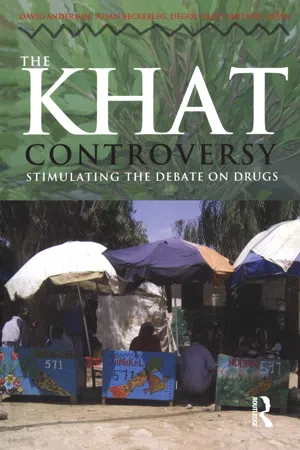
The Khat Controversy
Stimulating the Debate on Drugs
- 272 pages
- English
- ePUB (mobile friendly)
- Available on iOS & Android
eBook - ePub
The Khat Controversy
Stimulating the Debate on Drugs
About this book
Khat. A harmless natural stimulant or a lethal epidemic sweeping through the international drugs trade? Khat is a natural substance that, in the Middle East, is as ubiquitous as coffee is in the West. It is hugely popular in some African and Arab populations. But critics contend that it is a seriously addictive stimulant that damages the cardiovascular system. In a groundbreaking study, the authors go behind the veil of the drug, questioning its availability and its effect on its Red Sea producers. Interwoven with case studies from Djibouti to Rome, The Khat Controversy goes deeper to explore contemporary issues relating to globalization, ethnicity and culture. With its popularity escalating in London, Rome, Toronto and Copenhagen, khat is fast becoming a problem in the West. The first study of this contested drug, The Khat Controversy provides a concise introduction to the issues surrounding khat usage and suggests how policymakers should address them. The Khat Controversy: Stimulating the Debate on Drugs has received an honorable mention for the African Studies Association's 2008 Melville J. Herskovits Award.
Information
1 Introduction: Going Global
The Khat Controversy
Khat is the most recent plant-based psychoactive substance to spread across global markets. It has traditionally been consumed in East Africa and the Middle East, where it is also known as the ‘flower of paradise’, qat (transliterated from Arabic), miraa (its Kenyan name), chat (Ethiopian) and numerous other names which locals use to differentiate various varieties.1 The actual plant is an evergreen shrub of the Celastraceae, which grows best at an altitude of 5,000–8,000 feet (approx. 1,500– 2,500 metres). Wild khat trees can grow as high as 80 feet in an equatorial climate, but the farmed variety is kept at around 20 feet with constant pruning (Kennedy 1987; Goldsmith 1994; Lemessa 2001).
Wild plants have been found from Afghanistan to South Africa, but the cultivation of khat has for centuries been confined to a narrow geographical belt ranging from Yemen in the Arabian peninsula to the Meru highlands of Kenya. Over the last twenty years khat has become a global commodity, openly on sale in London and Amsterdam, and covertly in Toronto, Chicago and Sydney. Though global availability of this delicate product would be unthinkable without dramatic advances in transport technology, the key behind this commercial development has been the growth of sizeable markets in Djibouti, Somalia and major urban centres in Ethiopia, as well as across Europe and North America. It is safe to say that the unfolding problematic surrounding the use of khat in Western countries has corresponded to the arrival of large numbers of Somali and Ethiopian refugees from the web of conflict that has been haunting the Horn of Africa for the past thirty years.
Host countries in the West have responded in different fashions to this new phenomenon, with tolerance in the UK and the Netherlands but prohibition in Scandinavia and North America. Across these borders a consensus has formed over the likelihood of transmission. Khat, it is generally assumed, will not catch on among mainstream consumers. Not only are these already generously supplied with a range of mind-altering substances, but also Western consumers are unlikely to take to the involved and unfashionable mode of administration – the khat chew. Yet, this European indifference should not lead us to ignore the sharp rise in incidence of khat use in other parts of the world. The data from eastern Africa show how the border of khat use is shifting in all directions. It seems to fit ideally into the consumption trends and patterns of sociability of African towns, and provides a cost-effective alternative to alcohol. The spread of khat production and use has therefore become an issue of global concern.
Tales of Origin
The first origins are shrouded in pastoral myth which, as we find later in the book, repeats itself as a motif in the propagation of use along the ‘khat frontier’. Accordingly a shepherd, observing how happy and energetic his goats get every time they chew from this plant, experiments with chewing it himself and finds the effect pleasing (Getahun and Krikorian 1973; Trimingham 1952; Weir 1985). There is an ongoing discussion of whether cultivation originated in Yemen (Burton 1930) or Ethiopia (Weir 1985; Kennedy 1987), with no conclusive evidence on either side of the argument. This is not the only dispute along the Red Sea littoral, where claims to the first domestication of coffee and the residence of the Queen of Sheba remain to be settled.
Once its stimulant properties are recognized, khat becomes invested with spiritual significance and takes on cosmological value. This finds expression in one popular Ethiopian story relating that when God came to earth all plants bowed before him – showing their ultimate reverence. The exception was khat: a plant which stood straight with a posture of disrespect. Then God cursed – forever you be chewed by humans.2 For causing such divine displeasure khat has traditionally been prohibited by the Ethiopian Orthodox Church. Islamic clergy, by contrast, welcomed khat’s stimulating effects as a divine gift to assist in their studies (Hill 1965). Over the centuries khat has gained an important place in Muslim observance and rituals of piety in Eastern Ethiopia, particularly the Harerge region. For centuries, religious scholars have been chewing khat while spending long hours of the day and night reciting passages from the Holy Qur’an and praying to Allah (Gebissa 2004). This practice is continued to this day in this ancient seat of Islamic learning. Here khat is referred to as the ‘flower of paradise’, and prayers are offered before the beginning of the chew. Scholars maintain that, in contrast to alcohol consumption, the use of khat is not banned by the Qur’an (Almedom and Abraham 1994: 249–50).
In Ethiopia, then, khat has long played a symbolic function to distinguish Christianity from Islamic powers. Khat is first officially recorded in 1330 when the Muslim leader Sebra’din of Ifat threatens to sow khat in the backyard of emperor Amde Syon (Gebissa 2004). Conversely, khat chewing was forbidden to Orthodox Ethiopian Christians, and has only in recent years been used widely across the country. Earlier generations proved far less tolerant. The young emperor Lij Iyasu (1911–1916), the grandson of emperor Minelik, was excommunicated and lost his throne after being accused of chewing khat with Muslims in Harar.
In spite of the strong association between Muslims and khat use, the status of the substance within Islam is not uncontested. Yemen probably has the longest tradition of use, and the theological debate dates back to the fifteenth and sixteenth centuries, when arguments centred on the degree to which the plant can be considered an intoxicant (Varisco 2004: 111–12). To some extent the religious debate on khat persists, but the liberal interpretation that permits khat chewing among Muslims has gained the upper hand. Hence, Kennedy found in his Yemeni study that about 60 per cent of both men and women reported that chewing ‘draws one close to Allah’ (Kennedy 1987: 128). According to Kennedy:
Since its introduction hundreds of years ago, Islamic scholars and judges have been divided on the question of whether or not qat should be placed in the category of haram (forbidden) substances, along with alcohol, hashish, etc. As we noted earlier, some have argued that analogous to wine it has consciousness-altering properties, and since it is on the basis of such properties that alcohol was forbidden by the prophet, qat too should be forbidden. However, the prevailing legal ruling in Yemen has usually been the more strict interpretation; that since it was not explicitly mentioned in the Qur’an it should not be forbidden. (ibid.: 108)
The debate over the religious status of khat continues among East African and Yemeni Muslims. In Europe the discussion of khat has been from the start decidedly scientific. It entered the world of botanical knowledge after the return of the Danish expedition to Yemen in 1761. It was Carsten Niebuhr who conducted the first recorded self-experiments on khat, and Peter Forsskål to whom we owe the first botanical description and classification of Catha edulis (Forssk.). These early reports were followed in the course of the nineteenth and twentieth centuries by sophisticated pharmacological analyses of the psychoactive mechanisms, and more exhaustive accounts of the incidence and context of use.
Richard Burton, that most intrepid of Victorian gentleman travellers, visited Harar, the heartland of khat production in Ethiopia, in 1856 and was struck by the regularity of use. One of the first European experimenters, he was quick to note the pattern of administration and the combination with other substances, and offered a ready assessment of its psychoactive potency: ‘The people of Harar eat it every day from 9 a.m. till noon, when they dine and afterwards indulge in something stronger – millet beer and mead’ (Burton 1966: 196–7).
Burton’s report is not only one of the earliest, but also one of the most positive by a European. The spectacle of large numbers of Yemeni or Ethiopian men sitting together with wads of vegetable matter in their cheeks, flaccid gums, discoloured teeth and glassy eyes, did nothing to recommend either khat or its users to colonial administrators. When early medical examinations were interpreted within a socio-economic context, such as the strain on household income and the drag on labour productivity, khat began increasingly to be considered as a menace to the development of the region. Once again, this is a discussion that is continuing today.
Chewing Khat and its Effects
At harvest, khat is picked as a leaf, packed into bundles and wrapped in banana leaves to keep fresh. The consumer opens this bundle, often known as marduuf in Somalia (Elmi 1983a), robta in Yemen (Kennedy 1987) and zurba in Ethiopia, and delicately picks out leaves and stems. The leaves and/or the tender stems are worked into a wad in the cheek of the consumer. These are masticated over the course of the session, lasting anything between two and eight hours depending on context and occasion. The taste of the fresh leaves being slightly bitter, many users accompany their bundle with water and sweet drinks. Tea has traditionally been served, but fizzy, sugary drinks are increasingly popular. In most settings khat chewing has become associated with intense nicotine consumption, hubbly bubblies or ma’daa in Yemen, cigarettes in Ethiopia, Somalia and Kenya.
Chewers report an immediate emotional effect of euphoria, which increases the sense of well-being and can facilitate social interaction. Indeed, khat seems to greatly exacerbate the chewers’ urge to express themselves, albeit at the expense of their listening skills. The initial stage of a typical khat-chewing session is therefore characterized by a din of voices, with all attendant speaking excitedly and at the same time. Zaghloul describes the chewing experience as follows:
The chewer feels elation and well-being together with increased levels of energy and alertness; his self-esteem is enhanced. He becomes communicative and enjoys social interaction while having a sensation of heightened perceptive and imaginative ability as well as a … greater … capacity to associate ideas. For the observer, khat is seen to induce a state of mild euphoria and excitement accompanied by loquacity and, sometimes, hyperactivity and hypo-manic behaviour. (Zaghloul et al. 2003: 80)
This initial euphoria is followed by a quieter and more inward-looking mood. This is the phase celebrated in Arabic poetry as the time when musicians receive their inspiration. And then, in turn, comes a long and melancholic period. Some chronic users have been found to carry on chewing in order to postpone the comedown (Griffiths 1998; Hassan et al. 2002). In Ethiopia khat chewers may also come down to a ‘soft landing’ by drinking alcohol.
Studies on the use of illicit drugs suggest that the effect of any substance is largely conditioned by the context, the company and the expectations of the user, known among drug researchers as the set and setting (Zinberg 1984). With reference to khat, we therefore find different traditions of use. Among Ethiopian farmers, for instance, khat is popular as a performance enhancer taken early in the morning to ease the hardships of agricultural labour. In Addis Ababa, by contrast, university students, lorry drivers and night watchmen chew khat to stay awake and alert. In Yemen and Somalia there are ancient traditions of khat use in religious and scholastic settings, with many Qur’anic schools supplying khat for their students when reciting the suras of the Qur’an late into the night. Khat, like all stimulants, is therefore used in both social and formal settings.
The energizing effect does not preclude its use in strictly controlled ritual conditions, as is the case with hallucinogens or narcotics (Rudgley 1993). Hence the main function of khat is a communal one, stimulating sociability. Secluded, individual use remains rare and meets with disapproval among urban Ethiopians and Somalis. Like all stimulants, khat upsets established sleep patterns and proves exhausting after repeat administration. The disruption of natural bodily as well as social rhythms can cause disturbances in the mental well-being and social adjustment of some users. For most occasional users, however, the recovery phase is fairly benign, particularly when compared to that of other drugs.
Pharmacology of Khat
Attempts at isolating the psychoactive agents in khat date back to the nineteenth century, when Fluckiger and Gerock identified the first alkaloid in khat and called it katin (Halbach 1972). It was close to a hundred years later when research at the United Nations Narcotics Laboratory specified three main alkaloids, as cathinone, norpseudoephedrine (cathine) and norephedrine. For decades the efforts of chemists and pharmacologists had been frustrated by the acute instability of this alkaloid, which is only prevalent in the fresh vegetable matter. In the fresh leafs cathinone combines with cathine, norpseudoephedrine, and several other alkaloids, tannins and other ingredients not all of which have as yet been identified (Al-Hebshi and Skaug, 2005).
When the khat leaves are chewed, the cathine and cathinone are effectively extracted, isolated by enzymes active in the saliva and then directly resorbed through the oral mucosa. The effectiveness of the method has been demonstrated in controlled experiments where volunteers managed to extract around 90 per cent of both cathinone and cathine by chewing for over an hour (Toennes et al. 2003). Once absorbed the terminal elimination half life of cathinone was 1.4 hours, and for cathine 5 hours. The maximal plasma concentration for cathine occurred at 2.3 hours for cathinone and at 2.6 hours for cathine (ibid.; Widler et al. 1994).
The Advisory Council on the Misuse of Drugs comments that:
drugs with a fast onset of action have a high addictive potential. Although chewing khat is an efficient way to extract the active ingredients, it takes a long time to reach maximal plasma levels, and hence khat has less reinforcing properties than other stimulants such as amphetamine and cocaine. (ACMD 2006: 16)
Neuro-physiological Consequences of Khat Use
It is now well established that the chemical structure of cathinone resembles that of amphetamine. It also affects the central and peripheral nervous systems in a similar manner (Kalix 1999; Woolverton and Johanson 1984; Zelger et al. 1980). Animal experiments testing for discrimination and preference (Johanson and Schuster 1981; Woolverton and Johanson 1984) have found cathine to be rewarding in a manner similar to that of amphetamine or cocaine.
The effective mechanism of all three substances – khat, cocaine and amphetamines – is believed to work through increasing the concentrations of dopamine, a neurotransmitter, in specific regions of the brain. The sudden release of dopamine at presynaptic storage sites inhibits its re-uptake, and can eventually produce depletion of central dopamine (Schechter 1990a, 1990b) possibly leading to depression and aggressive behaviour. Cathinone also impacts on serotonin and the noradrenaline transporters (Glennon and Liebowitz 1982; Nielsen 1985; Rothman et al. 2003).
Moreover, cathinone seems to affect the ‘mesocorticolimbic reward system’, which is the neural base of all addictions (Desl...
Table of contents
- Cover
- Half Title
- Title Page
- Copyright Page
- Contents
- List of Tables and Figures
- Acknowledgements
- 1 Introduction: Going Global - The Khat Controversy
- Part I Khat in the Horn
- Part II Khat in East Africa
- Part III Khat in the Diaspora
- Notes
- Appendix: People Interviewed for The Khat Controversy
- Bibliography
- Index
Trusted by 375,005 students
Access to over 1.5 million titles for a fair monthly price.
Study more efficiently using our study tools.
Frequently asked questions
Yes, you can cancel anytime from the Subscription tab in your account settings on the Perlego website. Your subscription will stay active until the end of your current billing period. Learn how to cancel your subscription
No, books cannot be downloaded as external files, such as PDFs, for use outside of Perlego. However, you can download books within the Perlego app for offline reading on mobile or tablet. Learn how to download books offline
Perlego offers two plans: Essential and Complete
- Essential is ideal for learners and professionals who enjoy exploring a wide range of subjects. Access the Essential Library with 800,000+ trusted titles and best-sellers across business, personal growth, and the humanities. Includes unlimited reading time and Standard Read Aloud voice.
- Complete: Perfect for advanced learners and researchers needing full, unrestricted access. Unlock 1.5M+ books across hundreds of subjects, including academic and specialized titles. The Complete Plan also includes advanced features like Premium Read Aloud and Research Assistant.
We are an online textbook subscription service, where you can get access to an entire online library for less than the price of a single book per month. With over 1.5 million books across 990+ topics, we’ve got you covered! Learn about our mission
Look out for the read-aloud symbol on your next book to see if you can listen to it. The read-aloud tool reads text aloud for you, highlighting the text as it is being read. You can pause it, speed it up and slow it down. Learn more about Read Aloud
Yes! You can use the Perlego app on both iOS and Android devices to read anytime, anywhere — even offline. Perfect for commutes or when you’re on the go.
Please note we cannot support devices running on iOS 13 and Android 7 or earlier. Learn more about using the app
Please note we cannot support devices running on iOS 13 and Android 7 or earlier. Learn more about using the app
Yes, you can access The Khat Controversy by David Anderson,Susan Beckerleg,Degol Hailu,Axel Klein in PDF and/or ePUB format, as well as other popular books in Social Sciences & Anthropology. We have over 1.5 million books available in our catalogue for you to explore.