- 548 pages
- English
- ePUB (mobile friendly)
- Available on iOS & Android
eBook - ePub
About this book
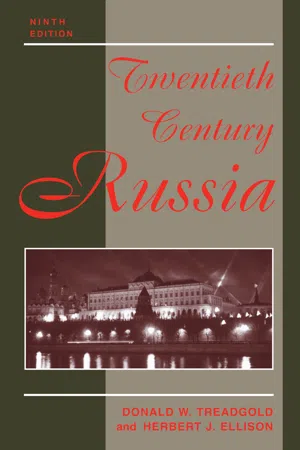
Donald Treadgoldwas one of the most distinguished Russian historians of his generation. His Twentieth Century Russia, a standard text in colleges and universities for several decades,has been regularly revised and expanded to reflect new events and scholarship. The present revision, by Professor Herbert Ellison, contains a major chapter on the Yeltsin era, and brings the Russian story to the final year of the century.Twice in the twentieth century the collapse of the Russian state and empire has been followed by an effort to build a democracy on the Western model. The first effort succumbed within a few months to Lenin's communist revolution, whose ideas and institutions dominated the history of Russia, and eventually much of the world, during the succeeding seventy-four years. In August 1991, an attempt by Soviet leaders to suppress democratic and nationalist movements unleashed by the Gorbachev reforms, and already victorious in Eastern Europe, precipitated instead an anti-communist revolution under the leadership of Boris Yeltsin.The revolution, and the sweeping transformation that followed, are treated in the new edition, which assesses the aims and scope of the first decade of Russia's second revolution. The transformation included a new constitutional structure, two fully democratic parliamentary elections and a presidential election (with another of each soon to come), a vigorous revival of political parties and political debate, and major questions about Russia's political future. Against the broad background of the Russian experience over a turbulent century, it raises the major questions: What are the prospects for Russian democracy? Why are the communists, following an anti-communist revolution, the most powerful parliamentary party in Russia's new parliament, and what is their impact? Why has the conversion to a market economy proved so difficult and painful, and what are its prospects? How has Russia related to the new states that were once fellow republics of the USSR? Why has the foreign policy of the new Russian democracy moved from a vision of partnership with the US to a reality of conflict and confrontation?Twentieth Century Russia poses these questions, and many more, for the student and the general reader alike, against the fascinating background of Russia's experience before, during and since the era of communist rule, exploring the roots of current developments in the communist and pre-communist past.
part one
New Currents in Old Russia
Introduction: Into Totalitarianism and Out of It
The Peoples and the Land
Russia, or the Russian Federation (both names are legal), contains slightly more than half the people who inhabited the Soviet Union (a shortened form of the official designation, Union of Soviet Socialist Republics), and four-fifths of its territory. The Russians are the predominant people of Russia; in contrast, in some of the former Soviet Union’s ethnically named subdivisions, the peoples concerned are not even the majority (for example, Kazakhs in Kazakhstan, Abkhazians in Abkhazia; the Latvians keep a sliver-like edge in Latvia).
The Russian language, together with Belarusian and Ukrainian, make up the Eastern Slavic subdivision of the Slavic branch of the Indo-European family.1 The three peoples who speak them are linked not only by language but by their traditional religion, Eastern Orthodox Christianity. The Russians, however, are by no means Russia’s only ethnic group. The Russian republic has thirty-one administrative subdivisions named for what is or was the most numerous non-Russian people of the area concerned. The two politically most active in the early 1990’s are the Tatars of Kazan (the Crimean Tatars seem more concerned with reestablishing themselves in their former homeland than with political self-assertion) and the Yakuts or Sakha. Both are Turkic,2 as are the Chuvash and Bashkirs; the Udmurts (formerly Votiaks) and Mari are Finnic; the Buriats and Kalmyks are Mongols, and dozens of other small peoples dot the map of Russia from the Gulf of Finland to the Bering Sea. The Chuvash and Udmurts are Orthodox Christians, but most of the other Uralic and Altaic peoples are Muslims or pagans, except for the Kalmyks and roughly half the Buriats, who are Buddhists.
Of the units that formerly made up the USSR, three have gained independence and have distanced themselves from the rest: Estonia, Latvia, and Lithuania; eleven are independent but are currently part of the Commonwealth of Independent States (Sodruzhestvo Nezavisimykh Gosudarstv), or CIS. Declarations of sovereignty and independence have been endemic since August 1991, and what those terms are going to mean in a given instance is still being worked out.
The first Slavic state on what later became Russian soil was organized in the ninth century in the region of Kiev. By 1240, when the Mongols invaded Europe, the Kievan state of “Rus” had disintegrated into small independent principalities. An important effect of the Mongol conquest was the devastation of the vicinity of Kiev and the consequent separation of the Eastern Slavs into two sections, to the west and northeast of the ruined city. The western area fell under the control of the large Lithuanian state, which first accepted dynastic union with Poland (1385) and then full union (1569). The northeast came to be ruled by the Grand Prince of Moscow, who in effect assumed the position of viceroy for the Mongols. About 1450 the Muscovite principate threw off its dependence on the Mongols (by this time Tatarized, so often called simply “Tatars”). In 1721, under Peter the Great, Muscovy was renamed the Russian Empire. During the next two centuries almost all Eastern Slavs were brought under the rule of St. Petersburg (Petrograd 1914–24, Leningrad 1924–91), which Peter built on a marsh by the Gulf of Finland and made his capital.
Many non-Slavs also inhabited the Empire. A small Jewish community had appeared in seventeenth-century Muscovy, and shortly before 1800 Catherine the Great established a Jewish “pale” (area of settlement) in the territories newly annexed from Poland. Finnic peoples lived intermingled with Russians, and Finland proper was taken from Sweden during the Napoleonic Wars. In 1814 the Congress of Vienna awarded a truncated “Congress Poland” to Russia. Both Finland and Poland achieved independence after the Russian Revolution. The Empire also included three other Christian peoples: Romanians (“Moldavians”) in Bessarabia, Armenians and Georgians in the Caucasus, and, almost entirely Muslim, the Central Asian Turks (today known as Kazakhs, Kyrgyz, Uzbeks, and Turkmens) and the Persian Tajiks. Central Asia was conquered in the late nineteenth century, Bessarabia and the Caucasus earlier.
The Georgians and Armenians had a history of civilization and independence that long antedated the history of the Russians. As the new ideology of nationalism spread through nineteenth-century Europe, at least the intellectuals among peoples who in modern times had never known nationhood, such as the Ukrainians, developed nationalist aspirations. Sometimes nationalism went hand in hand with socialism, and St. Petersburg severely repressed the expression of such ideas.
Only in the late nineteenth century, however, were active measures of Russification carried out. The very name “Russian Empire” may seem to imply an official preference for the Russian language and those who spoke it, but in fact it was a cosmopolitan state, where the imperial family was mostly German through almost two centuries of foreign marriages, and up to the mid-nineteenth century high officialdom was drawn from several European backgrounds. Discrimination was practiced against the Jewish religion but not against Jews who converted to Orthodox Christianity. The name “Ukrainian” was unknown to imperial law, which used the term “Little Russia” (Malorossiia). On the positive side, Finland enjoyed much autonomy until the Revolution, Poland until the Revolution of 1830. There was little effort to interfere with the religion and customs of the Muslim peoples or the Lamaistic Buddhists and pagans of Asiatic Russia. Schismatic (Old Believers, who had broken with the official church in 1667) and sectarian (Dukhobors, Molokane, Khlysty, Skoptsy) Russian Christians suffered more from governmental pressures than non-Christians (except Jews). In the Baltic region a German upper class descended from the Teutonic Knights ruled over Estonian and Latvian peasants and contributed many men to imperial officialdom. Individual foreigners, especially Germans but also Frenchmen, Englishmen, Scots, and others, received privileged treatment and held high positions in the government, universities, and professions. In general the tsars treated a multinational state as if it were a single nation but refrained from pressing such a policy to its logical conclusion.
The land is mostly flat and cold, and much is not tillable. Inadequate transportation has made it difficult to put to use the country’s immense store of natural resources. European Russia’s vast network of rivers, most of which rise near Moscow and flow to the Caspian, Black, Baltic, and White Seas, is useful when frozen or free from ice, but for much of the year it satisfies neither condition. The rivers of Siberia are wide, long, and of little use for commerce. They run from south to north to empty into the Arctic Ocean, and though Cossacks originally crossed Siberia by boat, using the rivers’ tributaries and portages between them, modern commerce does not lend itself to the same methods. Roads are too few and often poor, reduced to mud by the spring thaws. Railroads are extensively used but in 1994 are sadly in need of upgrading; the same is true of the gigantic national airline, Aeroflot.
Mountains are of little benefit. High ranges lie along the borders with China and nowhere else. Through the Hi gap in northern Sinkiang many nomadic conquerors passed en route to the European steppes; the Urals—by American or Swiss standards scarcely more than rolling hills—give way to flat plain several hundred miles from the Caspian Sea and allowed the nomads to proceed without hindrance to plunder Russia and territories beyond. On the west Russia is completely exposed geographically. From the Teutonic Knights in the thirteenth century to the armies of Napoleon in the nineteenth and those of Hitler in the twentieth, invaders have advanced across open plains. Moreover, mountains do nothing to lessen the rigors of the climate. They are high in the south, cutting off warmth, but there are none in the north of a size to prevent Siberian Arctic winds from sweeping south and westward.

Russia has some very rich soil: the black-earth (chernozëm) strip, which runs broadly across the south of European Russia, then narrows and disappears in central Siberia. North of it is the enormous forest known as the taiga, and along the Arctic coast is the treeless tundra. Russia’s warm southlands nearly disappeared when Ukraine and the three Caucasian states became independent, though a Mediterranean climate prevails in a strip of eastern Black Sea coast.
The Character of Russian Absolutism
By the nineteenth century Russian state and society had assumed a despotically regulated pattern which had been imprinted on the borderlands to a considerable extent. That pattern, whose chief characteristics were correctly identified by the early revolutionaries as autocracy and serfdom, had not taken shape in Russia until modern times. In the period of the Kievan state and its succession principalities under the Mongol yoke, medieval Russia had enjoyed a more fluid type of political and social organization. Trading city-states in the north, such as Novgorod and Pskov, which maintained close ties with Western Europe, had a large, free farmer class and a turbulent form of self-government in which the urban masses took part. The Kievan and other princes were restrained from arbitrary deeds by the popular assembly (veche), and although there were slaves, there was also a very numerous class of agriculturists whose relationship with their landlords was a contractually circumscribed one.
When the Muscovite princes threw off the Mongol yoke, they began to claim despotic prerogatives, partly in conscious or unconscious imitation of their former Mongol overlords and of their Byzantine coreligionists, whose primacy in the Orthodox world they claimed to have inherited when the Turks captured Constantinople in 1453. The tsars (as they now styled themselves) of Muscovy subjugated the northern trading city-states, dispersed the old assemblies, and although they summoned an assembly representative of the estates (Zemsky Sobor, or Assembly of the Land), it never acquired any power to limit the will of the monarch. In order to crush the old independent aristocracy (the boyars, who served any given prince at will), the tsars built up a new noble serving class (the dvoriane or gentry). In return for the support of the gentry, the state allowed them to reduce to serfdom the peasants who lived on their newly granted lands. The old village institution of peasant self-government, the commune (mir or obshchina, though the terms mean slightly different things at different times), was partially converted into an organ subservient to both the gentry landlords and the state, and was used to enforce the increasing weight of fiscal and other obligations which the peasants owed to both.
The last tsar and first Emperor, Peter the Great, virtually completed the long process of fixing the population into a small number of social classes with legally defined obligations and rights. Chiefly these were the gentry (into which the remnants of the boyars passed), the merchant groups, the state peasants (who lived on state lands and had no gentry landlords), and the private serfs—the last two groups constituting the great mass of the people of Russia. The remaining few slaves passed into serfdom.
In later Muscovite theory, the task of the peasants was to produce food, pay taxes, and (for a selected number of them) to serve as common soldiers in the army, while their gentry lords were bound to serve the state all their lives as civil officials or military officers. During the eighteenth century the obligations of the gentry were reduced and finally abolished, while their powers over their serfs became virtually those of slave-owners. However, they never attained the prerogatives of the earlier Western feudal lords, or even those of the contemporary nobles of the Germanic countries, and remained excluded from political power.
The imperial authority was vested in the Emperor alone. His will was not limited by law or any regularly constituted political body. The agency of his will was the imperial bureaucracy, whose powers reached far down into local affairs. In practice the Emperors did not press their powers to their theoretical limits. The opinions of their advisers and their judgment of the state of mind of the various social classes (chiefly of the legally favored gentry), the laws (especially after they were codified in the early nineteenth century), and their public allegiance to the precepts of the Christian religion, all had varying but substantial effects in restraining the monarchs from the extremes of arbitrariness. The Emperors did not attempt to exact positive commitments to an official ideology from creative artists and writers. Penalties were applied to revolutionary agitation by the secret police and the courts, but in a form and degree mild and irregular in comparison with twentieth-century totalitarianism.
The old pattern of autocracy and serfdom was greatly modified under Alexander II (1855–1881). Through the Emancipation edict and accompanying legislation serfdom was abolished. Other “Great Reforms” gave the freed peasant a share in a newly-created system of provincial and county self-government (the zemstvo), set up elective city councils for urban administration, and vastly improved the administration of justice and the method of recruitment of soldiers, from both of which the old principle of class preferment was eliminated. Nevertheless, the institution of autocracy remained intact, despite certain measures envisaging its limitation considered by Alexander II in his last days, which were laid aside only after he was assassinated by revolutionaries.
Through the efforts of officials responsive to gentry demands for restoration of their pre-Reform privileges, the Great Reforms were to some degree abridged in letter and spirit during subsequent decades. Mass discontent and the political demands of the intelligentsia combined to produce a ferment which erupted in the Revolution of 1905. As a result an Imperial Duma, or legislative assembly, was established as part of a new semi-constitutional system comparable to that of Prussia. The old absolutism was substantially modified, and in the later years of Nicholas Us reign (1894–1917) showed signs of breakdown. Meanwhile the peasantry was making progress in the direction of economic independence, and the old class lines were crossed ever more frequently. Russian culture was developing new variety, refinement, and also breadth. The growth of industry was very rapid. The final breakdown of tsarist absolutism in the midst of the domestic strains produced by the First World War seemed to foreshadow the establishment of some type of “open society” in Russia.
The Rise and Fall of Totalitarianism
The revolutions of 1905 and 1917 were mass upheavals not planned by anyone and anticipated by few; however, the revolutionary leadership devolved upon the few members of the intelligentsia who had worked out an a priori analysis of events and a program that they wished to put into effect. The revolutionary intelligentsia were unanimous in desiring the end of autocracy and the creation of a democratic government, and most of them supported some kind of plan for a socialist society. The masses generally believed themselves to be fighting for freedom and political rights as well as economic independence—or, as the slogan of the old peasant uprisings and two of the early revolutionary societies had it, “land and liberty.”
The shape of the revolution depended, however, not merely on programs but on leadership. A new regime might be formed from the old bureaucracy, or “public men” who had worked in the zemstvos, city councils (or Duma), or from the inexperienced intelligentsia, or a mixture of the three. After Lenin and the Bolsheviks seized power in the October Revolution, that section of the intelligentsia who were Bolshevik or pro-Bolshevik, along with many Bolshevik workers and a very few peasants, undertook to construct a new type of government—even though Lenin for a time used prerevolutionary bureaucrats, army officers, and the like where needed.
When the Communists (as the Bolsheviks renamed themselves in 1918, reverting to Marx’s term) had defeated their antagonists in the Civil War, their regime was still in the process of taking shape. Almost immediately after the seizure of power a new secret police and Red Army were organized, under the leadership and control of the expanding Communist Party. In 1921 Lenin made concessions to the peasants and small businessmen and traders through the New Economic Policy, but the Communist Party retained its monopoly of political power. Intra-Party debates about how far the policy of economic concessions should be pursued became intertwined with personal and factional rivalries. From the Par...
Table of contents
- Cover
- Half Title
- Title Page
- Copyright Page
- Contents
- List of Maps
- Preface to the Ninth Edition
- Part 1 New Currents in Old Russia
- Part 2 The Communists Take Power
- Part 3 Stalin’s Rule Through World War II
- Part 4 The Postwar Period
- Appendix
- A Selection of Materials for Further Reading
- About the Book and Author
- Index
Trusted by 375,005 students
Access to over 1.5 million titles for a fair monthly price.
Study more efficiently using our study tools.
Frequently asked questions
Yes, you can cancel anytime from the Subscription tab in your account settings on the Perlego website. Your subscription will stay active until the end of your current billing period. Learn how to cancel your subscription
No, books cannot be downloaded as external files, such as PDFs, for use outside of Perlego. However, you can download books within the Perlego app for offline reading on mobile or tablet. Learn how to download books offline
Perlego offers two plans: Essential and Complete
- Essential is ideal for learners and professionals who enjoy exploring a wide range of subjects. Access the Essential Library with 800,000+ trusted titles and best-sellers across business, personal growth, and the humanities. Includes unlimited reading time and Standard Read Aloud voice.
- Complete: Perfect for advanced learners and researchers needing full, unrestricted access. Unlock 1.5M+ books across hundreds of subjects, including academic and specialized titles. The Complete Plan also includes advanced features like Premium Read Aloud and Research Assistant.
We are an online textbook subscription service, where you can get access to an entire online library for less than the price of a single book per month. With over 1.5 million books across 990+ topics, we’ve got you covered! Learn about our mission
Look out for the read-aloud symbol on your next book to see if you can listen to it. The read-aloud tool reads text aloud for you, highlighting the text as it is being read. You can pause it, speed it up and slow it down. Learn more about Read Aloud
Yes! You can use the Perlego app on both iOS and Android devices to read anytime, anywhere — even offline. Perfect for commutes or when you’re on the go.
Please note we cannot support devices running on iOS 13 and Android 7 or earlier. Learn more about using the app
Please note we cannot support devices running on iOS 13 and Android 7 or earlier. Learn more about using the app
Yes, you can access Twentieth Century Russia by Donald Treadgold,Herbert J Ellison in PDF and/or ePUB format, as well as other popular books in History & 20th Century History. We have over 1.5 million books available in our catalogue for you to explore.