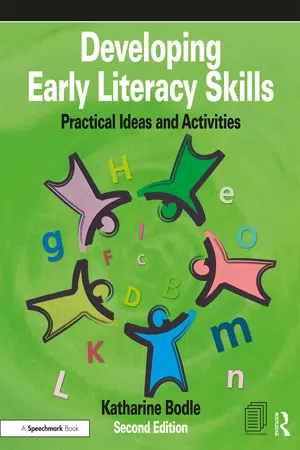
A valuable resource for professionals working with pre-school children, or with older children lacking basic literacy skills, this book provides practical photocopiable activities to develop the early skills required for success with literacy. Includes: rhyming activities; alphabet activities; phonological awareness; writing and handwriting; and reading. Each section is structured so that children can build up their knowledge and skills. Developed within the classroom, these ideas and activities can be used with a range of children in whole class, group and individual situations both at home and in pre-school settings. Designed to help children showing early signs of dyslexia or a specific learning difficulty, these activities will also benefit older children who lack a foundation of early literacy skills. This updated edition reflects changes in legislation, and includes refreshed word lists and new subject areas, such as visual perception, fine and gross motor skills. It is invaluable for teachers, learning support assistants, nursery workers, parents and carers.
- 160 pages
- English
- ePUB (mobile friendly)
- Available on iOS & Android
eBook - ePub
About this book
Information
SECTION 1
Basic skills
Introduction
Teaching guidelines
Activities
Using spoken language
General activities for school and home
Sharing reading
General activities for home
General activities for school and home
Turn-taking
General activities for school and home
Being aware of sounds
Activities for school and home
Activity 1: Locating sounds
Activity 2: Identifying sounds
Activity 3: Sound shakers game
Activity 4: Distinguishing sounds
Using auditory and visual memory
Activities for school and home
Activity 5: Kim’s game
Activity 6: Sequencing pictures
Activity 7: Matching pairs
Activity 8: My Granny went shopping
Activity 9: Can you do what I do?
Activity 10: Can you find it?
Activity 11: Sound pairs
Sequencing
Activities for school and home
Activity 12: Sequencing actions
Activity 13: Sequencing daily events
Activity 14: Following a recipe
Activity 15: Sequencing patterns
Activity 16: Visual timetable
Activity 17: Songs, rhymes and stories
Visual perception
Activities for school and home
Activity 18: Puzzlesheets
Activity 19: Find it
Activity 20: Build it
Photocopiable resource sheet
Introduction
The activities in Sections 2 to 6 assume that children have the basic skills that one would normally expect of their age group. If these skills are weak or lacking, then take some time to work on them by using this section before you start the activities in the rest of the manual. This should ensure that each child derives maximum benefit from the activities and makes progress in improving his literacy skills.
Using spoken language
If you encourage children to use spoken language in its correct form, they will be more likely to use complex sentences containing rich and varied vocabulary when writing. Their comprehension when reading will also improve as they will have a wide knowledge of words to draw upon.
Sharing reading
Sharing rhymes, stories and other books will help children to extend their vocabulary and will open the door to a whole new world of entertainment and information.
Turn-taking
This is an important life skill, and many games and activities within schools rely on children being able to take turns. Turn-taking is also important in conversing with others, with questions and answers alternating between different people.
Being aware of sounds
Being aware of sounds in the environment ensures that a child has the ability to listen critically and distinguish sounds in the spoken word. This is necessary when breaking words down into individual sounds (phonemes) when reading or spelling.
Using auditory and visual memory
A good memory is important in all aspects of learning. The short-term or working memory can hold between five and nine items if trained properly; most people remember about seven items, and some can remember many more.
It is important to learn how to ‘chunk’ items together in order to remember them more effectively. For example, it would be difficult to remember axpvswluqity, but it is easier to remember even a nonsense word like redbincastal. This second ‘word’ has the same number of letters as the first, but we can chunk it into red/bin/castal and remember it as three items. It is possible to train the short-term memory and by doing this we enable information to be held longer, to be manipulated and to be placed in the long-term memory.
When working with children it is helpful to bear in mind that we all remember best those things that:
•we use or practise frequently
•we have learnt recently
•are important or meaningful to us.
Sequencing
Sequencing skills rely on memory and on seeing patterns. We use many sequences in our daily lives, from remembering the order in which to dress, to using the sequence of the alphabet (when using a telephone directory) or knowing the order of the days of the week (when planning ahead). This section contains activities and techniques that can be used to improve these basic skills. They can be used both to check whether the basics skills are in place and as reinforcement activities.
Visual perception skills
Visual perception is the way the brain interprets what it sees. This is different to eye ‘vision’ which s...
Table of contents
- Cover
- Half Title
- Title Page
- Copyright Page
- Table of Contents
- Acknowledgements
- Introduction
- Section 1: Basic skills
- Section 2: Rhyming
- Section 3: Learning the alphabet
- Section 4: Phonological awareness
- Section 5: Reading
- Section 6: Writing and handwriting
- Conclusion
- Resources and suppliers
- Useful organisations
- Recommended books for young children
- References and further reading
Trusted by 375,005 students
Access to over 1.5 million titles for a fair monthly price.
Study more efficiently using our study tools.
Frequently asked questions
Yes, you can cancel anytime from the Subscription tab in your account settings on the Perlego website. Your subscription will stay active until the end of your current billing period. Learn how to cancel your subscription
No, books cannot be downloaded as external files, such as PDFs, for use outside of Perlego. However, you can download books within the Perlego app for offline reading on mobile or tablet. Learn how to download books offline
We are an online textbook subscription service, where you can get access to an entire online library for less than the price of a single book per month. With over 1.5 million books across 990+ topics, we’ve got you covered! Learn about our mission
Look out for the read-aloud symbol on your next book to see if you can listen to it. The read-aloud tool reads text aloud for you, highlighting the text as it is being read. You can pause it, speed it up and slow it down. Learn more about Read Aloud
Yes! You can use the Perlego app on both iOS and Android devices to read anytime, anywhere — even offline. Perfect for commutes or when you’re on the go.
Please note we cannot support devices running on iOS 13 and Android 7 or earlier. Learn more about using the app
Please note we cannot support devices running on iOS 13 and Android 7 or earlier. Learn more about using the app
Yes, you can access Developing Early Literacy Skills by Katharine Bodle in PDF and/or ePUB format, as well as other popular books in Education & Early Childhood Education. We have over 1.5 million books available in our catalogue for you to explore.