- 252 pages
- English
- ePUB (mobile friendly)
- Available on iOS & Android
eBook - ePub
Understanding Words That Wound
About this book
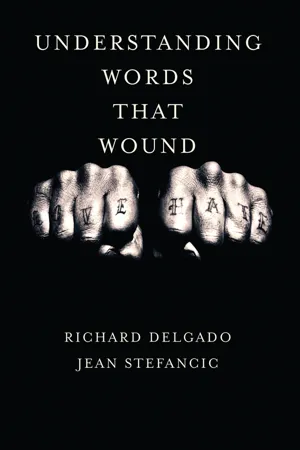
Written by leading critical race theorists Richard Delgado and Jean Stefancic, this volume succinctly explores a host of issues presented by hate speech, including legal theories for regulating it, the harms it causes, and policy arguments, pro and con, suppressing it. Chapters analyze hate speech on campus, hate speech against whites, the history
PART ONE
WHAT IS HATE SPEECH?
1
WORDS THAT WOUND: THE HARMS OF HATE SPEECH
WHAT IS HATE SPEECH?
Many people speak loosely about hate speech, without specifying what they mean or distinguishing the various types of utterance that might be under consideration. This is a sure recipe for analytical unclarity and policy disaster.
One can consider hate speech along various axes, including direct and indirect, veiled or overt, single or repeated, backed by authority and power or not, and accompanied by threat of violence or not. One can also consider hate speech based on the characteristic of the person or group at which it is aimed, such as race, sex, sexual orientation, or national origin. Hate speech can be targeted against one individual (“Smith, you goddamn African American, you are a …”). It can be directed against a small group (such as a black fraternity at a college campus). Or it can be aimed at a group in general (“I hate Xs; they should be thrown out of this country”). It can be delivered orally, in writing, or on the Internet. It can even take tangible form, such as a monument, flag, or sports logo.
Finally, one should differentiate hate speech in terms of who is doing the speaking—a teacher, a passerby, a public speaker, three hoodlums surrounding a small victim on a dark night, or an educated, genteel author who writes about the “X problem,” making clear that the problem with Xs is not the way they are treated but their culture or genes. As will be seen, different forms of hate speech correspond to the various kinds of remedy that writers and policy boards have been proposing. For example, direct, face-to-face hate speech based on race (“You___, go back to_____!; you don’t belong on this campus, you ignorant monkey!”) is often remedied by means of tort actions or campus codes backed up by administrative penalties. Hate speech accompanied by threats, assaults, or dramatic symbolic behavior such as cross-burning is often considered a crime punishable under a hate crime statute.
The different types of hate speech threaten different kinds of harm. The one-on-one (or many-on-one) kind can be the most shocking. It can cause serious psychological and physical harm, irrespective of whether the speaker also physically strikes or harms the victim. General hate speech—for example, a learned address by an educated bigot explaining why blacks or Jews cannot advance beyond a certain point—ordinarily does not cause immediate damage, even if overheard by one who understands that the passage is about him or her. The harm is long-term, as society internalizes and later acts on the message, for example by adopting immigration rules aimed at keeping the group out of the country.
The harms of face-to-face hate speech have been the most closely studied, although recently, subtle, or educated, hate speech and its effect on the fabric of society and the life chances of the groups it tarnishes has come under scrutiny. Finally, a small number of writers have focused on the harms of hate speech to the speaker himself or herself. The following sections address each of these issues.
INDIVIDUAL HARMS OF HATE SPEECH
The harms of hate speech include its adverse impacts—sometimes devastating ones—on the victim, the speaker, and society at large. The harms vary, of course, according to the type of hate speech. The more diffuse kind—for example, “All niggers are inferior and should go back to Africa”—is apt to be more harmful to society in general. The more targeted variety—“You goddamn nigger, go back to Africa”—harms society as well, particularly cumulatively, but its principal impact is felt by the individual victim.
Taylor v. Metzger, 706 A.2d 685 (N.J. 1998).
Racial insults are in no way comparable to statements such as, “You are a God damned … liar,” which [a standard guide] gives as an example of a “mere insult.” Racial insults are different qualitatively because they conjure up the entire history of racial discrimination in this country. [Citing Richard Delgado, Words that Wound: A Tort Action for Racial Insults, Epithets, and Name-Calling, 17 Harv. C.R.-C.L. L. Rev. 133, 157 (1982).]
PHYSICAL HARMS
Hate speech is not merely unpleasant or offensive. It may leave physical impacts on those it visits, particularly when uttered in one-on-one situations accompanied by at least an implicit threat—that is, by someone taller, larger, older, or more powerful than the victim or in a position of authority vis-à-vis him or her. The same is true when the hate speaker is a member of a group engaged in taunting a single member of a disempowered minority faction. Then, the response is internalized, as it must be, for talking back will be futile or even dangerous. In fact, many hate crimes have taken place when the victim did just that—spoke back to the aggressor and paid with his or her life.
The immediate, short-term harms of hate speech include rapid breathing, headaches, raised blood pressure, dizziness, rapid pulse rate, drug-taking, risk-taking behavior, and even suicide.1 The stresses of repeated racial abuse may have long-term consequences, including damaged self-image, lower aspiration level, and depression.2 Scientists suspect that the high blood pressure many African Americans suffer is associated with inhibited, constrained, or restricted anger, in addition to genetic factors.3 American blacks exhibit higher rates of high blood pressure and higher death rates from hypertension, hypertensive disease, and stroke than do similarly situated whites.4 Further, darker-skinned blacks experience a higher degree of felt stress than do their lighter–skinned counterparts, a correlation that may be a product of the greater discrimination5—the many “little murders,” in the words of one social scientist—the former suffer.6
In addition to the immediate physical harms—flinching, clenching, tightening of muscles, adrenaline rush, and the other somatic consequences of a sudden verbal assault—hate speech can cause mental and psychological effects. These include fear, nightmares, and withdrawal from society—what Joe Feagin and his collaborator call an impotent despair.7 The victim of hate speech, especially the one who fears more of the same, may behave circumspectly, avoiding the situations, places, and company where it could happen again. Needless to say, this “cultural mistrust,” a mild form of healthy paranoia, has implications for both the mental health and professional chances of minority workers.8 Other victims will respond with anger, either internalized or acted-out (neither of which is calculated to make things better).9 They are also likely to curtail their own speech, so as not to provoke more ridicule, put-downs, or revilement. Self-esteem may wither.
Victims may reject identification with their own race, the very feature that brought about the verbal attack.10 Or, conversely, they may affect a kind of false bravado, in which they try to convince themselves “It doesn’t get to me—I just let it roll off my back.” Alternatively, the person may rationalize—the speaker was just ignorant, or targeted him or her not because of race but some other feature. (“I guess he just didn’t like teenagers, the tie I was wearing, or the competition I posed for the next promotion at work.”)
Some victims may take refuge in alcohol, drugs, or other self-defeating escapes.11 This is true not only for blacks; three recent studies of Mexican Americans have found that experience with discrimination is associated with increased levels of stress, suffering, depression, and life dissatisfaction.12 Finally, social scientists who have studied the effects of disrespectful treatment and labeling have demonstrated that speech that communicates low regard for an individual because of race tends, over time, to create in the victim the very traits of inferiority that it assigns.13
Scholars who have studied the effects of racism and racist epithets on children believe that youthful victims are among the most easily damaged by racial epithets and name-calling. Children as young as three develop consciousness of race; they know, furthermore, that race makes a difference, and that it is better to be of some races than others.14
Minority children who hear stereotypes of their group as stupid, ugly, lazy, or untrustworthy will face hurdles that white children do not confront in growing up confident, happy, and poised. Children who bear the brunt of such language can respond in one of two ways. They can respond aggressively, such as by shouting back at or striking the one who insulted them. Or, they can behave passively and pretend to ignore the aggression. Neither response is successful. Children who behave aggressively in school or elsewhere are marked as troublemakers, adding to their alienation and rejection. Behaving passively is little better. Children who behave passively in the face of their own scapegoating turn the harm inward; robbed of confidence and a sense of ease, these children become defensive, morose, and in...
Table of contents
- Cover
- Half Title
- Title Page
- Copyright Page
- Table of Contents
- Acknowledgments
- Introduction
- Part One: What Is Hate Speech?
- Part Two: Words, Speakers, and Targets
- Part Three: Special Symbols, Speakers, and Shows
- Part Four: Hate in Broader Focus
- Appendix: International Treaties and Documents
- Glossary
- Index
Trusted by 375,005 students
Access to over 1.5 million titles for a fair monthly price.
Study more efficiently using our study tools.
Frequently asked questions
Yes, you can cancel anytime from the Subscription tab in your account settings on the Perlego website. Your subscription will stay active until the end of your current billing period. Learn how to cancel your subscription
No, books cannot be downloaded as external files, such as PDFs, for use outside of Perlego. However, you can download books within the Perlego app for offline reading on mobile or tablet. Learn how to download books offline
Perlego offers two plans: Essential and Complete
- Essential is ideal for learners and professionals who enjoy exploring a wide range of subjects. Access the Essential Library with 800,000+ trusted titles and best-sellers across business, personal growth, and the humanities. Includes unlimited reading time and Standard Read Aloud voice.
- Complete: Perfect for advanced learners and researchers needing full, unrestricted access. Unlock 1.5M+ books across hundreds of subjects, including academic and specialized titles. The Complete Plan also includes advanced features like Premium Read Aloud and Research Assistant.
We are an online textbook subscription service, where you can get access to an entire online library for less than the price of a single book per month. With over 1.5 million books across 990+ topics, we’ve got you covered! Learn about our mission
Look out for the read-aloud symbol on your next book to see if you can listen to it. The read-aloud tool reads text aloud for you, highlighting the text as it is being read. You can pause it, speed it up and slow it down. Learn more about Read Aloud
Yes! You can use the Perlego app on both iOS and Android devices to read anytime, anywhere — even offline. Perfect for commutes or when you’re on the go.
Please note we cannot support devices running on iOS 13 and Android 7 or earlier. Learn more about using the app
Please note we cannot support devices running on iOS 13 and Android 7 or earlier. Learn more about using the app
Yes, you can access Understanding Words That Wound by Richard Delgado,Jean Stefancic in PDF and/or ePUB format, as well as other popular books in Law & Public Law. We have over 1.5 million books available in our catalogue for you to explore.