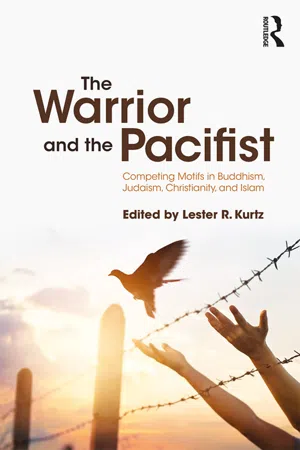
This book looks at two contradictory ethical motifs—the warrior and the pacifist—across four major faith traditions—Buddhism, Judaism, Christianity, and Islam—and their role in shaping our understanding of violence and the morality of its use. The Warrior and the Pacifist explores how these faith traditions, which now mutually inhabit our life spaces, bring with them across the millennia the moral teachings that have traveled from prehistoric humanity, embedded in the beliefs, rituals, and institutions socially constructed by humans to deal with ultimate concerns, core aspects of daily personal and social life, and life transitions.
eBook - ePub
The Warrior and the Pacifist
Competing Motifs in Buddhism, Judaism, Christianity, and Islam
- 342 pages
- English
- ePUB (mobile friendly)
- Available on iOS & Android
eBook - ePub
The Warrior and the Pacifist
Competing Motifs in Buddhism, Judaism, Christianity, and Islam
About this book
Information
1
Rethinking Religion and Violence
Violence moves back and forth in space, but also in time. Our rituals of violence—and moral legitimations of and objections to it—are diffused geographically and chronologically, within and across cultures and human history. At the core of our understanding of violence are the faith traditions that now mutually inhabit our life spaces. They bring with them across the millennia the moral teachings that have traveled from prehistoric humanity, embedded in the beliefs, rituals, and institutions socially constructed by humans to deal with ultimate concerns, core aspects of daily personal and social life, and life transitions.
The goal of this volume is to look at two contradictory ethical motifs—the warrior and the pacifist—across four major faith traditions—Buddhism, Judaism, Christianity, and Islam—and their role in shaping our understanding of violence and the morality of its use. Every era must wrestle with the issue of violence, but ours has a particular responsibility because our means of destruction are now god-like. For the first time, apparently, we have the ability to destroy not only our sworn enemies, but the ecosystem that sustains all life on our planet. Indeed, our struggle with violence has become not simply an individual or community concern, but an ultimate and universal one.
Buddhists have been addressing these issues for 2,500 years; they brought us together in Tokyo in spring of 2016 with generous funding from the Toda Foundation. Kevin Clements and Olivier Urbain selected and invited a group of scholars of religion and violence for an intensive session. Facilitated by Kevin Clements and Paula Green, we explored our differences and commonalities, our intellectual and personal responses and experiences with these two contradictory motifs. The chapters that follow grew out of that dialogue, combined with the years of research on this topic that the participants brought to the table.
A key feature of our understanding of violence is the idea of the ambivalence embedded in these motifs: humans tend to condemn and condone it at the same time, often using violence as a means for combating violence or punishing those who use it, as in incarcerating or executing criminals or military retaliations against invasions. This bi-valent—simultaneously positive and negative—attitude toward violence requires a distinction between good and bad violence, the legitimate and illegitimate. Those who choose violence, as does the warrior, are required to provide accounts for it, to others but also to themselves (see Bandura 1999).
That is where religious traditions enter the picture—the beliefs, rituals, and institutions of the faith traditions become major arbiters, either directly or indirectly, in the process of determining the ethical status of the decision to go to war and specific acts of war. What are the criteria for the “just” use of warfare and violence, and what are the taboos around its use?
As I argue in the final chapter of this book, both warrior and pacifist motifs and paths of action present serious dilemmas. The warrior is faced with taboos against killing that run through the world’s ethical traditions, and what appear to be some inherent tendencies among humans (and other animal species) to avoid killing their own (Grossman and Siddle 2008). The clearest evidence of this dilemma is the phenomenon now identified as Post-Traumatic Stress Disorder (PTSD) or, more precisely, Perpetrator-Induced Traumatic Stress (PITS; see MacNair 2002, forthcoming).
Gandhi tries to address these dilemmas by paradoxically combining the warrior and the pacifist in the nonviolent activist, who fights like the warrior but—like the pacifist—avoids harming.
Religion and Conflict1
A primary feature of religion’s role in a conflict is that it can intensify adversarial dynamics and lead to violence … or committed, radical nonviolence. In both cases, people are willing to sacrifice themselves—and others—when participants turn to violence. As Georg Simmel notes, the intensity of religious conflict is related to the fact that the parties to the dispute view themselves as
representatives of supraindividual claims, of fighting not for themselves but only for a cause, [which] can give the conflict a radicalism and mercilessness which find their analogy in the general behavior of certain very selfless and very idealistically inclined persons. Because they have no consideration for themselves, they have none for others either; they are convinced that they are entitled to make anybody a victim of the idea for which they sacrifice themselves.
(Simmel 1971: 87)
All conflict is relational, whether carried out by violent or nonviolent means; as Simmel (1971; cf. Kurtz 2005) notes, conflict is an intense form of interaction that often brings people together, even when the valence of the relationship is negative. Sheldon Ekland-Olson (2012, 336) observes that there is a “paradox of community in which the ties that bind us together become the ties that keep us apart.”
Religion is often the content of a conflict, though not its basis (Kurtz 2005). The conflict may be political, economic, class-based, familial, or even psychological, but religious issues become the content around which the conflict evolves and how it is articulated by the partisans. When fighting breaks out between Protestants and Catholics in Northern Ireland, or Hindus and Muslims in India, the conflict is as much economic as religious, even when it is framed by the media, politicians, or participants as religious. Conflicting parties and the media that report on them need an issue on which to focus their disagreement, especially if it is diffuse, complex, or particularly self-serving. Religion often provides potent content for battles, because it acts as a catalyst and can therefore change the properties of social forms, such as relationships. Moreover, if the cause is sacred—rather than self-interested or profane—it is easier to justify violence against the adversary or self-sacrifice in nonviolent resistance. Religious symbols become a lightning rod for conflict, as the 2017 burning cross of the KKK has in Charlottesville, Virginia.
Sometimes conflicts are truly religious, even when they contain other elements, and the conflict itself is sacralized. These conflicts often appear intractable, because adversaries invest so much of themselves and their identity in the conflict itself and its outcome that they will risk everything to perpetuate or escalate it until they win or lose. Religious controversy shares many characteristics with conflict in general, but has its own uniquenesses. First, because it deals with “unrestricted values” (Cavanagh 2009) or “ultimate concerns” (Tillich 1957), it is charged with great passion and meaning, and takes place on an abstract level. Second, religious conflicts are carriers and concealers of other forms of conflict. Sacred conflicts are likely to be extremely passionate, and are ironically those most likely to be carried out for profane purposes. It is not just the most holy causes that provoke religious conflict: the intensity of reaction provoked by a truly dastardly deed means that the act requires an exceptional account. Evil deeds therefore require sacred legitimation if the perpetrator is to avoid punishment or self-sanctioning (Bandura 1999; Kurtz 2005).
The more visible religious conflicts—or conflicts carried by religion—often recruit warriors committed to using violence to carry them out, but the same is true of nonviolent conflicts and even pacifism, both of which require a commitment that has religious characteristics even when not represented in the traditional language and rituals of a faith tradition. A Mohandas K. Gandhi, Martin Luther King, Jr., or Dorothy Day have an intense commitment to action and self-sacrifice that rivals that of any warrior. Long-term nonviolent campaigns are often sustained between major public events like mass demonstrations, strikes, and boycotts, by people of faith who work from a long-term, sometimes even “other-worldly” perspective, and their discipline and energy are motivated by their belief in a higher power, which often gives the conflict staying power.
The Plan
In the chapters that follow, we journey through the four major faith traditions of Buddhism, Judaism, Christianity, and Islam, then explore some trans-tradition approaches to peacebuilding and interfaith dialog. In my concluding chapter I draw upon the other contributions and fold them into my own research on this topic, which focuses on Gandhi’s efforts to address the warrior-pacifist dilemmas. Collectively, we hope to make a contribution to our understanding of this tension between the warrior and the pacifist with and across the traditions that we have now all inherited and that exist in the space we collectively inhabit.
We begin with Buddhism, generally perceived as the most peaceful of these traditions. The Buddha seems quite clear in his condemnation of violence, even hatred. In verse 5 of the Dhammapada, the Buddha says, “Hatred does not cease through hatred at any time. Hatred ceases through love. This is an unalterable law” (see Bodhipaksa 2015 for a discussion of its various translations).
Iselin Frydenlund challenges that common perception of Buddhism as pacifism, however, in her chapter, “Buddhism and Violence: An Oxymoron?” At times—especially when the community itself is threatened—even the Buddha appears to sanction violence in self-defense, a contradiction of his apparent pacifism that subsequent Buddhists have singled out to justify their use of violence. Frydenlund begins with monastic support for state violence in the Sri Lankan civil war, and then explores both canonical and traditional sources regarding the use of force in public affairs. She concludes that nonviolence is crucial in the tradition, especially for self-understanding, but that Buddhist ethics is particularistic and there is no systematized treatment of whether and when force and war are justified. Instead, various narratives in the Buddhist canon and literature play a crucial role as “discursive sites” where the use of force is often discussed as a necessary evil and the nonviolent state is only an ideal.
The other two chapters on the Buddhist tradition are more concerned with how contemporary Buddhists are addressing the causes of violence through a movement of “Engaged Buddhism.” Paula Green’s “Visions, Vitality, and Values of an Emerging Practice” provides an overview of that movement and how it places greater emphasis on the social implications of a tradition that has focused more on individual spirituality. She discusses its history and some key figures, noting how they emphasize the social implications of the Buddha’s teachings, and the role of such practices as meditation, mindfulness, sharing of authority, and reflective thinking in addressing problems of violence. In “Aspects of Social Engagement Within the Southeast Asian Buddhist World,” Jordan Baskerville and Somboon Chungprampree focus especially the part of that movement in which they are themselves involved. (Chungprampree serves as executive director of the International Society of Engaged Buddhists). The INEB attempts to apply the teachings of the Buddha on “overcoming suffering through the cultivation of ethics, wisdom and compassion” (Baskerville and Chungprampree) in the contemporary world, sometimes very concretely, as with the creation of the International Forum on Buddhist-Muslim Relations, which has a website at www.facebook.com/buddhistmuslimforum.
All three chapters on the Jewish tradition explore what Tirzah Firestone calls its “intertwining threads” of war and peace over a 4,000-year history. Stories of retribution and injunctions to conquer, annihilate, and kill in self-defense exist side by side with the principle that life must be saved at all costs. Murder is forbidden because humans are created in the Divine image, an idea that “provides the foundation for human rights and social justice within Western civilization.” Paul Scham identifies the uniqueness of Jewish thought on these issues, since it was purely theoretical during most of its long history, laying the groundwork for its spiritual descendants, Christianity and Islam. Noam Zion explores the complicated efforts to apply that abstract tradition in the real world, with the Israeli Defense Force’s (IDF) mixed effort to set limits on the use of force. The IDF uses the term “purity of arms” in an honor code designed to set legal limits on the use of force by Israeli soldiers in “ambiguous and dangerous field conditions.” Rather than evaluate how effectively this code works in practice, he explores the ways in which soldiers are given “non-militaristic virtue education” designed to cultivate a “warrior ethos that teaches compassion rather than vengeance.”
Nigel Biggar explores a similar idea in Christianity, with centuries-long efforts to set boundaries on the use of violence with a “just war” tradition that specifies when and how violence might be employed. He develops a carefully documented critique of the idea of Jesus as a pacifist by analyzing a major advocate of that position, Richard Hays (1996), and his book The Moral Vision of the New Testament. Biggar concludes that “the New Testament does not bear Richard Hays’ pacifist reading” and that “Christian opinion and practice in the early church were divided at least from the end of the second century.” The church does not go as far as the Israeli Defense Force’s “purity of arms,” however; Biggar contends that “Christian just warriors agree with their pacifist confreres that vengeance is not a proper motive for fighting” and that “the idea of a morally pure war” is not what the Christian “just war” doctrine means.
In order to round out the picture of Christianity in the volume, we have added a chapter from a different genre and by an author not attending our Tokyo gathering, but a piece most relevant to the task of this volume: Pope Francis’s message on World Peace Day, New Year’s Day, 2017. Although he ties his message firmly to previous papal and official pronouncements, he takes on not only war, as previous popes have done, but violence itself, and provides some good sociological analysis of what he calls “a horrifying world war fought piecemeal.” Moreover, he contends,
we know that this “piecemeal” violence, of different kinds and levels, causes great suffering: wars in different countries and continents; terrorism, organized crime and unforeseen acts of violence; the abuses suffered by migrants and victims of human trafficking; and the devastation of the environment.
What is the solution? It is not more violence, the pontiff declares: “Violence is not the cure for our broken world. Countering violence with violence leads at best to forced migrations and enormous suffering.” That path leads to “death, physical and spiritual, of many people, if not all.”
Instead, Pope Francis insists, the answers to the problem of violence lie with active nonviolence, which he finds consistent with the teachings of Jesus. “To be true followers of Jesus today also includes embracing his teaching about nonviolence,” he says, including the love of enemies, which is the nucleus of the Christian revolution, citing his predecessor Pope Benedict. Pope Francis does not mince words: “Violence profanes the name of God.”
Joseph Camilleri’s “Christianity and Islam in an Age of Transition: Violence or Healing” bridges our exploration of Christianity with that of Islam, situating the high-stake issue of the role of religion in a context of profound transition, one characterized by the “globalisation of insecurity” (Camilleri and Falk 2009). In addressing such questions as “Can it help to establish the normative foundations for a peaceful and ecologically sustainable world order?,” he compares two core traditions in this quest: Christianity and Islam. Camilleri observes that “the most serious shortcoming of just war principles is their elusiveness. They don’t easily translate into a coherent course of action either for the individual or the polity,” and notes that the two traditions share many of the same ambiguities. Mainstream Christianity has ample examples of the condemnation of warfare, however, and despite the acceptability of force under strict circumstances in Islam, “the weight of Islamic scholarship across the different jurisprudential schools portrays Islam as a religion deeply committed to justice and peace.”
All three chapters focusing on the Islamic tradition emphasize the peaceful and nonviolent possibilities of Islam, without ignoring obstacles and misunderstandings surrounding the tradition. Two of the authors are veterans of what we might call the “Islam as nonviolent” school; the third is an eloquent newcomer to the scholarly literature. Afra Jalabi, a native Arab speaker, suggests that
the word Islam, often mistranslated as “submission,” could more accurately be translated as peace-activation or peace-making, since it is a verb noun referring to the active moving or spreading of peace. In contrast, the word for submission, which in Arabic is Isstislam, which is a state of peacefulness that has been imposed externally.
A Muslim, however, is “an active peacemaker;” to be a Muslim “in the pure grammatical sense, is to be an active agent of peace,” which is why “nonviolence is a central teaching in the Quranic text as well as compatible to Muhammad’s own conduct.” In her chapter, Jabali then focuses “on some nonviolent possibilities often hidden in the buried trenches of our victorious religious histories and narratives.” We all “tend to exoticize others while redeeming our own cultural and religious practices,” so that paradoxically “we are the same in rejecting our sameness.” All four traditions in this volume are, she claims, “about breaking free from attachments,” and offer “liberation from false beliefs.”
In the Qur’an, according to Jabal...
Table of contents
- Cover
- Title
- Copyright
- Contents
- Note on Contributors
- Foreword
- 1 Rethinking Religion and Violence
- Part I The Buddhist Tradition
- Part II The Jewish Tradition
- Part III The Christian Tradition
- Part IV The Islamic Tradition
- Part V Addressing the Issues Cross-Culturally
- Index
Trusted by 375,005 students
Access to over 1.5 million titles for a fair monthly price.
Study more efficiently using our study tools.
Frequently asked questions
Yes, you can cancel anytime from the Subscription tab in your account settings on the Perlego website. Your subscription will stay active until the end of your current billing period. Learn how to cancel your subscription
No, books cannot be downloaded as external files, such as PDFs, for use outside of Perlego. However, you can download books within the Perlego app for offline reading on mobile or tablet. Learn how to download books offline
Perlego offers two plans: Essential and Complete
- Essential is ideal for learners and professionals who enjoy exploring a wide range of subjects. Access the Essential Library with 800,000+ trusted titles and best-sellers across business, personal growth, and the humanities. Includes unlimited reading time and Standard Read Aloud voice.
- Complete: Perfect for advanced learners and researchers needing full, unrestricted access. Unlock 1.5M+ books across hundreds of subjects, including academic and specialized titles. The Complete Plan also includes advanced features like Premium Read Aloud and Research Assistant.
We are an online textbook subscription service, where you can get access to an entire online library for less than the price of a single book per month. With over 1.5 million books across 990+ topics, we’ve got you covered! Learn about our mission
Look out for the read-aloud symbol on your next book to see if you can listen to it. The read-aloud tool reads text aloud for you, highlighting the text as it is being read. You can pause it, speed it up and slow it down. Learn more about Read Aloud
Yes! You can use the Perlego app on both iOS and Android devices to read anytime, anywhere — even offline. Perfect for commutes or when you’re on the go.
Please note we cannot support devices running on iOS 13 and Android 7 or earlier. Learn more about using the app
Please note we cannot support devices running on iOS 13 and Android 7 or earlier. Learn more about using the app
Yes, you can access The Warrior and the Pacifist by Lester R. Kurtz in PDF and/or ePUB format, as well as other popular books in Social Sciences & Religion, Politics & State. We have over 1.5 million books available in our catalogue for you to explore.