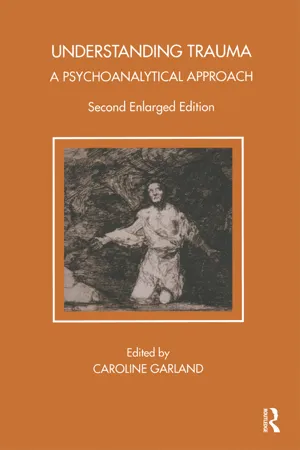
- 256 pages
- English
- ePUB (mobile friendly)
- Available on iOS & Android
eBook - ePub
About this book
Revised edition with additional chapter. This book, from the Tavistock Clinic Series, is about what follows the breakdown in functioning, either short or longer-term, provoked by a traumatic event. The authors offer a psychoanalytical understanding of the meaning of the trauma for an individual, illuminating theory with detailed clinical illustration and case histories. A range of therapeutic procedures is described.Major disasters draw attention forcibly to their effects on the survivors. Less often recognised are the long-term after-effects of the huge number and variety of more private events, either accidental or deliberately inflicted, on an individual's subsequent emotional and working life. This book is about what follows the breakdown in functioning, either short or longer-term, provoked by a traumatic event.What is distinctive about this book is that its authors offer a psychoanalytical understanding of the meaning of the trauma for an individual, illuminating theory with detailed clinical illustration and case histories. They show the process of treatment as their patients restore meaning to their lives, moving towards a new integration in which the event becomes a part of the whole, no longer dominating either waking or sleeping life. A range of therapeutic procedures is described, including a short series of individual consultations, groups and full analysis. A challenging and innovative work, rooted in psychoanalysis, this collection thoughtfully describes in detail the work for the Unit for the Study of Trauma and its Aftermath in the Adult Department of the Tavistock Clinic.
Information
Part One
Introduction
Introduction
Why psychoanalysis?
Caroline Garland
Nearly a dozen years ago, in 1986, six students who were qualifying at the same time at the Institute of Psycho-Analysis were celebrating this event with a party. That same evening, the radio news and the television screens gradually filled up with the story and pictures of the sinking of the ferry, the Herald of Free Enterprise, off the coast of Belgium, with the loss under appalling circumstances of hundreds of lives. As the enormity of the disaster became apparent, it seemed increasingly important to us that our brand-new qualification in the field of mental health should be put to work outside as well as inside the consulting room; to have an direct application in the area of external relations as well as in the intrapsychic world of the individual. The next day, two of us travelled to Dover to offer whatever we could in the way of back-up, support, listening, expertise. What we saw and learned that day (including the blunt fact that 'helpers' arriving unasked at the scene of a catastrophe is by no means always helpful) was the first stage in the formation by one of us of what became, about eighteen months later, the Tavistock's Unit for the Study of Trauma and Its Aftermath.
This book collects together some of that Unit's subsequent work with a variety of cases. Its chapters are written by clinicians who share an interest in the understanding of trauma, all of whom work or have worked at the Tavistock, and been associated with the Unit's work in one way or another. What is distinctive about this book's approach, amongst the many that have been published on trauma and traumatic stress, is that it focusses upon a psychoanalytic approach to the treatment of traumatised states of mind. These are the mental states currently known in DSM-IV and ICD-10 as Post-Traumatic Stress Disorders, although they have had a long history under other names (Garland, 1993). Psychiatric and psychological advances in their treatment have played an important role in identifying and defining a typical clinical picture, making possible epidemiological research, and including work on co-morbidity, as well as opening the way for studies of therapeutic effectiveness. These approaches have burgeoned, particularly in the United States and particularly since the extent and nature of the long-term damage to Vietnam veterans has become increasingly visible.
However, this work (which is looked at in more detail in Chapter 3), although providing part of the background to our own approach, is less central to it than is an understanding of psychoanalysis. Our own theoretical framework is grounded in the work of Freud and Klein, believing that the impact of traumatic events upon the human mind can only be understood and treated through achieving with the patient a deep knowledge of the particular meaning of those events for that individual. This means we pay detailed attention to the childhood and developmental history, since we regard as crucial the way in which the earliest relationships not only shape later mental (and thus character) structure but have a continuing and active influence in the internal world. These early experiences with others will inevitably influence the nature of the severe psychic wounding that may be received in the traumatic collision with the external world — in part through determining how those events will eventually come to be construed; in part through determining through those same internal structures the extent and nature of the recovery that is possible. The psychoanalytic approach therefore investigates, and tries to shift or modify, these internal object relations and the corresponding state of the internal world, rather than focussing primarily upon symptomatology and classifiable mental disorder.
It is central to the psychoanalytic view that to be caught up in a severely traumatic event stirs up without fail the unresolved pains and conflicts of childhood. When it comes to treatment, to attempt to understand the creature of the present without regard to his or her past may sometimes work, but for most patients it achieves at best a temporary and chronically unstable quiescence of the more acute after-effects of the immediate trauma, increasingly, clinical findings indicate that events have to be remembered, rather than forgotten or put out of one's mind. This fact is becoming very clear, for example in the case of holocaust survivors (e.g. Jucovy, 1992; Wardi, 1992). In spite of their understandable wish to put the past behind them and to spare their loved ones the knowledge of the worst of what they have been through, it seems in many cases that areas of hidden or denied parental devastation becomes a burden that may have to be carried unconsciously by the children, even grandchildren of survivors.
This fact, and others like it, especially where unconscious mental processes are involved, are the outcome of the very structure of the human mind. They cannot be willed out of existence. Psychoanalysis tries to document and understand these phenomena. Thus we use a psychoanalytic approach to the understanding and treatment of trauma because it addresses directly what is felt to be most disturbing, intransigent and deeply-rooted in the individual's response. The trauma touches and disrupts the core of his identity; and to address that level of disturbance is not something that can be done quickly or lightly.
So, in our view, for traumatised individuals to get better, the knowledge and the memory of the events they have suffered may need to become pan of, and integrated into, the individual's conscious existence, through being worked through instead of being walled-up in some avoided area of mental activity. Their meaning for the individual has to be discovered, even achieved, so that the individual's response makes sense to him or her, and can be thought about, rather than the trauma's being dismissed as bad luck, a meaningless 'accident', or fate. The task of therapy is hard, since the extent of human destructiveness has to be faced, in some instances in both perpetrator and survivor. Yet in the internal world there is no such thing as an accident; there is no such thing as forgetting; and there is no such thing as an absence of hatred, rage or destructiveness (as well as, of course, good and loving feelings), in spite of the urge in survivors to attribute all badness to the world outside them that caused their misfortune. These issues are what this approach, and this book, is about.
Each chapter is designed to be read separately, in that each draws upon, and spells out briefly, those elements of psychoanalytic theory that are relevant to its immediate clinical subject. However the book also has an overall structure. It is divided into five sections. The first contains an introduction to psychoanalytic thinking about trauma that I have written as Editor, describing some of the broad issues that are important in the understanding and treatment of survivors. It is followed by an essay by David Bell on the subject of the unconscious causation and meaning of the ostensibly accidental in everyday life. Accident investigators these days are more ready to pay attention to the state of mind of the pilot, the captain, the navigator, or the driver, in the hours before the fatal error. Was he stressed? Had he been drinking? Had he quarrelled with his crew? However, David Bell addresses how hard it remains to get the issue of unconscious motivation and, even more so, human destructiveness, into the public domain and into public consciousness. Many individuals expose themselves as well as others, to potentially traumatic situations — by tempting fate, by going too close to the edge — over and above the kind of everyday risks that are inevitable and desirable if one is to have a life at all. In our view, and in our Unit's by now considerable experience, unconscious factors are crucial when it comes to understanding why this decision was taken and not that one, or why this particular safety precaution was pushed aside or overlooked on this particular occasion.
The second section describes the opening moves in the therapeutic encounter. It contains a detailed account by David Taylor of two initial consultations in which he shows the significance of the psychoanalytic framework in establishing the fullest and deepest meaning of an event for a particular survivor. Linda Young then describes the four-session therapeutic consultation that is offered to all the Unit's referrals, through an account of the growing understanding achieved by both therapist and patient as the patient's reaction to a murderous assault upon him is described and elucidated.
At the end of the four-session consultation, most of those who come to the Unit are then offered the possibility of further treatment — for the individual, not for the trauma — and many accept it, recognising that the major upheaval provoked by the traumatic event in their internal, as well as external worlds, is not something that can be adjusted to quickly or easily if they are to make a good working recovery. Recovery is seen by the Unit as the capacity to get on with it, and in reasonably good spirits, rather than to get over it. The survivor can never be restored to his pre-trauma state (Garland, 1991). A traumatic event changes those who suffer it, and all change involves loss. As Isabel Menzies-Lyth (1989) points out, in the paper first given to the first of the Unit's termly conferences on trauma, survivors have much in common with the bereaved. 'He must mourn for something he has lost of himself. "I am not the person I was: I will never be the same again." The question, however, is whether in the end the survivor will be less of a person than before, a more disturbed person, or whether he can become more of a person, the disaster becoming a focus for growth.'
The third section of this book describes that very process, the struggle in once-weekly, psychoanalytically-informed treatment to become more, rather than less of a person, following a variety of extremely painful events. In Chapter 5, Linda Young and Elizabeth Gibb take up the difficult issue of grievance as it is encountered in certain survivors, often pre-dating the trauma developmentally, but equally often given fresh impetus by the trauma in the present. The consequences for treatment are serious, since the survivor's sense that his grievance (namely that his life has been altered in deeply unpleasant ways) can never satisfactorily be addressed or understood can be an overwhelming obstacle to change. Here, Graham Ingham's and Elizabeth Gibb's papers are central, since they describe through clinical material the work of mourning that has to be achieved if change and growth is to be set in motion. In my own chapter in this section i have addressed two further issues: first, the powerful adhesions that can develop between the trauma of the present and certain features of the individual's early history, particularly when the trauma is felt to provide confirmation of early phantasies; and second, the way in which these links can then be hard to shift because of the damage done by the traumatic event to the survivor's capacity to symbolise. Symbolisation is felt, following Segal (1957), to be the basis of a capacity for flexible thought, for the transformation of unassimilatable material into something more manageable, and ultimately for the capacity to mourn and move on. Finally in Chapter 9 Shankarnarayan Srinath describes, both through theory and through clinical illustration, the great significance of issues of identification for the understanding of the impact of trauma.
Two further papers by Nicholas Temple and David Bell form the fourth section of the book, both containing accounts of work with patients in five-times weekly analysis. Analysis offers a unique opportunity for study of the way in which traumatic early relationships affect the development of adult personality and vulnerabilities. Nicholas Temple's paper describes the treatment of a patient with many borderline features to her personality. He provides a detailed account of these processes in action, supplementing much of the recent work in psychiatry and forensic psychotherapy on the causal link between serious childhood traumata and the development of a borderline personality disorder. The final section broadens the picture, taking the Unit's work out into the community. I describe two pieces of work with entire groups that suffered traumatic events and subsequently asked for help. This work, a combination of an organisational and a group-therapeutic approach, is an important part of the Unit's work.
The book as a whole, as must be clear from this Introduction, is based upon the clinical therapeutic encounters that are the daily work of the Unit. Out of them has grown our understanding and respect for what has already been described by psychoanalytic writers of the past. To this body of work we have hoped to add our own clinical contributions, through careful and detailed attention to the stories that our patients have brought us, to the manner in which they have done so, and through our own thinking about the significance of what we have seen and heard, both for them as individuals and for the understanding of trauma in general.
1
Thinking About Trauma
Caroline Garland
What is a Trauma?
Trauma is a kind of wound. When we call an event traumatic, we are borrowing the word from the Greek where it refers to a piercing of the skin, a breaking of the bodily envelope. In physical medicine it denotes damage to tissue. Freud (1920) used the word metaphorically to emphasise how the mind too can be pierced and wounded by events, giving graphic force to his description of the way in which the mind can be thought of as being enveloped by a kind of skin, or protective shield. He described it as the outcome of the development in the brain (and therefore mind) of a highly selective sensitivity to external stimuli. This selectivity is crucial: shutting out excessive amounts and kinds of stimulation is even more important, in terms of maintaining a workable equilibrium, than is the capacity to receive or let in stimuli.
For infants and young children, when all goes well, that filtering function is largely served by the mother, or primary caretaker, through her sensitivity to what her baby is able to manage at any particular time. She acts to protect her baby from the extremes of experience, both environmental and emotional. Adults are in a different position. Some will have built up inside themselves, partly as the outcome of good parental provision, a capacity to take care of themselves in the best meaning of that phrase. Others will have been unable to achieve this degree of autonomy. Still others, for a variety of complex internal reasons, will actively seek out situations of risk, or extremes of stimulation, whether for positive or at least comprehensible reasons, or in more darkly self-destructive ways. Yet however well any individual feels he is normally able to take care of what he feels to be his own well-being, some events will overwhelm that capacity, will knock out ordinary functioning and throw the individual into extreme disarray. Much of the immediate disturbance and confusion is visible to the observer but eventually it extends far beyond the visible, into the depths of the individual's identity, which is constituted by the nature of his internal objects - the figures that inhabit his internal world, and his unconscious beliefs about them and their ways of relating to each other.
Not all traumatic events of course are that devastating. Sometimes one can see the mind engaged in protecting itself from the potential rent in its own fabric by engaging in a variety of defensive strategies. A man who slipped and fell on some icy steps outside his own front door and broke his ankle clearly heard the radiologist say that it was broken, but he 'knew' the radiologist was mistaken: he 'knew' it was only a sprain. Half an hour later, when the shock of the event had somewhat subsided, he was able to acknowledge that it was indeed broken and that he would be spending Christmas with his foot in plaster. This man was denying the extent of the damage so that he could absorb the news more gradually, at a pace that he could manage without feeling overwhelmed.
Sometimes when a piece of reality is felt to be quite unmanageable, the defence is correspondingly extreme. Freud (1924), talking about the route into psychosis, describes the genesis of delusions: 'a fair number of analyses have taught us that the delusion is found applied like a patch over the place where originally a rent had appeared in the ego's relation to the external world.' In a vulnerable character, the delusional 'patch' is clung to and embroidered to avoid the breakdown that would follow if the reality were admitted. A woman who had always had some difficulty accepting the exigencies of reality learned of the death of the youngest of her five children abroad. She was unable to deal with this agonising fact. She believed that he was alive, and that she was the victim of a police conspiracy designed to prevent her from discovering the hospital he had been taken to. Gradually the patch came to take over her whole functioning. She was unable to maintain relations with her older children who were themselves desperately upset not only by the loss of their brother, but also by what effectively became the loss of their mother. Thus the fear of one kind of breakdown, with which she could in time have been helped, was replaced by a more severe and more intractable breakdown in her functioning, in which all help was rejected - to accept it would have been to acknowledge the delusional nature of her belief that the boy was still alive.
So a traumatic event is one which, for a particular individual, breaks through or overrides the discriminatory, filtering process, and overrides any temporary denial or patch-up of the damage. The mind is flooded with a kind and degree of stimulation that is far more than it can make sense of or manage. Something very violent feels as though it has happened internally, and this mirrors the violence that is felt to have happened, or indeed has actually happened, in the external world. There is a massive disruption in functioning, amounting to a kind of breakdown. It is a breakdown of an established way of going about one's life, of established beliefs about the predictability of the world, of established mental structures, of an established defensive organisation. It leaves the individual vulnerable to intense and overwhelming anxieties from internal sources as well as from the actual external events. Primitive fears, impulses and anxieties are all given fresh life. Trust in the fundamental goodness of one's objects, that is to say the world itself, is shattered - who after all let this terrible event happen? Failed to protect you from it? Worse, might even have wished for or provoked it? Loss of a belief in the predictability of the world, and in the protective function of one's good objects, both internal and external, will inevitably mean a resurgence of fears about the cruelty and strength of bad objects. There is a rapid slide into primitive paranoid beliefs about one's status in the world. Crucially, the anxieties coincide: the external event is perceived as confirming the worst of the internal fears and phantasies - in particular the reality and imminence of death, or personal annihilation, through the failure of those good objects (internal and external) to provide protection from the worst.
Thus a trauma is an event which does precisely this: overwhelms existing defences against anxiety in a form which also provides confirmation of those deepest universal anxieties. The damage done, more often than not, is neither trivial nor temporary. Some kind of help is therefore important, whether arrived at fortuitously or sought out, intentional and organised.
Although Freud's description of the way in which such events breach the protective shield is an important, indeed necessary, part of understanding trauma, it is not on its own, as I have already suggested, sufficient. It still has a mechanistic quality. It describes the breakdown in the smooth running of the machinery of mind, but not the collapse of meaning: the failure of belief in the protection afforded by good objects, and from that point onwards the longer-term consequences for the entire personality.
In the Trauma Unit's Workshop, we have come to think of the ensuing processes as the transformation of the traumatic event, whatever it might have been, into a shape that is recognisable as an existing form of internal object relationship. Since an object-relations perspective in psychoanalysis believes that all events are attributable to some notion of an agent held to be responsible for them, for both good and ill, a traumatic event, not surprisingly, is attributed to some very noxious agent indeed. As I have said, the event provides confirmation of the most persecutory of unconscious phantasies about one's objects, even the world itself. The internal good object that one believed one might turn to for protection or for help has been revealed to be careless, or unconcerned, or worse, malignant. Bion (1962) points out how a hunger pain is interpreted by the infant not as the absen...
Table of contents
- Cover
- Half Title
- Title
- Copyright
- Contents
- Preface
- Acknowledgements
- Contributors
- Part One Introduction
- Part Two Assessment and Consultation
- Part Three Treatment in Psychoanalytic Psychotherapy
- Part Four Psychoanalysis
- Part Five Groups
- Suggestions for Further Reading
- Bibliography
- Index
Trusted by 375,005 students
Access to over 1.5 million titles for a fair monthly price.
Study more efficiently using our study tools.
Frequently asked questions
Yes, you can cancel anytime from the Subscription tab in your account settings on the Perlego website. Your subscription will stay active until the end of your current billing period. Learn how to cancel your subscription
No, books cannot be downloaded as external files, such as PDFs, for use outside of Perlego. However, you can download books within the Perlego app for offline reading on mobile or tablet. Learn how to download books offline
Perlego offers two plans: Essential and Complete
- Essential is ideal for learners and professionals who enjoy exploring a wide range of subjects. Access the Essential Library with 800,000+ trusted titles and best-sellers across business, personal growth, and the humanities. Includes unlimited reading time and Standard Read Aloud voice.
- Complete: Perfect for advanced learners and researchers needing full, unrestricted access. Unlock 1.5M+ books across hundreds of subjects, including academic and specialized titles. The Complete Plan also includes advanced features like Premium Read Aloud and Research Assistant.
We are an online textbook subscription service, where you can get access to an entire online library for less than the price of a single book per month. With over 1.5 million books across 990+ topics, we’ve got you covered! Learn about our mission
Look out for the read-aloud symbol on your next book to see if you can listen to it. The read-aloud tool reads text aloud for you, highlighting the text as it is being read. You can pause it, speed it up and slow it down. Learn more about Read Aloud
Yes! You can use the Perlego app on both iOS and Android devices to read anytime, anywhere — even offline. Perfect for commutes or when you’re on the go.
Please note we cannot support devices running on iOS 13 and Android 7 or earlier. Learn more about using the app
Please note we cannot support devices running on iOS 13 and Android 7 or earlier. Learn more about using the app
Yes, you can access Understanding Trauma by Caroline Garland in PDF and/or ePUB format, as well as other popular books in Psychology & History & Theory in Psychology. We have over 1.5 million books available in our catalogue for you to explore.