- 272 pages
- English
- ePUB (mobile friendly)
- Available on iOS & Android
eBook - ePub
About this book
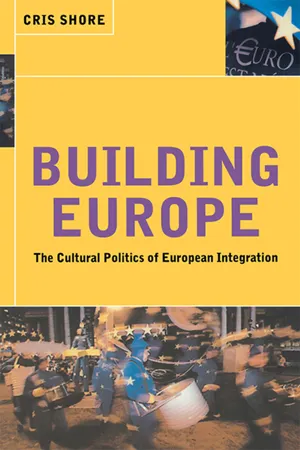
The development of the European Union has been one of the most profound advances in European politics and society this century. Yet the institutions of Europe and the 'Eurocrats' who work in them have constantly attracted negative publicity, culminating in the mass resignation of the European Commissioners in March 1999.
In this revealing study, Cris Shore scrutinises the process of European integration using the techniques of anthropology, and drawing on thought from across the social sciences. Using the findings of numerous interviews with EU employees, he reveals that there is not just a subculture of corruption within the institutions of Europe, but that their problems are largely a result of the way the EU itself is constituted and run. He argues that European integration has largely failed in bringing about anything but an ever-closer integration of the technical, political and financial elites of Europe - at the expense of its ordinary citizens.
This critical anthropology of European integration is essential reading for anyone with an interest in the culture and politics of the EU.
Information
Part I
Inventing Europe
1 Forging a European nation- state? The European Union and questions of culture
The world of culture clearly cannot remain outside the process of completion of the big European internal market: that process demands the formation of a true European culture area.
Introduction: transcending the nation-state in Europe?
In his introduction to the European Commission’s mass-circulation booklet entitled A Citizen’s Europe, Pascal Fontaine1 sets out what he sees as the rationale and moral foundation for the European Union (EU).2 ‘It is an experiment whose results are of universal significance, an attempt to establish between States the same rules and codes of behaviour that enabled primitive societies to become peaceful and civilised’ (Fontaine 1993: 6). According to the Commission, the EU exists first and foremost ‘to build peace’. This objective, together with the idea of creating a new kind of ‘supranational’ political order in Europe, is enshrined in the founding Treaties of the European Economic Community (EEC). As the preambles to the 1957 Treaty of Rome and 1951 ECSC Treaty state, the aim is ‘to lay the foundations for an ever closer union among the peoples of Europe’, and even
to substitute for age-old rivalries the merging of their essential interests; to create, by establishing an economic community, the basis of a broader and deeper community among peoples long divided by bloody conflicts; and to lay the foundations for institutions which will give direction to a destiny henceforward shared.
From the outset, these goals have embodied a supranational and federalist logic, however controversial these terms may be in some EU member states. Subsequent treaties may have removed or disguised the emotive word ‘federalism’ from their final texts, as was the case in 1991 with the Maastricht Treaty,3 but a federalist vision of Europe has been implicit in the ethos and organisational structures of the European Community ever since its creation. As Konrad Adenauer, chancellor of the Federal Republic of Germany and one of the signatories to the Treaty of Rome, wrote of the 1950 Schuman plan: ‘I was in full agreement with the French government that the significance of the Schuman proposal was first and foremost political, not economic. This plan was to be the beginning of a federal structure of Europe.’4 The aim in 1951, as today, was to bind Europe’s nation-states into a federal political system.
Underlying this objective were a series of political and cultural assumptions about the causes of war and the future of European societies that are intrinsic to the EU’s conception of history. According to the European Commission, the antithesis of peace and the major obstacle to European integration is the continuing presence of the nation-state and its allied ideology of nationalism. ‘What alternative is there for the citizens of the new greater Europe’, Fontaine asks rhetorically, ‘but a return to nationalism, insecurity and instability, if they opt for any course other than union and solidarity?’ Quoting Jean Monnet, one of the Community’s ‘founding fathers’ and ‘visionary statesmen’, he declares: ‘We are not forming coalitions between States but union among peoples’. For the Commission, integration is not simply about the elimination of barriers to trade or the free movement of capital, goods and labour. Rather, it is primarily a ‘humanistic’ enterprise involving a ‘coming together’ among peoples of different national cultures. This is the reason, Fontaine claims, that the creation of a ‘people’s Europe’ became the Commission’s ‘avowed political objective in the 1970s’ (Fontaine 1993: 7).
These comments highlight an issue of major importance not only for EU officials and supporters concerned with furthering European integration, but also for historians and social scientists interested in the future of the nation-state. According to EU policy-makers, the European Union has created an institutional framework for what is, in effect, a new kind of pan-European political architecture that will transcend the old international order based on competitive nation-states. While the ideal of a Europe close to its well-informed citizens united by shared cultural values and a sense of belonging to a ‘common European homeland’ has long been part of the raison d’être and moral foundation of the European Union, the idea of creating a pan-national ‘People’s Europe’ emerged only relatively recently as a political issue. However, this raises the fundamental question of whether a ‘supranational community’ or ‘European nation – state’ is possible. Anthony Smith (1991; 1992a; 1992b) has argued that most previous pan-national movements failed to achieve their political goal of unification largely because of deficiencies in the cultural field, which in turn stemmed from the poor state of their communications technologies. But given the nature of mass communications today the opportunities for superseding the nation-state and creating cultural pan-nationalism in Europe are immeasurably greater than in the past. If there is a basis for transcending the nation-state, Smith adds, it is located in the ‘patterns of European culture’ and ‘in traditions like Roman law, Greek philosophy and science, Hebraic ethics and Christian theology, as well as their Renaissance and Enlightenment successors’. These traditions have permeated the European continent to produce a ‘European culture-area’ or ‘family of cultures’ (Smith 1993: 133).5
What is striking about these remarks is their similarity to official EU discourses on ‘European culture’ (Shore 1996; 1998). However, unlike European Union officials, Smith concludes that despite these unifying elements any attempt to create a supra-national community in Europe is unlikely to succeed on the social and cultural levels:
Of course, one can forge supra-national institutions and create economic and political unions, as Bismarck did for the German states. But this frequently cited parallel contains an obvious flaw. Language and historical memories, as well as myths of ethnic descent, united the population of the German states; the same factors divided the peoples of Europe.
In Smith’s opinion, ‘national identity’ derives from a deep-rooted sense of ethnic community whereas ‘European identity’ appears as a relatively superficial and ineffectual force: a Utopian dream of intellectuals and idealists with little chance of mobilising mass consciousness. Ernest Gellner gives a more subtle twist to this idea, arguing that a sense of national identification, although in historical terms a recent phenomenon, has become intrinsic to the modern subject:
The idea of a man without a nation seems to impose a strain on the modern imagination . . . A man must have a nationality as he must have a nose and two ears. All this seems obvious, though, alas, it is not true. But that it should have come to seem so very obvious is indeed an aspect, perhaps the very core, of the problem of nationalism. Having a nation is not an inherent attribute of humanity, but it has now come to appear as such.
European integration and the problem of identity
Smith and Gellner in their different ways highlight the problem confronting EU officials and policy-makers in their attempt to achieve ‘ever closer union among the peoples of Europe’: how to transform the heterogeneous and traditionally fiercely nationalistic peoples of Europe into Europeans? For EU officials, the challenge is to find a European alternative to the axiomatic and hegemonic grip that the nation-state continues to hold over the minds of the peoples of Europe. As Gellner (1983) argues, the focus of political loyalties in modern societies is no longer to a monarch or land or faith but rather to a culture.
This is the dilemma confronting EU officials and politicians today: the Single European Act of 1987 and the Maastricht Treaty of 1992 have laid the economic and legal foundations for what has become in effect, an embryonic ‘European state’. As Goldstein (1993: 122-3) described it, this was to be ‘the first transnational state of the nuclear era’ which, when completed, ‘would rank among the legends of world history’. However, if it is a new state, it is a state ‘without a European nation, since there is still no European mass media, parties, interest groups (except in business), or public’ (Hoffman 1993: 31). Unlike most nation-states, what the EU conspicuously lacks is a common culture around which Europeans can unite. There is no popular ‘European consciousness’ to rival that of the nation-state or lend support to those economic and legal foundations. Moreover, those cultural elements which give unity and coherence to existing national identities (such as shared language, history, memory, religion) tend to divide rather than unite fellow Europeans. The problem recalls Massimo d’Azeglio’s comment following Italian unification in 1870: ‘we have made Italy: now we must make Italians’.6 Despite the massive transfer of regulatory and decision-making powers from the nation-states to the European Union, there has been no corresponding shift in popular sentiment or political loyalty.
Until the 1980s, public support was not a high priority for EU political elites. Their attitude was summed up by Pascal Lamy, Jacques Delors’s chef de cabinet and powerful political fixer: ‘The people weren’t ready to agree to integration, so you had to get on without telling them too much about what was happening’.7 This characteristically dirigiste approach was heavily influenced by traditional ‘neo-functionalist’ theories of integration. These assumed that political and social integration would follow automatically from economic and legal integration, almost as a by-product of the measures required for building the European Economic Community (EEC) and the single market. Over four decades ago, Ernst Haas posed the question of whether political actors in the member states could be ‘be persuaded to shift their loyalties, expectations and political activities towards a new centre, whose institutions possess or demand jurisdiction over pre-existing national states’ (Haas 1958: 16). The neofunctionalist answer was that the public’s loyalty to the emerging European institutions would grow as each successive step towards political union demonstrated the economic benefits to be gained by further integration. This ‘instrumental loyalty’, so the argument went, would provide sufficient ‘permissive consensus’ to enable each subsequent step towards ever-closer union to be implemented. Prosperity and the success of the integration process itself would therefore fuel and legitimise further progress towards, and public acceptance of, political unification.
European integration, to date, has been an elite-led, technocratic affair orchestrated primarily by ‘a small layer of key politicians and civil servants’ with little reference to the ‘citizens of Europe’ in whose name it justifies its existence (Hoffman 1995: 235). This harsh assessment is not confined to critics and opponents of the European Union. According to the Reflection Group which prepared the 1996 Intergovernmental Conference, ‘the Union’s principle internal challenge is to reconcile itself with its citizens’ and ‘ensure that European construction becomes a venture to which its citizens can relate’ (Reflection Group 1995: 2, 1). However, it also recognised that public dissatisfaction with the EU has arisen from
a high level of unemployment. . . social rejection and exclusion, the crisis in relations between representatives and those represented . . . the European Union’s growing complexity and the lack of information on, and understanding of, its raison d’être . . . [problems which] are receiving no satisfactory response from the Union because of the gaps or shortcomings in its mechanisms.
Seldom has the EU appeared so unpopular or irrelevant to the needs of its citizens. These views were echoed in Jacques Santer’s first speech to the European Parliament in Strasbourg as Commission President when he warned that ‘the future of the Community can no longer remain the prerogative of a select band of insiders’ (Santer 1995: 4). This, however, is precisely how many people perceive the EU. The high rate of voter abstention and declining turnout at successive European elections – which has fallen from over 61 per cent in 1979 to under 50 per cent in 1999 – indicates that electors remain largely indifferent or hostile to the EU (cf. Lynch 1993).8 This was confirmed by the EU’s own 1997 Euro-barometer report. Support for EU membership across the Union had plummeted from 73 per cent in 1991 to just 46 per cent, while only 41 per cent of European electors think their country benefits from EU membership (CEC 1997a). This unpopularity arises also, according to Hoffman (1995: 235) from the fact that ‘European bureaucrats’ have consciously tried ‘to bury the controversial issues under a mountain of 300 technical directives and because the parliament, despite its new power . . . continues to appear remote and bogged down in technicalities’.
Identity and legitimacy
Despite four decades of institutional attempts to build Europe at the level of popular consciousness, the ‘peoples of Europe’ have simply not embraced the ‘European idea’ in the way that was hoped for or, indeed, predicted by neofunctionalist models of integration. The task confronting the Commission, to coin its own phrase, is how to transform this ‘technocrats’ Europe’ into a popular ‘people’s Europe’. However, this does not just entail winning more public support for the EU: Rather, the challenge lies in creating a ‘European public’ in the first place. By far the greatest obstacle to European integration today hinges around the problem of legitimacy. The credibility and authority of the European Union’s supranational institutions, which include the Commission, Court of Justice and European Central Bank, rests upon their claim to represent the ‘European interest’ over and above that of the individual member states. This, however, presupposes a transnational European public whose ‘general will’ arises from common interests that can be represented and championed by these supranational bodies.
The fundamental dilemma for the EU lies in the fact that the ‘European public’, or demos, barely exists as a recognisable category, and hardly at all as a subjective or self-recognising body – except perhaps among a small coterie of European politicians, administrators and businesspeople. Four decades after the birth of what some authors proclaim as ‘the world’s first truly trans-national organisation’9 the European integration process has conspicuously failed to engender a transnational European public. The essential ingredient that is missing from the European Union is the political identification of the peoples of Europe. For Muttimer (1996: 284-5), the EU’s ‘central institutions must be granted political legitimacy by the community’s population before a true political community can emerge’. As Miguel Herrero de Miñón states (1996: 1), ‘the people of Europe are remote from the decision-making process because there is no such thing as a “European people” ’. This inevitably raises the question: ‘what is this “European interest” that EU institutions were created to serve? Herrero de Miñoó’s answer (1996: 1) is blunt: ‘the lack of “demos” is the main reason for the lack of democracy. And the democratic system without “demos” is just “cratos”, power.’
As Graham Leicester (1996) argues, without the critical underpinning of truly transnational democracy the new European constitutional order will fail and the self-denominated political needs and reasons of Europe’s institutions will simply become a new version or ‘raison d’état ‘. The most successful federations of our time invariably have a national body politic; a sense of ‘we, the people’ – not simply enshrined in the rhetoric of official constitutions, but embedded in the fabric of popular consciousness. Western democracy, based on the Roussonian principle of the ‘general will’ and the sovereign people, ‘requires both empowered repres...
Table of contents
- Cover
- About the Book
- Title Page
- Copyright
- Contents
- List of Illustrations
- Preface
- Introduction: European integration as a cultural project
- Part I: Inventing Europe
- Part II: EU civil servants
- Bibliography
- Index
Trusted by 375,005 students
Access to over 1.5 million titles for a fair monthly price.
Study more efficiently using our study tools.
Frequently asked questions
Yes, you can cancel anytime from the Subscription tab in your account settings on the Perlego website. Your subscription will stay active until the end of your current billing period. Learn how to cancel your subscription
No, books cannot be downloaded as external files, such as PDFs, for use outside of Perlego. However, you can download books within the Perlego app for offline reading on mobile or tablet. Learn how to download books offline
Perlego offers two plans: Essential and Complete
- Essential is ideal for learners and professionals who enjoy exploring a wide range of subjects. Access the Essential Library with 800,000+ trusted titles and best-sellers across business, personal growth, and the humanities. Includes unlimited reading time and Standard Read Aloud voice.
- Complete: Perfect for advanced learners and researchers needing full, unrestricted access. Unlock 1.5M+ books across hundreds of subjects, including academic and specialized titles. The Complete Plan also includes advanced features like Premium Read Aloud and Research Assistant.
We are an online textbook subscription service, where you can get access to an entire online library for less than the price of a single book per month. With over 1.5 million books across 990+ topics, we’ve got you covered! Learn about our mission
Look out for the read-aloud symbol on your next book to see if you can listen to it. The read-aloud tool reads text aloud for you, highlighting the text as it is being read. You can pause it, speed it up and slow it down. Learn more about Read Aloud
Yes! You can use the Perlego app on both iOS and Android devices to read anytime, anywhere — even offline. Perfect for commutes or when you’re on the go.
Please note we cannot support devices running on iOS 13 and Android 7 or earlier. Learn more about using the app
Please note we cannot support devices running on iOS 13 and Android 7 or earlier. Learn more about using the app
Yes, you can access Building Europe by Cris Shore in PDF and/or ePUB format, as well as other popular books in Social Sciences & International Relations. We have over 1.5 million books available in our catalogue for you to explore.