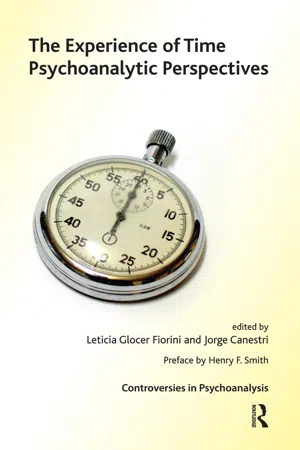
eBook - ePub
The Experience of Time
Psychoanalytic Perspectives
- 230 pages
- English
- ePUB (mobile friendly)
- Available on iOS & Android
eBook - ePub
The Experience of Time
Psychoanalytic Perspectives
About this book
In contemporary psychoanalysis, the concepts of time and history have become increasingly complex. It is evident that this trend offers us an opportunity to think about the intercrossing of the different temporal dimensions imbuing the subject, an inevitable aspect of the analytic process. History is time past but what is recovered is now the working through of the subject history, which carries the mark of both passing time and re-signifying time. It is precisely the notion of history that gains different dimensions when a purely deterministic analysis is disassembled. Continuities and breaks are found between subjective time and chronological time; between the inevitable decrepitude of the biological body with the passing of time and the timelessness of the unconscious; between linear, circular times and retroactive re-signification; between facts, screen memories, memory and the work of constructing history; between the times of repetition and the times of difference; between reversible and irreversible time; between the timelessness of the unconscious and the temporalities of the ego.
Information
Chapter One
From the ignorance of time to the murder of time. From the murder of time to the misrecognition of temporality in psychoanalysis1
It is striking that the problem of time has been the source of far fewer discussions than themes relating to space. We have talked about the construction of analytic space (Viderman, 1970), of transitional space (Winnicott, 1953), but there is nothing analogous applying to time. It would seem that this theme has been avoided. Freud developed his ideas in a fragmentary and unsystematic way, as they appeared to him, and never brought together his diverse conceptions on time into a single presentation. Thus, he left us with a mosaic of temporal mechanisms without conceptual unification. After him, and profiting from this fact, analysts preferred, it seems, to circumvent the difficulty by not expressing an opinion on the unity to be identified in the diverse aspects described, instead of endeavouring to put the different facets of this concept into perspective. A tendency to return to the past—a regressive process—made analytic thinking return surreptitiously to a pre-psychoanalytic conception of time. In a more recent inspiration, it seems that the genetic approach, which for Freud was only one of the procedures for treating the subject of time, has progressively imposed itself in a predominant manner as the one that necessarily supplanted the others by eclipsing what stood out as specific to the theorization of the whole.
An immediate intuition makes us conceive of psychoanalysis as a fundamentally historical discipline, since it is a question, through it, of examining the consequences of a fixed or deviated evolution of development, linked to the vicissitudes of that which could not be integrated and has undergone multiple fates. The latter themselves influence the idea that one gets of the relations between history, its impasses, how the stages of its development are inscribed, its incapacity to resolve the conflicts that have arisen and their eventual subsequent return in forms that must be decoded if one is to understand how they are related to the experiences of the past that were unable to integrate them. All this is reproduced in each treatment and is related with both the vicissitudes and failures that are its conclusion. Attention has recently been directed towards the risks of the treatment, the uncertainties, and even the obstacles that stood in the way of recovery, as discussed by Freud in 1937; the relation of these diverse vicissitudes with the problems linked to temporality has been neglected.
It seems evident that the heart of the sphere of influence of psychoanalysis should be situated within the framework of the experience of the session, but this apparently obvious fact is counter-balanced by two remarks. First, numerous examples drawn from Freud’s work show that the session does not have a monopoly on manifestations that bear witness to the organization and effects of the unconscious in relation to time. Let me just cite, to focus our ideas, the reactions arising from the contemplation or analysis of certain cultural works (Moses, Hamlet), or, again, certain experiences where the psyche has to accommodate psychic phenomena due to reorganizations of the past or the present reactivating in a new way the oldest wishes, etc. (Leonardo Da Vinci and a Memory of his Childhood [1910], “A disturbance of memory on the Acropolis” [1936a]).
To be sure, repression appears to be the principal mechanism responsible for a disturbance of memory that has preferred to reject into forgetting what it is unwilling to remember. However, this burying is scarcely passive. Fragments forming part of dream associations, co-opting and juxtaposing themselves by affinity, bear witness to a work of the un-conscious in conformity with what Freud called “the attraction by the pre-existing repressed”.
The case of the dream, however demonstrative it might be, is more complex. The dream itself occurs outside the dreamer’s consciousness, thus, by definition, outside the session, but it needs the work of the session in order to be interpreted. For Freud, the dream is a form of memory that survived repression thanks to disguises that render unrecognizable its relation with the past (the dream-work). Many other examples naturally lend support to this idea. More than any other manifestation, the transference refers to fragments of the past that could not be elaborated; it is clear that it goes beyond the framework of the session. One cannot expect less of a discipline whose aim was clearly the remembering of the forgotten years of childhood, the method being indistinguishable here from the therapeutic technique (Donnet, 2001), until Freud was obliged to recognize that the lifting of infantile amnesia, a desirable aim, was not always achievable, and that this modified the perspective of analytic work. But here, too, repression can concern details whose importance resides in their contiguity with the material to be repressed.
Once the repression has been identified, any psychic manifestation recognized as belonging to the return of the repressed is necessarily bound up with the past through the relations it allows us to surmise between the elements that reappear of that which had to be turned away from consciousness and distanced from it, and that which now demands to be heard in spite of the wish to reduce it to silence. This is not to limit the return of the repressed to that which was excluded from consciousness, for the condition of its return is to dress itself up in disguises that make it unrecognizable with regard to that which was condemned in the past and excluded from consciousness. To pass the censorship, it now assumes more accessible forms in order to escape a reinforcement of forgetting and to acquire once again a presence that obliges us to consider it as still actual.
The most demonstrative case of such work is the screen memory, which, like a collage, agglomerates recollections belonging to different periods of life. Freud even went as far as to assert that all of what is essential from infantile psychic life has been retained in the screen memory (Freud, 1917b, p. 148). Sometimes, the repression does not concern the lived experience, but one of its psychic elements.
Already in his study on screen memories in 1899, Freud notes the particularities of memory, rarely present in the form of a continuous chain of events. In fact it has been remodelled under the influence of a process: “conflict, repression, substitution involving a compromise” (Freud, 1899a, p. 308). In fact, one finds at the basis of what is remembered the displacement that permits the juxtaposition of phenomena belonging to different periods of childhood. Thus, events recollected dating from the post-pubertal period are contiguous with events of childhood. It is not only that the innocence of childhood permits their evocation, but rather that the contiguity with more clearly sexual memories suggests that they, too, were impregnated by a sexuality whose traces had disappeared and which are then surmised après coup. Likewise, important recollections coexist with indifferent recollections in order to mark their importance and to conceal their links with sexuality.
In short, the presence of the mnemic image is not a sufficient element for identifying the unconscious representation and for recognizing the significant element, sometimes constructed after former events have been recounted by the family circle. Besides, what seems important today did not have the same importance in the past, which is now re-emerging. What is more, associations show how a childhood impression can be revived. The falsification of memories that forbids the access of the original impression to consciousness through resistance serves the repression that dominates the experience and helps to substitute shocking and disagreeable impressions with other more innocuous ones.
In this first approach, Freud already draws on diverse types of temporalities, one of which, that linked to the development of the libido, is connected with a mode of evolution of a biological type, with the description of the successive phases of the predominance of the bodily zones of the libido. But this evolutive basis is already modified by experience that will mark more particularly certain stages, the fixations, and, subsequently, the tendency to return backwards towards the privileged fixations owing to the mechanism of regression. What needs to be noted here is the bidirectional tendency of the psyche, which is well illustrated by dreams.
However, in the course of this evolution, the memories of the epochs traversed seek to be put to advantage in an attempt to explain that which remains dissimulated by adults. The memories play a role in the construction of infantile sexual theories which will persist beyond elucidations into the real nature of the events concerned and will continue to be active in the adult unconscious: curiosity about the conception of children and the relations between the sexes, how pregnancy is accomplished.
In short, all memory is indicative; the rapport with that which had to be repressed remains the essential issue and can only be approached through the effects of contiguity, which invite us to surmise what the object of repression must have been and oblige us to consider a mode of temporality that is essentially different from consciousness (consciousness and memory are mutually exclusive, Freud says), or we rely on that which can be remembered according to the schemes of conscious memory. The most remarkable feature remains the absence of the wearing effects of the past in the manifestations that can be attached to the unconscious.
The study of the transference psychoneuroses would make it possible to confirm Freud’s earlier ideas, the study on repression offering the most complete picture. Yet, Freud necessarily expected to discover other related forms which necessitated more nuances. For example, in his study on Schreber (Freud, 1911c), he distinguishes a form of repression that needs to be differentiated from the usual procedure encountered in the neuroses. In place of the general idea that what is supposed to be suppressed within (repression) comes back from without in hallucination, he substitutes another mechanism, wishing no doubt to radicalize the refusal of a psychotic nature characterized by this type of counter-investment: that which has been abolished within returns from without. So, it is not only what has been suppressed, but what has known, more than an annulment by consciousness, a veritable annihilation. This is what gave Lacan cause to describe the Verwerfung as different from the Verdrängung. This abolition could be understood as an erasure of the internal links constitutive of symbolization, which affects all the internal relations that call for different modes of interpretation than those of the neuroses, for the organization of the material bears the mark of this symbolic deficiency.
Other mechanisms would be described later on, as in the dis-avowal of fetishism (Spaltung), where Freud describes for the first time a defensive process that says simultaneously yes and no (Verleugnung) (yes, my mother has no penis; no, that cannot be true), accompanied by a displacement on to a secondary zone to replace the missing penis; this is the function of fetish-substitutes (suspender belts, stockings, etc.).
Last, the study of negation provides the opportunity for a new metapsychological construction, which shows Freud is eager to extend the process of negation beyond language, conceiving of a scale ranging from the earliest oral impulses expressed by all forms of rejection, to the later forms of repression, whereas affirmation manifests itself by the wish to take into oneself, to introject, to identify with. So, foreclosure, repression, disavowal, and negation form an ensemble whose common denominator is recourse to a mode of judgement by yes or by no which unites these different expressions and relates to what I have called “work of the negative” (Green, 1993). The repression of Oedipal impulses gives infantile sexuality its diphasic status.
On the other hand, Freud was to assume the existence of hypothetical factors that he introduced with the aim of categorizing the multiplicity of experiences, regrouping them according to the so-called primal fantasies. Not everyone accepted this hypothesis, but it is very difficult to see how the experiences are regrouped according to shared aims that escape consciousness. Such would be the role played by the fantasies of seduction, castration, and the primal scene, to which Freud was to add the taboo on omophagia. Freud gives them the function of being primitive fantasies. There was a wish to make the infantile sexual theories play this role, but their role is rather to reflect them. Lacan called them “key-signifiers”.
The line followed up until then was to undergo a profound mutation with the introduction of the repetition compulsion. One might be tempted to see in it a complementary form of the ignorance of time defended by Freud at the level of unconscious phenomena. However, here the new situation introduced by Freud is, above all, designed to back up his idea that repetition stands in the way of the phenomenon of remembering, which he had hitherto considered as characterizing the essence of the therapeutic process. Repetition is not only a form of memory block. The compulsion to repeat takes the place of remembering. While the latter referred to a negation of temporality which made it possible to go beyond phenomena linked to the wearing effects of time, thereby resisting forgetting and allowing a desire to subsist which remains active, here it is a question of a form, which, through repetition, constitutes a denial of the temporal movement. It suggests a form of abolition close to foreclosure, a murder of time, the repetition exhausting itself through thwarting the effects whereby remembering makes it possible to infer that which is covered over and can no longer even make use of the opportunities opened up by displacement and disguise.
The modification that was introduced with the compulsion to repeat had been preceded by a change which was to lead to the cascade of changes marking the turning-point of 1920. Indeed, at this date, Freud unequivocally impugned the notion of the unconscious in the second chapter of The Ego and the Id (1923b). He contested there the importance of the role he had accorded to the unconscious representations which could participate in the memories that were themselves unconscious. He was now proposing a new form for the fundamental elements of the psyche: the instinctual impulse, which, let it be noted, contains no reference to representation and now constitutes the most primitive basis of psychic activity. It is evident that the theory of memory was thereby drastically changed. The “outside-time” now exists not as a system of traces anchored in the past and the unconscious, but in the form of a repressive dynamic traversing the psyche through the tensions of a raw libidinal erotism and of a destructivity which seeks to undo the links that have succeeded, not without difficulty, in forming themselves concerning the traces of this past.
However, even if the instinctual impulse is now considered as the material on which the construction of the psyche is built, according to Freud the dream continues to be a form of memory. It is as though the elaboration of the representative function made it possible to link up memories with unconscious representations that remain a vehicle for a disguised form of memory. Likewise, for Freud, it is no longer necessary to regard the transference as a transference of elements belonging to history and to the past. If it now depends on the compulsion to repeat, it induces us to make a deduction allowing us to infer the relations that have become inaccessible to consciousness between the past and the present. It is up to the analyst to render present these links between past and present; even if he considers that it is not always necessary to communicate them, he notes the discrete signs whose meaning is none the less clear, which he can postulate on this subject. Nowadays, the interpretation of the transference will be direct, doing without justifications invoking its relation with the past.
In truth, though Freud could not immediately accept the consequences of his discoveries, these were already implicitly present as early as 1914 (the compulsion to repeat taking over from remembering, now set aside). The second theory of the psychic apparatus, placing the instinctual impulse at the basis of the psyche, was substituted for the unconscious representations hitherto conceived of as being directly linked to the unconscious. On the other hand, the id of the new topography was loaded with contents borrowed from phylogenesis, which were challenged by the majority of psychoanalysts.
Without any doubt, a radical turning had been taken, but it is impossible to evaluate the consequences without examining closely the originality of the conception of time, which Freud stacked up more than constructed, refraining at least from trying immediately to establish the coherence that constituted its originality. For the first of the realities from which we must begin is the observation of the heterogeneity of the psyche, with which different, not to say divergent, modalities of temporal exercise are connected. The first is that which sees time as an a priori of sensibility (Kant, from whom Freud differentiates himself), that is to say, as a component constituted outside conscious thought. However difficult it might be to give a clear definition of it, the triple categorization present–past–future can infiltrate surreptitiously a mode of thinking which, without having broken its ties with consciousness, is connected with the unconscious, as can be seen from the case of phantasy.
We may say that it [a phantasy] hovers, as it were, between three times—the three moments of time which our ideation involves. Mental work is linked to some current impression, some provoking occasion in the present which has been able to arouse one of the subject’s major wishes. From there it harks back to a memory of an earlier experience (usually a...
Table of contents
- Cover
- Half Title
- Title
- Copyright
- CONTENTS
- SERIES PREFACE
- ABOUT THE EDITORS AND CONTRIBUTORS
- FOREWORD: “The past is present, isn’t it?”
- INTRODUCTION
- CHAPTER ONE From the ignorance of time to the murder of time. From the murder of time to the misrecognition of temporality in psychoanalysis
- CHAPTER TWO A problem with Freud’s idea of the timelessness of the unconscious
- CHAPTER THREE Why did Orpheus look back?
- CHAPTER FOUR Unconscious memory from a twin perspective: subjective time and the mental sphere
- CHAPTER FIVE The time of the past, the time of the right moment
- CHAPTER SIX The impact of the time experience on the psychoanalysis of children and adolescents
- CHAPTER SEVEN Time and the end of analysis
- CHAPTER EIGHT The first narrative, or in search of the dead father
- CHAPTER NINE The destruction of time in pathological narcissism
- CHAPTER TEN Hindu concepts of time
- INDEX
Trusted by 375,005 students
Access to over 1.5 million titles for a fair monthly price.
Study more efficiently using our study tools.
Frequently asked questions
Yes, you can cancel anytime from the Subscription tab in your account settings on the Perlego website. Your subscription will stay active until the end of your current billing period. Learn how to cancel your subscription
No, books cannot be downloaded as external files, such as PDFs, for use outside of Perlego. However, you can download books within the Perlego app for offline reading on mobile or tablet. Learn how to download books offline
Perlego offers two plans: Essential and Complete
- Essential is ideal for learners and professionals who enjoy exploring a wide range of subjects. Access the Essential Library with 800,000+ trusted titles and best-sellers across business, personal growth, and the humanities. Includes unlimited reading time and Standard Read Aloud voice.
- Complete: Perfect for advanced learners and researchers needing full, unrestricted access. Unlock 1.5M+ books across hundreds of subjects, including academic and specialized titles. The Complete Plan also includes advanced features like Premium Read Aloud and Research Assistant.
We are an online textbook subscription service, where you can get access to an entire online library for less than the price of a single book per month. With over 1.5 million books across 990+ topics, we’ve got you covered! Learn about our mission
Look out for the read-aloud symbol on your next book to see if you can listen to it. The read-aloud tool reads text aloud for you, highlighting the text as it is being read. You can pause it, speed it up and slow it down. Learn more about Read Aloud
Yes! You can use the Perlego app on both iOS and Android devices to read anytime, anywhere — even offline. Perfect for commutes or when you’re on the go.
Please note we cannot support devices running on iOS 13 and Android 7 or earlier. Learn more about using the app
Please note we cannot support devices running on iOS 13 and Android 7 or earlier. Learn more about using the app
Yes, you can access The Experience of Time by Jorge Canestri, Leticia Glocer Fiorini, Jorge Canestri,Leticia Glocer Fiorini in PDF and/or ePUB format, as well as other popular books in Psychology & History & Theory in Psychology. We have over 1.5 million books available in our catalogue for you to explore.