- 107 pages
- English
- ePUB (mobile friendly)
- Available on iOS & Android
eBook - ePub
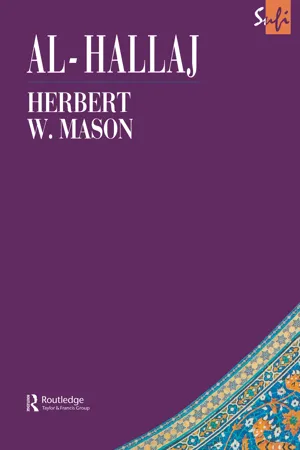
Al-Hallaj
About this book
The life and teachings of Islam's most dramatic and controversial mystic, Husayn ibn Mansur, better known as Al-Hallaj (the reader of hearts).
Information
I
“He will be veiled to my glances until my body disappears (talâsha) in the lights of His Essence (anwârî thâtîhi); and then no trace, no mark, no aspect and no memory of me will remain.”— Akhbâr, no. 10
THE FACTS OF HIS LIFE AND THEME OF DISAPPEARANCE
The facts of his life are this: he was born Husayn ibn Mansûn1 of Persian parents ca. 244 AH/858 AD in the village of Tur, district of Bayda in the Arabicized province of Fars in south-western Iran. His father, a wool carder (hallâj), a profession practised intermittently by his son, followed his trade through such textile centers as Ahwaz and Tustar, settling his family eventually in the traditionalist Sunnite Arab town of Wasit in southern Iraq ca. 255/868. In 260/873, having completed his basic education in the Hanbalite Qur'anic school of that fervent center, the young Hallaj returned alone to Tustar, where he became a disciple of a celebrated Sunnite Qur'anic scholar and mystic named Sahl, whose approach to the primary source of his Muslim faith was decidedly and decisively for the young apprentice more esoteric and interiorizing than had been the instruction by memorization and exoteric commentary in Wasit. Sahl's path harkened back to and extended the intense detachment from the world of the earliest ascetics of Islam, notably to the Islamic first century's Hasan of Basra, the willfully dark and mournful Persian precursor and indeed spiritual progenitor named in most later mystics' chains of mystical authority (isnâd). He remained with Sahl for approximately two years, after which he made his way westward once again to Iraq, this time to Basra in the far south where he made his profession of Sufism and received the Sufi habit, implying commitment to a common rule of life and a carefully prescribed and historically authenticated path.
Basra at the time was a center for the diffusion of the Sufi movement, the principal distinct but corresponding schools having grown up in Khurasan in northeastern Iran and in the capital city of Baghdad, where the mystic Muhâsibî (d. 243/857) had moved from Basra with his followers to form that major center whose most eminent shaykh would be Junayd (d. 298/910). In Basra Hallaj came under the direct influence of one close to Junayd, ‘Amr Makkî. (d. 297/909)
In 264/877 he married there the daughter of Abû Ya'qûb Aqta', a secretary of Junayd and fellow Sufi of ‘Amr Makkî. Of this, his only marriage, there would be three sons and a daughter. One of these sons, Hamd, left an account of his father's later life and martyrdom. According to this account a quarrel between the two Sufis over the marriage, of which ‘Amr Makkî disapproved, led Hallaj to journey north to Baghdad to consult Junayd.
Evidence of such spiritual jealousy and posses-siveness accompanied Hallaj throughout his life and grew from excessive attachment to him by his masters and, later, disciples, exacerbating any eventual doctrinal differences that arose. Junayd, the recognized leader of the schools of Iraq, advised the cultivation of patience in the spiritual tradition of Hasan of Basra, and Hallaj returned to his life in the home of his father-in-law in Basra.
This town, built originally as a frontier garrison outpost during the rapid expansion period of Islam into Mesopotamia and Iran, following the death of the Prophet Muhammad in 11/632, had become an Arab literary center in the Umayyad period. It was in this post-classical period, that is, between the death of the last of the so-called Rightly Guided Caliphal successors, ‘Ali, the Prophet's son-in-law in 41/661, and the emergence of the ‘Abbasid dynasty and its successful revolt in 133/750, that the Umayyad Caliph ‘Abd al-Malik from his capital in Damascus had defined the conquered regions of Mesopotamia and Iran to the Oxus River in eastern Khurasan as “Al-'Iraq”, the two Iraqs, western and eastern, and put them under the governing control of his leading military commander Hajjâj, a near legendary figure of early Islam. This man of cultural grandeur and iron rule commanding first from the garrison towns of Basra and Kufa and eventually building as governor his own capital of Wasit, midway between the two, created an atmosphere through his ostentatious patronage conducive to a flowering of Arabic philological studies and authoritative Qur'anic recitation. Among later Sufis he was remembered most for his failed attempt to compete personally in both “sciences” with the ascetic Hasan of Basra, whom he invited to his palace in Wasit in order to discredit. This was incidentally one of the first confrontations in Islam between a state and a purely spiritual leader over the issue of authority argued as it was on the plane of Arabic and Qur'anic knowledge. Such confrontation would become a recurring theme in Islamic history with variations in argument centered on the same unsettled issue. Basra, however, gradually yielded its prominent position in the later Umayyad and early ‘Abbasid period to its northern sister outpost Kufa and ultimately to Baghdad as a center of Arabic grammatical and philological and Qur'anic studies. The Basra sojourn influenced Hallaj in two principle ways: the imprint upon his language of mystical thought and, from its older Arabic heritage, styles of didactic and lyric poetry; and the quickening of his consciousness of social injustice.
Basra had become in the third Islamic century a center also of social crisis, prompted by the revolt of black slaves, the Zanj, imported from the Sudan and East Africa to dig in the salt mines of lower Iraq. As a result of gross mistreatment by the ‘Abbasid Sunnite masters ruling from Baghdad and aroused by opposition from Shi'ite propagandists using the issue to undermine the authority of the dynasty's central government, the banner was raised as an outcry for justice in a religious community that professed equality among all members. It was a classic confrontation between the major sectarian divisions also derived from early Islamic history; and Hallaj found himself in the middle of the crisis through his Shi'ite in-laws, the Karnabâ'î family, who supported the revolt ideologically.
Hallaj, a Sunnite of a strong traditionalist formation, found himself in a Shi'ite milieu, one that had been deeply imbued with Hellenistic and neo-gnostic cultural attitudes and thought throughout the century of his birth, the century that saw the founding of the famous Bayt al-hikma translation center in Baghdad for the dissemination of Greek learning and ideas under the patronage of the quasi-Shi'ite, anti-traditionalist Caliph al-Ma'mûn. Most important for Hallaj and other traditionalist Sufis would be the influence of a philosophical vocabulary and a dialectic mode upon their Sunnite response to Shi'ite propaganda. His aroused level of dialogue, both on the subject of justice and on the defense of Qur'anic based Islam, was determined in this intense period. Furthermore, his exposure to other religious perspectives and traditions, long a Shi'ite predisposition formed through its concerted intellectual, political, and cultural opposition to Sunnite “orthodoxy”, left the apparent imprint of eclecticism upon him and gave rise later among certain of his Sunnite enemies to accusations of his being a Shi'ite or even a Christian in disguise. His identification with the awaited Shi'ite Mahdi by certain of his later devotees also led his early Shi'ite supporters to eventually accuse him of falsehood and assumption of religious prophethood belonging to them. In sum, it was a period that exposed his character to the dangers of spiritual sectarianism, long a feature of Islamic history, and something Hasan of Basra had descried for his Community; and now it helped set the stage for Hallaj's martyrdom, which in his passion for justice and unity of all Muslims under God he appeared to invite.
The Zanj revolt failed in 270/883 and the ‘Abbasid Caliph Muwaffaq firmly in power in the capital reestablished control over Basra and the southern region of Iraq. Hallaj soon after made the first of his three extended pilgrimages to Mecca, this on the ‘Umra or minor pilgrimage performable at any time of the year, in this instance remaining there for the duration of one year, during which he was said to fast continuously in preparation for a higher ascetical calling. Like Hasan of Basra and many subsequent Sufis he saw the purification of his own heart as prerequisite for the realization of any moral and spiritual vocation on behalf of his Community. It was most probably this youthful experience that strengthened his conviction of the meaning of the sayha bi'l-Haqq, the outcry of justice as witness of the true Reality of God and the Truth of God's transcendent Uniqueness. After it he appears to have become confirmed in his opposition to political extremism and tyranny of any coloration as well as to quietistic Sufism of the sort he ascribed, rightly or wrongly, to his masters, including Junayd, who in his mind represented detachment and withdrawel in prayer from any engagement in political activity. This rejection of quietism separated him thus from the traditional ascetical stance defined originally by Hasan of Basra, who had preached patient endurance in the face of tyranny and the cultivation of fear and sorrow (khawf wa huzn); fear in anticipation of God's Judgement and the world to come, and sorrow over our and others' sins in the world in which we find ourselves now.
It was roughly around this period that he engaged in discussions with three notable Sufis that clarified these positions as well as his developing position on personal inspiration from God (ilhâm): in Mecca with ‘Amr Makkî; in Kufa with Ibrahim Khawwâs; and in Baghdad with Junayd. Hamd, in his biographical account, mentions a meeting at this time between his father and Junayd with a group of Sufis (fuqarâ') in which a question was posed concerning “the desire for a personal mission (mudda'î)” and about which Junayd advised patience and calm to the obviously agitated youth. Other sources place this meeting at the time of the marriage crisis during their first and possibly, in fact, their only encounter. What matters from all this is his divergence from traditional Sufism as maintained by the Baghdad school. In Basra, however, to which he returned to rejoin his wife following his pious retreat in Mecca, he attracted a number of disciples and commenced his “personal mission”.
A year later, his father-in-law renounced him and his positions, and Hallaj left Basra for Tustar with his wife and his brother-in-law, a Karnabâ'î Shi'ite associate, where he preached (in Arabic, as he spoke no Persian) to Arabicized audiences with considerable success. He continued to be attacked in letters sent from Basra by his former master ‘Amr Makkî which were instrumental in making him forego for himself any further ties with Sufi masters and the garb of Sufism itself, though this garb remained one of his many “costumes” during his travels on occasion and, later, in prison in Baghdad.
Once returned to his familiar Islamized and Arabicized Iranian cultural milieu, around the centers of Tustar and Ahwaz, he became a visitor in the circles of landed gentry, upper echelon bureaucrats, and well-to-do patrons, the so-called abnâ' ad-dunyâ, who had provided the pre-Islamic Persian Sasanian Empire with the same monied exploitive functionaries and cultured scribes, now largely Shi'ite but who still represented an eclectic mix of religious backgrounds and influences, including Nestorian Christian, Jewish, Zoroastrian and, by the end of the 4th/10th century, quasi-Buddhist. It was in this atmosphere especially, and among its sympathizers in Baghdad and elsewhere, that support for speculative thought and experimental research was cultivated, particularly in science, philosophy, alchemy, medicine, and literary anthologizing and criticism. Traditionalist Muslim piety and asceticism became interiorized and weakened in such centers.
Though Hallaj was recognized and indulged as a popular itinerant preacher (wâ'iz) with a mission, his language continued to become more abstract and dialectical in the mode of these non-traditionalist (Mu'tazilite and Shi'ite) proponents of philosophy (falsafa) in the patronized circles of the region.
Around 274/887, in his 30th year, he was arrested by Sunnite government agents and publicly whipped in Nahiyat al-Jabal, between Sus in Iran and Wasit in Iraq, probably a victim of mistaken identity as a political agitator, an agent of the Qarmathians, that radical left wing Shi'ite group bent explicitly on the overthrow of the ‘Abbasid government and its supporters whom the latter suspected everyone critical of themselves to secretly be. There was a possibility, though no proof, of some moderate Shi'ite complicity suspecting him to be claiming the role of the Mahdî, whom he had preached was Jesus, who in his return would proclaim the final spiritual truth of truths and canonical path of paths. In fact, this incident may have marked his first publicly proclaimed identification with Jesus, though by no means implied conversion to Christianity, either then or at the times of his subsequent imprisonments and martyrdom when he would again cite and even call upon Jesus as an intercessor through the compassion of his shared suffering or when (in Dîwân, M.LVI, 1.2) he expresses his expectation of dying on the Cross and states that he no longer wishes to go to Mecca or Medina. Hallaj, in this same poem (1.1), is drawing on Qur'an 18 and the figure of the mystical guide of Sufis, al-Khadir, in his allusion to the “broken boat”, and not implying that his concept of a spiritual journey and personal witness is based on rejection by Islam or of Islam, nor that his notion of “the disappearance of the self in God” belonged to any other realm than that of transcendence, not to culture, sociology, politics or membership in any other religion. His enemies questioned his sincerity, then and later, in vain, for his practise of Muslim piety remained strong in him always to the very end. They turned gr...
Table of contents
- Cover
- Half Title
- Title Page
- Copyright Page
- Table of Contents
- Dedication
- Foreword
- I. The Facts of His Life and Theme of Disappearance
- II. The Resurfacing of His Life and Its Repeated Impact
- III. The Problem of Universalism
- IV. The Question of Uniqueness
- V. Reprise: Who was Hallaj and What is His Place in Islamic Mysticism?
- VI. The Death of Al-Hallaj
- VII. Selected Bibliography
- Name Index
- Index of Terms
Trusted by 375,005 students
Access to over 1.5 million titles for a fair monthly price.
Study more efficiently using our study tools.
Frequently asked questions
Yes, you can cancel anytime from the Subscription tab in your account settings on the Perlego website. Your subscription will stay active until the end of your current billing period. Learn how to cancel your subscription
No, books cannot be downloaded as external files, such as PDFs, for use outside of Perlego. However, you can download books within the Perlego app for offline reading on mobile or tablet. Learn how to download books offline
Perlego offers two plans: Essential and Complete
- Essential is ideal for learners and professionals who enjoy exploring a wide range of subjects. Access the Essential Library with 800,000+ trusted titles and best-sellers across business, personal growth, and the humanities. Includes unlimited reading time and Standard Read Aloud voice.
- Complete: Perfect for advanced learners and researchers needing full, unrestricted access. Unlock 1.5M+ books across hundreds of subjects, including academic and specialized titles. The Complete Plan also includes advanced features like Premium Read Aloud and Research Assistant.
We are an online textbook subscription service, where you can get access to an entire online library for less than the price of a single book per month. With over 1.5 million books across 990+ topics, we’ve got you covered! Learn about our mission
Look out for the read-aloud symbol on your next book to see if you can listen to it. The read-aloud tool reads text aloud for you, highlighting the text as it is being read. You can pause it, speed it up and slow it down. Learn more about Read Aloud
Yes! You can use the Perlego app on both iOS and Android devices to read anytime, anywhere — even offline. Perfect for commutes or when you’re on the go.
Please note we cannot support devices running on iOS 13 and Android 7 or earlier. Learn more about using the app
Please note we cannot support devices running on iOS 13 and Android 7 or earlier. Learn more about using the app
Yes, you can access Al-Hallaj by Herbert I. W. Mason in PDF and/or ePUB format, as well as other popular books in Theology & Religion & Religious Biographies. We have over 1.5 million books available in our catalogue for you to explore.