- 144 pages
- English
- ePUB (mobile friendly)
- Available on iOS & Android
eBook - ePub
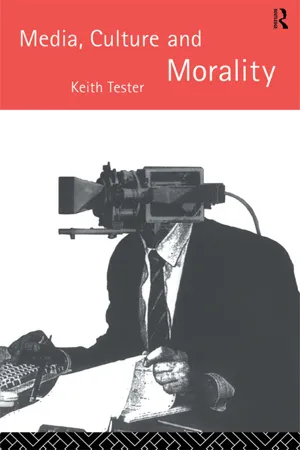
Media Culture & Morality
About this book
First published in 1994. The media report terrible events. But the academic study of the media is increasingly trivial and lacking in moral seriousness. Media, Culture and Morality examines how this paradoxical situation could have emerged. The author seizes upon the disparity between the enormous production of books in the field and the lack of substantive insights generated. He argues that such a mass of self-conscious criticism should have provided a moral critique of contemporary culture not the quagmire of theoretical verbiage and threadbare politicizing we are faced with today. The book is a disturbing speculation on the fate of moral and cultural values in a media-dominated world.
Information
Chapter 1
The problem of cultural studies
The discipline called cultural studies has had a massive impact on the problems and possibilities of the academic study of culture. It has made new areas of debate leap into the limelight and has transformed the ways in which people tend to look, talk and think about the cultural activities and products that surround them and, indeed, that they perform. Cultural studies has accomplished that rare feat of moving from the small worlds of academia and into the mainstream of informed debate. And it has managed to do all of that in the space of a couple of decades. Without doubt, cultural studies has been one of the greatest success stories of post-war academic and intellectual life, not just in its ‘home’ of Britain, but increasingly in other parts of the English-speaking world too.
But all of these benefits have associated costs. Perhaps the costs – the dark side of the achievements of cultural studies – could be, or more simply just were, brushed aside during the initial burst of enthusiasm of and for the new discipline. But the costs can be ignored no longer. It is time that they were pulled, if need be screaming and yelling, into the light so that cultural studies can learn to be reflexive, and for that matter, a little more becomingly modest, about all that it has done. I want to propose that the costs associated with cultural studies can be broadly divided into two sorts. Firstly, cultural studies is a discipline built around a narrative theme (the theme of popular culture) which is incapable of sustaining any kind of critique of the institutions, arrangements and the practices of everyday life. Secondly, the theme of popular culture is used in such a way that cultural studies becomes incapable of confronting important questions of cultural and moral value in anything approaching a serious manner. Basically, it is reasonable to propose that to the extent that cultural studies has become more and more successfully involved in the academic and intellectual establishments, so it has become more and more facile and useless if it is hoped to address pressing questions of how we might be required to live as responsible individuals in a world of cultural and moral uncertainty.
Cultural studies has ceased to be a significant and eye-opening study of all that we do and hold dear. Instead, and most certainly since the early 1980s, cultural studies has become little more than a circular, self-validating and exclusive mode of inquiry. Cultural studies has become about nothing other than cultural studies. Within the discipline, certain questions are asked all too repetitively and other questions are asked not at all. In this way it can be suggested that cultural studies has actually become a brake on the study of culture; cultural studies has become an obstacle to be cleared if the study of culture is going to be possible and, moreover, if it is going to be possible in a fashion that makes it worth doing.
Cultural studies has become a hindrance rather than a help because it has become increasingly predictable. The predictability has a number of dimensions. Firstly, the predictability surrounds the mode of address of cultural studies. Simply, cultural studies texts tend to be written in a very specific language and fashion; a restricted range of references is used to inform the discourse of any number of studies (for example Antonio Gramsci and Raymond Williams are nearly always quoted approvingly) and the language of the texts is indebted to a highly complex and frequently obscure turn of phrase. There is something like a cultural studies house style. Secondly, the predictability surrounds the objects of study. Cultural studies texts tend to be about a fairly restricted number of issues: consumerism, the media, sexuality (and more specifically masculinity), the cultural practices of youth. Thirdly, the predictability surrounds the national focus of cultural studies. For the most part, cultural studies is about the English-speaking world and, even more specifically, about the experiences of and reactions to metropolitan life in the English-speaking world. Certainly, this Anglocentrism is being rapidly punctured thanks to studies of black cultural forms in the United States and Australia, but one looks generally in vain for a cultural studies light being brought to bear on, say, France or Peru or even Scotland.
Perhaps a fine example of the tendencies that presently bedevil cultural studies is the concern with the study of consumerism. Now, consumerism has always been an important object of scrutiny for cultural studies (for example one of the founding texts of cultural studies Richard Hoggart’s The Uses of Literacy – is nothing other than an investigation of the cultural consequences of changing patterns of consumption; see Hoggart 1958), but this object came fully to the fore during the 1980s. The concern with consumption and consumerism reached something like its apotheosis in the pages of the now defunct British magazine Marxism Today and, in particular, in the so-called New Times project (see Hall and Jacques 1989). There is little or no sign of an abatement of the concern with consumption and consumerism even though the consumer boom of the 1980s has collapsed into the negative equity recession of the 1990s. Cultural studies work on consumption and consumerism continues to talk about the niche retailing successes of a chain store like Next even though the store and its shoppers have been battered by debt. Moreover, it is perhaps a little immoral to spend scarce academic and intellectual resources on the study of shopping when one of the most obvious facts of the 1990s cultural milieu (at least in Britain) is the collapse of the welfare state. What is interesting about shops today is not what is in them but who sleeps in their doorways. About this cultural studies remains roaringly silent. Indeed, all the time cultural studies continues to be so silent, it will be morally vacuous and, essentially, a wilfully trivial analysis of contemporary social and cultural problems.
It must be stressed that I am in no way blaming the individual practitioners of cultural studies for the silences and the vacuity of what it is that they do. The problems I have identified run much deeper than individual research biographies or interests. The problems are almost necessarily a consequence of the narrative preconditions of the discipline itself. An investigation of the concerns, presuppositions and the procedures of cultural studies shows that the discipline cannot be anything other than silent over questions of cultural and moral value or even certain institutions and arrangements of cultural activity and production. In this chapter I will try to expose some of the preconditions of cultural studies. In so doing I will show how they have involved what amounts to the wholesale appropriation of the study of the media by cultural studies and how that appropriation has, in its turn, led to the development of an immensely peculiar attitude towards what is important about the media. Through all of this revelation, it will eventually be possible to develop some kind of appreciation – or at least a series of vague hints – about how a sociological study of these self-same issues might be not only different but also much more serious.
Any attempt to unravel and reveal the founding assumptions and the narrative procedures of cultural studies is lucky indeed. Not only have the practitioners of the discipline tended to be very keen to talk about the conditions of the emergence of their concerns and perspectives (see, for example, Hall 1980, 1990, 1992) but also cultural studies quickly became a central plank in the academic practices of the Open University. Through this involvement in the distance learning techniques of the Open University, and especially through the clarity and accessibility of the University’s course books, the protagonists of cultural studies have outlined their positions very clearly indeed (see, for example, Bennett 1980, 1981, 1981a, 1986, 1986a). However, these texts tend to be of somewhat different kinds. The ones written by Stuart Hall are rather inclined to be histories of the struggles of institutional politics and of different ways of seeing and understanding the world of cultural activity. In Hall’s texts, all of these struggles more or less inevitably lead to the carrying out of the kind of work for which cultural studies has become well known. Hall tells tales of a history of Titans. Consequently, his essays might well be revealing and sometimes even almost exciting, but perhaps their usefulness is rather circumscribed; they might well be gold-mines of information for future historians of cultural studies, but perhaps the present moment is too close to the events discussed by Hall to appreciate the full significance of his story (if, of course, significance there is).
For the purposes of this book, and for the purposes of my analysis of cultural studies, the texts produced by Tony Bennett are much more useful. For the most part, Bennett’s texts are intended to be either pedagogic in themselves (they are learning aids for the students of the Open University) or they are reflections on pedagogic practices and procedures. Bennett takes great pains to spell out in a clear and concise manner the meanings, implications and what he perceives to be the importance, of cultural studies. As such, it is the work of Tony Bennett that I will mostly use in order to construct a model of the preconditions, directions and indeed the preclusions of the discipline of cultural studies. However, I want to make it plain that I am discussing Bennett’s texts in so far as they can be taken to represent the much greater problem of cultural studies; to repeat, my concern is to develop a critique of cultural studies and not the individuals who practise it. It would indeed be possible to say that my use of Bennett is itself something by way of a compliment to his ability to speak for an entire discipline rather than entirely for himself.
Bennett is very careful to define the terms of his discourse. It is important to look at some of these definitions since, to a considerable extent, it is because of definitions of the kinds proposed by Bennett that cultural studies is extraordinarily concerned with some problems and utterly quiet about others. Usefully, Bennett begins at the beginning and defines the meaning of the word ‘culture’. Bennett does this because, firstly, culture is a word with a long and complicated history of historical resonances and insinuations (a history that is revealed by a book which is somewhat outside of the canon of cultural studies; Norbert Elias’s The History of Manners; see Elias 1978); secondly, Bennett has to define the meaning of the word ‘culture’ because he wants to distance himself from notions that the word can only be applied to certain products like books and paintings but not to others like magazines or photographs. Bennett uses a far larger, and a far more all-encompassing, definition than that. Bennett wants to use the word ‘culture’ as ‘an umbrella term to refer to all of those activities, or practices, which produce sense or meaning’ (Bennett 1981: 82). Here, then, Bennett is making a point which not very many sociologists, anthropologists or possibly even philosophers would find it hard to accept. Basically, he is saying that culture consists in all of those things that make our lives and the world make sense. Culture is everything that makes things speak.
But what distinguishes cultural studies from sociology, anthropology or philosophy, is quite what it is that is taken to make sense. Whereas sociologists might concentrate on institutions and arrangements, or where anthropologists might concentrate on ritual practices or strategies of the classification of natural objects, or indeed where philosophers might concentrate on categories of the mind or on some zeitgeist, Bennett is more interested in texts. Bennett begins modestly, but his definition of culture quickly moves onto more original ground. For him, culture means:
the customs and rituals that govern or regulate our social relationships on a day-to-day basis as well as those texts – literary, musical, televisual and filmic – through which the social and natural world is re-presented or signified – made meaning of – in particular ways in accordance with particular conventions.
(Bennett 1980: 82–3)
It is worth examining this passage in a little detail and worth trying to take it apart to see how it works.
One of the clearest aspects of Bennett’s definition of culture is quite how important he takes culture to be. According to Bennett, it is culture that fundamentally shapes and determines social life. Moreover, for him culture is not something to be found in specific places like art galleries; rather, culture is everywhere and it is everything that we do. Culture is the word processor I am using now just as it is the book you are currently reading. Bennett says that culture is an integral and an indivisible part of our daily lives and, in particular, it is through certain texts which are readily available that the world is made to make sense for us. At this point Bennett’s definition of culture begins to hint at the relationships and practices that are at the very heart of the concerns of the cultural studies enterprise. Bennett makes two points which need examination and explanation. Firstly, he says that culture is ‘social relationships on a day-to-day basis’. Secondly, he says that the texts which make sense of the world are ‘constructed in accordance with particular conventions’. These two points are extremely significant. They lead to the grounding category of the cultural studies narrative; the category of popular culture. They are also the means by which Bennett is able to make his otherwise massively wide definition of culture a little more specific so that it ceases to be ‘virtually coterminous with human life. Everything would be in; nothing would be out’ (Bennett 1981: 84).
When Bennett says that culture is to be found in day-to-day relationships and that it is also shaped by particular conventions he is basically saying two things. Firstly, Bennett is arguing that culture can only be understood through a detailed analysis of the relationships of the consumption and the production of things like television, literature or films. This would involve detailed studies of institutions and audiences. Secondly, Bennett is making a slightly wider point which suggests that since it is involved in daily life, and since its procedures of production are determined to one degree or another by conventions, so culture has to be analysed in terms of the material and ‘real life’ relationships which are the basis of the meanings that make the world make sense. Do the meanings come from daily life, which thus simply uses cultural texts as something like blank pages that can in principle make whatever sense we want them to make? Or is meaning a product and a reflection of the conditions of the production of the cultural text and does it thus impose certain definitions on daily life?
These are the two questions, and the two problems to be resolved, which underpin the central cultural studies category of popular culture. Popular culture is understood as the place in which the practices of daily life and the pressures of external conventions come together. For Bennett, popular culture is specifically to be understood as the place of the intersection of the abilities and potentials of daily life to make sense of the world with the capacity of conventions to impose some sense and thereby deny the validity of other senses. This distinction between daily life and outside convention is taken to be one instance of a wider struggle in capitalist social relations. Here, then, when Bennett adds some content to his otherwise broad definitions he tends to provide a very specific inflection to the debate (and a reading of Bennett 1981a at least seems to suggest that the inflection along the lines of the conflicts of capitalist social relationships tends to be based on an assertion as opposed to an analysis). Consequently, Bennett argues that popular culture ‘consists not simply of an imposed mass culture that is consonant with the interests of the dominant class, nor simply of a spontaneously oppositional working-class culture’ (Bennett 1981a: 31). Instead, popular culture is ‘an area of negotiation between the two within which – in different forms of popular culture – dominant, subordinate and oppositional elements are “mixed” in different combinations’ (Bennett 1981a: 31).
But this negotiation is not at all something that takes place between two equal partners, and neither is it something that is carried out for the benign benefit of all. The point is that this formulation of popular culture means that it almost of necessity becomes identified as a place of complex and pressing political conflict and disputation. For Bennett, it has to be realized that the ruling class does not remain dominant (does not remain the arbiter of convention) solely because it has the big guns of dull compunction at its beck and call. The ruling class remains dominant, and retains dominance, also because it is able to convince other social groups that what is best for it, is, in fact, best for everyone else as well. That is, the ruling class is dominant precisely to the extent that it is able to make itself speak ‘for the people’. In this way the word ‘popular’ is used in a very specific sense; something is popular when it becomes identified as of and for a constituency called ‘the people’.
Tony Bennett is making important theoretical points about the status and the implications of popular culture. He is also, of course, seeing popular culture in political terms. After all, if the aim of the ruling class ‘is to enjoy social, moral and intellectual authority over the whole of society’ (Bennett 1981a: 31), then questions of the consumption and the production of culture, and questions of the negotiations between differently powerful social groups, become political at their very heart. Indeed, Bennett emphasizes the political importance of popular culture – and therefore the centrality of politics to the form and the content of popular culture itself – when he writes that, if the dominant position of the ruling class is to be maintained, ‘then its views must reach into and be influential in “framing” the ways in which, at the level of culture, the members of subordinate classes “live”, experience or respond to their social situation’ (Bennett 1981a: 31). With this comment about the importance of the ideas of the ruling class filtering out to all the other social groups so that the dominated make sense of the world in terms which are not incompatible with the interests of the dominant, Bennett is alluding to the concept of hegemony. This concept is absolutely central to the intellectual enterprise of cultural studies. It is also through the concept of hegemony that the practitioners of cultural studies attempted, and for that matter continue to attempt, to link their academic inquiries with practical political matters (and in this way cultural studies upholds the maxim of Karl Marx’s ‘Eleventh Thesis on Feuerbach’ that the point is not just to interpret the world; the point is to change the world as well; see Marx 1946).
Bennett argues that thanks to the concept of hegemony it is possible to examine how, ‘within the sphere of popular culture there takes place a series of transactions between the culture and ideology of society’s ruling groups and those of the subordinate classes’ (Bennett 1981a: 31). This theoretical insight itself implies a series of detailed and well- researched studies of the nature of those transactions in the ‘real world’ of cultural relationships. Bennett continues to say that the transactions between the ruling and the subordinate groups mean that ‘through state or commercially provided forms of popular culture, the former [that is, the ruling group] reaches into the latter [that is, the subordinate classes], redefining and re-shaping it only to be partially accepted, opposed, resisted, turned against itself, and so on’ (Bennett 1981a: 31). It is important to note the last few words of that last quotation; Bennett is making it quite plain that the ruling class does not establish its rule once and for all so that, after the moment of establishment, it can rest on its laurels. Rather, Bennett is saying that the ruling group has to construct its dominance over and over again, on a day-to-day basis; it can never rest. As such, day-to-day popular culture is itself inevitably a place of conflict, struggle and resistances. But that also means that popular culture is a place of politically motivated compromises and more or less uneasy alliances.
These are all insights which are opened up to cultural studies by the concept of hegemony. The concept is taken from the work of the Italian Marxist philosopher Antonio Gramsci. By the concept of hegemony, Bennett understands ‘the processes through which the ruling class seeks to negotiate opposing class cultures onto a cultural and ideological terrain which wins for it a position of leadership’ (Bennett 1986: xv). As such, with hegemony the ruling class does not rule to the exclusion of everything that is not of itself but, rather, the ruling class is understood as able to retain its leadership to the extent that it is able to accommodate successfully opposing and competing interests within a general system that is in line with its own interests. Hegemony is about how the ruling class is able to get subordinate social groups to consent to the prevailing state of affairs and it does this by offering the subordinate a stake in the status quo: ‘what is thereby consented to is a negotiated version of ruling class culture and ideology’ (Bennett 1986: xv).
As it were in parenthesis this is a suitable place to point to one of the me...
Table of contents
- Cover
- Half Title
- Title Page
- Copyright Page
- Contents
- Introduction
- 1 The problem of cultural studies
- 2 The culture industry
- 3 The audience
- 4 The media and morality
- 5 The silence
- Bibliography
- Name index
- Subject index
Trusted by 375,005 students
Access to over 1.5 million titles for a fair monthly price.
Study more efficiently using our study tools.
Frequently asked questions
Yes, you can cancel anytime from the Subscription tab in your account settings on the Perlego website. Your subscription will stay active until the end of your current billing period. Learn how to cancel your subscription
No, books cannot be downloaded as external files, such as PDFs, for use outside of Perlego. However, you can download books within the Perlego app for offline reading on mobile or tablet. Learn how to download books offline
Perlego offers two plans: Essential and Complete
- Essential is ideal for learners and professionals who enjoy exploring a wide range of subjects. Access the Essential Library with 800,000+ trusted titles and best-sellers across business, personal growth, and the humanities. Includes unlimited reading time and Standard Read Aloud voice.
- Complete: Perfect for advanced learners and researchers needing full, unrestricted access. Unlock 1.5M+ books across hundreds of subjects, including academic and specialized titles. The Complete Plan also includes advanced features like Premium Read Aloud and Research Assistant.
We are an online textbook subscription service, where you can get access to an entire online library for less than the price of a single book per month. With over 1.5 million books across 990+ topics, we’ve got you covered! Learn about our mission
Look out for the read-aloud symbol on your next book to see if you can listen to it. The read-aloud tool reads text aloud for you, highlighting the text as it is being read. You can pause it, speed it up and slow it down. Learn more about Read Aloud
Yes! You can use the Perlego app on both iOS and Android devices to read anytime, anywhere — even offline. Perfect for commutes or when you’re on the go.
Please note we cannot support devices running on iOS 13 and Android 7 or earlier. Learn more about using the app
Please note we cannot support devices running on iOS 13 and Android 7 or earlier. Learn more about using the app
Yes, you can access Media Culture & Morality by Keith Tester in PDF and/or ePUB format, as well as other popular books in Social Sciences & Ethics & Moral Philosophy. We have over 1.5 million books available in our catalogue for you to explore.