- 181 pages
- English
- ePUB (mobile friendly)
- Available on iOS & Android
eBook - ePub
About this book
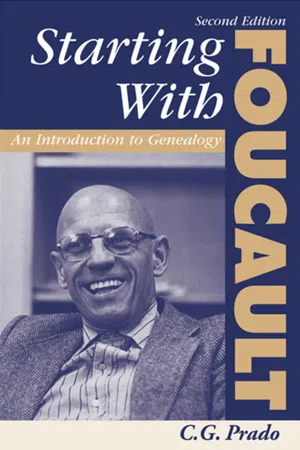
Michel Foucault had a great influence upon a wide range of disciplines, and his work has been widely interpreted and is frequently referred to, but it is often difficult for beginners to find their way into the complexities of his thought. This is especially true for readers whose background is Anglo-American or "analytic" philosophy. C. G. Prado argues in this updated introduction that the time is overdue for Anglo-American philosophers to avail themselves of what Foucault offers. In this clear and greatly-revised second edition, Prado focuses on Foucault's "middle" or genealogical work, particularly Discipline and Punish and Volume One of The History of Sexuality, in which Foucault most clearly comes to grips with the historicization of truth and knowledge and the formation of subjectivity. Understanding Foucault's thought on these difficult subjects requires working through much complexity and ambiguity, and Prado's direct and accessible introduction is the ideal place to start.
Information
Chapter One
Foucault: Challenge and Misperceptions
"At the time of his death ... Michel Foucault was perhaps the single most famous intellectual in the world."1 So opens James Miller's biography of Foucault. Alan Ryan goes further, asserting that Foucault "was the most famous intellectual figure in the world" when he died.2 David Macey's biography makes the more modest claim that at his death Foucault "was without doubt France's most prominent philosopher." But Macey adds that Foucault's international reputation had "almost eclipsed his reputation in France."3 Miller goes on to say that "scholars were grappling with the implications of [Foucault's] empirical research" across the academic spectrum and "pondering the abstract questions [he] raised."4 Jonathan Arac outdoes Miller in claiming that "Foucault's work . . . changed the basis for the work of all scholars."5
This high estimation of Foucault is shared by many North American academics in disciplines ranging from political science and cultural geography through sociology to literary criticism and film studies. Many students in these disciplines consider Foucault a champion in the struggle against what they regard as stultifying disciplinary traditions. The striking exception is "analytic" philosophers, who largely dismiss Foucault. Most philosophers whose post-Kantian canon prioritizes the work of Frege, Russell, Moore, and Wittgenstein do not consider Foucault a philosopher, much less a philosopher who has something to say to them. They regard Foucault as a paradigmatic "Continental" thinker, one whose post-Kantian canon emphasizes the work of Flegel, Heidegger, Flusserl, and Merleau-Ponty.6 Their negative perception of Foucault goes further than seeing him as a member of a different intellectual tradition. They dismiss Foucault as holding "postmodern" views that are inimical to proper philosophizing. Didier Eribon observes in his biography of Foucault that Foucault "drew huge crowds" on his visits to North America7 but was "completely ignored by most American philosophers."8 For example, Foucault's visits to the University of California at Berkeley9 were at the invitation of departments other than philosophy. The philosophers did not consider Foucault to be doing anything relevant to their interests and areas of expertise.10 Foucault was not just ignored; he was disparaged. Richard Rorty notes that "a distinguished analytic philosopher ... urged that 'intellectual hygiene' requires one not to read . . . Foucault."11 Foucault was not only aware of this hostility; he seemed to relish it. He claimed that he was "very proud" that some thought him dangerous for being, in their view, "an irrationalist, a nihilist."12
Despite analytic philosophers' disdain, Foucault had a huge influence on North American humanities and social sciences. He raised questions about "the reach of power and the limits of knowledge, the origins of moral responsibility and the foundations of modern government, the character of historical inquiry and the nature of personal identity."13 Yet despite some of these questions being philosophical by any reasonable standard, Foucault still does not figure in the bulk of the writing and teaching of North American analytic philosophers. They ignored Foucault when he began to achieve global notice and continue to ignore his work. Some of them have taken a belated interest in that work, if only because of its current prominence and its having defied predictions of modish transiency. But when analytic philosophers do consider Foucault's work, treatment of it usually runs more to invective than to sympathetic investigation or exposition. A paper typifying this treatment describes Foucault as not only wrong about nearly everything he did say, but as ultimately having "nothing to say" with respect to "philosophical theories of truth and knowledge."14
Foucault remains intellectually distant to most analytic philosophers. This is not only because he is outside their tradition; they also believe his writings belong to a tradition the standards and methods of which fall short of their own.15 Analytic philosophers see Foucault as in a tradition that is more literary than rigorous and technical. Speaking of Foucault's work, Eribon remarks that North American philosophers "saw no need of this 'literature,' which they ranked in the . . . French tradition of Bergson and Sartre."16 Analytic philosophers' perception and characterization of Foucault as unrigorous and too literary adversely affects their students. If the students are curious about his work, because of his importance in other disciplines, they are predisposed to find it beyond the pale of technical (read "tough-minded") philosophy. Students then see Foucault as someone whose work does not merit the close study it requires. Alternatively, the exclusionary attitude of their professors prompts other students to revere Foucault as an iconoclastic champion opposed to technical (read "sterile") philosophy. They then are predisposed to find in his work all sorts of ideas supportive of their agendas. The upshot is that the combination of Foucault's importance outside philosophy, and characterization of Foucault's work by analytic philosophers as too problematic in conception and development, elicits opposed and equally unproductive responses. On the one hand, aspirants to orthodoxy ignorantly dismiss Foucault as too literary on the implicit or explicit say-so of their professors. On the other hand, would-be radicals fervently but equally ignorantly embrace various more-or-less popularized versions of Foucault's views. In numerous seminars on Foucault, I have had to work as hard to disabuse ardent students of basic misconceptions as to engage the unresponsive ones.
Foucault's writings are not difficult in the way that Immanuel Kant's are difficult. But his mode of expression and his style are unfamiliar enough to North American readers to mislead and even to irritate them, thereby making what is not inherently difficult nonetheless inaccessible.17 Style aside, Foucault's work has characteristics that invite misinterpretation. His work exhibits a topical specificity at odds with abstract philosophizing and is deliberately marginal. Foucault employs a measure of provocative intellectual craftiness. Some important shifts in his thinking conspire to invite misunderstanding. There is no single work that adequately represents the complex, variegated, and evolutionary totality of Foucault's philosophical vision. In fact, Foucault's work resists holistic interpretation.18 In spite of his own avowals about the unity of his project, his books "hardly ever refer back to his previous works."19 This is why those who read only spottily in his work, basing their impressions on one or two books or articles, invariably form distorted and often astonishingly different ideas of his views.20 Many are introduced to Foucault through The History of Sexuality because of its popularity. They then encounter the concept of "power" as it is used to advance a particular thesis about sexuality. The consequence is that power quite wrongly looks to them like covert manipulation. It is difficult to understand the concept of power without first reading Discipline and Punish, where Foucault develops the idea. Reading The History of Sexuality first, and then reading, say, the quite differently conceived Archaeology of Knowledge poses another interpretive trap. In this case the results are most likely bafflement or misguided dismissal of one or the other work. Unfortunately, even systematic reading of several works does not ensure understanding of Foucault by those who approach his work from outside his intellectual tradition. This is in part because of differences in idiom and tradition and in part because of internal development in his thought. Additionally, Foucault always addresses circumscribed issues and always in opposition to established philosophical and historical scholarship. He leaves it to his readers to make the connections, and the connections often are made in varying ways.
The basic premise of this book is that a special strategy is necessary to read Foucault productively. Not only is it insufficient to read only one or two of his books or articles to get the gist of his thought, one should not begin at the beginning as with most philosophers. To start with Madness and Civilization is to risk an erroneous initial impression that Foucault's work is not philosophical enough. To start with the much discussed and in some ways most imposing major "archaeological" work, The Order of Things, is to risk misconstruing his middle and last books as less philosophical than they actually are. Despite their originality, The Order of Things and The Archaeology of Knowledge are methodologically and even thematically closer to traditional philosophy than are the books that follow them. Of greatest importance in Foucault are his challenges to traditional philosophical methods and assumptions and to established conceptions of truth and knowledge. Those challenges are raised most clearly and definitively in his "genealogical" works. It is counterproductive to approach his work in a manner that in any way erodes the philosophical force of these works.
To get a good understanding of Foucault, one must begin in the middle, with the major genealogical works: Discipline and Punish and The History of Sexuality, Volume 1. That is where we find the most pointed indictments of traditionally conceived truth, knowledge, and rationality. That is where we find the sharpest articulations of the ideas that truth and knowledge are products of power, that the subject is product of disciplinary techniques, and that rationality is itself an historical product. Once the nature and scope of these challenging ideas is appreciated, it is possible to go back to Madness and Civilization or The Order of Things, and forward to The Use of Pleasure or The Care of the Self, and productively understand the progression of Foucault's thought. Moreover, the major genealogical works comprise what is most philosophically significant in Foucault's work for my audience: analytic philosophers. It is in those works that Foucault most directly addresses what he describes as of greatest moment: "truth itself."21
The aim of this book is to provide those who have not read or have only dipped into Foucault's writings with an accessible introduction to his genealogy. Once readers grasp Foucault's radical ideas concerning truth, knowledge, the subject, and rationality, and understand how these are products of power relations, they will have what is most important in Foucault's thought. This book also has a therapeutic aim. Whether or not because of their philosophical significance, though one would hope because of it, Discipline and Punish and especially The History of Sexuality, Volume 1, are Foucault's most widely read books. Unfortunately, these also are the most often misinterpreted and misused of his works. The ideas presented in these books are prone to distortion and hasty appropriation. Not only are they difficult ideas, they are Foucault's most revolutionary insights and therefore what is most intellectually exciting in his work...
Table of contents
- Cover
- Half Title
- Title
- Copyright
- Contents
- Preface to the Second Edition
- 1 Foucault: Challenge and Misperceptions
- 2 The Domains of Analysis
- 3 Genealogical Analytics
- 4 Making Subjects
- 5 The Manufacture of Knowledge
- 6 The Faces of Truth
- 7 Truth and the World
- 8 Novel Construals and Cogency
- Βibliography
- Index
Trusted by 375,005 students
Access to over 1.5 million titles for a fair monthly price.
Study more efficiently using our study tools.
Frequently asked questions
Yes, you can cancel anytime from the Subscription tab in your account settings on the Perlego website. Your subscription will stay active until the end of your current billing period. Learn how to cancel your subscription
No, books cannot be downloaded as external files, such as PDFs, for use outside of Perlego. However, you can download books within the Perlego app for offline reading on mobile or tablet. Learn how to download books offline
Perlego offers two plans: Essential and Complete
- Essential is ideal for learners and professionals who enjoy exploring a wide range of subjects. Access the Essential Library with 800,000+ trusted titles and best-sellers across business, personal growth, and the humanities. Includes unlimited reading time and Standard Read Aloud voice.
- Complete: Perfect for advanced learners and researchers needing full, unrestricted access. Unlock 1.5M+ books across hundreds of subjects, including academic and specialized titles. The Complete Plan also includes advanced features like Premium Read Aloud and Research Assistant.
We are an online textbook subscription service, where you can get access to an entire online library for less than the price of a single book per month. With over 1.5 million books across 990+ topics, we’ve got you covered! Learn about our mission
Look out for the read-aloud symbol on your next book to see if you can listen to it. The read-aloud tool reads text aloud for you, highlighting the text as it is being read. You can pause it, speed it up and slow it down. Learn more about Read Aloud
Yes! You can use the Perlego app on both iOS and Android devices to read anytime, anywhere — even offline. Perfect for commutes or when you’re on the go.
Please note we cannot support devices running on iOS 13 and Android 7 or earlier. Learn more about using the app
Please note we cannot support devices running on iOS 13 and Android 7 or earlier. Learn more about using the app
Yes, you can access Starting With Foucault by C. G. Prado in PDF and/or ePUB format, as well as other popular books in Philosophy & Epistemology in Philosophy. We have over 1.5 million books available in our catalogue for you to explore.