- 400 pages
- English
- ePUB (mobile friendly)
- Available on iOS & Android
eBook - ePub
Ritual Communication
About this book
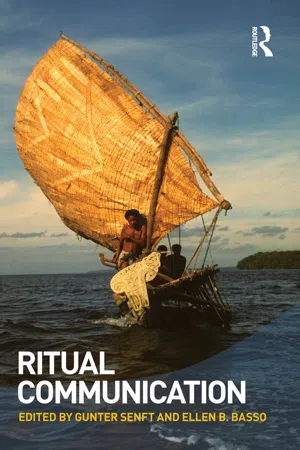
Ritual Communication examines how people create and express meaning through verbal and non-verbal ritual. Ritual communication extends beyond collective religious expression. It is an intrinsic part of everyday interactions, ceremonies, theatrical performances, shamanic chants, political demonstrations and rites of passage. Despite being largely formulaic and repetitive, ritual communication is a highly participative and self-oriented process. The ritual is shaped by time, space and the individual body as well as by language ideologies, local aesthetics, contexts of use, and relations among participants. Ritual Communication draws on a wide range of contemporary cultures - from Africa, America, Asia, and the Pacific - to present a rich and diverse study for students and scholars of anthropology, sociology and sociolinguistics.
Information
one
Little Rituals
John B. Haviland
Mexican folk discourses partake of several great traditions of ritual language, including the codified responsive dialogues of the Catholic catechism and the massive parallel diphrasism of Mesoamerican emotionally charged or powerful speech. Sometimes, in the Tzotzil of Zinacantan, Chiapas, the two forms are partially merged—for example, in the prayer of shamans and religious officeholders. Resonances of both these great traditions resound in interactions of more mundane sorts in Zinacantan, from domestic conversations to performances in political meetings, markets, and other public spaces. In this chapter I concentrate on these "little rituals," in which echoes of more thoroughly regimented, formulaic, and contextually bound ways of using language can be heard. What do such echoes tell us about the people who produce them, about what they are doing, and about talk and interaction in general? The Zinacantec material underlines the way ritual forms, themselves inherently multimodal, tend to leak beyond the boundaries of full-blown ritual events. Such leakage in turn illustrates again the profound indexicality of talk in interaction and begins to explain some of the coercive effects of ritual talk, on which I focus.
Zinacantec Tzotzil and its closest neighbors have been classic exemplars in the taxonomic study of "ways of speaking" (Gumperz and Hymes 1972), starting with the foundational works of Bricker (1974) and Gossen (1973,1974a, 1974b). My own studies of Zinacantec gossip (Haviland 1977a, 1977b, 1998) amplified but also somewhat undermined the early taxonomies. Irvine's (1979) critique of the notion of formality made it impossible to continue to confound distinct senses of the word—talking without elaboration of "formal language," for example—and a similar critical exercise could be mounted against the term "ritual language." Further, Bauman's development of the notion of performance (1977; Bauman and Briggs 1990) highlighted both interactive and social-structural (or even ethical) aspects of ways of speaking missing in the classic formulations.
My understanding of the social life of talk draws on several foundations: the idea of interaction and face elaborated by Goffman (1981a, 1983); Silverstein's (1976) emphasis on indexical dimensions of language use, linking speech to contexts both assumed and imposed; and the recognition of the social historicity and multiple voicing of speech in work by Bakhtin and his circle (Bakhtin 1981 [1934], 1986). Goffman's insistence on placing talk in a wider interactive frame and his "interaction rituals" are obvious inspirations for the phrase "little rituals." Similarly, one could understand "ritualization" to be a displacement or recalibration of distinct but laminated contexts indexically projected, in Silverstein's parlance, by talk in interaction. Finally, the ritual echoes in quotidian Zinacantec interaction clearly reflect the generic leakage characteristic, for Bakhtin, of "secondary genres," but with somewhat more sociological bite.
A Merolico
I start not in highland Chiapas but in a central plaza of downtown Mexico City, the Alameda, where many of the city's poor go on Sundays for "free" entertainments. Among these are the spectacles provided by merolicos, celebrated fast-talkers who purvey everything from fortunes, herbs, and joke books to spells and recipes for conquering lovers or vanquishing enemies (Bauman 2004; Haviland 1993, 2005b; Sobrevilla del Valle 2000).
An accomplished merolico is Felix, who takes money from people in return for a magical talisman and an offer of spiritual and practical advice. At a crucial point in his performance, when he has arranged his public in a tight circle around him, arms outstretched, fists clasping their talismans, and each person having already "donated" a few small coins to him for his blessing, Felix demonstrates his extraordinary powers by inserting a steel ice pick into his nostril and apparently straight into his brain. As the public gasps and stares, he walks around the circle, ice pick projecting from his face, touching each person in turn. Then he kneels in the center of the circle. After incanting a blessing, he appropriates a piece of the catechism designed to ensnare the audience willy-nilly in a responsive commitment to his purposes. In the following portion of a transcription of such an exchange, M is the merolico, and A is the audience:
- 13 m; Todos decimos...
- Let us all say...
- 14!Así sea!
- So be it!
- 15 a; Así sea
- 16 m; Ave María purísima [placing his right palm over his heart]
- Hail Mary most pure,
- 17 a; Sin pecado concebida
- Conceived without sin.
- 18 m; Ave María purísima [louder]
- 19 a; Sin pecado concebida
- 20 m; Ave María purísima
- 21 a; Sim pecado concebida
Having secured the participation of the public—following his direct command (13), the assembled crowd repeats his "So be it" (15)—he goes on (16) to elicit, first somewhat uncertainly (17), then with perfect coordination in the repetitions (19-21), the appropriate response from the audience to his "Hail Mary most pure": "conceived without sin." He then induces the members of the audience to cross themselves, seemingly involuntarily, at the appropriate moment (24-27):
- 22 m; En el nombre sea de dios bendito todopoderoso
- In the name of blessed, all powerful God,
- 23 Demos tu bendicíon
- Give us your blessing.
- 24 En el nombre del padre
- In the name of the Father,
- 25 Del hijo
- Of the Son,
- 26 Del espuítu
- And of the
- 27 Santo
- Holy Spirit.
- 28 Amen
Felix now sits back on his heels and engages an entirely different though equally powerful set of folk religious traditions, oriented less toward the reflexive responses of Catholic ritual than toward the awe and fear associated with Mesoamerican magic. He assumes in sequence, via the hypothetical ascriptions of others, the roles of witch, sorcerer, animal spirit companion (the nagnal of Aztec tradition), snake charmer, diviner, spiritist (santero, i.e., devotee of a cult of saints), and shaman, pronouncing himself, finally, "teacher of teachers":
- 30 m; Me dicen bmjo
- They call me a witch.
- 31 Me dicen hechicero
- They call me a sorceror.
- 32 Me dicen nagiuil
- They call me a spirit companion.
- 33 Perdónenme
- Excuse me,
- 34 Otros me dicen pitonista
- Others call me a snake charmer.
- 35 Hay quien me dice adivino
- There are some who call me a psychic.
- 36 Señor
- Sir,
- 37 Soy santero
- I am a worshipper of saints.
- 38 Soy curandero
- I am a curer.
- 39 Soy
- I am
- 40 Maestro de maestros
- Teacher of teachers.
The merolico endows himself (and by extension his talisman) with a variety of powers: those of priest and intermediary to God, of the saints and the Virgin, of sorcery and witchcraft, of divination, and of healing. He borrows language from Catholic and popular traditions to accomplish both crowd and mind control. He has earlier demonstrated his control over snakes, and most recently over a six-inch steel shank inserted apparently straight into his brain. As he speaks he now exercises his power over the members of the crowd, causing them to move their bodies and respond on his command. These same powers, or fear of them, will ultimately cause many in the audience to part with up to a week's earnings before they can be freed from Felix's circle.
Zinacantec Ritual Language
Let me turn now to Chiapas and to a seemingly inconsequential snippet of interaction. In August 2004, as I accompanied the entourage of a prestigious ritual officer ("cargoholder") en route to an important fiesta, we stopped at a village on the road to pick up several helpers. My ninety-year-old compadre, P, blind and nearly deaf, made his way out to the road to meet the passing group, and there ensued a brief encounter while the truck was being loaded with people and provisions. A senior helper and the cargoholder's wife greeted the old man and exchanged a few words, and the cargoholder's official tot-me? (lit., 'father-mother', or ritual adviser) offered him a few sips of cane liquor. There could scarcely be a more prosaic interaction than this—a chance meeting between acquaintances, a mere parenthesis to a much larger ritual event. Before looking at its details, let me proceed to an extremely abbreviated mini-ethnography of Tzotzil ritual speech.
The language of prayer in Zinacantec Tzotzil is organized into parallel structures. Song (Haviland 1967), formal denunciation (Laughlin 1975), and some ordinary talk (Haviland, 1996) share with prayer the use of stylized images and sentiments, lexicalized as more or less fixed pairs (and sometimes triplets or quadruplets) of expressions structured tightly together (see Gossen 1974, 1974b, 1985, for Chamula prayer; see Laughlin 1980, Haviland 1967, 2000 for Zinacantan).
In its canonical form, a Zinacantec curer's prayer proceeds as a series of strictly parallel lines that differ from one another in only a single element—sometimes a lexeme, sometimes just a root. Although every Zinacantec can muster at least some couplets, and other Zinacantec specialists may be extraord...
Table of contents
- Cover
- Half Title
- Series Page
- Title Page
- Copyright Page
- Contents
- List of Figures
- Acknowledgments
- List of Contributors
- Introduction
- 1 Little Rituals
- 2 Everyday Ritual in the Residential World
- 3 Trobriand Islanders' Forms of Ritual Communication
- 4 "Like a Crab Teaching Its Young to Walk Straight": Proverbiality, Semantics, and Indexicality in English and Malay
- 5 Access Rituals in West African Communities: An Ethnopragmatic Perspective
- 6 Ritual and the Circulation of Experience: Negotiating Community in the Twentieth-Century Amazon
- 7 Communicative Resonance across Settings: Marriage Arrangement, Initiation, and Political Meetings in Kenya
- 8 Ritualized Performances as Total Social Facts: The House of Multiple Spirits in Tokelau
- 9 Unjuk Rasa ("Expression of Feeling") in Sumba: Bloody Thursday in Its Cultural and Historical Context
- 10 Civility and Deception in Two Kalapalo Ritual Forms
- 11 Private Ritual Encounters, Public Ritual Indexes
- 12 "While I Sing I Am Sitting in a Real Airplane": Innovative Contents in Shuar and Achuar Ritual Communication
- 13 Interior Dialogues: The Co-Voicing of Ritual in Solitude
- References
- Index
Trusted by 375,005 students
Access to over 1.5 million titles for a fair monthly price.
Study more efficiently using our study tools.
Frequently asked questions
Yes, you can cancel anytime from the Subscription tab in your account settings on the Perlego website. Your subscription will stay active until the end of your current billing period. Learn how to cancel your subscription
No, books cannot be downloaded as external files, such as PDFs, for use outside of Perlego. However, you can download books within the Perlego app for offline reading on mobile or tablet. Learn how to download books offline
We are an online textbook subscription service, where you can get access to an entire online library for less than the price of a single book per month. With over 1.5 million books across 990+ topics, we’ve got you covered! Learn about our mission
Look out for the read-aloud symbol on your next book to see if you can listen to it. The read-aloud tool reads text aloud for you, highlighting the text as it is being read. You can pause it, speed it up and slow it down. Learn more about Read Aloud
Yes! You can use the Perlego app on both iOS and Android devices to read anytime, anywhere — even offline. Perfect for commutes or when you’re on the go.
Please note we cannot support devices running on iOS 13 and Android 7 or earlier. Learn more about using the app
Please note we cannot support devices running on iOS 13 and Android 7 or earlier. Learn more about using the app
Yes, you can access Ritual Communication by Gunter Senft,Ellen B Basso in PDF and/or ePUB format, as well as other popular books in Social Sciences & Communication & Public Speaking. We have over 1.5 million books available in our catalogue for you to explore.