- 360 pages
- English
- ePUB (mobile friendly)
- Available on iOS & Android
eBook - ePub
About this book
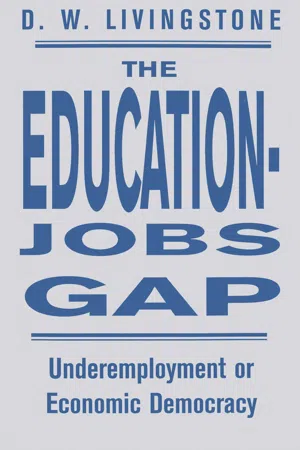
According to Ivar Berg's performance criteria, over half of the U.S. workforce is now underemployed. Using analysis based on U.S. and Canadian surveys of work and learning experiences and other documental data, author David Livingstone exposes the myth of the "learning enterprise" and argues that the major problem in education-work relations is not education but the mismatch between work and worker.
1
The Knowledge Society: Pyramids and Icebergs of Learning
Miniaturized electronic technology and its major product, information, cannot be controlled.... Access to information has escalated beyond anything that could have been imagined a decade ago.
—Knel-Paz 1995,267,269
Despite the spread of democracy and the rise of the working classes in America, the elite among us often are so indifferent to and illiterate about the folklore or folk cultures, that the folk world represents the equivalent of a low-frequency communication that seldom or never reaches their ears. Yet folk culture represents what has been the dominant world culture since humankind began.... If literacy is to be defined realistically, then it must include developing an awareness and appreciation of the activities and daily interests of most people most of the time in contemporary society. The problem of most people is not the lack of knowledge, but the question of how to manage the scope and intensity of information on a daily basis.
—Browne 1992,127,179
Introduction
To live is to learn. Continual social learning is the most distinctive feature of human beings. We are born more helpless than most other species and then constantly socialized by ever more complex and sophisticated communications with other humans throughout our lives. The cumulative body of human knowledge has grown greatly as we have created many new means of collecting raw data, converted the data into useful information and organized information into diverse bodies of knowledge.1 Public libraries, camera and sound recording equipment, telephones, radio and television, computers, and a multitude of other new information technologies have proliferated over the past century. When the world around us becomes more challenging or uncertain, our first effective response is often to try to learn more about the situation rather than reacting instinctively In the current context of economic uncertainties and global challenges to various institutionalized forms of social life, and with the spread of computerized digital telecommunications, our efforts in pursuit of knowledge have been increasing exponentially.2 By virtually every measure, we are now spending more time acquiring knowledge than ever before in the history of our continually learning species.
Many discussions of learning focus exclusively on organized activities related to educational institutions. Some discussions of teacher led education reduce the focus even further by equating education with schooling. Much of the learning that occurs within current educational institutions has been very hierarchically organized, not only in terms of content sequences but also in terms of who has access to advanced forms of knowledge. Certainly many social analysts over the past century have been preoccupied with the general issue of hierarchical, standardized control of expanding forms of information within formal organizations such as schools as well as paid workplaces.3 In this chapter, I will document both the continuing expansion of these "educational pyramids" and their extended reproduction throughout our lives. But I will also consider other forms of learning which occur beyond the realm of organized educational institutions, learning which is less hierarchical and more voluntary and therefore harder to detect, measure or control. Such activities constitute "icebergs of learning." The character and extent of people's participation in this informal learning cannot be simply derived from their formal educational statuses. In particular, there is massively more learning occurring among those in the lower levels of the formal educational pyramid than is generally recognized. Many forms of knowledge remain beyond effective hierarchical control as our sources of information continue to proliferate. Also, virtually all forms of human knowledge have tacit practical dimensions as well as recordable cognitive dimensions. Active engagement in informal learning of both recorded and tacit dimensions continues to be an integral part of the reality of the operation of knowledge-based societies and of advanced industrial workplaces. Orwell's Big Brother may be watching ever more, but it is increasingly impossible to attend to all that we know.
The General Expansion of Learning Activities
Three general sorts of learning practices may be distinguished: formal education or schooling, nonformal or further education, and informal learning.4 Formal education has been defined as full-time study within state-certified school systems. Modern formal schooling has been restricted almost exclusively to young people who have been expected to proceed through extensive graded curricula in lockstep fashion prior to achieving complete adult status.5 Nonformal or further education is all other organized educational activities, including further courses or training programs offered by any social institution. It is such organized non-formal educational programs offered mainly to adults on a part-time basis by diverse authorities that have been the primary focus in recent academic and policy maker discussions about "lifelong learning" and a "permanent education culture." Informal learning refers to all those individual and collective learning activities that we do beyond the authority or requirements of any educational institution. Any deliberate effort to gain new understanding, knowledge or skill to which we devote a discernible amount of time and recognize as such may be considered to be an informal learning project.
The distinctions among these three types of learning are somewhat arbitrary and becoming increasingly blurred. Self-directed adult learners have found it convenient to continue more of their learning projects in flexibly scheduled part-time school-based programs, and with advanced credit through such means as prior learning assessment. Independent learners can also consider a burgeoning array of standardized packages of learning materials designed and sold by large private corporations to both school systems and individual consumers. Younger students increasingly face the material necessity of combining part-time paid work with part-time studies, often with multiple transitions between school and work rather than a locks tep march from the end of schooling into the permanent workforce. School authorities increasingly recognize the demographic reality that getting more adult informal learners into their classrooms is the only immediate hope for sustaining enrollment numbers now that the post-World War II baby boomers have marched through and birth rates have declined. The expansion of nonformal or further adult education into the realms of both formal schooling and informal learning now appears to be serving a wide variety of interests. But, whatever distinctions may be made among types of learning, our collective devotion to learning activities through formal schooling, further adult education courses and informal learning continues to grow very substantially.
The Continuing Growth of Schooling
The rate of participation in formal schooling has grown almost continuously throughout the past century. Since the end of the post-World War II period of general economic expansion around 1970, enrollment ratios in post-secondary formal education have continued to increase in most advanced indust...
Table of contents
- Cover
- Half Title
- Title
- Copyright
- Contents
- List of Tables and Illustrations
- Preface
- Acknowledgements
- Introduction: Reversing The Education-Jobs Optic
- 1 The Knowledge Society: Pyramids And Icebergs of Learning
- 2 The Many Faces of Underemployment
- 3 Voices from the Gap: Underemployment and Lifelong Learning
- 4 Debunking the "Knowledge Economy": The Limits of Human Capital Theory
- 5 Explaining the Gap: Social Struggles Over Knowledge and Work
- 6 Bridging the Gap: Prospects for Work Reorganization in Advanced Capitalism
- Endnotes
- Glossary of Acronyms
- Bibliography
- Index
Trusted by 375,005 students
Access to over 1.5 million titles for a fair monthly price.
Study more efficiently using our study tools.
Frequently asked questions
Yes, you can cancel anytime from the Subscription tab in your account settings on the Perlego website. Your subscription will stay active until the end of your current billing period. Learn how to cancel your subscription
No, books cannot be downloaded as external files, such as PDFs, for use outside of Perlego. However, you can download books within the Perlego app for offline reading on mobile or tablet. Learn how to download books offline
Perlego offers two plans: Essential and Complete
- Essential is ideal for learners and professionals who enjoy exploring a wide range of subjects. Access the Essential Library with 800,000+ trusted titles and best-sellers across business, personal growth, and the humanities. Includes unlimited reading time and Standard Read Aloud voice.
- Complete: Perfect for advanced learners and researchers needing full, unrestricted access. Unlock 1.5M+ books across hundreds of subjects, including academic and specialized titles. The Complete Plan also includes advanced features like Premium Read Aloud and Research Assistant.
We are an online textbook subscription service, where you can get access to an entire online library for less than the price of a single book per month. With over 1.5 million books across 990+ topics, we’ve got you covered! Learn about our mission
Look out for the read-aloud symbol on your next book to see if you can listen to it. The read-aloud tool reads text aloud for you, highlighting the text as it is being read. You can pause it, speed it up and slow it down. Learn more about Read Aloud
Yes! You can use the Perlego app on both iOS and Android devices to read anytime, anywhere — even offline. Perfect for commutes or when you’re on the go.
Please note we cannot support devices running on iOS 13 and Android 7 or earlier. Learn more about using the app
Please note we cannot support devices running on iOS 13 and Android 7 or earlier. Learn more about using the app
Yes, you can access The Education-Jobs Gap by D W Livingstone in PDF and/or ePUB format, as well as other popular books in Economics & Labour Economics. We have over 1.5 million books available in our catalogue for you to explore.