- 224 pages
- English
- ePUB (mobile friendly)
- Available on iOS & Android
eBook - ePub
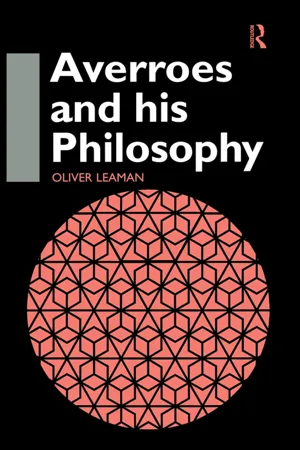
Averroes and His Philosophy
About this book
Despite his important stature in the history of philosophy, Averroes is a thinker whose work has been left largely unexplored in this century. It is the aim of this book to rectify this omission, and to argue that his philosophical output is of considerable philosophical as well as historical significance.
Information
PART I
Metaphysics
Metaphysics
INTRODUCTION
THE response which Averroes provided to the critique of philosophy offered by Ghazali is interesting for a number of reasons, chief among which is the high standard of philosophical argument involved on both sides of the dispute. Averroes objects to the ways in which philosophy has been tarred with the Avicennan brush, and we shall see in this part how he tries to construct an account of philosophy which is independent of Avicenna. He does not just argue that Avicenna presents views which are alien to Aristotle, and so must be invalid, as is so often assumed. Averroes rather seeks to establish a logical connection between the very different views of Avicenna and Ghazali and then attempts to demolish them both together. Ghazali is regarded as taking Avicenna to his logical conclusion, thereby revealing the infelicities in that whole approach to philosophy. We will go through some of the discussions in the Tahāfut al-tahāfut (Incoherence of the Incoherence) in combination with other texts to show how this general line can be made plausible. This is a very lively series of discussions and ties in well with Averroes’ more directly technical writings. Although Averroes had the last word, in many ways Ghazali had the last laugh, since the form of philosophy represented and defended by Averroes went into a sudden decline in the Islamic community after his death. By contrast, the status of Ghazali has remained formidable up to today. In the dispute there is something of a theme shared by both parties, and that is concerned with the appropriate use of language to discuss God and his relationship with the world. Ghazali keeps on pressing the philosophers to admit that their model of God and his influence over the world is very different from a full-blooded religious view. He implies that the philosophical model of the world could do without a deity quite easily since there is no central and significant role for such an entity. The response by Averroes is to accuse Ghazali of only being prepared to accept a concept of a God which is remarkably similar to that of a very powerful human being, God with a status rather similar to that of Superman. We shall eventually see what implications their views have for their understanding of how language works. Their disagreement reveals intriguing features of language when pushed to its limit and is very far from being a medieval argument of nothing but historical interest.
The Incoherence of the Incoherence
The First Proof
In his First Discussion Ghazali sets out to discuss ‘those proofs that make an impression on the mind’ (TT 4) in favour of the eternity of the world. He is opposed to these proofs, not merely on the religious grounds that he believes they contravene an acceptable concept of the deity as omnipotent creator, but because he argues that they are invalid as proofs. It is very important throughout to grasp that this is his main rationale for his argument. In the First Proof he characterizes one of the philosophers’ proofs as following from the impossibility of the temporal coming from the eternal. If it is accepted that God is eternal, and if it is inconceivable for the temporal to emerge from the eternal, then God could not create a world at a particular time. It would follow that, since the world exists, it must be eternal. The argument is that, if something eternal could exist without the world also existing, then the existence of the world is merely a possibility, something waiting to be brought to actuality. When this event eventually does occur, i.e. the world is brought to existence, then some change must have occurred to bring this about. If no change did occur, then no world would result. If a change does occur, the question arises as to why it occurs now and not before, a question which leads to an infinite regress since it can be asked of every putative time at which the world came into being. This argument form is taken to support the view that the world must have been in existence eternally.
Averroes is in the fortunate position of not having to agree with everything his philosophical predecessors propounded, and he certainly does not agree with this argument form as it stands. He condemns the argument as: ‘in the highest degree dialectical … does not reach the level of demonstrative proof. For its premisses are common notions, and common notions come close to being equivocal, whereas demonstrative premisses are directed towards things belonging to the same kind’ (TT 5). In his attack on the argument he is particularly scathing on the way it employs the notion of possibility, where it raises the status of the world as a mere possibility. Averroes points out that we talk about something possible taking place in a number of different ways, and it is not always the case that something outside the agent brings about the change. He gives the example of ‘the transition in the geometer from non-geometrizing to geometrizing, or in the teacher from non-teaching to teaching’ (TT 6) which can be explained in terms of the characteristics of the agents involved without calling up an infinite regress. Averroes’ point in this section is that the philosophical issues involved in the question of something eternal causing something else to happen and how change is brought about are complicated and difficult topics which require detailed and careful discussion, and the sketch of a philosophical argument which Ghazali produces is only a caricature of a proper philosophical argument.
Ghazali goes on to put the blunt question:
Why do you deny the theory of those who say that the world has been created by an eternal will which has decreed its existence in the time in which it exists, its nonexistence lasting until the time it ceases and its existence beginning from the time it begins, while its existence was not willed before and therefore did not happen, and that at the precise moment it began it was willed by an eternal will and so began? What is the objection to this theory and what is absurd in it? (TT 7).
Ghazali is trying to establish the acceptability of the common-sense view that God just existed by himself for a time, then decided he would bring the world into existence, did it, and so it is now in existence. What is wrong with thinking about an eternal will ordering the world to come into existence at a particular time, so that the question of why it did not come into existence earlier, nor later, is answered by saying that it came into existence precisely when it was told to by God, and not a moment earlier or later? After all, I can sit in front of a blank piece of paper in my typewriter, decide to type some material on it, and then set about accomplishing the task. There will indeed be a gap between my decision and the implementation of the decision. Averroes argues that this sort of approach ignores the disanalogy between an eternal and a temporal will. We have reasons for doing things, we have dispositions to act, and we can choose what we are going to do. God’s will has been in existence forever and we cannot really think of things occurring to it in the same casual way as things occur to us. If God had decided to do something, what could make him change his mind? After all, before the world is created there is nothing else in existence to change his mind. Once God has decided to do something, why should its instantiation be delayed? There exists nothing to delay it, since nothing but God exists in the first place, and even if it did it would be incapable of defying the divine fiat. As Ghazali quite accurately characterizes the philosophers’ argument, ‘At one moment the object of will did not exist, everything remained as it was before, and then the object of will existed. Is this not a perfectly absurd theory?’ (TT 10).
Ghazali goes on to wonder whether the divine will is not more similar to the temporal will than we might think. He gives the example of a man delaying a divorce until his spouse actually commits an offence, or an offence takes place, and we might also think of the example of a postdated cheque. Can we not want something to happen in the future, and yet at the same time delay its instantiation? As Averroes puts it:
In the same way as the actual divorce is delayed after the formula of the divorce till the moment when the condition of someone’s entering the house, or any other, is fulfilled, so the realization of the world can be delayed after God’s act of creation until the condition is fulfilled on which this realization depends, i.e. the moment when God willed it. But conventional things do not behave like rational (TT 12).
This is a strange way of putting his point. God might regard rational events as paradigmatically conventional. For example, the natural events of the world might appear to be conventional in the sense of being lawlike regularities which have been divinely established. Yet Averroes goes on to claim that, ‘in this matter there is no relation between the concept drawn from the nature of things and that which is artificial and conventional’ (TT 13). Ghazali follows up his argument with the suggestion that the eternal will is really very unlike the temporal will, so that arguments which the philosophers might use about the workings of our own minds to draw conclusions about God’s will are unsatisfactory. Just because we cannot generally delay the effects of our actions and decisions if there is not an obstacle to the existence of those effects, it does not follow that God cannot. Averroes is very scathing about this approach, and rightly so. The philosophers have argued that there are serious difficulties in making sense of the proposition that God could delay a decision about the creation of the world, and they argue that this suggests that the world must be regarded as eternal. They have tried to demonstrate logically the incompatibility between an eternal will and a temporal creation, and it is just not good enough for Ghazali in this opening section to hint that the philosophers do not present a valid argument form, but only an appeal to intuition (TT 13).
Ghazali decides to throw in another argument to suggest that the philosophers go awry in maintaining the eternity of the world. This argument is based upon the infinity of the revolutions of the planets on the assumption that the universe is eternal. If the latter is the case, then the revolutions of the planets have been going on forever. Yet they are acknowledged to move at different rates and it is possible to establish proportional relationships between them. If all the movements are infinite, how can it be possible to establish such relationships, and specify precisely what they are? How can we even determine whether such proportions are even or uneven (TT 16)? Averroes’ rather scornful response to this approach is solidly based upon his support for an Aristotelian understanding of the nature of infinity. Aristotle allowed the existence of accidental and potential infinites, but not essential and actual infinites. He puts it in this way:
Our adversaries believe that, when a proportion of more or less exists between parts, this proportion holds good also for the totalities, but this is only necessary when the totalities are finite. For where there is no end there is neither ‘more’ nor ‘less’. The admission in such a case of the proportion of more or less brings with it another absurd consequence, namely that one infinite could be greater than another. This is only absurd when one supposes two quantities which are actually infinite, for then a proportion does exist between them. When, however, one imagines things potentially infinite, there exists no proportion at all. This is the right answer to this question, not what Ghazali says in the name of the philosophers (TT 19).
Averroes accepts the existence of accidental but not essential infinite series. An infinite causal chain such as that of human beings replicating themselves with descendants must not be regarded as a totality which can be measured and compared with other totalities. Infinite quantities have no beginning and no end, and when we think about the beginning of everything Averoes claims that ‘The starting point of his acts is at the starting point of his existence; for neither of them has a beginning’ (TT 23).
Ghazali goes on to suggest that the philosophers do acknowledge at least one actual infinite quantity:
According to your principles it is not absurd that there should be actual units, qualitatively differentiated, which are infinite in number; I am thinking of human souls, separated through death from their bodies. How will you refute the man who affirms that this is necessarily absurd in the same way as you claim the connexion between an eternal will and a temporal creation to be necessarily absurd? This theory about souls is that which Avicenna accepted, and it is perhaps Aristotle’s (TT 25–6).
Averroes rejects this claim with some vehemence, pointing out with some accuracy how distant such a conception of the afterlife is from Aristotelian philosophy where ‘the impossibility of an actual infinite is an acknowledged axiom … equally valid for material and immaterial things’ (TT 27). We shall return to this point in more detail when we come to consider Averroes’ views on the soul. For the moment it is important to grasp that Averroes and Ghazali are offering two different accounts of the nature of infinity, a difference which later on in the Tahāfut becomes quite crucial.
This discussion of the issues involved in making sense of the temporal emerging from the eternal is really just preliminary skirmishing before we reach the main point at TT 34. Here Ghazali faces squarely the problem of explaining how God can be taken to choose to create the world at a particular time when for him all times are the same. How is he motivated to create the world at one time rather than at another time? What could encourage him to create then rather than earlier or later? What principles could he have had in mind when thinking about when to create the world? The main problem is to explain how God could choose a particular time to create when there is no way of distinguishing one time from another time. As Averroes points out, it is difficult to see how Ghazali makes out his case:
for two similar things are equivalent for the willer, and his action can only attach itself to the one rather than to the other through their being dissimilar, i.e. through one’s having a quality the other has not. When, however, they are similar in every way and when for God there is no differentiating principle at all, his will will attach itself to both of them indifferently and … it will attach itself either to the two contrary actions simultaneously or to neither of them at all, and both cases are absurd (TT 36).
Ghazali argues very interestingly here that not only can the divine will differentiate between two similar alternatives, but the human will can too:
Suppose two similar dates in front of a man who has a strong desire for them, but who is unable to take them both. Surely he will take one of them through a quality in him the nature of which is to differentiate between two similar things … Everyone, therefore, who studies, in the human and the divine, the real working of the act of choice, must necessarily admit a quality the nature of which is to differentiate between two similar things (TT 37–8).
This is a very interesting suggestion. When faced with two equivalent alternative courses of action, we have to select one if we are to act, and we must have a reason for selecting that one. Yet if there is no difference between the courses of action as such apart from the fact that they are distinct, we as choosers must provide the reason for selecting one rather than another. If even we can do it, then surely there is no difficulty in conceiving of God just choosing when the world should begin regardless of the similarity of all the competing starting dates. Ghazali suggests that any difficulty in accepting this proposition is no more than a failure in human imagination rather than a conceptual difficulty. Yet Averroes’ reply to this argument is entirely effective. He argues that, where we have a choice between two similar alternatives, the choice is really between accepting one of the alternatives and rejecting both. For instance, if one is hungry and is presented with equivalent dates, the choice may seem to be between the dates, but really it is between eating and not eating. Either date will satisfy one’s hunger, and in choosing a date one is choosing not to remain hungry. The actual date one goes for is entirely incidental to the purpose in hand. But does this matter? Cannot Ghazali still use this example to show how God can arbitrarily choose a particular time to create the world? The problem with his argument here is that it is designed to suggest that the divine will can establish a difference where none previously exists, whereas the truth of the matter is that in the example a choice is made between alternative courses of action where a difference does already exist (TT 40–1).
Ghazali broadens his argument to suggest that the world could have a different physical structure than it does have without any interference in the workings of the world. He produces examples of facts with variations which might easily be very different from their present state. He discusses the differences in the directions of the movements of the spheres, and the choice of a pair of definite points in the outer sphere to serve as poles around which the heavens revolve. As far as the latter is concerned, since all parts of the sphere are of the same character, nothing could render any one pair of opposite points preferable to another as a locus of the poles. In addition, what is the necessity of accepting that the movements of one of the heavenly spheres to the west and the others to the east represent the only way in which such spheres could move? Ghazali argues that the same effects would certainly be achieved in a universe which moves in the opposite direction, with the highest sphere moving to the east rather than to the west. If this is true, then the existing organization of the universe is entirely arbitrary. This line of argument is designed to establish that there are instances in the universe ...
Table of contents
- Cover Page
- Half Title page
- Title Page
- Copyright Page
- Dedication
- Contents
- Preface
- Note on the Text
- Introduction to the Second Edition
- Introduction: The Cultural Context
- I Metaphysics
- II Practical Philosophy
- III Reason, Religion, and Language
- Select Bibliography
- Index
Trusted by 375,005 students
Access to over 1.5 million titles for a fair monthly price.
Study more efficiently using our study tools.
Frequently asked questions
Yes, you can cancel anytime from the Subscription tab in your account settings on the Perlego website. Your subscription will stay active until the end of your current billing period. Learn how to cancel your subscription
No, books cannot be downloaded as external files, such as PDFs, for use outside of Perlego. However, you can download books within the Perlego app for offline reading on mobile or tablet. Learn how to download books offline
Perlego offers two plans: Essential and Complete
- Essential is ideal for learners and professionals who enjoy exploring a wide range of subjects. Access the Essential Library with 800,000+ trusted titles and best-sellers across business, personal growth, and the humanities. Includes unlimited reading time and Standard Read Aloud voice.
- Complete: Perfect for advanced learners and researchers needing full, unrestricted access. Unlock 1.5M+ books across hundreds of subjects, including academic and specialized titles. The Complete Plan also includes advanced features like Premium Read Aloud and Research Assistant.
We are an online textbook subscription service, where you can get access to an entire online library for less than the price of a single book per month. With over 1.5 million books across 990+ topics, we’ve got you covered! Learn about our mission
Look out for the read-aloud symbol on your next book to see if you can listen to it. The read-aloud tool reads text aloud for you, highlighting the text as it is being read. You can pause it, speed it up and slow it down. Learn more about Read Aloud
Yes! You can use the Perlego app on both iOS and Android devices to read anytime, anywhere — even offline. Perfect for commutes or when you’re on the go.
Please note we cannot support devices running on iOS 13 and Android 7 or earlier. Learn more about using the app
Please note we cannot support devices running on iOS 13 and Android 7 or earlier. Learn more about using the app
Yes, you can access Averroes and His Philosophy by Oliver Leaman in PDF and/or ePUB format, as well as other popular books in Philosophy & Philosophers. We have over 1.5 million books available in our catalogue for you to explore.