- 240 pages
- English
- ePUB (mobile friendly)
- Available on iOS & Android
eBook - ePub
About this book
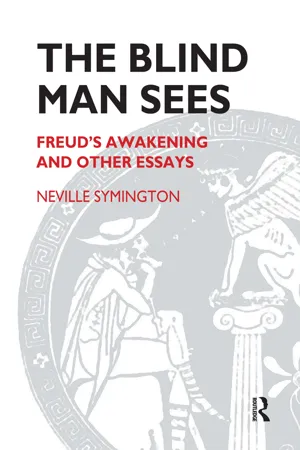
The papers in this book have been written over a period of fifteen years, and focus in the similarity between psychoanalysis and religion. The author argues that psychoanalysis can be seen as a scientific religion with Freud as the leader of the movement. He examines the various stages of the journey made by a religious leader from "blindness" to "founding an institution" and finds counterparts in the development of psychoanalysis while drawing examples from Buddhism, Christianity and Islam. He invites the reader on a journey with him - to examine the human mind, our society, the process of psychoanalysis, science and philosophy. He successfully uses examples from the consulting room to illuminate his arguments. The author's honest accounts of the search for answers relevant to all of us encourage the reader to think further and deeper than he or she had intended. 'The psychoanalyst examines scientifically the emotional pattern in himself and the other.
Information
Chapter One
Freud's awakening
When the young Freud was a research student in Brücke’s physiological laboratory, he walked home earnestly and, after giving a cursory glance at his sisters, went straight into his small office to continue studying. He was 26, and one day he walked home deep in thought and entered the house with the usual earnest intent upon his face. He was moving directly towards his study when he saw his sisters talking with an attractive girl of about their age. He stopped in his tracks, and, to his sisters’ surprise, he started talking to this attractive visitor. That moment signalled a momentous change in the life of Freud. “Ha, ha, he fell in love—that’s all”, I can hear you say. True, for Freud but falling in love had consequences that were to be momentous in the history of our culture.
Two thousand five hundred years before this event there was another, which occurred in a remote part of Northern India. A young nobleman, named Siddhartha, ventured forth one day out of his father’s palace under the guidance of Channa, his charioteer. He had until that day never been out of the palace, we are told, but lived a life enclosed within the bosom of his family, living intimately with his wife and son. On this eventful day Channa pointed out to him an old man, a sick man, a dead man, and a wandering ascetic. He was rudely awakened, as if out of a trance, and that night he slipped out of his father’s palace, cast off his nobleman’s garb, donned the clothes of a beggar, and set forth on the life of a wandering ascetic. That event was also momentous in the history of culture both in the East and later in the West.
Both these men were religious leaders of enormous significance. I think most of you would accept that Siddhartha, known to us as the Buddha, was the founder of a religion, but I can imagine that you might ridicule me for putting Freud into the same category; yet I do so in all seriousness. I can only ask you to be patient while I try to explain myself.
Stages in the development of the religious leader
Those great religious leaders who have fashioned our world have, in their religious development, passed through six distinct stages:
- blindness;
- awakening;
- struggle;
- enlightenment;
- the gathering of followers;
- the founding of an institution.
In some cases these stages are clearly differentiated, whereas in others there may be a coalescence of two or more of them, but I believe that it is always possible to recognize them in the life of great religious leaders. I am taking as my model of the religious leader the life of Siddhartha Gautama or the Buddha—the Enlightened One in whom these stages stand out with particular clarity.
Blindness
Until the age of 20, Suddhodana, Siddhartha’s father, who was Raja of the Sakya clan in northern India, kept his son within the confines of his palace with explicit instructions that he was not to venture into the outside world and in particular that he was not to see those aspects of life which Teilhard de Chardin has called our diminishments: illness, old age, death, corruption, suffering, sin, injustice, malevolence, and so on (Chardin, 1964). We hear that Prince Siddhartha had lived through his childhood and adolescence in this state of naive innocence and that it was achieved through his father placing a protective barrier around his first-born. We hear that Siddhartha married, had a son, and yet still lived within this aura of primeval innocence. Then, on that eventful day, he rode out in a chariot with Channa, one of his father’s equerries, and there on his journey Channa pointed out to him first an old man, then a sick man, and then a dead man, and at the sight of each he asked his charioteer the meaning of what he saw. His servant answered him that this comes to all men. The Prince was troubled that such was the effect of birth. Then he saw a recluse with shaven head and tattered yellow robe. Again he asked Channa to tell him what sort of man was this, and he was told that it was someone who had gone forth into the homeless life. He returned to the palace, pondering deeply all that he had seen, and then that evening he bid farewell to his wife and baby and in the silence of the night went out again with Channa, his charioteer, who left him on the edge of the forest where he exchanged his princely clothes for those of a beggar and went forth into the homeless life, alone to seek liberation from dukkha or suffering.
This stage of blindness can also be seen in Mahavira, a contemporary of the Buddha in India and the founder of Jainism. It was at the age of 30, on the death of his parents, that suddenly his eyes were opened, and he renounced the noble life of a kshatriya. It is also very clear in the account of St Paul’s conversion. As Saul, he was blindly persecuting the newly formed Christian religion when on the road to Damascus he was struck off his horse and saw a bright light and heard the words of Jesus: “Why persecutest thou me?” He was taken, blind, to a house in Damascus, and then after three days scales fell from his eyes and he was able to see. His state of blindness is symbolized in this story. There are also condensed in it the stages of struggle and enlightenment.
In the Christian tradition the conversion experience is always associated with The Call, Vocation, or Das Ruf, and this has tended to obscure its essence that lies in an awakening out of blindness to a clear seeing of death and destruction. The new-seeing is also of the presence of these forces within the circumference of the individual’s own life. An illustration of this same blindness can be seen in contemporary times in the life of Leonard Cheshire VC. He led the successful Dambuster bombing raids over Germany during the Second World War. He had led over a hundred such raids without the full impact hitting him; then, when the war with Germany had ended, he was asked to witness the bombing of Nagasaki from an observation plane. He had been told that this was an especially big bomb, but he was somewhat cynical about it—after all, he had dropped many huge bombs over Germany. But when he saw the nuclear bomb explode, he was shaken to the core. He realized that what he had witnessed was of a totally different order to what he had been accustomed to. Then the full force of the destruction of which he had been an agent hit him. He was shaken out of his blindness, and he was gripped by a determination to live the rest of his life dedicated to construction rather than destruction.
In all these cases the person in question has been blind to some important aspect of life. In the case of the Buddha, he has been blind to death, disease, old age, and voluntary ascesis. The latter means that he was blind to the realization that there are people who decide to live their lives in this particular way, who decide to reject the luxuries of life in pursuit of a higher knowledge. The particular blindness here is to a psychic principle of action related to a new vision of life. It is blindness to that inner power that is the source of action. The realization of this power has been a central focus in the teachings of great religious leaders. It is the power of inner action that exists in all and is capable of mobilization. The Buddha had been blind to this.
Mahavira, the founder of Jainism, was awakened at the time when his parents died. He had been blind to the reality of death. St Paul had been blind to the fact that these followers of the Way (Christians) were people with feelings. “Why persecutest thou me?” he is asked on the road to Damascus. In other words, there is a person with feelings in each of these Christians whom you are persecuting. He had been blind to the reality of personhood and to his own destruction of real people. He had been blind to the consequences of his own actions. Leonard Cheshire had been blind to the destruction he was perpetrating when dropping bombs over Germany.
Can we sum up what this blindness is about? It is ultimately a blindness to what we do and also, more importantly, to what we don’t do. And this psychological blindness to our own inner psychic acts is accompanied by a psychological blindness to human susceptibility: susceptibility to death, to old age, to pain. The blindness to knowledge of inner psychic acts and to human susceptibility form together into a single psychological reality. They are only logically distinct, but phenomenologically they are one. In the absence of a word for this phenomenon I propose to call it vital realization. It is the living realities of the world suffused with personal emotional meaning. The state of blindness, then, is inert reality. I use this term because it refers to realities that are present in the mind, but they are just there—there is no emotional relationship to them. This, however, needs some qualification. The state of blindness is not an existential fact but a psychological one— that is, one that is created and maintained through inner psychological action.
Awakening
I prefer to use the term awakening to the word conversion. Conversion means a turning to God, and whereas the awakening I am talking about is frequently accompanied by a turning towards God, it is not necessarily so. In the case of the Buddha, he, like Freud, explicitly rejected any belief in God.1 Also, conversion is frequently associated with unconscious guilt, and it is not necessarily accompanied by an awakening from a state of psychological blindness.
What, then, are the elements that go to make up this awakening? There is a psychological move from blindness to vital realization. What are the elements that bring it about? It seems to be twofold: there is an exposure to a bigger and more intense stimulus, most clearly illustrated in the case of Leonard Cheshire, but this is preceded by a procession of increasingly powerful inner acts. These inner acts cannot burst into birth without the external catalyst. What we know is that a combination of inner acts with the external catalyst brings about this transition from blindness to wakefulness or from inert reality to vital realization.
I call this new state of affairs vital realization, because the individual has, through an inner act, created a new relation to reality. What has been created is a personal emotional relation to an aspect of reality. We must take the legend of the Buddha’s awakening as a mythological expression of what I am talking about. It strains credibility to believe that the Buddha had never seen an old man or someone ill. In a palace with numerous attendants, servants, and their children there must have been many old people, sick and deformed people, and deaths would have occurred many times. So what the myth describes accurately is an inner reality. There was knowledge of these realities in his mind, but there was no personal emotional relation to them. There are, therefore, two ways in which a reality can be present in the mind— either it is just there as a piece of baggage, or it is something that is a personal creation of the mind. Either the mind is crushed by the external reality, or the mind creates the reality out of its own resources. The human mind does not create “ex nihilo” but out of the material that it is surrounded by, as the potter fashions a pot out of an amorphous mass of clay. Working as an analyst, I have frequently had communications from patients demonstrating a changed relation to a fact. A patient said, “I have often heard it said that trust takes a long time to build up, but I had never realized it before”, or “I have often talked about concern for people but never realized what it meant before”, or “I know that for the last two years you have been speaking to me, but I only felt it for the first time yesterday”, or “I have often talked about abandonment but only yesterday experienced it and understood it for the first time.”
The examples that I could adduce of this could be far more numerous. In the above quotations the word “realize” is crucial—that is, I had never made it real before. These two mental phenomena—inert reality and vital realization—have been described by Bion as beta elements and alpha elements. I want, however, to use my two terms, as they give emphasis to the subjective aspect of the experience. Awakening occurs when there is a transformation of inert reality into vital realization. It is a mental transformation that is more radical than any miracle. I believe that the miracles that frequently accompany the accounts of such change in the lives of saints and mystics are, again, a mythological expression of this seemingly miraculous mental transformation.
I once had an experience of this in the consulting-room, where I made an interpretation and the patient had a staggering realization. For a few moments I felt like Jesus curing the blind man. I am happy to tell you that I did not feel very comfortable in this new identity and was glad that it was only transitory. I mention this, though, because, had I wanted to relate this experience to a child, then I should have used the story of Jesus and the blind man as a symbol. I believe that the miracles in the life of Jesus (and other holy people) are themselves symbols of this inner mental transformation. Of Jesus, the gospels record people as saying, “No one else has taught as this man. . .” (John 7: 46). In other words, he has seen and understood the law and the Prophets of the Old Dispensation in a uniquely new and personal way. They were encapsulated within a vital realization for him, whereas for others they were simply an inert reality. Before departing from this section on awakening, I want to see if we can get some more psychological understanding of it. Are there any precursors to the moment of awakening? What are its psychological accompaniments? I believe that prior to the moment of awakening, the person is frequently ill. This illness is the manifestation of an inner state of crisis. It is for this reason that Winnicott, who was a psychoanalyst and paediatrician, said that illness is a normal concomitant of development, and he makes the surprising statement, “it can be more normal for a child to be ill than to be well” (Winnicott, 1958, p. 4). In the paper from which this quotation comes, he describes how a child called Joan became ill when a new baby arrived. He then says: “had the new baby not arrived. . . Joan would have remained in robust health, but the value of her personality would have been to some extent diminished owing to her having missed a real experience at the proper age”. What I am saying, therefore, is that the transformation from inert to vital mental reality is always a psychological crisis for the individual, the external manifestations of which are often illness, either physical or mental. A Buddhist told me of a new psychological awakening that occurred in her twenties, but it had been preceded by a severe depression, together with pneumonia.
Prior to the final moment of awakening, there have always been signals that have given the person a start, like flashes of lightning disturbing the peace of the night. Saints describe having tried to push these flashing thoughts aside. This is beautifully expressed within the Christian symbolism by Francis Thompson in his poem “The Hound of Heaven”.
I fled Him, down the nights and down the days;
I fled Him, down the arches of the years;
I fled Him, down the labyrinthine ways of my own mind;
and in the midst of tears I hid from Him, and under running laughter,
Up vistaed hopes I sped;
And shot, precipitated,
Adown Titanic glooms of chasmèd fears,
From those strong feet that followed, followed after.
But with unhurrying chase,
And unperturbed pace,
Deliberate speed, majestic instancy,
They beat—and a Voice beat
More instant than the Feet—
“All things betray thee, who betrayest me.”
I fled Him, down the arches of the years;
I fled Him, down the labyrinthine ways of my own mind;
and in the midst of tears I hid from Him, and under running laughter,
Up vistaed hopes I sped;
And shot, precipitated,
Adown Titanic glooms of chasmèd fears,
From those strong feet that followed, followed after.
But with unhurrying chase,
And unperturbed pace,
Deliberate speed, majestic instancy,
They beat—and a Voice beat
More instant than the Feet—
“All things betray thee, who betrayest me.”
[Thompson, 1913, pp. 107–113]
How are we to understand that which he is fleeing from? Whom or what does the Lord Jesus symbolize? From what is he turning away? He turns to outer distractions, to concreteness. “He” then represents a seeing of the same objects, but in a new way. So, at the end of the poem, “He” says:
All which I took from thee I did but take,
Not for thy harms,
But just that thou might’st seek it in My arms.
Not for thy harms,
But just that thou might’st seek it in My arms.
In other words, he sees in a new way. Why is awakening resisted so severely when, once it has been overcome, the neophyte gives potent expression to joy—a joy for having reached this new reality? In analysis, this question confronts me continually. Why all the resistance when the patient declares feeling more fulfilled once that bridge from inert to vital has been crossed? Two answers readily come to mind: the person has to face the wasted years and effort, and it is a challenge to take up new responsibilities. I have spoken of these matters with patients, and yet they seem only partial explanations. They are not explanations that bear the ring of authenticity. At root, resistance is a violent refusal of personal life, and this is deeply embedded in the psychic drama of human life. Vital realization brings with it pain, so it is mixed blessing. It is of the very essence of being human that we have this conflict of opposites writ into the deepest strata of our being. Selfanalysis is nothing else than an ever plunging deeper into new layers of this ancient conflict, and in this it resembles very closely the inner search and ascesis of the mystics. I would like to quote to you a passage from Teilhard de Chardin’s Le Milieu Divin:
And so for the first time in my life perhaps (although I am supposed to meditate every day!), I took the lamp and, leaving th...
Table of contents
- Cover
- Half Title
- Title
- Copyright
- Dedication
- Contents
- INTRODUCTION
- CHAPTER ONE Freud's awakening
- CHAPTER TWO Was Freud influenced by Brentano?
- CHAPTER THREE An exegesis of conscience in the works of Freud
- CHAPTER FOUR Freud's truth
- CHAPTER FIVE The relation between the determinist and the religious model of the mind
- CHAPTER SIX The unconscious as an amoral construction
- CHAPTER SEVEN Religion and science in psychoanalysis
- CHAPTER EIGHT The nature of reality
- CHAPTER NINE Religion and consciousness
- CHAPTER TEN The true god and the false god
- CHAPTER ELEVEN Natural spirituality
- CHAPTER TWELVE An enquiry into the concepts of soul and psyche
- CHAPTER THIRTEEN Religion and spirituality
- CHAPTER FOURTEEN Is psychoanalysis a religion?
- CHAPTER FIFTEEN The murder of Laius
- CHAPTER SIXTEEN Psychoanalysis and human freedom
- CHAPTER SEVENTEEN Failure of internalization in modern culture
- CHAPTER EIGHTEEN Anti-Semitism: another perspective
- REFERENCES
- INDEX
Trusted by 375,005 students
Access to over 1.5 million titles for a fair monthly price.
Study more efficiently using our study tools.
Frequently asked questions
Yes, you can cancel anytime from the Subscription tab in your account settings on the Perlego website. Your subscription will stay active until the end of your current billing period. Learn how to cancel your subscription
No, books cannot be downloaded as external files, such as PDFs, for use outside of Perlego. However, you can download books within the Perlego app for offline reading on mobile or tablet. Learn how to download books offline
Perlego offers two plans: Essential and Complete
- Essential is ideal for learners and professionals who enjoy exploring a wide range of subjects. Access the Essential Library with 800,000+ trusted titles and best-sellers across business, personal growth, and the humanities. Includes unlimited reading time and Standard Read Aloud voice.
- Complete: Perfect for advanced learners and researchers needing full, unrestricted access. Unlock 1.5M+ books across hundreds of subjects, including academic and specialized titles. The Complete Plan also includes advanced features like Premium Read Aloud and Research Assistant.
We are an online textbook subscription service, where you can get access to an entire online library for less than the price of a single book per month. With over 1.5 million books across 990+ topics, we’ve got you covered! Learn about our mission
Look out for the read-aloud symbol on your next book to see if you can listen to it. The read-aloud tool reads text aloud for you, highlighting the text as it is being read. You can pause it, speed it up and slow it down. Learn more about Read Aloud
Yes! You can use the Perlego app on both iOS and Android devices to read anytime, anywhere — even offline. Perfect for commutes or when you’re on the go.
Please note we cannot support devices running on iOS 13 and Android 7 or earlier. Learn more about using the app
Please note we cannot support devices running on iOS 13 and Android 7 or earlier. Learn more about using the app
Yes, you can access The Blind Man Sees by Neville Symington in PDF and/or ePUB format, as well as other popular books in Theology & Religion & History & Theory in Psychology. We have over 1.5 million books available in our catalogue for you to explore.