- 260 pages
- English
- ePUB (mobile friendly)
- Available on iOS & Android
eBook - ePub
About this book
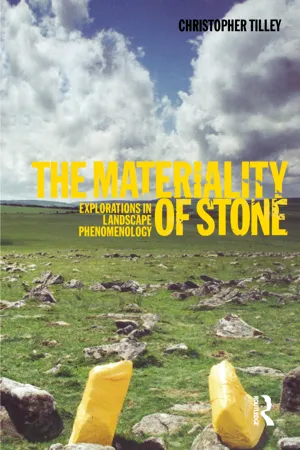
With Wayne Bennett From the silky wax qualities of the surfaces of some quartz menhirs to the wood-grain textures of others, to the golden honeycombed limestones of Malta, to the icy frozen waves of the Cambrian sandstone of south-east Sweden, this book investigates the sensuous material qualities of stone. Tactile sensations, sonorous qualities, colour, and visual impressions are all shown to play a vital part in our understanding of the power and significance of prehistoric monuments in relation to their landscapes. In The Materiality of Stone, Christopher Tilley presents a radically new way of analyzing the significance of both 'cultural' and 'natural' stone in prehistoric European landscapes. Tilley's groundbreaking approach is to interpret human experience in a multidimensional and sensuous human way, rather than through an abstract analytical gaze. The studies range widely from the menhirs of prehistoric Brittany to Maltese Neolithic temples to Bronze Age rock carvings and cairns in southern Sweden. Tilley leaves no stone unturned as he also considers how the internal spaces and landscape settings are interpreted in relation to artifacts, substances, and related places that were deeply meaningful to the people who inhabited them and remain no less evocative today. In its innovative approach to understanding human experience through the tangible rocks and stone of our past, The Materiality of Stone is both a major theoretical and substantive contribution to the field of material culture studies and the study of European prehistory.
Information
1 From Body to Place to Landscape
A Phenomenological Perspective
[Phenomenology] is a philosophy for which the world is always ‘already there’ before reflection begins – as an inalienable presence; and all its efforts are concentrated upon re-achieving a direct and primitive contact with the world, and endowing that contact with a philosophical status . .. It also offers an account of space, time and the world as we ‘live’ them.
Merleau-Ponty, Phenomenology of Perception, 1962: vii
Introduction
Epoché is the Greek word meaning ‘suspension of belief’, a bracketing of experience, which provides a starting point for all phenomenological analysis. The beliefs to be called into question are those dogmas arising in that which is ordinarily termed common sense or the ‘natural attitude’. Phenomenology involves the attempt to describe the objects of consciousness in the manner in which they are presented to consciousness. It attempts to reveal the world as it is actually experienced directly by a subject as opposed to how we might theoretically assume it to be. The aim is not to explain the world (in terms, say, of physical causality or historical events or psychological dispositions) but to describe that world as precisely as possible in the manner in which human beings experience it. Such description, if it succeeds, is necessarily a re-description and thus may lead to fresh insights and new knowledges of what there is in the world and how it impacts on human consciousness, and vice versa. Phenomenology is a style or manner of thought rather than a set of doctrines, rules or procedures that may be followed, a way of Being in the world and a way of thinking in it. It stands directly opposed to the empiricist or positivist (scientific) ‘natural attitude’ when applied to the study of people or society. Such thought may tell us something of value about physical objects, but it is incapable of coping with that attribute which is most distinctively human: subjectivity.
Phenomenology, like other living and developing philosophical positions, involves thinkers adopting often very divergent and contradictory views (see Hammond et al. 1991), from the initial transcendental position of Husserl, to Heidegger’s later mediations on time and Being, to the more existentialist viewpoints of Sartre and Merleau-Ponty. In this chapter I discuss the work of Merleau-Ponty, and some inspired interpreters, whose emphasis on experience always being experience of something, from a bodily point of view, seems to be of most direct relevance for conceptualizing the complex lived experience of place and landscape in the past and in the present.
The Bodily Basis of Experience
We get into place, move and stay there with our bodies. But the fact is neither innocent or trivial; it is momentous in its consequences. It is also massively obvious, despite being massively overlooked in previous treatments of space and place.
Casey, The Fate of Place, 1997: 239
The distinctive feature of Merleau-Ponty’s exposition of a phenomenological perspective is that it is grounded in the physicality and material existence of the human body in the world. From this basic fact all our experience, understanding and knowledge of the world flow. In this sense he expouses a materialist position running counter to any form of idealism or intellectualism that would try to situate and understand the world from the perspective of a disembodied mind somehow outside of the body. Precisely because people are physical objects we are able to perceive the world, but there is no purely objective ‘outside’ vantage point for doing so: for example, a disembodied mind outside a particular setting and a flux of temporal events. We experience and perceive the world because we live in that world and are intertwined within it. We are part of it, and it is part of us. Our bodily Being-in-the-world provides the fundamental ground, or starting point, for our description of it. Analysis starts from the standpoint of the body-subject, which, however, does not encounter or understand itself mechanistically as an object amongst a world of other objects or as a transcendental ego, a pure consciousness without a body. The body-subject is a mind physically embodied, a body and a mind which always encounters the world from a particular point of view in a particular context at a particular time and in a particular place, a physical subject in space-time. An epochal consciousness of this world is dependent on self-consciousness of this embodied situation which in turn makes our own experience possible.
For Merleau-Ponty, the problem of meaning, or rationality, is explicable in terms of the perception of the body-subject. Perception constitutes the bond, or contact, between consciousness and the world from which meanings arise. It is necessary to raise the questions: who is it and what is it that perceives? In raising and answering this question, Merleau-Ponty provides a radically different kind of answer than that given in empiricist and intellectualist (idealist) philosophies. For empiricists, a body-object registers passively sensations imposed on it externally. For idealists, the object is actively registered by the internal operation of an intellectual Cogito or mind. Both positions separate mind from body and both consider the body as an object among other objects in the world. Breaking with both positions, Merleau-Ponty sets out to transcend a mind/body dualism and an objectivism that would reduce the body to a mechanical object. For Merleau-Ponty, the lived body is both object and subject. From the point of view of a subject, the body is not an object outside of consciousness but the only way of being present in the world and being conscious of it. In other words consciousness is corporeal. The lived body is a way of viewing and feeling the world and the way a subject comes to know and express this viewing and feeling. Perceptual consciousness cannot be an absolute interiority, a pure presence to itself. It is rather a bodily presence in the world and a bodily awareness of it. The relationship of a subject and his or her body is an inner one: I have a body and that is my consciousness. Such a perspective creates a significant break with a mechanistic approach to the body in which it is a mere thing which belongs to no-one, only being individualized by the mind. The lived body, the body with a mind, is for every person particular way of inhabiting the world, of being present in it, sensing it. The lived body combines being-in-itself (an object form) and being-for-itself (a subject form), but is reducible to neither. The lived body allows us to know what space, place and landscape are because it is the author of them all. From the body we learn what is near, what is far, that which is above, that which is below, etc., the horizon line: the limits of our vision.
Consciousness is ‘being towards-the-thing through the intermediary of my body . . . we must therefore avoid saying that our body is in space, or in time. It inhabits space and time, (Merleau-Ponty 1962: 138–9). So consciousness is not a matter, in the first place, of ‘I think that’ but of ‘I can’ (ibid.: 137). Perceptual consciousness arises from a body-subject, a knowing body. In this manner a phenomenological approach transcends traditional distinctions between subject and object. The lived body is neither, but a dynamic combination of the two, and in this manner it is possible to claim that subjectivity arises from objectivity, and vice versa, and it is therefore not possible to be ‘purely’ objective or ‘purely’ subjective. Our experience and knowledge of the world is a combination of both. The experience of the body is intrinsically ambiguous precisely because this experience transcends subject/object dualisms. The body is not an object, nor is my consciousness of the body a thought. I can only know my body through living it. The body is me myself but I can also know it ‘from the outside’. When I touch my left hand with my right hand my body is both touching and touched, subject and object, a union of the two. So the human body is a presence in the world always marking a point between being a ‘thing in itself’ (a pure thing) and a ‘being for itself’ (a pure consciousness), a third kind of thing (Low 2000: 12), being that body and sensing that being.
So this body is my presence in the world and only this body allows me to sense myself and others and things. The immaterial mind, somehow divorced from the body, is a philosophical mirage or phantom. At the basis of all, even the most abstract, knowledge is the sensuous, sensing and sensed body in which all experience is embodied: subjectivity is physical.
We are always in and of our bodies and cannot leave them. We can turn away from a physical object, or walk away from a person, but we can never escape our own bodies. Since I cannot move my body away from me, it can never be an object in the sense of a table or any other physical entity. Similarly, I may move around and experience different aspects of a thing but I always experience them through my body in the same way. I cannot alter the manner in which I sensuously experience the world. I can choose the side which a physical object presents itself to me. This freedom is not possible in the perception of my own body (Merleau-Ponty 1962: 90). We necessarily see the world in profiles, or from certain angles, but cannot experience ourselves in the same way. While I may observe the world according to the situation I take up in it, I can never observe myself in the same way. I can never, for example, perceive of my body being over there. To do so would require a second body (ibid.: 91). In the mirror I appear as an object, but this is a reversal of the phenomenological facts because as a subject I am what I can only see of myself by using it: I both am there and am invisible to myself (Merleau-Ponty 1968: 249; Priest 1998: 79). We do not and cannot experience our body as just another thing, yet the physicality of our bodies structures the manner in which we experience things, places and landscapes.
Bodily Dyads: Elementary Structures of Embodied Experience
The body, in relation to the experience of place and landscape, has six basic and concrete dimensions: above/below or up/down; in front/behind and to the right/to the left. It is around and in terms of a living moving body that these terms have somatic relevance and relate to each other and come into specific sets of relationships. These dimensions relate both to the body itself, which may be thought of in terms of up/down (head/feet) and of having a front side to which the head faces and a back side, and in relation to basic bilateral symmetry (a left and right hand, arm, foot, etc.). But such terms extend beyond the body itself and connect the body with the world: there are things to the front and right of me and things to the back and left of me, and so on. So bodily dimensions are not internal to the body but link the body to the world, and are always changing and relational. In addition to these six basic dimensions, there are other bodily terms fundamental to human experience: here/there: where my body is as opposed to where it is not, or might be; and near/far. In relation to the body the latter opposition may refer to things that are in reach (near) and those out of reach (far) or things in close proximity to myself as opposed to those far away: the land on which I stand and the line of the horizon that lies beyond me. But none of these oppositions can be unambiguously defined, and all are constantly changing in relation to the body in motion where things that were to the left of me may now be to the right, things that were far away become near, and what was near (here) becomes distanced through motion. The proper locus for all these dimensions is between my body and the world. Bodily motion takes place in terms of the six basic dimensions which always exist in relation to a particular person and a particular place. From an embodied perspective we relate to place and landscape through these relational coordinates of our body. The body embeds and apprehends itself in terms of what is above or below it (‘height’), to the right or left (‘breadth’) and to the front or back (‘depth’), and in all known human languages there appear to be lexical items naming these asymmetrical axes of spatial orientation (Casey 1993: 76).
The up/down, above/below or vertical distinction thus comes to have fundamental metaphorical significance in expressions in which ‘up’ is equated with ‘happy’ and ‘sad’ with being ‘down’, in which drooping posture typically goes along with sadness and depression, erect posture with a positive emotional state (Lakoff and Johnson 1980: 15). Similarly, consciousness tends to be equated with up and unconsciousness with down (we sleep lying down). Additionally, in Anglo-American culture the following associations are usually made (ibid.: 16-18)
| Health and life | Sickness and death |
|---|---|
| Power | Absence of power |
| More | Less |
| High status | Low status |
| Good | Bad |
| Virtue | Depravity |
| UP | DOWN |
and all the associated metaphors (e.g. he has a lofty position; things are looking up) are rooted not only in common cultural connotations but also in the physical bodily experience of the body and its various states of waking and sleeping, sense or otherwise of well-being, etc., and it is virtually impossible to disentangle the two. The up/down distinction is rooted not only in the upright standing and moving posture of the human body as it stands or walks on the earth, but also in relation to the world that envelops it: things that are above and below you, that you must move up to or down to in order to reach. The horizon line is an epitome of the limits of our horizontal vision of the earth but it also serves to separate above from below, the visible and the visible, the present and the future, that which lies beyond. We may move ahead or behind, forward or backward, higher or lower. Standing on a horizontal plane, things in front of us tend to be up (a map will usually be orientated so that what is ahead of us is up) and those behind us tend to be down. Through movement the former may usually correspond to the future, the latter to the past. And we refer to what comes before and that which comes after.
Aristotle comments that ‘“above” is not anything you like, but where fire, and what is light, move. Likewise “below” is not anything you like, but where heavy and earth things move’ (Physics Book 4). This fundamental distinction between the lightness of the sky associated with spirit powers and the heaviness of the land, the domain of humans, is one made over and over again in world religions and countless ethnographies. Uprightness is manifested both in the body and in the world. This is the source of medieval and Renaissance views on the concordia mundi, whereby the head and the sky as well as the genitals and the sublunar region correspond to each other (Casey 1993: 80). And this corresponds to a distinction between the noble orifices of the head compared with the genitals, excrement and defilement (Douglas 1970). Places such as sacred mountains associated with light and air that lie up and above always tend to be priviledged culturally and emotionally while places situated down below tend to be associated with darkness and death. Up and down are thus become terms to which are attached essential moral purpose and the values of superior and inferior. Natural and cultural things of significant height (mountains, cliffs, waterfalls, church spires, buildings, stones, ceramic vessels, monuments) most usually impress and we find them awe inspiring as they relate to the physicality of our bodies.
The vertical axis of up/down appears to be more important in matters of our bodily spatial orientation than either front/behind or left/right distinctions, which organize things in terms of a horizontal axis. And the left/right distinction is itself dependent on a prior front/back distinction. It is only in terms of a distinction between front and back that left and right can be distinguished in any systematic way. The body is always between front and back, left and right. A sense of encirclement by what is to the front of us and what is to the back is fundamentally different from the manner in which a distinction between up and down constitutes an independent dimension of which the body is always a part as part of an earth/ heavens cosmic axis. What lies ahead or behind me is always delimited by sensory visual, tactile, auditory and olfactory fields. That which is above or behind, to the left or the right, is intimately connected to the body in place, sensing place. In terms of front and back there is a fundamental asymmetry. We look forward, move and do things, act in the world, prim...
Table of contents
- Cover
- Half Title
- Title Page
- Copyright Page
- Contents
- List of Figures
- List of Tables
- Preface
- Acknowledgements
- 1 From Body to Place to Landscape: A Phenomenological Perspective
- 2 Sprouting Rhizomes and Giant Axes: Experiencing Breton Menhirs
- 3 From Honey to Ochre: Maltese Temples, Stones, Substances and the Structuring of Experience
- 4 Frozen Waves and Anomalous Stones: Rock Carvings and Cairns in a Southern Swedish Landscape
- 5 Conclusions: The Past as Dreamwork
- References
- Index
Trusted by 375,005 students
Access to over 1.5 million titles for a fair monthly price.
Study more efficiently using our study tools.
Frequently asked questions
Yes, you can cancel anytime from the Subscription tab in your account settings on the Perlego website. Your subscription will stay active until the end of your current billing period. Learn how to cancel your subscription
No, books cannot be downloaded as external files, such as PDFs, for use outside of Perlego. However, you can download books within the Perlego app for offline reading on mobile or tablet. Learn how to download books offline
We are an online textbook subscription service, where you can get access to an entire online library for less than the price of a single book per month. With over 1.5 million books across 990+ topics, we’ve got you covered! Learn about our mission
Look out for the read-aloud symbol on your next book to see if you can listen to it. The read-aloud tool reads text aloud for you, highlighting the text as it is being read. You can pause it, speed it up and slow it down. Learn more about Read Aloud
Yes! You can use the Perlego app on both iOS and Android devices to read anytime, anywhere — even offline. Perfect for commutes or when you’re on the go.
Please note we cannot support devices running on iOS 13 and Android 7 or earlier. Learn more about using the app
Please note we cannot support devices running on iOS 13 and Android 7 or earlier. Learn more about using the app
Yes, you can access The Materiality of Stone by Christopher Tilley in PDF and/or ePUB format, as well as other popular books in Social Sciences & Architecture General. We have over 1.5 million books available in our catalogue for you to explore.