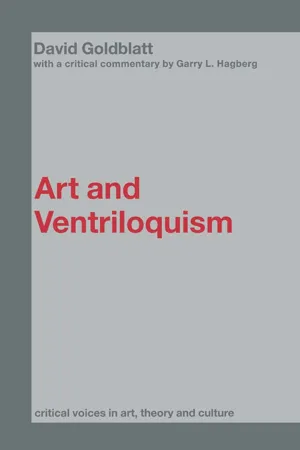
This exciting collection of David Goldblatt's essays, available for the first time in one volume, uses the metaphor of ventriloquism to help understand a variety of art world phenomena. It examines how the vocal vacillation between ventriloquist and dummy works within the roles of artist, artwork and audience as a conveyance to the audience of the performer's intentions, emotions and beliefs through a created performative persona. Considering key works, including those of Nietzsche, Foucault, Socrates, Derrida, Cavell and Wittgenstein, Goldblatt examines how the authors use the framework of ventriloquism to construct and negate issues in art and architecture. He ponders 'self-plagiarism'; why the classic philosopher cannot speak for himself, but must voice his thoughts through fictional characters or inanimate objects and works. With a close analysis of two ventriloquist paintings by Jasper Johns and Paul Klee, a critical commentary by Garry L. Hagberg, and preface by series editor Saul Ostrow, Goldblatt's thoroughly fascinating book will be an invaluable asset to students of cultural studies, art, and philosophy.
- 224 pages
- English
- ePUB (mobile friendly)
- Available on iOS & Android
eBook - ePub
Art and Ventriloquism
About this book
Information
index
Note:
Artworks and books are entered by title, followed by the name of the artist or writer in brackets, e.g. Art as Language (Hagberg)
The medium of works other than books is shown in brackets after the title and before the author or artist’s name, e.g. Actor (painting) (Klee) 170
Illustrations are indexed by page number and figure number, e.g. Aronoff Center (DAAP) 109 (Fig. 5.1)
References to material in the pre-liminary section is shown in Roman numbers, e.g. Greenberg, C. xiii–xiv
“active spectatorship” 148
Actor (painting) (Klee) 170
actors see drama; performers
Actor’s Mask (painting) (Klee) 170
aesthetic style see style
Alcibiades 95–6
analogy, in architectural text 126
animate/inanimate duality 1, 2, 3, 155–6, see also anthropomorphism
Anscomber, Elizabeth 78
anthropocentrism 101, 115, 171
anthropomorphism 59–60; in Cavellian conversation 155–6; in Greek theater 101–2; nature and art 57
aphorisms 164–5
Apology (Plato) 99–100
appearance and reality 6, 7
Aronoff Center (DAAP) 109(Fig. 5.1), 113–14, 128
“arbitrary text” 111, 123–8
architectural self 108, 109–11, 115–16; dislocation of 124–8
architecture: the “arbitrary text” 123–8; the architectural text 122–3, 126; classicism and modernism 23–5; concept of ecstasis in 107–8, 116–19; Eisenman’s projects 112–16; Greek 117; modern 163–4; Nietzsche on 64; “ordinary” 162–3; as philosophical paradigm 129; and self-intervention 22–3; tradition/dislocation dichotomy in 108–11, 127; transfiguration ...
Table of contents
- Cover
- Half Title
- Critical Voices in Art, Theory and Culture
- Title Page
- Copyright Page
- Dedication
- Table of Contents
- Introduction
- Preface
- Acknowledgments
- Critical commentary
- Bergen and McCarthy: the logic of an act
- Nietzsche and ventriloquism
- Self-spacing: Foucault's ventriloqual tendencies
- Socratic ventriloquism: theatricality and the voice of logos
- The dislocation of the architectural self
- Self-plagiarism: the ecstatic recycling of the artist's voice
- Cavellian conversation and the life of art
- Epilogue: two ventriloqual paintings
- Notes
- Index
Trusted by 375,005 students
Access to over 1.5 million titles for a fair monthly price.
Study more efficiently using our study tools.
Frequently asked questions
Yes, you can cancel anytime from the Subscription tab in your account settings on the Perlego website. Your subscription will stay active until the end of your current billing period. Learn how to cancel your subscription
No, books cannot be downloaded as external files, such as PDFs, for use outside of Perlego. However, you can download books within the Perlego app for offline reading on mobile or tablet. Learn how to download books offline
Perlego offers two plans: Essential and Complete
- Essential is ideal for learners and professionals who enjoy exploring a wide range of subjects. Access the Essential Library with 800,000+ trusted titles and best-sellers across business, personal growth, and the humanities. Includes unlimited reading time and Standard Read Aloud voice.
- Complete: Perfect for advanced learners and researchers needing full, unrestricted access. Unlock 1.5M+ books across hundreds of subjects, including academic and specialized titles. The Complete Plan also includes advanced features like Premium Read Aloud and Research Assistant.
We are an online textbook subscription service, where you can get access to an entire online library for less than the price of a single book per month. With over 1.5 million books across 990+ topics, we’ve got you covered! Learn about our mission
Look out for the read-aloud symbol on your next book to see if you can listen to it. The read-aloud tool reads text aloud for you, highlighting the text as it is being read. You can pause it, speed it up and slow it down. Learn more about Read Aloud
Yes! You can use the Perlego app on both iOS and Android devices to read anytime, anywhere — even offline. Perfect for commutes or when you’re on the go.
Please note we cannot support devices running on iOS 13 and Android 7 or earlier. Learn more about using the app
Please note we cannot support devices running on iOS 13 and Android 7 or earlier. Learn more about using the app
Yes, you can access Art and Ventriloquism by David Goldblatt in PDF and/or ePUB format, as well as other popular books in Art & Art General. We have over 1.5 million books available in our catalogue for you to explore.