- 292 pages
- English
- ePUB (mobile friendly)
- Available on iOS & Android
eBook - ePub
Superconductivity Of Metals And Alloys
About this book
Drawn from the author's introductory course at the University of Orsay, Superconductivity of Metals and Alloys is intended to explain the basic knowledge of superconductivity for both experimentalists and theoreticians. These notes begin with an elementary discussion of magnetic properties of Type I and Type II superconductors. The microscopic theory is then built up in the Bogolubov language of self-consistent fields. This text provides the classic, fundamental basis for any work in the field of superconductivity.
Information
1
FUNDAMENTAL PROPERTIES
1–1 A NEW CONDENSED STATE
We take a piece of tin and cool it down; at a temperature T0 = 3.7°K we find a specific heat anomaly (Fig. 1-1a). Below T0 the tin is in a new thermodynamical state. What has happened?
It is not a change in the crystallographic structure, as far as x rays can tell. It is not a ferromagnetic, or antiferromagnetic, transition. (It can be seen by magnetic scattering of neutrons, that tin carries no magnetic moment on an atomic scale.) The striking new property is that the tin has zero electrical resistance. (For instance, a current induced in a tin ring has been observed to persist over times > 1 year.) We say that tin, in this particular phase, is a superconductor, and we call the permanent current a supercurrent.
A large number of metals and alloys are superconductors, with critical temperatures T0 ranging from less than 1°K to 18°K. Even some heavily doped semiconductors have been found to be superconductors.
Historically, the first superconductor (mercury) was discovered by Kammerling Onnes in 1911.
The free energy FS in the superconducting phase can be derived from the specific heat data and is represented on Fig. 1-1b (solid line). The dotted line gives the corresponding curve Fn for the normal metal. The difference is called the condensation energy. It is not of order kBT0 per electron; it is, in fact, much smaller, of order (where EF is the Fermi energy of the conduction electrons in the normal metal). Typically EF ~ 1 eV and kBT0 ~ 10−3 eV. Only a fraction of the metallic electrons have their energy significantly modified by the condensation process.
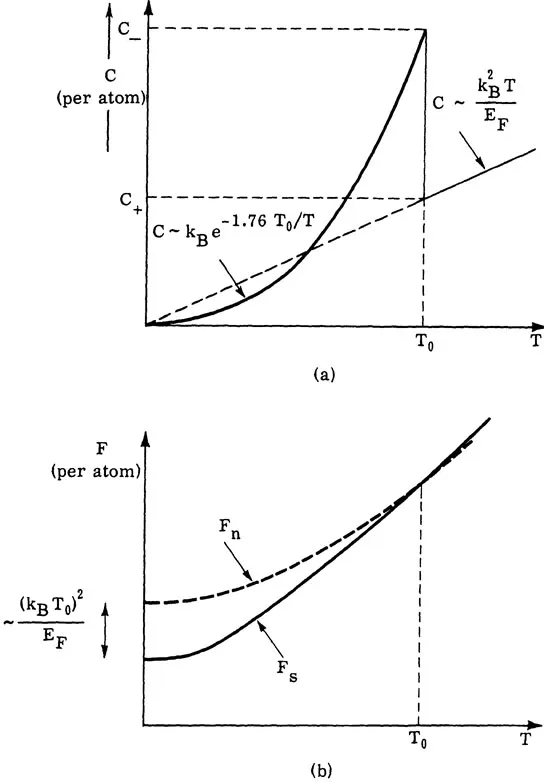
Figure 1-1
(a) The electronic specific heat C of a superconductor (in zero magnetic field) as a function of temperature (qualitative plot). Above T0 (in the normal phase) where EF is the Fermi energy. At the transition point T0, C has a discontinuity. At ≪ T0, C is roughly exponential C ~ exp (− 1.76 T0/T). (b) Free energy of the superconducting phase (FS) and of the normal phase (Fn) versus temperature. The two curves meet (with the same slope) at the transition point T = T0. At T = 0 the difference Fn – FS is of order per atom.
1–2 DIAMAGNETISM
The London Equation
We now extend our energy considerations to situations where there are supercurrents jS (r) and associated magnetic fields h(r) in the sample.1 We see that in the limit where all fields, currents, and so on, are weak and have a slow variation in space the condition of minimum free energy leads to a simple relation between fields and currents (F. and H. London, 1935).
We consider a pure metal with a parabolic conduction band; the electrons have an effective mass m. The free energy now has the following form:
(1-1) |
where FS is the energy of the electrons in the condensed state at rest and Ekin is the kinetic energy associated with the permanent currents. Let us call v(r) the drift velocity of the electrons at point r. It is related to the current density jS by
(1-2) |
(where e is the electron charge, and nS the number of superconducting electrons per cm3). Then w...
Table of contents
- Cover
- Half Title
- Title Page
- Copyright Page
- Dedication
- Table of Contents
- Chapter 1 Fundamental Properties
- Chapter 2 Magnetic Properties of First Kind Superconductors
- Chapter 3 Magnetic Properties of Second Kind Superconductors
- Chapter 4 Description of the Condensed State
- Chapter 5 The Self-Consistent Field Method
- Chapter 6 Phenomenological Landau-Ginsburg Equations
- Chapter 7 Microscopic Analysis of the Landau-Ginsburg Equations
- Chapter 8 Effects of Strong Magnetic Fields and of Magnetic Impurities
- Index
Trusted by 375,005 students
Access to over 1.5 million titles for a fair monthly price.
Study more efficiently using our study tools.
Frequently asked questions
Yes, you can cancel anytime from the Subscription tab in your account settings on the Perlego website. Your subscription will stay active until the end of your current billing period. Learn how to cancel your subscription
No, books cannot be downloaded as external files, such as PDFs, for use outside of Perlego. However, you can download books within the Perlego app for offline reading on mobile or tablet. Learn how to download books offline
Perlego offers two plans: Essential and Complete
- Essential is ideal for learners and professionals who enjoy exploring a wide range of subjects. Access the Essential Library with 800,000+ trusted titles and best-sellers across business, personal growth, and the humanities. Includes unlimited reading time and Standard Read Aloud voice.
- Complete: Perfect for advanced learners and researchers needing full, unrestricted access. Unlock 1.5M+ books across hundreds of subjects, including academic and specialized titles. The Complete Plan also includes advanced features like Premium Read Aloud and Research Assistant.
We are an online textbook subscription service, where you can get access to an entire online library for less than the price of a single book per month. With over 1.5 million books across 990+ topics, we’ve got you covered! Learn about our mission
Look out for the read-aloud symbol on your next book to see if you can listen to it. The read-aloud tool reads text aloud for you, highlighting the text as it is being read. You can pause it, speed it up and slow it down. Learn more about Read Aloud
Yes! You can use the Perlego app on both iOS and Android devices to read anytime, anywhere — even offline. Perfect for commutes or when you’re on the go.
Please note we cannot support devices running on iOS 13 and Android 7 or earlier. Learn more about using the app
Please note we cannot support devices running on iOS 13 and Android 7 or earlier. Learn more about using the app
Yes, you can access Superconductivity Of Metals And Alloys by P. G. De Gennes in PDF and/or ePUB format, as well as other popular books in Technology & Engineering & Condensed Matter. We have over 1.5 million books available in our catalogue for you to explore.