- 376 pages
- English
- ePUB (mobile friendly)
- Available on iOS & Android
eBook - ePub
About this book
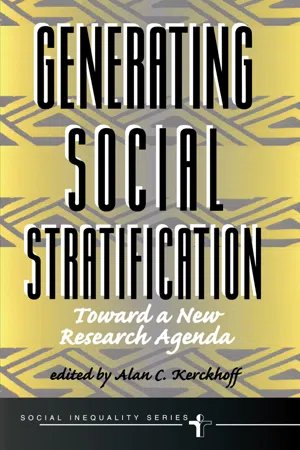
In this book some of the leading stratification scholars in the U.S. present empirical and theoretical essays about the institutional contexts that shape careers. Building on recent advances in theory, data, and analytic technique, the essays in this volume work toward the goal of identifying and assessing the processes by which a birth cohort is distributed in the stratification system, given their positions of origin in that system. Alan Kerckhoff's introduction situates the studies in this volume within the context of previous stratification research over several generations, making the book an invaluable resource for scholars and graduate students.
Information
Part One
Conceptualizing Careers and Stratification Processes
The emerging conceptualization of the processes by which societal stratification is generated includes a consideration of factors at multiple levels of analysis ranging from the dynamics of individual functioning to the nature of the society’s economic and political system. The challenge we face is to integrate our knowledge of these multiple levels in ways that clarify the nature of stratification generating processes. The three papers included in Part I suggest some of the features of the broad conceptualization we need. In this way, they help to set the stage for the other papers that follow.
In the first paper in Part I, Angela O’Rand emphasizes the importance of this multilevel conceptualization. She reminds us that the life course is an on-going process whose shape is dependent on multiple sources of influence. She succinctly reviews bodies of literature dealing with the full life course, showing how institutional and individual factors help to produce the observed trajectories. She shows how what she calls the “traditional institutional approaches” differ from “relational approaches” and how they complement each other in contributing to an understanding of the role of social structure in shaping the life course.
The second paper, by Jeylan Mortimer, concentrates on the social psychology of achievement, emphasizing the significance of socialization processes both within the family and outside it. Mortimer rightly argues that it is not a question of choosing between a structural and a social psychological approach to achievement; it is essential that we see the connections between the two. She also points out that, of the two bodies of literature dealing with education and labor force processes, the literature on the labor force has been less concerned with the role of social psychological processes. She speculates about how educational and labor force experiences can alter attitudes and values and asks us to think more deeply and clearly about how structures and social psychological processes are interrelated.
In the third paper in Part I, Alan Kerckhoff directs our attention to the structured contexts of individual careers, devoting much of the discussion to an analysis of important differences in those contexts among industrial societies. The effects of both educational and labor force contexts are discussed, but perhaps the most important issue dealt with is the societal variation in the nature of the linkages between those two contexts. Kerckhoff uses the identified inter-societal differences to generate some tentative hypotheses that deal with social psychological effects on individuals as well as overall societal patterns of social stratification.
Together, these three papers provide an indication of the breadth of the research agenda to whose development this volume is dedicated. Each of them makes reference to the other papers in this collection, but they also point up additional kinds of investigation that are, or need to become, part of the overall effort. The papers in Parts II, III and IV point to the complexities of societal stratifying processes. They bring into focus the general observations O’Rand makes about the life course being a multilevel process. They provide numerous examples of the need to take both social structural and social psychological processes into account, as Mortimer suggests. And, they demonstrate the importance of the kinds of inter-organizational linkages dealt with by Kerckhoff as well as the global characteristics of the societies studied.
1
Structuration and Individualization: The Life Course as a Continuous, Multilevel Process
Sociologists have long recognized the promise of cross-level analysis for linking individual behaviors to social structures and for distinguishing the separate processes operating between levels. However, until recently methodological obstacles have hindered the successful achievement of this promise. Theoretical expositions on the transposition between levels of analysis extend back to the early fifties, including a particularly insightful and prophetic discussion by C. Wright Mills (1953) who anticipated the pivotal role of methodological as opposed to conceptual innovations for the ultimate resolution of these issues. The specification of the properties of collectivities at successive levels of analysis (e.g. Coleman, 1970) and the separation of structural from individual effects (e.g. Blau, 1960) are among the earliest and most persistent conceptual concerns that are now arriving at some methodological solution (e.g. Huber, 1991; DiPrete and Forristal, 1994).
Social transitions over the life course provide strategic subject matter for cross-level analyses. The movement of individuals within and between institutional contexts brings into focus how lives are shaped at social interfaces and, in turn, how institutions may themselves be transformed in response to the social friction exerted by demographic processes, i.e. by aggregate patterns of individual transitions (O’Rand, 1995). As such, cross-level analysis reveals what Anthony Giddens refers to as structuration, or how social structures are both constituted by human agency and at the same time the medium of this constitution (Giddens, 1976:121).
Studies of life-course transitions—from the transition to adulthood, through midlife transitions associated with employment or labor force shifts and family change, to the transition to retirement—are revealing patterned variations in their trajectories and temporal organizations that emerge from the interaction between institutional contexts and individual biographies (Mayer and Tuma, 1990; Elder and O’Rand, 1994). These pathways of individual trajectories indicate what might be referred to as the essential tension between the structuration and the individualization of the life course across institutional contexts. As such, the continuous, cumulative process of the life course organized by multilevel forces is a strategically appropriate domain for cross-level analysis.
In the present essay, recent examinations of life course processes will be reviewed in light of their implications for the study of both the variability of individual trajectories and the institutional patterning of variability. Two themes in these studies will be considered. The first is individualization, or what is referred to in aging research as the thesis of heterogeneity, an idea supported principally by longitudinal demographic research on populations in advanced western societies (particularly the U. S.). Second, is the specification of social structure. Here there are alternative approaches to structuration: chief among these are what might be referred to as traditional institutional examinations and relational approaches. Both have developed rapidly in the new structuralism benefiting from methodological innovations in multilevel modeling and network analysis and from growing databases that span social contexts. Each makes a distinctive contribution to the analysis of structure.
Individualization Over the Life Course
The focus on transitions among life phases and the structural interfaces that shape these transitions is revealing the demographic and institutional mechanisms that organize lives. It is also unveiling the considerable heterogeneity of life trajectories. We have learned, for example, that the so-called transition to adulthood in the United States is not a crisp, sequence of statuses following strong age or timing norms (Hogan and Astone, 1985; Rindfuss, 1991). Rather it is a demographically dense yet temporally heterogeneous ordering of multiple transitions (including leaving school, leaving home, starting work, forming households, becoming a parent) that is driven less by age norms per se than by institutionalized linkages or pathways across education, work, and family domains that differentiate among subgroups of the adolescent population.
John Modell (1989) argues that the trend towards the normative “loosening” of this transition has emerged steadily over this century. His social history of the transition from youth to adulthood between 1920 and 1975—aptly titled Into One’s Own—documents the extension of education later into the life course, changes in marital and parental timing and their determinants, changes in the transition to stable employment, and changes in the propensity for marriage and divorce and in their covariates (especially parenthood), among other trends. Overall, he observes that men’s and women’s life-course trajectories in family and work participation patterns are becoming increasingly similar and that the life paths between black and white populations in which earlier inequalities appear to be exacerbated over time by structural opportunities and demographic patterns are becoming more dissimilar.
The master trend, according to Modell, has been in the “liberating of one transition from the next—the weakening…of determinate sequences and intervals” by the “injection of increasing volition into the youthful life course” (Modell, 1989:332-333). The ever-growing availability of economic and cultural resources provided to the young by family, governmental, and market structures is argued by Modell to be the principal source of this intercohort trend. But his argument accounts less rigorously for within-cohort variations and divergence among class, race and gender categories. The stratified bases of “volition” and the primary institutional contexts that define the options available to segments of succeeding cohorts of U. S. adolescents over this century are less clearly delineated by him.
Studies reported in this volume would suggest that the increased heterogeneity in the transition to adulthood in the U.S. may be in part accounted for by the jointly influential phenomena of (1) expansion of educational opportunities; (2) the stratification of the educational institution along class-related ability groupings or tracks as well as across private and public school contexts; and (3) the weak coupling of educational and employment institutions. Paradoxically, school-to-job linkages have grown increasingly ambiguous as more and more adolescents achieve secondary school educations. All in all, the impact of schooling on early life-course trajectories is a model of cross-level influences on divergent life pathways (Kerckhoff, 1993).
Midlife—a life phase once typified as demographically sparse—appears actually to be more and more punctuated by status transitions that increase the heterogeneity of life trajectories. And as we are finding for the transition to adulthood, these transitions have diverse temporal features; their timing, ordering, density, even reversibility yield multiple trajectories. Family formation and dissolution, movements into and out of jobs, and changing intergenerational dependencies pervade the adult life course. These heterogeneities, like those evident in the transition to adulthood, appear to be products of the interplay among demographic and structural processes channeling individuals. And, they are producing divergent socioeconomic trajectories anchored in early opportunities but deflected by adult transitions related to work, family, health and other contingencies of adulthood.
Even the retirement transition is becoming more demographically varied as its boundaries are being pushed backward and forward by reversible transitions among work, family, leisure and health statuses over a more and more extended period of life (Dannefer, 1988). Retirement is not a narrowly demarcated, absorbing, and determinate sequence of events defined by straightforward exits from work. We are identifying multiple pathways in and out of work that follow different schedules in later years. Employment in “post-career” or bridge jobs, partial and intermittent work, and disability are among several alternative routes to retirement that can be added to the traditional pension and health pathways studied for 80 many years among older male workers. These multiplying patterns emanate from the interplay of biography and social change (Henretta, 1992; O’Rand, 1995; Elder and O’Rand, 1995).
The Thesis of Heterogeneity
Demographers, epidemiologists, social historians and sociologists have observed patterns of increasing differentiation within aging cohorts from birth to death (Dannefer, 1987, 1988, 1991). These patterns are constructed by sequentially contingent status transitions or life pathways in which later transitions are constrained by earlier ones. Over time, the general pattern of differentiation produces diverse outcomes of interest, including individualization and inequality. The most striking patterns of individualization have been found in the study of health and illness in aging populations (Maddox, 1987). Health-related experiences and behaviors interact with other life transitions with cumulative and relatively highly individualized outcomes in old age. Intertwined life trajectories of health, work, family, leisure reflect highly individualized exposures to opportunities and risks related to health and functioning in later life.
Similarly, older populations exhibit greater social and economic inequalities than younger age groups due to the cumulative effects of differential opportunities and achievements over time. For example, conventional measures of income inequality across age groups (specifically gini coefficients) repeatedly reveal higher levels of dispersion among older groups (Crystal and Shea, 1990). The cumulative advantage hypothesis, initially proposed by Robert Merton (1968) to explain the high levels of inequality in productivity and recognition among scientific careers, is now more widely applied to study aging or life-course processes of social inequality linking individual behaviors with structural phenomena related to systems of advantage and disadvantage that continuously stratify cohorts over time (see Dannefer, 1987, 1991).
Social psychologists have observed across multiple studies that stability coefficients of personal characteristics such as attitudes, performance levels, and patterns of social relations increase with age (Elder and O’Rand, 1995 for review; Alwin, 1993). Here it is observed that patterns of self-definition, actualization or legitimation are sequentially reinforced or otherwise reestablished as individuals move across opportunity contexts. Short durations between transitions appear to increase stability coefficients; longer durations seem to attenuate them.
The social psychology of achievement appears to reflect a similar persistence across contexts. At a structural level, achievements in earlier structural contexts regulate the access to new contexts of achievement. Accordingly, the interfaces between institutional environments, as those between schools and jobs or between jobs, constrain individual transitions and allocate individuals selectively between contexts (Kerckhoff, 1993; see Kalleberg’s contribution to this volume).
At the individual level, earlier achievements enhance self-selection processes via mechanisms related to self-esteem, identity formations, social competency and reinforced achievement motivation. Thus, structural allocation and self-selection processes enhance intraindividual stability and interindividual heterogeneity over time (Alwin, 1993). Jeylan Mortimer’s essay in this volume aptly depicts these processes in the social psychology of achievement.
The growing heterogeneity of life pathways following different transition sequences and timing patterns is shedding more light on the complex interplay of changing institutional arrangements and changing lives. Even the idea of the ‘triangularization’ or the ‘tripartitioning’ of life into pre-work, work, and non-work phases correlated with age is losing its usefulness for conceptualizing the social organization of the life course (Wilensky, 1981; Kohli, 1988; Riley, 1993). Lives move along asynchronous tracks which multiply with age, especially following the transition to adulthood, and appear to produce a pattern of individualization. The synchronization of educational, family, work, leisure, health and other transitions is the central generating mechanism of the life course.
The institutional and contextual mechanisms for these changes after the transition from secondary education are anchored in the workplace, the family, and in the wider cultural and political-economic environments in which these proximate life contexts are embedded (Mayer and Schoepflin, 1989). And while we are learning that educational transitions may follow the one from secondary education in adolescence in late-20th century societies, the strong differentiating effects of this transition for l...
Table of contents
- Cover
- Half Title
- Title
- Copyright
- Contents
- Preface
- PART ONE Conceptualizing Careers and Stratification Processes
- PART TWO Educational Contexts and Processes
- PART THREE Education and Labor Force Linkages
- PART FOUR Social System Contexts
- About the Book and Editor
Trusted by 375,005 students
Access to over 1.5 million titles for a fair monthly price.
Study more efficiently using our study tools.
Frequently asked questions
Yes, you can cancel anytime from the Subscription tab in your account settings on the Perlego website. Your subscription will stay active until the end of your current billing period. Learn how to cancel your subscription
No, books cannot be downloaded as external files, such as PDFs, for use outside of Perlego. However, you can download books within the Perlego app for offline reading on mobile or tablet. Learn how to download books offline
Perlego offers two plans: Essential and Complete
- Essential is ideal for learners and professionals who enjoy exploring a wide range of subjects. Access the Essential Library with 800,000+ trusted titles and best-sellers across business, personal growth, and the humanities. Includes unlimited reading time and Standard Read Aloud voice.
- Complete: Perfect for advanced learners and researchers needing full, unrestricted access. Unlock 1.5M+ books across hundreds of subjects, including academic and specialized titles. The Complete Plan also includes advanced features like Premium Read Aloud and Research Assistant.
We are an online textbook subscription service, where you can get access to an entire online library for less than the price of a single book per month. With over 1.5 million books across 990+ topics, we’ve got you covered! Learn about our mission
Look out for the read-aloud symbol on your next book to see if you can listen to it. The read-aloud tool reads text aloud for you, highlighting the text as it is being read. You can pause it, speed it up and slow it down. Learn more about Read Aloud
Yes! You can use the Perlego app on both iOS and Android devices to read anytime, anywhere — even offline. Perfect for commutes or when you’re on the go.
Please note we cannot support devices running on iOS 13 and Android 7 or earlier. Learn more about using the app
Please note we cannot support devices running on iOS 13 and Android 7 or earlier. Learn more about using the app
Yes, you can access Generating Social Stratification by Alan C Kerckhoff in PDF and/or ePUB format, as well as other popular books in Social Sciences & Labour Economics. We have over 1.5 million books available in our catalogue for you to explore.