- 324 pages
- English
- ePUB (mobile friendly)
- Available on iOS & Android
eBook - ePub
About this book
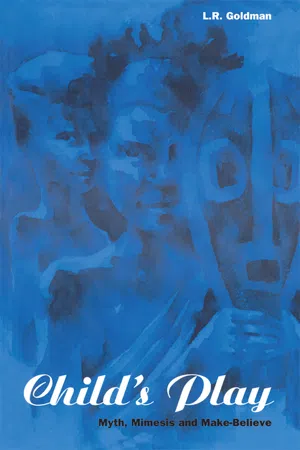
This innovative book finally takes seriously the need for anthropologists to produce in-depth ethnographies of children's play. In examining the subject from a cross-cultural perspective, the author argues that our understanding of the way children transform their environment to create make-believe is enhanced by viewing their creations as oral poetry. The result is a richly detailed 'thick description' of how pretence is socially mediated and linguistically constructed, how children make sense of their own play, how play relates to other imaginative genres in Huli life, and the relationship between play and cosmology. Informed by theoretical approaches in the anthropology of play, developmental and child psychology, philosophy and phenomenology and drawing on ethnographic data from Melanesia, the book analyzes the sources for imitation, the kinds of identities and roles emulated, and the structure of collaborative make-believe talk to reveal the complex way in which children invoke their experiences of the world and re-invent them as types of virtual reality. Particular importance is placed on how the figures of the ogre and trickster are articulated. The author demonstrates that while the concept of 'imagination' has been the cornerstone of Western intellectual traditions from Plato to Postmodernism, models of child fantasy play have always intruded into such theorizing because of children's unique capacity to throw into relief our understanding of the relationship between representation and reality.
Information
Chapter 1
Naming and Gaming
Huli
Question: I ambologo beraria minaribe? Where did you get that baby?
Answer: Hai/Anga maneha beraria minaru I got it from the top of the banana/pandanus tree
[Huli caretakers frequently identify heard but unseen frogs in the bush as ‘babies’. When a newborn arrives, the above response references the frogs mentioned on previous occasions.]
Anglo-Australian
Question: Where do babies come from?
Answer: I found it under the gooseberry [mulberry] bush/in the cabbage patch/the stork brought it.
Ethnographic Context
The above conventionalised question-response sequences speak directly of attitudes to truth-telling and of the social expediency of pretence between caretakers and children. Such cultural routines do more though than register an intercultural coincidence. They surely display universal problems associated with children as Homo interrogans - their responses to a new arrival, the symbolism attached to newborns, and the problems that confront adults when accounting to younger others for their existence. That cultures should have engendered broadly comparable and fossilised speech sequences attests to a perhaps ubiquitous recognition that the unvarnished facts of procreation may hurt children. We understand from the mere existence of these routines that certain types of knowledge are ‘classified’ in nature, and thus compel culturally shaped and pretenceful responses. Children are socialised through pretence as much as to pretence by the ‘play sequences’ (Anderson 1986:332; cf. Furth 1996:10) of adults’ lies, lullabies, threats, teases and stories. Such seemingly mundane interchanges have the power to open up the sub-cultural world of caretaking as one predicated upon deception and false promise. These sensitise the child to the dissonance between someone’s presentation of the world and the way the world otherwise seems (Marrelli 1994:263; Goldman 1995). Significantly, this question-response sequence is in Hull as in Western cultures remembered as knowledge communicated predominantly by female caregivers.
In this chapter my concern then is to present a preparatory backcloth to social fantasy play in Hull by examining the culturally patterned, or ‘ready-made’, set of analogic renamings found in ‘baby-talk’, nursery rhymes and lore, and child games. In the talk for and by children speech play (bi gini) becomes, as it were, a prolegomenon to the speech of play. But why choose these particular exemplars of interaction? The answer lies in part with the fact that such a triangulation of phenomena permits me to display the interrelationships between pretences as acts of ‘renaming’, the wide spectrum of behavioural forms in which these inhere, and the critical links that are thereby established to the mythopoeic levels of adult culture. The following analyses of socio-dramatic play given in Chapters 3 and 4 are thus situated within a continuum of practices lying along the vector from mimesis to mythos. But there is more to the rationale than mere context-ualisation. The presentation adheres to well-established findings in socio-linguistics that implicate the modelling behaviour of nursery lore, of ‘adult-infant baby talk and dandling interaction’ (Kirshenblatt-Gimblett 1976:177), and of child peer lore, in the development of metalinguistic awareness about speech aesthetics and communicative competence. That is, such behaviours are significant in the acquisition of a culture’s structuring poetic structures.
But while speech play is more often considered with respect to its patterns of rhetorical and mnemonic efficacy, its contributory role in how language and narrative lessons are learnt - thus indexing how ‘speech play is instrumental to the acquisition of adult verbal art’ (Sanches and Kirshenblatt-Gimblett 1976:105; cf. Goldman 1983) - and equally as a gauge of the importance of language itself in the culture, the focus here is somewhat different. The question being addressed is how these resources manifest, and are secreted within, a pervasive set of pretence practices and rationales. Inasmuch as such speech exchanges appear anatomically focused - as both semantically and linguistically about ‘body and hand’ - they articulate (for reasons explained in the previous chapter) an ethno-ludology of ‘pretending and playing’. Children’s games, as well as the games played with children, provide the analyst with a special arena for rethinking the relationships between pretence and its role in knowledge acquisition and communication. This is not to claim that all there is to ludic pretence is enculturation, but rather to explore the manner in which it is both generative as well as expressive of Huli culture.
As an apt introduction to the ascribed values of speech in Hull it is useful to unpack from the comparison of routines cited above some further insights. As primordial symbols of fertility or familiar locations, banana and pandanus trees seem figuratively comparable to the mulberry bush or the nurturing nuances evoked by a stork carrying a sling (no doubt suggested by storks’ habit of nesting in human abodes throughout Europe). Such fecundity derives from their status as staple ancestral foods, which implicated them in a host of traditional rituals associated with a person’s physical and spiritual well-being. For example, following birth the placenta (nu to - ‘umbrella bag’) and part of the umbilical cord (lumbi - ‘one long’) were planted in a pandanus tree to ensure promotion of growth. Similarly, repossession of a lost soul involved a rite known as ‘planting the pandanus seedling’ (anga wai hangaga), in which a knotted tuft of hair known as the ‘hair umbilical’ reattached the subject to its shadow. Moreover, as we will see below, pandanus metaphorically signify ‘penis-male-fertilityîn Hull nursery lore (Table 1.1 below D.6) repeatedly figuring in mundane medical pathologies and folklore. Thus the cure for snoring (ka) involved creeping under a pandanus root system and making a false pretence; the snorer directs the snore ‘You wait here and I’ll come back soon!’ while departing in the belief that the snore is forever and hopelessly entrapped.
| Adult Speech Term | English | Baby-Talk | Literal Meaning |
|---|---|---|---|
| | |||
| A. 1 Hina | Sweet potato (Ipomoea batatas) | Amu namu | – |
| 2 Du | Sugar cane (Saccharum officinarum) | Hambu | lips |
| 3 Tiabu | Highland pitpit (Setaria palmifblia) | Habu | |
| 4 Anga | Pandanus | Haboli | – |
| 5 Lini | Fruit | Haboli | – |
| 6 Gereba | Rungia (Rungia klossi) | Abuda | – |
| 7 Tigibi | Water dropwort (Oenanthe javanica) | Abuda | |
| B. 1 Puya | Snake (generic) | Nē | – |
| 2 Tia | Marsupial (generic) | Auwi | – |
| 3 Huru | Rat | Auwi | – |
| 4 Nogo | Pig | Ani nani | |
| 5 Wena | Fish | Mena | – |
| 6 Yago | Frog | Gago | – |
| 7 Gau | Lizard | Au | – |
| 8 Haiya | Tadpole | Gagua | – |
| C. 1 Iba | Water | Dada | – |
| 2 Pu | Urine/Urinate | Dada hambira | ‘fetching water’ |
| 3 Ti | Excreta | Dē/Dī | – |
| 4 Ta | Defecate | Ega bora | ‘hitting birds’ |
| 5 Wali wahe/yomo | Old woman/female cognate (+1 gen.) | Bama | – |
| 6 Agali wahe/yomo | Old man/male cognate (+1 gen.) | Mama | |
| 7 Ni | Sun | Aba | ‘father’ |
| 8 Ega | Moon | One | ‘wife’ |
| 9 Dange | Cowrie shell | Gange | |
| 10 Ira | Fire/anything dangerous | Nē | – |
| D. 1 Hale | Ears | Hale nano/ kope nainya | ‘mushrooms’ |
| 2 Gi/Ge hondone | Fingers/toes | Gi/Ge goloma | ‘short digits’ |
| 3 Gi | Hand | Ame/Dabi | – |
| 4 Ngui | Nose | Iba gendo | ‘water source’ |
| 5 Ge | Leg | Be gauni | ‘new bamboo’ |
| 6 Wi | Penis | Anga | ‘pandanus nut’ |
| 7 Hamba | Vagina | Mbare/mburu mbare | ‘water insect (?)’ |
| 8 Here | Buttocks | Nanombe | ‘mushroom’ |
| 9 Haguene | Head | Hubi gaiya/mambu | ‘taro’ |
| 10 Manda iri | Head hair | Gulu abai | ‘marsupial fur’ |
| 11 Andu/Andu ibane | Breast/breast milk | Amu | ‘mother / dearest one’ |
| 12 Gi/Ge | Hands/legs | Hariagani | ‘roads/tracks’ |
| E. 1 Bira | Sit | Baba la | – |
| 2 Palia | Sleep | Abu la | – |
| 3 Mali | Dance | Honda handa bia | – |
| 4 Waya | Wash | Dada bia | – |
| 5 Ba | Hit | Ah Ah bia/da bia | – |
| 6 Gali | Baby | Ambolo | – |
Similarly, bananas are symbolically important as a source of baby nutrients as well as leaves which provide the first waist-apron (mandibu) of the child. But beyond such superficial continuities between these Hull and Western sequences there is also one quite explicit discontinuity. In Hull the newborn is...
Table of contents
- Cover
- Half Title
- Series Page
- Title Page
- Copyright Page
- Dedication Page
- Contents
- Foreword
- Preface
- Transcription Conventions
- Abbreviations
- Introduction
- 1 Naming and Gaming
- 2 Pretend Play
- 3 Changing Roles
- 4 The Ogre: A Melanesian Cyclop
- 5 The Trickster: A Melanesian Enantiomorph
- Afterword
- Appendix 1
- Appendix 2
- Bibliography
- Index
Trusted by 375,005 students
Access to over 1.5 million titles for a fair monthly price.
Study more efficiently using our study tools.
Frequently asked questions
Yes, you can cancel anytime from the Subscription tab in your account settings on the Perlego website. Your subscription will stay active until the end of your current billing period. Learn how to cancel your subscription
No, books cannot be downloaded as external files, such as PDFs, for use outside of Perlego. However, you can download books within the Perlego app for offline reading on mobile or tablet. Learn how to download books offline
Perlego offers two plans: Essential and Complete
- Essential is ideal for learners and professionals who enjoy exploring a wide range of subjects. Access the Essential Library with 800,000+ trusted titles and best-sellers across business, personal growth, and the humanities. Includes unlimited reading time and Standard Read Aloud voice.
- Complete: Perfect for advanced learners and researchers needing full, unrestricted access. Unlock 1.5M+ books across hundreds of subjects, including academic and specialized titles. The Complete Plan also includes advanced features like Premium Read Aloud and Research Assistant.
We are an online textbook subscription service, where you can get access to an entire online library for less than the price of a single book per month. With over 1.5 million books across 990+ topics, we’ve got you covered! Learn about our mission
Look out for the read-aloud symbol on your next book to see if you can listen to it. The read-aloud tool reads text aloud for you, highlighting the text as it is being read. You can pause it, speed it up and slow it down. Learn more about Read Aloud
Yes! You can use the Perlego app on both iOS and Android devices to read anytime, anywhere — even offline. Perfect for commutes or when you’re on the go.
Please note we cannot support devices running on iOS 13 and Android 7 or earlier. Learn more about using the app
Please note we cannot support devices running on iOS 13 and Android 7 or earlier. Learn more about using the app
Yes, you can access Child's Play by Laurence R. Goldman in PDF and/or ePUB format, as well as other popular books in Social Sciences & Psychotherapy. We have over 1.5 million books available in our catalogue for you to explore.