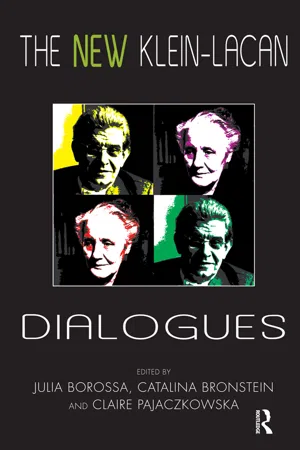
This book provides a timely exploration and comparison of key concepts in the theories of Melanie Klein and Jacques Lacan, two thinkers and clinicians whose influence over the development of psychoanalysis in the wake of Freud has been profound and far-reaching. Whilst the centrality of the unconscious is a strong conviction shared by both Klein and Lacan, there are also many differences between the two schools of thought and the clinical work that is produced in each. The purpose of this collection is to take seriously these similarities and differences. Deeply relevant to both theoretical reflection and clinical work, the New Klein-Lacan Dialogues should make interesting reading for psychoanalysts, psychotherapists, mental health professionals, scholars and all those who wish to know more about these two leading figures in the field of psychoanalysis.The collection centres around key concepts such as: 'symbolic function', the 'ego', the 'object', the 'body', 'trauma', 'autism', 'affect' and 'history and archives'.
eBook - ePub
The New Klein-Lacan Dialogues
- 352 pages
- English
- ePUB (mobile friendly)
- Available on iOS & Android
eBook - ePub
The New Klein-Lacan Dialogues
About this book
Information
PART I
CHAPTER ONE
An introduction to Melanie Klein’s ideas
Who was Melanie Klein?
Melanie Klein’s work had a profound impact on both British and international psychoanalysis. The richness and originality of Klein’s discoveries makes it very difficult to discuss the full impact that her ideas had in Britain and abroad, as her followers continue to develop her theories into what is today a very rich, always expanding, school of thought.
Melanie Klein (née Reizes) was born in Vienna on 30 March, 1882. She was the youngest of four children and, while her father came from an orthodox Jewish family, Melanie had a liberal upbringing, with religion playing little part in family life. Her father married Melanie’s mother (Libussa Deutsch) when he was forty-four and Libussa was twenty-five. They first settled in a small town outside Vienna, but later moved to Vienna, where her father found it difficult to work as a doctor and was forced to move into dental practice.
Two of Melanie’s siblings died young. They both had a long-lasting and important influence on Melanie. Sidonie was four years older than Melanie. She died when Melanie was four. The relationship with her brother Emanuel marked her deeply, as he was a very gifted young man who took an interest in Melanie’s development and coached her so that she could enter the gymnasium. But Emanuel was a sickly young man, who had tuberculosis and rheumatic fever. He died at the age of twenty-five. At seventeen Melanie met her future husband, Arthur Klein, whom she married at the age of twenty-one. She relinquished her intention to study medicine and psychiatry and instead attended extramural classes in art and history. The couple settled in Rosenberg, then in the Hungarian province of Liptau, and had three children: Melitta, born in 1904, Hans, born in 1907, and Erich, born in 1914. In 1909 Melanie Klein settled with the children and her mother in Budapest, and it was there where she started her first analysis with the prominent Hungarian analyst Sandor Ferenczi. In 1913 Ferenczi wrote his paper “Stages in the development of the sense of reality” (Ferenczi, 1913), in which he explored the characteristics of infantile omnipotence and the infant’s access to a sense of reality. The concepts he developed were taken up, though later modified, by Melanie Klein. Ferenczi encouraged her to devote herself to psychoanalysis, particularly child analysis, for which, he said, she had a particular talent (Bronstein, 2001a; Klein, 1959). In 1919, after reading her paper “The development of a child” Melanie Klein became a member of the Hungarian Psychoanalytical Society (Klein, 1921). The following year Klein met Karl Abraham at the International Psychoanalytical Congress in The Hague. He encouraged her to devote herself to child analysis and suggested that she settle in Berlin. Around this time Melanie Klein separated from her husband, and in 1921 she moved to Berlin where she underwent analysis with Abraham, who greatly supported and encouraged her in her work with children. In April 1924, at the Salzburg International Psychoanalytical Congress, Klein read a paper entitled “The technique of the analysis of young children” (an early version of her 1926 paper “The psychological principles of early analysis”) (Klein, 1926). This paper had a strong impact on Ernest Jones, James and Alix Strachey, and other English psychoanalysts attending the conference. Ernest Jones invited Klein to give a series of lectures in London. In 1925, during an interruption of her own analysis due to Abraham’s illness, Klein visited England, where she was warmly welcomed. After Abraham’s unexpected death, in December 1925, Klein accepted Jones’s invitation to settle in England, where she remained until her own death on 22 September 1960. England provided a stimulating environment and a welcoming home for the development of Klein’s theoretical ideas and for her clinical practice. In 1929 she was recognised as a training analyst and she started work with her first candidate. In 1938 the Nazis occupied Vienna, and Ernest Jones, with the help of Princess Marie Bonaparte and the US ambassador in Paris, negotiated with the Nazis for Freud, his family and colleagues to be allowed to leave Austria. Freud and his family came to England. This move opened up strong theoretical controversies in the British Psychoanalytical Society concerning the discrepancy between Melanie Klein’s approach to psychoanalysis and what was seen as a “Freudian psychoanalysis” (King & Steiner, 1991). Tensions between the different ideas on child analysis sustained by Melanie Klein and Anna Freud became more evident after the arrival of Freud and his family in London, and became more acute after Freud’s death in 1939. A series of discussions were agreed at the British Psychoanalytical Society. These “Controversial Discussions” took place between 1941 and 1946. The discussions involved scientific, educational, and administrative problems, and had the aim of deciding whether the new views concerning child development and psychoanalytic technique to treat both children and adults, proposed by Melanie Klein and her followers (Susan Isaacs, Paula Heimann, Joan Riviere, and others), were compatible with the classical view of psychoanalysis as understood by Anna Freud and her colleagues in Vienna and Berlin, and whether Klein should remain in, or be expelled from, the psychoanalytical community.
The psychoanalytic play technique
As is often the case with scientific discoveries, the finding of new tools opened the door to important new developments, seen, for instance, in Freud’s development of the method of “free association”. Klein saw an equivalence between play, dreams, and phantasy as manifestations of the child’s unconscious.
In their play children represent symbolically phantasies, wishes, and their experiences. Here they are employing the same language, the same archaic, phylogenetically acquired mode of expression as we are familiar with in dreams. (Klein, 1926, p. 134).
Klein regarded children’s play as symbolically meaningful as the adult’s free associations. In psychoanalytic work with children, their play has to be taken into account as having meaning in this specific context, as part of the transference relationship to the analyst.
Klein’s first patient was a five-year-old boy, whom she called “Fritz” (thought to have been Klein’s own son, Erich) (Grosskurth, 1986). In 1924 Klein started analysing a number of children in Berlin. One of them, Rita, was two years and nine months old. She suffered from night terrors, animal phobias, an inability to tolerate frustrations, problems with eating, and an inhibition to play. She compulsively washed her dolls. The outbreak of her neurosis coincided with the birth of her little brother. In the first session Rita became quite anxious and wanted to leave the room, to go outside. Klein went with her to the garden and interpreted Rita’s anxiety as fear that Klein would do something to her while alone with her in the room, and she linked this to Rita’s night terrors. Rita’s anxiety eased and became friendly. The interpretation of Rita’s negative transference and the change that this produced strengthened Klein’s conviction of the importance to interpret the child’s anxieties and phantasies from the very beginning, and that “Exploration of the unconscious is the main task of psychoanalytic procedure, and that the analysis of the transference is the means of achieving this aim” (Klein, 1955, p. 123).
In the first period of the development of her theories Klein focused on the issue of inhibition. She was still following Abraham’s and Freud’s theory of libidinal phases. She saw libido as the prime psychic mover and, following Freud, believed in the existence of an epistemophilic instinct rooted in libido and expressed in all the child’s activities (Spillius, 1994). Klein initially saw aggression as a component of the libidinal (sexual) drive, and through her work with young children she recognised the importance of early aggressive impulses. Later, from around 1932, with the acceptance of Freud’s theory of the death instinct, she modified her theory of anxiety, linking it with the threat to the ego arising from the death instinct (Bronstein, 2001a; Freud, 1920g; Petot, 1990).
Klein stressed her conviction that the psychoanalyst should not exert any educative influence on the child, and that the child develops a transference relationship to the analyst from very early on. These ideas were points of disagreement with Anna Freud.
From the analysis of children Klein came to some theoretical conclusions:
● An early onset of anxiety linked to aggression rather than to the repression of libido (she follows here Freud’s second theory of anxiety).
● The relevance of the infant’s interest and curiosity in respect of the mother’s body.
● An archaic Oedipus complex and an early onset of guilt.
● An early superego that is not as strictly connected to the Oedipus complex as in Freud.
Unconscious phantasies and internal objects
Kleinian theory is both a drive and an object-relations theory.
Among Klein’s main meta-psychological points are (De Bianchedi et al., 1984):
1.The duality of life and death drives, and the conflict generated by them, with early anxiety linked to fear of annihilation of the ego stemming from the death drive while later anxiety is about the damage done to the object.
2.A theory of early mental functioning, with an ego than can perceive anxiety and the establishment of object relations from the beginning of life.
3.The ubiquitous quality of unconscious phantasy.
4.The theory of splitting and projective and introjective identification as structuring functions of the mind.
5.A theory of “positions” instead of “phases” of development. The notion of “position” describes a specific configuration of object relationships, impulses, anxieties, and defences that persist through life: there are two basic constellations of mental life. The two positions, paranoid–schizoid and depressive, are modes of psychic functioning that last through life. They describe a specific posture that the ego takes up in relation to its objects (Hinshelwood, 1991).
6.A theory of technique based on these postulations. Kleinian analysis stresses the importance of working with the patient’s psychic reality, with the analysis of unconscious phantasies and anxieties about internalised objects as they are experienced and manifested in the transference relationship.
Klein assumed that from the moment of our birth, all experiences are accompanied by unconscious phantasies. At the time of the “Controversial Discussions”, Klein’s use of the notion of “phantasy” was seen to be very different from Freud’s notion of “fantasy”. The subject of unconscious phantasy was chosen to be discussed at the “Controversial Discussions”, and it was probably the major theoretical theme of all the Scientific Discussions that took place then. On 27 January 1943, during these series of discussions, Susan Isaacs presented her paper “The nature and function of phantasy” which was published in 1952 (“An account of the Freud-Klein controversies, 1941–1945”, will be found in King & Steiner, 1991) (Isaacs, 1948). In her paper Isaacs stressed that unconscious phantasies are the primary content of all mental processes. She also wrote about an innate capacity of phantasising, and suggested that the content of phantasies, though influenced by experiences with external objects, was not entirely dependent on them. We could say that mental mechanisms, such as projection, introjection, identification, etc., are all processes that can be described from the outside, but that from the perspective of the subject they are mentally represented by unconscious phantasies.
Klein outlined a theory to describe what she thought took place in the very first months of life. She assumed that from the moment of birth all our experiences are accompanied by unconscious phantasies. It is the basic mental activity present from birth onwards, the primary unconscious content. Unconscious phantasies are the representations of all an individual’s experiences: internal, external, physical, and mental. They bring together ideation and affect.
Freud described “fantasies” as mainly formed according the logic of secondary process (like daydreams). For him, fantasies would be linked to an unconscious wish that is blocked from fulfilment. But he also described what he called “primal fantasies”, which he thought were inherited (such as the primal scene, castration, seduction by an adult).
Klein views phantasies as synonymous with unconscious thought (the spelling of the word with ph is in order to denote that they might be both conscious and unconscious) It is the essential content of the unconscious mind. The earliest phantasies are primitive and raw, and are experienced mainly as visceral sensations and urges (perhaps more akin to what Freud called “thing presentations”). These early phantasies were described by Kristeva as “metaphors incarnate” (Kristeva, 2001, p.150). The expression of unconscious phantasies in words comes much later than their original sensory formulation (Isaacs, 1948; Spillius, 2001).
Phantasies express unconscious impulses and wishes. There is a continued interplay between phantasies and the perception of external reality. External reality can operate not only as a stimulus for the creation of phantasies, but also as a confirmation of disproof of them. For example, a depressed mother can not only contribute to the creation of certain phantasies of damage in her baby, but can also become the proof to the baby of the damage that his attacking phantasies could have done to his mother.
Unconscious phantasies involve a belief in the existence of an “object”. Their content is intimately connected to internal objects. The picture of internal objects making up an internal world grows out of and extends Ferenczi’s description of introjection (1909, 1912) and Freud’s (1917e, 1921c) and Abraham’s (1924) descriptions of the incorporation and internalisation of objects. We use the word “object” to refer to that to which the subject relates (Bronstein, 2001b). We are mostly describing someone or something that has an emotional meaning for the individual. It alludes to the distinction “subject-object”. An internal object is a parental object that has been actively introjected....
Table of contents
- Cover
- Half Title
- Title Page
- Copyright Page
- Table of Contents
- Acknowledgements
- About the Editors and Contributors
- Editors’ Introduction: The new dialogues: Freud, Klein, Lacan
- Part I
- Part II
- Part III
- Part IV
- Part V
- Part VI
- Part VII
- Part VIII
- Part IX
- Index
Trusted by 375,005 students
Access to over 1.5 million titles for a fair monthly price.
Study more efficiently using our study tools.
Frequently asked questions
Yes, you can cancel anytime from the Subscription tab in your account settings on the Perlego website. Your subscription will stay active until the end of your current billing period. Learn how to cancel your subscription
No, books cannot be downloaded as external files, such as PDFs, for use outside of Perlego. However, you can download books within the Perlego app for offline reading on mobile or tablet. Learn how to download books offline
Perlego offers two plans: Essential and Complete
- Essential is ideal for learners and professionals who enjoy exploring a wide range of subjects. Access the Essential Library with 800,000+ trusted titles and best-sellers across business, personal growth, and the humanities. Includes unlimited reading time and Standard Read Aloud voice.
- Complete: Perfect for advanced learners and researchers needing full, unrestricted access. Unlock 1.5M+ books across hundreds of subjects, including academic and specialized titles. The Complete Plan also includes advanced features like Premium Read Aloud and Research Assistant.
We are an online textbook subscription service, where you can get access to an entire online library for less than the price of a single book per month. With over 1.5 million books across 990+ topics, we’ve got you covered! Learn about our mission
Look out for the read-aloud symbol on your next book to see if you can listen to it. The read-aloud tool reads text aloud for you, highlighting the text as it is being read. You can pause it, speed it up and slow it down. Learn more about Read Aloud
Yes! You can use the Perlego app on both iOS and Android devices to read anytime, anywhere — even offline. Perfect for commutes or when you’re on the go.
Please note we cannot support devices running on iOS 13 and Android 7 or earlier. Learn more about using the app
Please note we cannot support devices running on iOS 13 and Android 7 or earlier. Learn more about using the app
Yes, you can access The New Klein-Lacan Dialogues by Julia Borossa, Catalina Bronstein, Claire Pajaczkowska, Julia Borossa,Catalina Bronstein,Claire Pajaczkowska in PDF and/or ePUB format, as well as other popular books in Psychology & History & Theory in Psychology. We have over 1.5 million books available in our catalogue for you to explore.