- 256 pages
- English
- ePUB (mobile friendly)
- Available on iOS & Android
eBook - ePub
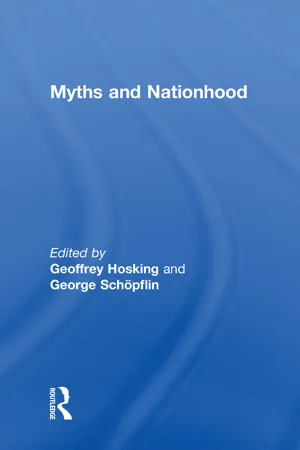
Myths and Nationhood
About this book
Myths are central to the way we live and how we define ourselves. In this pioneering book, a group of specialists--among them Anthony Smith, Norman Davies, Geoffrey Hosking and George Schopflin--look at the general and theoretical nature of myth on a universal basis and examine the specific myths of various nations. With nationhood and ethnicity at the centre of political attention, the book is timely in illuminating the deeper, underlying issues of nationalism that cause so much conflict throughout the world.
Information
THE MYTH OF DIVINE ELECTION AND AFRIKANER ETHNOGENESIS
Bruce Cauthen
Throughout history, the concept of chosenness has been a potent catalyst for social mobilization and national coherence. Chosenness consists in the idea of a particular people who have been especially anointed by the Deity to discharge a mission and whose destiny is divinely and cosmologically determined; they may also collectively possess a divine warrant to subdue ‘heathens’ and propagate the faith in a heathen land. When the cause of a people is conceived to be the very will of God, the collectivity is infused with a powerful sense of purpose that transcends more mundane considerations of social organization. Theirs is a calling to which all members of the community must respond. Failure to realize the collective vocation may incur the wrath of the Deity, lead to the dismemberment of the people and — for its individual members — the prospect of eternal damnation. The very land on which the group dwells is thought to be hallowed ground as it is believed to be deeded exclusively to them as a consecrated parcel from the Almighty Himself. This mystically sublime stewardship acquires an increasingly emotive dimension when the soil has been soaked with the blood of ethnic kinsmen.1
The classic example of a chosen people is, of course, the ancient Israelites whose epic narrative of election, exodus, exile in the wilderness, and ultimate redemption has been related to successive generations through the Old Testament. As the nomadic wandering of the Jews of antiquity was in preparation for their eventual occupation of the Promised Land, the physical habitation of this sacred homeland by the Israelites was essential for the realization of their election and the establishment of their corporate identity.2
Many peoples have identified themselves as instruments of providential design or have interpreted their national history or destiny as the will of God.3 Of course, such sublime self-conceptions tend to create collective attitudes of moral superiority, although, as Anthony Smith cautions, there is a distinction to be drawn between chosenness and ethnocentrism:
A myth of ethnic election should not be equated with plain ethnocentrism. Ethnic communities have quite commonly regarded themselves as the moral centre of the universe and as far as possible affected to ignore or despise those around them. A myth of ethnic election is more demanding. To be chosen is to be placed under moral obligations. One is chosen on condition that one observes certain moral, ritual, and legal codes, and only for as long as one continues to do so. The privilege of election is accorded only to those who are sanctified, whose life-style is an expression of sacred values. The benefits of election are reserved for those who fulfil the required observances.4
Although the concept of chosenness may seem somewhat anachronistic in the presumably modern, rational and secular world of today, the resurgence of religious fundamentalism and, particularly, religious nationalism5 clearly indicates that the myth of divine election is a phenomenon whose contemporary socio-political relevance can hardly be discounted. Until quite recently, however, the notion of a chosen people has received remarkably scant scholarly attention — at least from a comparative perspective. Moreover, much of the contemporary research has been of a decidedly deconstructionist approach, which tends to dissect and ultimately dismiss a people’s historical myth of divine election as little more than a quasi-religious programme, fabricated and manipulated by a nationalist élite, and imposed on the masses as a vehicle for political mobilization. In this regard, the concept of chosenness is often interpreted as merely a sanctimoniously contrived ideology, retroactively interjected back into history, to justify a dubious record of ethnocentrism, racism, territorial aggrandizement, warfare, enslavement or worse.
This has certainly been the case with a number of recent studies which have examined the Afrikaner concept of ethnic election. Yet, generally, as the ecclesiastical historian William Hutchinson counsels, ‘appeals to popular ideas of chosenness, whether these were offered by literary figures or by politicians, probably cannot be dismissed out of hand as cynical constructions. The evidence suggests that policymakers in nineteenth-century Europe and America, like their successors in various world societies of today, were dependent for some of their support on religiously derived beliefs that they did not need to construct — beliefs that, for good or ill, were really there.’6
Afrikaner Ethnic Election
In certain ways the Afrikaners seem to illustrate the model of a people conspicuously and self-consciously committed to follow that which they see as the will of God. It may well be argued that a distinct sense of collective piety (which some may dismiss as nothing more than religiosity, sanctimony and hypocrisy) has traditionally pervaded the Afrikaner psyche. Deep religious devotion was characteristic of the early Boers and, even in the present day, Christianity remains a powerful force in Afrikaner society. The traditional Afrikaans’ churches — particularly the predominant Dutch Reformed Church, which has maintained an ‘official character’7 since the inception of the Dutch colony at the Cape — remain pivotal social institutions, and membership levels of Afrikaners are comparatively high for any industrialized society. Even Leonard Thompson, whose writings have hardly been sympathetic to Afrikaner religious belief, concedes that,’despite the inroads of urbanization and capitalism, religion continues to be a determining influence over the personal beliefs, corporate behavior, and the self-justification of Afrikaners’.8
Christian conviction has certainly been a defining factor of Afrikaner identity.9 Afrikaners, both élite and ordinary, of all political persuasions, continue to invoke the name of God, and dramatically employ biblical and apocalyptic imagery just as their ethnic forebears did in days past. The Afrikaner vigorously equates his cause as a providentially defined mission.10 Certainly, Andries Treunicht, the late leader of the Conservative Party and a clergyman by profession, encapsulated his political message within a theological discourse. Eugene Terre’Blanche of the notorious Afrikaner Weerstanbeweging (AWB) regularly denounces all enemies of the Boer people as anti-Christ. However, the public articulation of fervent religious conviction is an activity which is hardly confined to conservative Afrikaners: when the well-known Afrikaner dissident Beyers Naude broke with the National Party in the 1970s, he did so denouncing apartheid as a sin and a doctrinal heresy, and he named his anti-apartheid organization ‘The Christian Institute’. And when former State President F.W. de Klerk was recently asked why he had abolished apartheid, his response was that God had instructed him to do so.
Given this intensely religious atmosphere which, even today, continues to infuse Afrikanerdom, it is hardly surprising that approaches which have emphasized the socio-cultural influence of religion have proven such a dominant theme in the literature and have been continually employed, even by recent researchers, to analyse the growth of Afrikaner ethnic identity and of Afrikaner nationalism. Yet although this perspective, known as the Calvinist paradigm,11 has remained a prevalent and enduring approach, the school of thought is not without its detractors. In this regard, the most vocal and consistent critic of the Calvinist paradigm has been the Afrikaner political scientist Andre du Toit.12
It should prove instructive to consider in some detail the objections registered by du Toit and evaluate the cogency of his critique before we examine the historical development of the concept of Afrikaner chosenness. One tenet of du Toit’s argument is located in drawing a sharp ideological distinction between the English Puritans who settled in New England and the Dutch who colonized the Cape. Du Toit asserts that the well-educated Puritans commanded a sophisticated theological knowledge of the set of complex Calvinistic principles and envisaged the establishment of a new society founded upon their intellectual understanding of Calvinism. In contrast, the territorial interest of the Dutch was purely commercial; they also lacked the rich theological and rigorous intellectual traditions of Puritanism, and were largely unconcerned with the construction of a religiously defined society.13 The Puritans — prior to their landing at Plymouth Rock — perceived themselves as a people chosen to build the city on the hill, the New Jerusalem; according to du Toit, however, the Dutch laboured under no such mystical or sublime imperative. To substantiate this point, du Toit points not only to the theological marginalization in the Cape Colony, but also to the lack of social — especially ecclesiastical — organization on the frontier as the trekboers, or nomadic farmers, began to migrate eastward in the eighteenth century:
Linked only tenuously with the market and the cash economy based on the Cape, without regular schools, for the most part outside the reach of the few functioning congregations and subject to only the flimsiest of administrative controls, the trekboers outside of the western Cape were in fact for generations without most of the institutional constraints or socializing agencies which could have been instrumental in retaining and transmitting intellectual and social conditions. In such circumstances it becomes questionable in what sense one could expect to find any theological tradition at all, let alone such a systematic and sophisticated doctrine as that of Calvinism.14
There is an implicit insinuation, then, in du Toit’s work that the Dutch settlement of the Cape was essentially devoid of any genuine religious devotion and that, as the Boer migrated eastward, his faith — already minimal and inauthentic — was subjected to a continual erosion on the frontier.
Du Toit argues that no distinct ideology of Afrikaner chosenness was articulated until nearly a century and a half after the colonization of the Cape. He recalls that travellers, who left written accounts of their expeditions, did not detect any psychological inclinations among ...
Table of contents
- Cover
- Half Title
- Title Page
- Copyright Page
- Preface
- Contents
- The Contributors
- The Role of Myth: An Anthropological Perspective, or: ‘The Reality of the Really Made-Up’
- The Functions of Myth and a Taxonomy of Myths
- The ‘Golden Age’ and National Renewal
- The Myth of European Unity
- Myth-Making and National Identity: The Case of the GDR
- Making History: Myth and the Construction of American Nationhood
- The Myth of Divine Election and Afrikaner Ethnogenesis
- National Myths in the New Czech Liberalism
- Polish National Mythologies
- National Mythology in the History of Ideas in Latvia: A View from Religious Studies
- The Myth of Zion among East European Jewry
- Myths of National History in Belarus and Ukraine
- The Russian National Myth Repudiated
- Index of Names
Trusted by 375,005 students
Access to over 1.5 million titles for a fair monthly price.
Study more efficiently using our study tools.
Frequently asked questions
Yes, you can cancel anytime from the Subscription tab in your account settings on the Perlego website. Your subscription will stay active until the end of your current billing period. Learn how to cancel your subscription
No, books cannot be downloaded as external files, such as PDFs, for use outside of Perlego. However, you can download books within the Perlego app for offline reading on mobile or tablet. Learn how to download books offline
Perlego offers two plans: Essential and Complete
- Essential is ideal for learners and professionals who enjoy exploring a wide range of subjects. Access the Essential Library with 800,000+ trusted titles and best-sellers across business, personal growth, and the humanities. Includes unlimited reading time and Standard Read Aloud voice.
- Complete: Perfect for advanced learners and researchers needing full, unrestricted access. Unlock 1.5M+ books across hundreds of subjects, including academic and specialized titles. The Complete Plan also includes advanced features like Premium Read Aloud and Research Assistant.
We are an online textbook subscription service, where you can get access to an entire online library for less than the price of a single book per month. With over 1.5 million books across 990+ topics, we’ve got you covered! Learn about our mission
Look out for the read-aloud symbol on your next book to see if you can listen to it. The read-aloud tool reads text aloud for you, highlighting the text as it is being read. You can pause it, speed it up and slow it down. Learn more about Read Aloud
Yes! You can use the Perlego app on both iOS and Android devices to read anytime, anywhere — even offline. Perfect for commutes or when you’re on the go.
Please note we cannot support devices running on iOS 13 and Android 7 or earlier. Learn more about using the app
Please note we cannot support devices running on iOS 13 and Android 7 or earlier. Learn more about using the app
Yes, you can access Myths and Nationhood by George Schopflin,Geoffrey Hosking in PDF and/or ePUB format, as well as other popular books in Politics & International Relations & Politics. We have over 1.5 million books available in our catalogue for you to explore.