- 320 pages
- English
- ePUB (mobile friendly)
- Available on iOS & Android
eBook - ePub
About this book
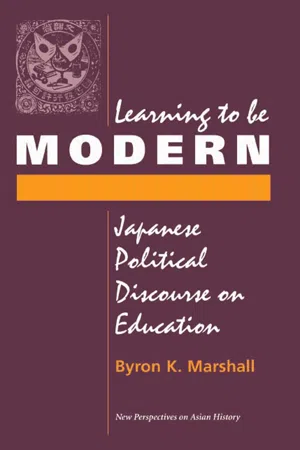
Emphasizing the political discourse and conflict that have surrounded Japanese education, this book focuses on the three main issues of central versus local control, elitism versus equality, and nationalism versus universalism.
Information
1
Clarifying Loyalty and Filial Piety: 1800-1850s
The aim of education, elementary and advanced, is to clarify human relationships. In the elementary program of education the various human relationships are made clear.
—Yamazaki Ansai, 16501
The [Confucian] teaching of Chu Hsi has had the full confidence of successive shoguns…. Lately, however, various new theories have been put forward, heterodox teachings have become popular, and social standards have been broken down.
—Lord Matsudaira Sadanobu, 17902
The patterns of schooling in Japan of the early nineteenth century formed a richly textured mosaic, reflecting the patchwork political quilt and the multicolored social life of the late Tokugawa era. Politically, the country was divided into some 250 semiautonomous domains under the control of hereditary lords, or daimyo, and their retainers, or samurai. Legally, the population was sharply divided into three groups—nobles, peasants, and townspeople—which formed a steep pyramid with the nobles at the top. But in terms of economic income and social status, the shapes of Tokugawa life were much more complex and fluid than the official view would have it. Although much of both structure and ideals would be swept away in the civil war that accompanied the Meiji Restoration at the end of the 1860s, the revolutionary nature of the Meiji reforms cannot be appreciated without at least a brief overview of the educational policies and intellectual currents that formed the traditional background for modern Japan.
The Decentralized Tokugawa State
The political regime that gave its name to the early modern period in Japanese history was founded in 1600. In that year a coalition of daimyo led by the House of Tokugawa won a huge military victory and ended over a century of feudal warfare among the samurai class. The central government created over the next several decades is referred to as the Tokugawa shogunate, reflecting the decision by the head of the Tokugawa family to take shogun, or “generalissimo as his formal title rather than to usurp the imperial throne. The result was a political system in which the Tokugawa shogun nominally recognized the ultimate sovereignty of the imperial house, which resided at the court in Kyoto, while the shogun actually exercised power from the Tokugawa castle in the city of Edo (modern-day Tokyo). The imperial court with its royal family and associated nobles was permitted to continue much as it had for the previous eight centuries, without political power and dependent upon the leaders of the samurai aristocracy for economic sustenance. In return the shogun could claim, as viceroy or military commander, a historical legitimacy and political authority derived from the myths about the imperial house.
Daimyo and Samurai
Beneath these dual peaks of court and shogunate, the rest of the political pyramid consisted of daimyo lords and their samurai retainers. The victory of the Tokugawa coalition had led not to the destruction of the autonomous domains of the daimyo but rather to a pragmatic compromise. The hereditary daimyo families were permitted to administer their domains as fiefs from the shogun, their liege lord. In these domains the daimyo each administered criminal and civil law, levied taxes, planned public works, and maintained their own corps of armed samurai. In law, daimyo were answerable only to the shogun, who held them to certain basic rules regarding such matters as arms limitations and who also issued vague abstract injunctions to the daimyo about benevolence in their treatment of the people.
What is important for our purposes is to note that the Tokugawa political tradition was one in which educational policy, like other matters of public policy, was left largely in the hands of these domain governments. This does not mean that there were over 250 separate styles of political rule or 250 educational philosophies. The daimyo houses had survived the civil wars of the sixteenth century by learning similar lessons about governing their territories. They were now participants in a national political culture that strongly influenced their administrations toward a common pattern. There was also the model of the shogun himself, the national hegemon who in his other role as a territorial lord governed the largest single domain in the country, a domain that included about one-third of all urban dwellers as well as a large percent of the nation’s villagers. Nevertheless, it must be emphasized that the Tokugawa tradition of political control in early modern Japan was one of decentralization, not centralization.3
The higher echelons of both shogun and daimyo governments were staffed by samurai. The samurai class made up somewhere between 6 percent and 10 percent of the population. Each samurai head of household was separately linked by feudal ties of fealty and benevolence to his own daimyo. Although the Tokugawa had samurai of its own, the overwhelming majority of the samurai were not direct vassals of the shogun but rather were vassals of lords who were in their turn vassals to the Tokugawa. The aristocratic samurai of the nineteenth century were descendants of medieval military knights formerly based on agrarian land. By the early eighteenth century, however, all but a small minority of samurai had been moved into urban areas around daimyo castles and placed in quasi-bureaucratic chains of command.
The establishment of the Tokugawa regime resulted in over 200 years free from civil war and, since Tokugawa foreign policy aimed at limited contact with its neighbors, free from foreign wars. Thus, although the Bushido ideology of the samurai continued to stress their martial heritage, the samurai of the Tokugawa period filled the bureaucratic hierarchy of officialdom rather than riding to battle as swordsmen and archers, as had their forefathers. In their roles as civil servants, samurai were responsible for directing the collection of taxes, administrating the cities, supervising village officials, overseeing the police courts, inspecting religious establishments, and regulating commerce and the other functions of early modern government. In short, in the course of two centuries between 1600 and 1800 the samurai were transformed into a civil administrative class. The corollary was that they were increasingly required to prepare for these roles through formal schooling.
Entry into samurai status and the rank of each samurai family was determined primarily by birth; therefore the crucial qualifications for office were inherited. The prolonged civil wars of the medieval period had culminated in the stable sociopolitical order of seventeenth-century Tokugawa Japan. The military’s preoccupation with a bureaucratic chain of command and the feudal aristocracy’s fastidious concern for genealogical propriety combined to produce an interlocking latticework of governmental posts and official ranks. In this hierarchy the relative income, power, and prestige of a samurai and his family were to a great degree determined by the quality of the service that had been rendered by his forefathers. Few formal mechanisms for either promoting the talented or demoting the mediocre were resorted to with any frequency in normal times.4 The only routine way in which an individual male samurai could permanently move up in rank was to be adopted by another samurai family who needed an heir. This opportunity, of course, was very rarely available to the eldest son, who was needed to carry on his own family line.
Commoner Society
In law and social theory, Tokugawa was a hierarchically ordered society in which various functional classes, including townspeople, had different obligations and privileges. There was variation among daimyo domains but some generalizations seem accurate of all domains.
Commoners in urban communities, though not routinely taxed, were subject to special regulations. Nevertheless, the urban mercantile elites in their roles as commercial bankers, rice brokers, shippers, warehousers, and wholesalers acquired over time a great deal of economic power. Socially and culturally as well as economically, this class came to dominate the life of the city. Although municipal government was the prerogative of the samurai bureaucracy, neighborhood affairs were largely left to the leading citizens, who arranged such basic needs as fire fighting, rubbish removal, and what formal schooling that existed in the towns.
One of the most remarkable features of the cultural life of early nineteenth century Japan was how much of it assumed literacy, indeed depended upon it. Although there are no statistical measures of literacy per se, there is a wealth of indirect evidence to support the generalization that mid-nineteenth century Japan compared favorably with almost any country in the world.5 It is estimated that some three-quarters of merchants in large cities and more than half elsewhere would have been literate in part because of the importance of keeping business accounts. Data on the number of bookstores, lending libraries, and publishing houses suggest a large urban audience for other printed materials.6 Perhaps half of the wives and daughters in this merchant class would also be able to read. Literacy among male artisans would vary according to type of community and even region of the country, but a reasonable estimate would be between 40 and 60 percent. That there were libraries lending books for a small fee implies a reading public not exclusively in the upper-income brackets, since presumably the wealthier individuals could afford to purchase their own copies. In the 1830s, Edo, with a population of a million, had 800 such lending libraries, approximately 1 for every 1,250 inhabitants. Osaka, smaller at 400,000 people, had about the same number of libraries per capita.7
Despite the significant degree of urbanization in nineteenth-century Japan, over 80 percent of the population was rural. The most common livelihood was agriculture, which was sometimes accompanied by fishing in coastal villages and timbering in the mountains. Rice was the dominant crop wherever it could be cultivated efficiently. Other grains were grown in the colder season. By the early nineteenth century there was a wide variety of foodstuffs as well as commercial crops such as oilseed, cotton, and tobacco. The rural villages were also the main source of such highly valued handicraft products as pottery, lacquer, paper, sake wine, and raw silk.
The long process of commercialization in Tokugawa agriculture contributed to marked social stratification in most if not all Japanese villages with a considerable disparity in the distribution of wealth, power, and prestige. Since urban merchant enterprises were commonly restricted by law in their rural activities, affluent village families had opportunities to combine landholding with commercial operations such as marketing, handicraft industries, and moneylending. The patriarchs of these households filled the political roles of village headman and community elder and organized such communal affairs as the annual cycle of religious festivals.
At the bottom of village society were landless peasants, who tilled their landlords’ fields as sharecroppers and provided the seasonal labor needed in such handicraft industries as rope making, textile weaving, and sake or soy sauce brewing. They had little direct say in village affairs. Instead, landless peasants’ interests in community water rights and similar concerns were represented by their landlords, whose ancestors had often been the landlords of the peasants’ ancestors. In between the very top and bottom of rural society were the small and medium-sized landholders who might or might not have direct inputs into village politics, depending in many cases upon their family relations with the village elite.
In rural areas the rate of literacy was doubtless considerably lower than in the towns and cities. Nevertheless, it would be erroneous to picture the nineteenth-century village as composed of nothing but unlettered peasants. Daimyo and their samurai depended a great deal on the written word in their attempts to control their subjects and thus rural Japan was thickly papered with government records of many kinds.
Census accounts, land registers, and tax files were just the beginning of the layers of records that accumulated. Added to these were the written pronouncements distributed by their lords to inspire and warn the people about immoral and criminal behavior. All of these writings imply that at least those male peasants who served as local officials had to be literate. Moreover, the agricultural almanacs that were published in large numbers as well as the discovery of storerooms well stocked with books in the homes of nineteenthcentury villagers reveal that literacy was by no means limited to such official matters. Perhaps half of the middling peasant males and a third of the lower strata may have been able to read and write some simple Japanese, although there were no doubt isolated areas where less than a quarter would have had even this rudimentary skill.8
Nationalism and Tokugawa Ideology
Nationalism, as it came to be understood in Japan by the end of the nineteenth century, had only limited meaning or emotional appeal in the Tokugawa period. Although Japan already possessed many of the characteristics of a modern nation-state—an ethnically homogeneous populace with a common history and political sovereignty over a distinct area—the notion of nationhood was not necessarily a meaningful reference for identity or a sanction for behavior. The main foci for identity for the commoner were the village community and the extended family group; for the samurai, the feudal domain. Loyalty was owed by the samurai specifically to his feudal lord, who, in turn, owed allegiance to the Tokugawa house as hereditary liege lord. The imperial throne, later to become the premier focus for national identity, was a very shadowy institution in the early nineteenth century. Sanctioning political authority and underlying the norms of political behavior was a set of ethical assumptions stemming in large part from a neo-Confucian reading of human history and of natural principles that govern the larger world.
The focus of cultural loyalty formed when these originally Chinese views of the moral order of the universe became intermixed with Shinto and Buddhist precepts and adapted to the Bushido tradition of the Japanese samurai class. In the neo-Confucian intellectual tradition patronized by the shogun and most daimyo, cultural identity resided in an identification with the devotion to an ethical conception of what it meant to be civilized in general rather than what it meant to be Japanese in particular. But Confucianism was only one of the intellectual traditions of the Tokugawa era. By the early nineteenth century three distinct intellectual currents flowed through the educational field and affected the content of school curriculum as well as administrative policy: (1) that of the Confucians, who can be considered an intellectual elite under the Tokugawa regime by virtue of the subsidies received from the shogun and various lords; (2) that of scholars of Nativist Studies, who increasingly challenged the Confucians on the basis of an indigenous tradition they claimed predated Chinese influence; and (3) that of a small but increasing number of specialists in Western Learning, whose services came into greater demand after 1800.
Confucian Studies
Although Confucianism in the late Tokugawa period was not quite as fractured as nineteenth-century Christianity in the West, there were many rooms in its mansion. Originating in China, whose culture continued to be held in great esteem by Japanese Confucians in terms of institutional ties and even, to a significant extent, in doctrinal aspects, Tokugawa Confucianism developed largely independently from China. The single most important seat was the Shōheikō Academy. In addition to serving as the main facility for advanced schooling for Tokugawa housemen, it also produced teachers who were employed in the samurai academies of numerous daimyo domains. Politically, Shōheikō Confucians preached loyalty to the Tokugawa shogun as either himself the virtuous prince envisioned by Confucius or at least the viceroy of an emperor who reigned with the mandate of heaven but delegated governmental power to the shogun. Political stability, social harmony, and economic well-being were all deemed to depend upon a government that maintained a proper social hierarchy and induced correct moral attitudes among its people. Since different social classes had different social functions, th...
Table of contents
- Cover
- Half Title
- Title Page
- Copyright Page
- Contents
- List of Tables
- List of Figures
- Preface
- Introduction
- 1 Clarifying Loyalty and Filial Piety: 1800-1850s
- 2 Knowledge from Throughout the World: The Reforms of the 1870s
- 3 Assimilating the Elements: 1879-1905
- 4 To Liberate Education from Bureaucratic Control: 1905-1931
- 5 Mobilizing the Spirit of the Nation: 1931-1945
- 6 Stamping out the Bad, Stamping in the New: 1945-1950
- 7 Warfare Waged Between the Entrenched: 1950-1969
- 8 The Challenge of a New Era: 1970-1989
- 9 Our National Identity as Japanese: Post-Shōwa Japan
- Notes
- Bibliography
- About the Book and Author
- Index
Trusted by 375,005 students
Access to over 1.5 million titles for a fair monthly price.
Study more efficiently using our study tools.
Frequently asked questions
Yes, you can cancel anytime from the Subscription tab in your account settings on the Perlego website. Your subscription will stay active until the end of your current billing period. Learn how to cancel your subscription
No, books cannot be downloaded as external files, such as PDFs, for use outside of Perlego. However, you can download books within the Perlego app for offline reading on mobile or tablet. Learn how to download books offline
Perlego offers two plans: Essential and Complete
- Essential is ideal for learners and professionals who enjoy exploring a wide range of subjects. Access the Essential Library with 800,000+ trusted titles and best-sellers across business, personal growth, and the humanities. Includes unlimited reading time and Standard Read Aloud voice.
- Complete: Perfect for advanced learners and researchers needing full, unrestricted access. Unlock 1.5M+ books across hundreds of subjects, including academic and specialized titles. The Complete Plan also includes advanced features like Premium Read Aloud and Research Assistant.
We are an online textbook subscription service, where you can get access to an entire online library for less than the price of a single book per month. With over 1.5 million books across 990+ topics, we’ve got you covered! Learn about our mission
Look out for the read-aloud symbol on your next book to see if you can listen to it. The read-aloud tool reads text aloud for you, highlighting the text as it is being read. You can pause it, speed it up and slow it down. Learn more about Read Aloud
Yes! You can use the Perlego app on both iOS and Android devices to read anytime, anywhere — even offline. Perfect for commutes or when you’re on the go.
Please note we cannot support devices running on iOS 13 and Android 7 or earlier. Learn more about using the app
Please note we cannot support devices running on iOS 13 and Android 7 or earlier. Learn more about using the app
Yes, you can access Learning To Be Modern by Byron Marshall in PDF and/or ePUB format, as well as other popular books in Education & Educational Policy. We have over 1.5 million books available in our catalogue for you to explore.