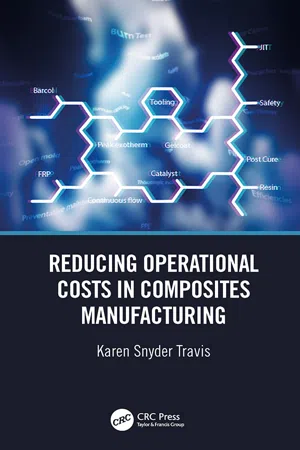
Reducing Operational Costs in Composites Manufacturing
eBook - ePub

Reducing Operational Costs in Composites Manufacturing

  1. 192 pages
  2. English
  3. ePUB (mobile friendly)
  4. Available on iOS & Android
eBook - ePub

Reducing Operational Costs in Composites Manufacturing

About this book

Reducing Operational Costs in Composites Manufacturing provides organization-specific principles for managers working in the composites industry. It utilizes a "how to" format for reducing operational costs and provides examples for each principle.

In the first two sections, readers learn how to evaluate the existing environment to determine the best course of action when developing a plan to achieve goals. This is followed by a deeper understanding of why character strengths are important, and how to effectively manage employees in section three. Section four helps the new manager to think outside the box by bringing in other managers to evaluate and offer suggestions. Finally, section five teaches the reader how to sustain and continually enhance what they have put in place.

Uniquely aimed at the composites industry, this book helps professionals and managers implement process change, gain control of struggling facilities, enhance the strengths of more efficient organizations, and consider manufacturing costs of in a new light.


Frequently asked questions

Yes, you can cancel anytime from the Subscription tab in your account settings on the Perlego website. Your subscription will stay active until the end of your current billing period. Learn how to cancel your subscription.
No, books cannot be downloaded as external files, such as PDFs, for use outside of Perlego. However, you can download books within the Perlego app for offline reading on mobile or tablet. Learn more here.
Perlego offers two plans: Essential and Complete
  • Essential is ideal for learners and professionals who enjoy exploring a wide range of subjects. Access the Essential Library with 800,000+ trusted titles and best-sellers across business, personal growth, and the humanities. Includes unlimited reading time and Standard Read Aloud voice.
  • Complete: Perfect for advanced learners and researchers needing full, unrestricted access. Unlock 1.4M+ books across hundreds of subjects, including academic and specialized titles. The Complete Plan also includes advanced features like Premium Read Aloud and Research Assistant.
Both plans are available with monthly, semester, or annual billing cycles.
We are an online textbook subscription service, where you can get access to an entire online library for less than the price of a single book per month. With over 1 million books across 1000+ topics, we’ve got you covered! Learn more here.
Look out for the read-aloud symbol on your next book to see if you can listen to it. The read-aloud tool reads text aloud for you, highlighting the text as it is being read. You can pause it, speed it up and slow it down. Learn more here.
Yes! You can use the Perlego app on both iOS or Android devices to read anytime, anywhere — even offline. Perfect for commutes or when you’re on the go.
Please note we cannot support devices running on iOS 13 and Android 7 or earlier. Learn more about using the app.
Yes, you can access Reducing Operational Costs in Composites Manufacturing by Karen Snyder Travis in PDF and/or ePUB format, as well as other popular books in Technology & Engineering & Chemical & Biochemical Engineering. We have over one million books available in our catalogue for you to explore.

Section 1

Understanding Your Weaknesses

1

The Basics of Composite Manufacturing

Introduction

At a minimum, a general understanding of the various departments in composite manufacturing is helpful or necessary for developing the most advantageous plan to reduce operational costs. The following departments are explained briefly in this chapter and will be addressed in more detail in other chapters throughout the book. They are divided into three groups: departments that support the manufacturing processes including safety, maintenance, engineering, procurement, production control, quality control and quality assurance, and warrantee; departments that manufacture the product including mill, tooling, gelcoat, lamination, pull and release, trim and grind, and repair; and departments that add to or complete the manufacturing processes including but not limited to sub-assembly, assembly, upholstery, and shipping.

Support Departments

These departments do not add labor or materials to the completed product but do affect the ability to perform the manufacturing and production processes in a controlled, repetitive, and consistent way.
  • Safety
    Safety is one of the most critical departments in a composite facility and can be the costliest if left unchecked. The Safety department is responsible for working with the plant management to make sure the employees understand the hazards they work with and adhere to the safety practices and government laws. They are also responsible for working with the materials and maintenance groups to be certain the safe handling of all chemicals is followed. The costs from not following safe work practices can range from minor fines to complete loss of a composite facility, or death of an employee.
  • Maintenance
    The Maintenance department is key to keeping the facilities in operational order. This should include all building structural, electrical, mechanical & plumbing, as well as all equipment, machinery & tools. Preventative maintenance is essential to reduce downtime events. The Maintenance manager should track all spending in this department and should report monthly to the plant manager regarding any issues from the workforce on the care of equipment, machinery, tools, and the facility.
  • Engineering
    The Engineering department develops new product and adjusts as necessary, which includes all molds, jigs, fixtures, guides, and patterns. This department is also responsible for making sure all production parts are assigned a part number, a Bill of Materials, and the allocation of labor hours to manufacture.
  • Procurement
    The Procurement department is responsible for ordering, receiving, storing, packaging, and delivering all products used to manufacture the end product. They take information from engineering, and source at least two vendors for each product. Their goals are to keep the cost of the products at a level commensurate with the goals set by engineering and keep the stock at a level that allows for Just-In-Time (JIT) deliveries without production interruptions.
  • Production Control
    If you think of the plant in the likeness of a person, the Production Control department would certainly be the brain. This department is key to keeping everything in the plant flowing without hiccup or bottleneck. Production Control defines labor at work centers, schedules all work in a balanced timeframe, and determines completion dates on all manufactured product. They work closely with Engineering, plant management, sales, and procurement to assure a smooth production flow, and provide the necessary paperwork and schedules for each area of the plant.
  • Quality Control/Assurance
    Quality Assurance is the responsibility of every person working in the facility. Each individual that touches any part of an end product or works in an area that supports the manufacturing process, is responsible for making sure everything they do for the company is 100% accurate.
    Quality Assurance can be performed formally with checkpoints and sign offs at every function, or it can be an honor system with effective leadership checking sporadically during the process to be sure the product is manufactured according to the quality standards.
    Quality Control is performed after the process is completed and is usually done by an inspector working in a Quality Control department that usually does not answer to the plant manager. Although product quality is the responsibility of the plant manager, it can be a conflict of interest to have this department working directly for the person responsible for the production of finished product, especially if the owners or officers of the company places more value on completions dates than quality.
  • Warrantee
    Although this department is not directly involved with the manufacturing of composite product, often the replacement or repair of sold product is given to the manufacturing process to complete, and this can interrupt the normal process flow of manufacturing especially where tooling and mold availability are not commensurate with product manufacturing requirements. An example of this issue happens when a warranted composite component part must be added to the production schedule, but the production schedule for that mold does not allow time for additional product.

Manufacturing Departments

These departments are directly involved in the manufacturing process and add labor and materials to the completed product.
  • Mill
    Often called the “Wood Shop” or “Fab Shop”, this department is composed of equipment and tools that cut and process raw core materials such as wood, composite sheets, plastics, fiberglass, and other structural materials used as support structures applied in the lamination processes of certain types of composites. A good example is the stringer system which is laminated into the hull of a boat.
    This department may also manufacture support structures for other departments, which add to the manufacturing processes such as core material for upholstery or completed cabinetry for assembly functions. As core and support materials have changed from using mainly wood to including other composite materials, the name of this department also changed from wood shop to fab shop or Mill.
  • Tooling
    The Tooling or mold department is responsible for maintaining and preparing the molds for production. The supervisor of this department should keep a log file on all molds, which identifies how the mold was built, any repairs performed on the mold, and the wax cycle.
  • Gelcoat
    The Gelcoat spray department takes the prepared molds from the tooling area and prepares them for the gelcoat spray. The department is responsible for maintaining the spray equipment and calibrate the guns at every shift. They are also responsible for checking to be certain all controls are in place prior to spraying, which includes visual inspections of the equipment, spray area, chemicals, and molds.
  • Lamination
    Lamination applies layers of materials that bond together to give the end product strength and stability. This can be done in several ways such as filament winding, spin molding, open molding, closed press molding or s...

Table of contents

  1. Cover
  2. Half Title
  3. Title Page
  4. Copyright Page
  5. Dedication
  6. Table of Contents
  7. Preface
  8. Acknowledgments
  9. Author Biography
  10. Section 1: Understanding Your Weaknesses
  11. Section 2: Getting Organized
  12. Section 3: Hiring and Keeping the Best Employees
  13. Section 4: Utilizing Free Support
  14. Section 5: Sustain
  15. Section 6: Forward-Thinking
  16. Glossary
  17. References
  18. Index