- 328 pages
- English
- ePUB (mobile friendly)
- Available on iOS & Android
eBook - ePub
What's A Peasant To Do? Village Becoming Town In Southern China
About this book
Since China entered the post-Mao "Reform Era" in the late 1970s and early 1980s, the Chinese economy has taken off as few economies ever have. Labor migration, rural enterprises, rising production, and globalization have all combined to end the isolation of the Chinese countryside. Yet although China's unsurpassed economic boom has produced reams of impressive statistics, has this economic growth led to improving the livelihood of the average Chinese person? Has development accompanied economic growth? Has the promise of "opening to the outside" been fulfilled in providing a better life for China's 1.2 billion-plus people? In this book, which is based on field work, Guldin presents and explores some of the changes sweeping through China in the 1990s that are affecting hundreds of millions of people. Guldin looks at the growth of town and village enterprises, labor mobility, and the other aspects of rural urbanization to investigate the connection between economic growth and development in contemporary China. The political changes at the village level, the swelling flows of capital, data, goods, and people, new ways of thinking and behaving, and a significant surge in social inequalities are all topis for chapter discussions. Guldin invites readers to face the same question that former Chinese peasants must face, namely, how to respond, as their villages are transformed forever.
Information
Part 1
Townizing Southern China
Chapter 1
Introduction: Reflections on Growth and Development
Growth
Since China entered the post-Mao Reform Era in the late 1970s and early 1980s, the Chinese economy has taken off as few economies have in the past. Merely a decade later, double-digit economic growth figures were taken as a matter of course, for since 1979 China has averaged a 10-percent per-year increase in its gross domestic product (GDP) and per-capita output has been doubling every ten years (CDN 11/11/95, Kristof and WuDunn 2000). While the long-industrialized economies of Japan, the United States, and Europe were optimistically hoping for growth rates of 4—5 percent, China’s foreign reserves were steadily building (U.S.$70 billion, the worlds fifth highest, by 1995, and 121 billion by mid-1997), and its economy averaging 12 percent growth between 1992 and 1997 (although growth in 1998 slowed to somewhat less than 8 percent). Inflation, a major headache of planners and consumers alike in the early 1990s (when prices were increasing 24 percent per year in 1994), fell to less than 2 percent in 1997 (Faison 1997a; Xu 1997). Some predict that by 2010, this robust economy will become the world’s second largest, behind only that of the United States and, within the following decade or even earlier, become the world’s largest (Mittelman and Pasha 1997:154; Yu 1994:96).
Once a Cold War—blockaded, self-reliant, iconoclastic economy and society, China has rapidly emerged in the 1980s and 1990s as an increasingly globally engaged society. Foreign investment in China soared to U.S.$81.4 billion in 1994 from U.S.$2.9 billion only a decade earlier. Earlier development policies based on import substitution shifted to export-led strategies led by the forces of international globalization. The once all-powerful center has loosened the reins of control, and decentralization has increased the impact of outside forces on China. As the capacity of the center in Beijing to organize the country decreases, and as provinces have become increasingly financially independent (Guangdong Province, for example, relied on Beijing for only 2 percent of its investment capital by the early 1990s, down from 80 percent in 1979), the once-vaunted machinery of the Chinese communist state now only oversees rather than actively runs the economy and society (New York Times Magazine 1996; Yu 1994).
Yet although China’s unsurpassed economic boom has produced reams of impressive statistics, has this economic growth led to improving the average Chinese’s livelihood, as Sun Yat-sen wished for the Chinese people three quarters of a century earlier in his Nationalist Party platform? Has development accompanied economic growth, with positive social and political changes (Mittelman and Pasha 1997:25, 81)? Has the promise of “opening to the outside”—in the words of the oft-repeated Chinese government policy slogan—been fulfilled in providing a better life for China’s 1.3 billion people?
Clearly, life has been changing in China. The decollectivization of land tilling, the dismantling of the commune structures, and the move to a “socialist market economy” in the early 1980s, have proceeded apace and transformed much of the givens of the economy and of daily life. Dramatic increases in productivity during this reform era seem to have shattered the old ceiling imposed by both the pre-Revolutionary society and the pre-reform collectivist economy wherein labor supply was inflexible. Production innovations such as mixing private and collective and distribution readjustments utilizing market and planning enabled China’s rural output to soar 250 percent during the 1980s while population only increased 15 percent (Huang 1991:631-632).
In 1980, four-fifths of Chinese were still tied economically and administratively to the land, but these forces of reform and globalization have succeeded in dramatically reducing that proportion. In only two decades, agriculture’s hold on the majority of the population has weakened greatly: between 1978 and 1989 alone, agriculture dropped from employing 70.7 percent of the labor force to 60.2 percent, and then to only 57 percent by 1993. The pace has continued unabated and within a few years, there will be as many nonfarmers in China as farmers—for the first time since China entered the Neolithic ten millennia ago (Chen and Parish 1996:63; Guldin 1992a:229-230; Hook 1996:122).
Key to this transformation has been the growth of the township and village enterprises (TVEs), those former agricultural cooperative manufacturing and processing industries, which were taken over by the town and village governments in the early reform era. They have absorbed much of the agricultural surplus labor released from the land as communes were dismantled, expanding their labor force at an annual rate of 13 percent per year during the 1980s and employing 135 million workers by 1997. They have become a crucial element of China’s expanding industrial production, contributing 26 percent of GDP, 44 percent of gross value of industrial output (GVIO), and 35 percent of export earnings and growing at an annual increase in production of 15 percent per year in the mid-1990s (CND 1997d; Huang 1991:632; Vinje 1997:3-4). Their place in a changing China was reaffirmed with the implementation of the nation’s Eighth Five-Year Plan (1991—1995) which emphasized TVEs linking up with the international market. Export-oriented TVEs now constitute one of the most dynamic sectors of the entire Chinese economy (Aggarwal 1997:1—2), although their spectacular growth rate slowed considerably during the late 1990s (Becker 2000).
TVEs also are the main source of local towns and villages’ revenue, supplying between 60—80 percent of their operating funds. As the state-owned sector of the economy continues to shrink, the TVEs are taking up the slack in providing revenue for local governments, employing local laborers, and undertaking local social welfare responsibilities. Yet not everyone falls neatly onto this safety net when state enterprises fold or when there is not enough work on the farm. Rural unemployment is still a significant problem and tens of millions have migrated to look for employment outside their home districts (CND 1998a; Tyson and Tyson 1992b:9; Vinje 1997:6). A shortfall of fully 290 million rural jobs is foreseen in the coming decades (Guo 2000).
Labor migration, rural enterprises, rising production, and globalization have all combined to end the isolation of the Chinese countryside. For most of the country, former commune peasants have become farmers, workers, and entrepreneurs, as they engage in a national and often international economic nexus and as they are engaged in turn by new ways of thinking, interacting, and consuming. The old barriers erected to keep rural dwellers in their place, both literally and figuratively, have crumbled as the villages themselves become more like the towns from which they once stood so distinctly apart. With official statistics proclaiming 43 percent of the nation already living in “urban” areas by 1996 (CND 1997e), it seems safe to assume that China is undergoing a vast process of village transformation, whereby the new pressures and trends of contact with the outside, changing lifestyles and economy, and unprecedented rural-urban flows of information, goods, capital, and people are rapidly turning the venerable “peasant China” often millennia into a “townized” 21st-century nation-state.
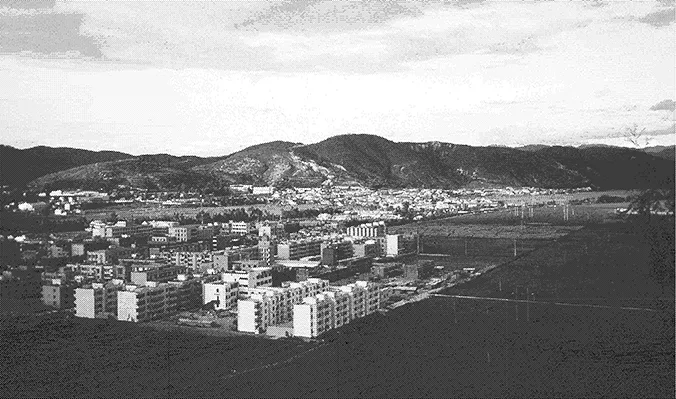
Deagriculturization of the land: Shuangjiang Town, Eshan.
Reflections on Contemporary China
But are all these changes “good for the Chinese”?—to paraphrase the old question Jews used to ask about their future when changes were afoot. Has the society which has captured half the investment going to the developing world (Mufson 1995b) made use of that economic growth to improve people’s lives? A very important question, this, for much of the globe’s economic strategy has aimed at “developing” the poorer countries of the globe through foreign investment, globalization, and marketization. Does China’s robust economy serve as a sterling example of how economic growth leads to development—the bettering of people’s lives—or does it show convincingly the opposite, that despite ever rising production curves, GVIO trends, and other statistical signs of health, growth without development is also possible?
The question is fundamental, too, because more than a billion people are living with its results. The whole reform effort, after all, was launched in the early 1980s to jump-start a stalled Chinese revolution’s promise of ever more advances on the road to a Communist-inspired prosperity. Although living standards for the overwhelming majority of Chinese people had been raised substantially in the first decade or so after the end of the Civil War in 1949 and 1950, years of disastrous political campaigns and natural calamities had brought economic growth—and development—to a halt. Between 1957 and 1976, “the mass of Chinese experienced little material improvement in their lives” (Mittelman and Pasha 1997:172). Once the revolutionary icon and authoritarian leader Mao Zedong had passed from the scene in 1976, policy pragmatists, led by Deng Xiaoping, took command of the state and pursued various heterodox avenues in pursuit of economic growth and the emergence of a stable and strong Chinese nation.
This book looks at the growth of TVEs, labor mobility, and the other aspects of rural urbanization—of townization, actually—to investigate the connection between economic growth and development in contemporary China. Based on fieldwork conducted with Chinese colleagues in Yunnan, Hunan, Fujian, and Guangdong (see Figure 1.1) beginning in 1992 and supplemented by follow-up visits and discussions with those colleagues and others, what follows is an investigation of the changes which are affecting peoples’ lives. The political changes at the village level, the swelling flows of capital, data, goods, and people, the new ways of thinking and behaving, and a significant surge in social inequalities are all topics for discussion as we mull over the implications of growth for the daily welfare. With innate faith in neither the “magic of the marketplace” nor the wisdom of the Chinese governmental and Party1 leadership, “Townizing China” takes a hard look at some of the changes sweeping through 1990s China.
On Binational Collaboration
Working with Chinese colleagues meant that we worked to blend our differing national academic styles. The holy grail of Western anthropological fieldwork, the year of immersion within one village or field site, yielded to the common contemporary Chinese practice of multiple short-term visits to a number of villages or field sites. Depth yielded to breadth, as we were able to conceive of patterns of social changes affecting districts, regions, and provinces, while relying on the familiarity of the “native anthropologists’” ready rapport and cultural sensitivity to compensate for the lack of time depth in each particular location. Our multiple identities, as country nationals, as social scientists, as friends, were all invoked during our interactions both in the “field” and “back home” in our university bases.
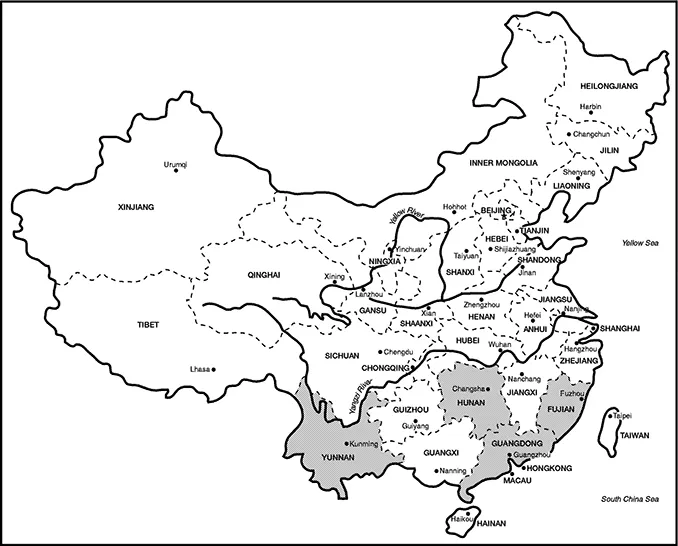
FIGURE 1.1 Map of China—Fieldwork Provinces
Narayan (1993:676–677) perceptively critiques the concept of native anthropologist for its colonialist flavor of a hierarchically privileged central core versus a marginal periphery. However, in China, the power equation between foreign anthropologists and the domestic variety may be more equal structurally than elsewhere and may help to obviate the problems of unbalanced collegial ties. A strong and often suspicious national, regional, and local bureaucracy places many binders on the foreigner who would like to do as he or she pleases. Those who bump up against the bureaucracy rather than working with it find their China research much more troubled than those who follow their Chinese colleagues’ examples in guanxi2 manipulation according to Chinese cultural rules (and who soft-pedal or avoid politically sensitive topics).
The false dichotomy between anthropologist and native anthropologist to which Narayan refers also relates to the influence that anthropologists and other social scientists have had on shaping the way that Chinese have looked at their own society. Myron Cohen a few years ago (1993:156—157) pointed out that Western assumptions that there is a fundamental and deep opposition between the city-dweller and the farmer, based on Westerners’ readings of their own European history, have “played a role in the Chinese concept of the peasant.” The term nongmin, usually glossed as “peasant” entered Chinese as a “modern” word, as many new Chinese words did in the early twentieth century, from the Japanese (Cohen 1993:155). This new term carried with it “modernizers”’ contempt for the culturally “backward” and unsophisticated farmer “traditionalists”—whether in Meiji-era Japan, Warlord-era China, or the industrializing West. Western and Chinese intellectuals have united in casting a negative light on the “peasants” of their societies; avoiding such biased terminology,3 this volume quickly abandons the “peasants” in its title and dubs agriculturists as simply “farmers.” Perhaps, too, as some suggest (Kearney 2000; Nelson 1997:382), “peasants,” real peasants as embodiments of classic feudal systems, have been gone from the face of the earth for at least 200 years.
Other terms also bedevil the researcher and serious student of China, none more confusing than a term at the heart of this volume, “urbanized.” Even China’s official census has different, conflicting definitions of “urban.” This leads the reader of such documents to choose between interpretations. We find, for instance, that the 1990 census, following administrative designations, labels Guangdong Province as 100 percent urbanized since the province is now bureaucratically divided into various “city” (shi) regions or municipality zones. Yet, the same census contained an alternative reading, based on household registration, which yielded provincial urbanization rates of 12 percent in 1953, 18.3 percent in 1964, 19.3 percent in 1982, and 36.8 percent in 1990 (Guangdong 1991). Yet, as we will see in the following chapters and particularly in the one on population and household registration, even this latter figure is unreliable as the interaction and flow between ...
Table of contents
- Cover
- Half Title
- Title Page
- Copyright Page
- Dedication Page
- Contents
- List of Illustrations
- Acknowledgments
- Part 1 Townizing Southern China
- Part 2 Village Becoming Town
- Part 3 Townizing Life
- Part 4 Problems Amidst Plenty
- Glossary
- References
- Index
Trusted by 375,005 students
Access to over 1.5 million titles for a fair monthly price.
Study more efficiently using our study tools.
Frequently asked questions
Yes, you can cancel anytime from the Subscription tab in your account settings on the Perlego website. Your subscription will stay active until the end of your current billing period. Learn how to cancel your subscription
No, books cannot be downloaded as external files, such as PDFs, for use outside of Perlego. However, you can download books within the Perlego app for offline reading on mobile or tablet. Learn how to download books offline
Perlego offers two plans: Essential and Complete
- Essential is ideal for learners and professionals who enjoy exploring a wide range of subjects. Access the Essential Library with 800,000+ trusted titles and best-sellers across business, personal growth, and the humanities. Includes unlimited reading time and Standard Read Aloud voice.
- Complete: Perfect for advanced learners and researchers needing full, unrestricted access. Unlock 1.5M+ books across hundreds of subjects, including academic and specialized titles. The Complete Plan also includes advanced features like Premium Read Aloud and Research Assistant.
We are an online textbook subscription service, where you can get access to an entire online library for less than the price of a single book per month. With over 1.5 million books across 990+ topics, we’ve got you covered! Learn about our mission
Look out for the read-aloud symbol on your next book to see if you can listen to it. The read-aloud tool reads text aloud for you, highlighting the text as it is being read. You can pause it, speed it up and slow it down. Learn more about Read Aloud
Yes! You can use the Perlego app on both iOS and Android devices to read anytime, anywhere — even offline. Perfect for commutes or when you’re on the go.
Please note we cannot support devices running on iOS 13 and Android 7 or earlier. Learn more about using the app
Please note we cannot support devices running on iOS 13 and Android 7 or earlier. Learn more about using the app
Yes, you can access What's A Peasant To Do? Village Becoming Town In Southern China by Greg Guldin in PDF and/or ePUB format, as well as other popular books in Social Sciences & Asian Politics. We have over 1.5 million books available in our catalogue for you to explore.