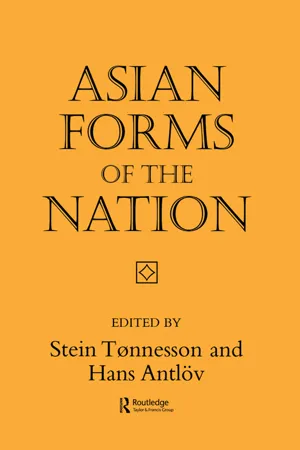
The general tendency among theorists in nationalism and national identity has been to assume that the modernization process in Asia and Africa is a kind of distorted reflection of a Western precedent; Asian forms of the nation have rarely been seen as independent, alternative models. Among today's leading theoreticians, there is a growing tendency to take Asia seriously, and to include Asian examples in the general discussion. The aim of the present collection is to build on and reinforce this tendency. It does not postulate any specifically Asian form of the nation, as opposed to a Western one. Rather, it seeks to demonstrate that in Asia, as well as in Europe, each nation forms a unique amalgam which can be compared fruitfully with others. History, culture and geography have posed various kinds of limits to what can be imagined (as Benedict Anderson puts it). The relationship between geographical space and national construction is explored in depth here.
- 368 pages
- English
- ePUB (mobile friendly)
- Available on iOS & Android
eBook - ePub
Asian Forms of the Nation
About this book
Information
CHAPTER ONE
Asia in Theories of Nationalism and National Identity
There have been five main variants of nationalism, states a recent study, defining the ‘five roads to modernity’ as the English, French, Russian, German and American. They ‘set the examples followed by the rest of the planet’.1 The inclination of many scholars has been to assume that the formation of nations in Asia and Africa, sometimes even in the pioneering Latin America, has been a distorted reflection of the European precedents. Over the last ten to fifteen years, however, the scholarship on nationalism and national identity has gone through a process of sophistication and globalization. The national phenomenon outside Europe is being studied more intensely than before, and non-European scholars are taking up positions in the theoretical debate.2 It has become more common to discover the particular forms that nations have taken in Africa, America and Asia, and compare them to the several European varieties. The purpose of the present book is to make this into a lasting trend and ensure that Asia becomes unavoidable in the general debate. The chapters are built on papers from a workshop on ‘Comparative Approaches to National Identity in Asia’, held at the Nordic Institute of Asian Studies in May 1994, with Benedict Anderson as keynote speaker. This first chapter has been written subsequently and is meant to serve as an introduction.
Asia, we contend, has its own national forms, which are no mere reflections of European or American models. We shall not argue that there is something specifically Asian about these forms but that each Asian nation, just like the European and American ones, has its own individual character that is not exactly identical to any other but which may still be fruitfully compared with others. It is true that nationalism emerged in eighteenth-and nineteenth-century Western Europe and in the Americas. It was here that the principle of national sovereignty first developed, with its emphasis on representative institutions, a centralized administration, fixed borders, popular identification with the state through education, national festivals, compulsory military service and a public jurisdiction. These general features characterize the universally applicable principle of the ‘nation-state’, a principle which did indeed spread from Europe to the rest of the planet. Stateless societies, tributary political hierarchies and monarchic states have all but disappeared from the globe. In order to be successful in the new global marketplace, it is important for a state to develop and maintain a collective ‘we-feeling’ among its citizens, and a sense that the state belongs to them. If the citizens do not identify with the state, its authority may erode, and territories with little effective authority cannot attract investments and generate growth. The irony of the world today is that globalization undermines the sovereignty of each individual state while at the same time making it increasingly important for a state, in order to be competitive in the global market, to obtain the strong dedication from its citizens that sovereign nation-states have been particularly apt at achieving. We define the term ‘nation-state’ broadly as a state which the great majority of the citizens identify with to the extent of seeing it as their own, and we see ‘nationalism’ as an ideological movement for attaining or maintaining a nation-state. 3 What, then, is a ‘nation’? This is the most difficult question, and one that has already been answered in many different ways. We shall abstain from offering another definition here, and just quote two influential ones below.
Why should we be particularly interested in Asian forms of the nation? Apart from a normative obligation to overcome eurocentrism, and the obvious need of Asians – and Asianists – to study nationalism in ‘their’ part of the world, there are also two more scholarly reasons. First, existing theory needs to be tested against non-European cases. If a theory cannot explain the Asian evidence, then it is not globally applicable. By examining Asian cases, it may be possible to test the explanatory range of theories established from Europe. A preparatory step in this direction will be to examine how some of the most sophisticated established theoreticians have tried to incorporate Asia in their theoretical frameworks. A further step will be to single out some of the most salient controversies within existing theory and see to what extent Asian cases sustain one or the other view.
Second, from an inductive perspective, we may consider some basic features distinguishing Asia from Europe, and see if these features can engender fruitful questions leading to new theoretical insights. In this way we may be able to formulate new theory that can also inform the study of nationalism in Africa, the Americas and Europe.
Asia in Three Important Theories
Since the 1970s a number of fine scholars have launched innovative theories about how national identities are formed in various kinds of interplay between politics, historical memory and cultural construction. These are theories that go beyond political philosophy and treat nationalism as a social phenomenon, in much the same way as with religions.4 From the many authors we have selected three for special scrutiny, all of whom have adopted a global approach: Ernest Gellner, Benedict Anderson and Anthony D. Smith. Our purpose is to examine the implications of their theories for the understanding of nationalism and national identity in Asia.
The foundation of Ernest Gellner’s argument, as presented in his Nations and Nationalism (1983), is a distinction between the agrarian and industrial stages of human history. He denies the existence of nationalism in agrarian societies, situates the nationalist phenomenon primarily in the early stages of industrialization, and believes that it may fade away in more ‘mature, homogeneous’ industrial societies. In agrarian societies there was always a cultural gulf between the rulers and the ruled. High (literary) and low (non-literary) cultures existed simultaneously, with the high cultures being normally larger than any individual state, and the low cultures generally much smaller: almost everything in an agrarian society thus ‘militates against the definition of political units in terms of cultural boundaries’.5 Industrial society, by contrast, requires a homogeneous system of education that merges high and low culture, either by imposing the high culture on the population or by upgrading a low culture to a high culture. It is during this homogenization process that nationalism is generated. Gellner suggests a typology of nationalisms built on a model combining three inputs: distribution of power, access to education, and ethnic (low cultural) division. In agrarian societies only the powerful have access to education, thus ethnic division does not present a problem. But when the cultural homogenization required by industry sets in, uneven access to power and education between groups that lend themselves to ethnic demarcation creates a problem. This, in turn, gives rise to nationalism and determines its form. If some groups have little access to both power and education, they will form their own nationalisms in opposition to their rulers. This is Gellner’s first model, called ‘Habsburg’ or ‘Balkan’, which he finds has been emulated in twentieth-century Africa south of the Sahara. If the powerless get access to education and are able to coalesce into an ethnic majority within a culturally divided society, one gets the ‘classical liberal Western nationalism’ of the Italian or German kind (no non-European example is mentioned). If the powerless are better educated than the powerful, but represent a minority without a specific homeland, one gets Gellner’s third type, ‘diaspora nationalism’ of the Jewish (and overseas Chinese and Indian) kind.
Is this model applicable to Asia? Gellner’s thinking is built mainly on the experience of the Christian and Islamic civilizations, but he draws other parts of Asia into his discussion. Asia figures prominently in the chapter where he demonstrates how agrarian societies preclude nationalism. One of his low-culture examples is the Himalayan peasant, who can move freely between caste, clan and village identities but can never assume a national one.6 This example is discussed in Chapter 8 of this volume by Graham E. Clarke, who explains the continuing resilience of non-national identities in Himalaya by topographical obstacles to inter-valley communication. The Himalayan peasant may not, perhaps, be all that typical of pre-modern societies, but Gellner also tries to demonstrate the non-national character of Asian high cultures: the Islamic, the Hindu and the Confucian. In passing he concedes, however, that at least two of them form partial exceptions to his rule. Islamic culture is an exception because the distinction between high and low culture was already blurred at the agrarian stage: Islamic society was therefore ‘ideally prepared’ for the merger ‘required’ in the age of industry. Confucian high culture was also an exception because it was so closely linked to one individual state; it thus anticipated ‘in that way, but that way only’ the modern linkage of state and culture.7 The pre-nationalist linkage between state and culture in China forms the point of departure for Torbjörn Lodén in Chapter 10 where he discusses whether the Chinese are finally about to liberate themselves from an age-old quest for political unity.
When Gellner leaves the agrarian societies, and explains how high and low cultures merge during the transition to industrial society, only one of the major high cultures, the Islamic, remains distinctly in focus. Gellner develops the point of how ‘unique’ this culture has been in allowing for a swift merger between high and low culture. Islam has thus lent itself easily to be used as an idiom for modern national identities, at least in those nations which are differentiated by Islam, or a variant of Islam, from other nations. Gellner’s view here is markedly different from the general assumption that Islam has hampered the development of nationalism by offering a wider, alternative framework of identity.
One weakness of Gellner’s book is his lack of precision as to when the transition from agrarian to industrial society occurred in the various parts of the world. His readers may be left with the assumption that twentieth-century African and Asian nationalism is a kind of delayed repetition of what happened in Europe when it was industrialized. Researchers working from such an assumption might look for Asian Balkans, Germanies and Jews, with little prospect of improving their understanding of either Asia or the nationalist phenomenon. But Gellner has virtually nothing to say about industry, or the needs of economic enterprise, as such. His chapter on ‘industrial society’ deals almost uniquely with culture. He simply assumes that educational – and hence cultural – homogenization reflect industrial need. Gellner seems, implicitly, to define industrial society as a society with a standardized system of education.8 This identification of industry and school prevents him from taking into account the homogenizing capacity of standardized systems of education in pre-industrial China, Korea, Japan and Vietnam; it also prevents him from taking full account of how Western-style teaching in (non-industrialized) European colonies influenced local nationalism. Despite these weaknesses Gellner’s theory may still inspire fruitful questions concerning the friction between the Islamic community as a whole and each Islamic nation, and also concerning some of the current cultural processes of educational standardization in the industrializing countries of Pacific Asia. Perhaps the main point we can learn from Gellner is the crucial role that ethnic inequalities in access to education have had in determining the form of each nationalism, hence nation.9 The applicability of Gellner’s theory to Asian cases, however, is limited by his lack of appreciation for the way in which the international state system has compelled societies everywhere, with little regard for whether or not they were industrial, to seek integration through nationhood.10 Gellner’s causal model is built on imbalances within each single (but loosely defined) industrializing society. International factors such as the role of European colonialism, or American and Soviet inspiration, are not included in his model. They are of tremendous importance in Asia.
Our second theoretician, Benedict Anderson, does much to rectify the second flaw in Gellner’s model by launching a sophisticated diffusionist theory. He deals with the spread of nationalism from the Americas and Europe and its adaption in the rest of the world. The spread of nationalism from Europe was also the preoccupation of Elie Kedourie, a leading scholar of nationalism in the 1960s, but whereas Kedourie described the contaminating influence of the nationalist idea as such, Anderson tries to track down a radical overall change of human consciousness of which nationalism is but one expression. Notably, the change of consciousness involved entirely new concepts of time and space.
In his Imagined Communities, first published in 1983 and revised and expanded in 1991, Anderson argues that the nation is a cultural construct, not in the sense of building on historical tradition but in that of being collectively imagined by all those going to the same kinds of school, viewing or listening to the same media, sharing the same mental map of the nation and its surrounding world, or visiting the same museums. There is thus nothing immanent or original about the nation: it is a construct, similar everywhere, only using different symbols, but it always considers itself as antique: it creates its own narrative, imagining itself as ‘awakening from sleep’.
Whereas Gellner (like us) has found it best to abstain from a formal definition of the term ‘nation’, Anderson defines it as ‘an imagined political community – and imagined as both inherently limited and sovereign.’ 11 He uses the word ‘imagine’ as almost synonymous with ‘see’ or ‘visualize’, and does not imply a ‘false consciousness’. That a community is ‘imagined’ does not mean it is ‘imaginary’. All communities larger than villages (where people meet face-to-face are imagined. In pre-nationalist societies there were two main larger cultural systems: the religious community and the dynastic realm. The religious communities were not territorial but were held together by sacred languages, and the dynastic realm was linked to a dynasty, not to an ethnic group or nation. The prevailing concepts of time and space were concrete, complex and rooted in nature, and built around sacred or dynastic centres. At this juncture new and far more rigid concepts of time and space were disseminated. The idea emerged that history is a chain of causes and effects, and peoples got histories attached to a designated homeland. A new consciousness linking an abstract, empty, homogeneous and chronological time to the fate of a people living within a rigidly demarcated, mapped geographical space, was spread through print capitalism: book publishing and newspapers. Where Gellner’s focus was on education, that of Anderson is on the media.
Like Gellner, Anderson offers three, but different, types of nationalism: creole, linguistic (or vernacular) and official. In his view, these were the three models shaped in America and Europe, and which became available to people in other places from about the second decade of the nineteenth century. Twentieth-century nationalism in Asia and Africa – ‘the last wave’ in Anderson’s pre-Gorbachev terminology – could draw on more than a century of human experience and three earlier models of nationalism.12 Notice how his terminology ‘activates’ those at the receiving end: models become ‘available’ and the Asians and Africans ‘draw on’ earlier models. Sometimes he uses the verb ‘pirate’. The emulators do not necessarily copy only one model but can draw on lessons from all of them to create their own blend.
When revising Imagined Communities in 1991, Anderson regretted that he had overestimat...
Table of contents
- Cover
- Half Title
- Title Page
- Copyright Page
- Contents
- CHAPTER ONE Asia in Theories of Nationalism and National Identity
- CHAPTER TWO The Frontiers of Japanese Identity
- CHAPTER THREE Maps and the Formation of the Geo-Body of Siam
- CHAPTER FOUR Annam and Vietnam in the New Indochinese Space, 1887–1945
- CHAPTER FIVE Gender and Nation in Hindu Nationalism
- CHAPTER SIX Contradictions and Ambivalence in the Hindu Nationalist Discourse in West Bengal
- CHAPTER SEVEN ‘This God-Forsaken Country’: Filipino Images of the Nation
- CHAPTER EIGHT Blood, Territory and National Identity in Himalayan States
- CHAPTER NINE The Karen Making of a Nation
- CHAPTER TEN Nationalism Transcending the State: Changing Conceptions of Chinese Identity
- CHAPTER ELEVEN The Construction of the Post-Colonial Subject in Malaysia
- CHAPTER TWELVE Nations-of-Intent in Malaysia
- SELECT BIBLIOGRAPHY
- INDEX
- LIST OF CONTRIBUTORS
Trusted by 375,005 students
Access to over 1.5 million titles for a fair monthly price.
Study more efficiently using our study tools.
Frequently asked questions
Yes, you can cancel anytime from the Subscription tab in your account settings on the Perlego website. Your subscription will stay active until the end of your current billing period. Learn how to cancel your subscription
No, books cannot be downloaded as external files, such as PDFs, for use outside of Perlego. However, you can download books within the Perlego app for offline reading on mobile or tablet. Learn how to download books offline
Perlego offers two plans: Essential and Complete
- Essential is ideal for learners and professionals who enjoy exploring a wide range of subjects. Access the Essential Library with 800,000+ trusted titles and best-sellers across business, personal growth, and the humanities. Includes unlimited reading time and Standard Read Aloud voice.
- Complete: Perfect for advanced learners and researchers needing full, unrestricted access. Unlock 1.5M+ books across hundreds of subjects, including academic and specialized titles. The Complete Plan also includes advanced features like Premium Read Aloud and Research Assistant.
We are an online textbook subscription service, where you can get access to an entire online library for less than the price of a single book per month. With over 1.5 million books across 990+ topics, we’ve got you covered! Learn about our mission
Look out for the read-aloud symbol on your next book to see if you can listen to it. The read-aloud tool reads text aloud for you, highlighting the text as it is being read. You can pause it, speed it up and slow it down. Learn more about Read Aloud
Yes! You can use the Perlego app on both iOS and Android devices to read anytime, anywhere — even offline. Perfect for commutes or when you’re on the go.
Please note we cannot support devices running on iOS 13 and Android 7 or earlier. Learn more about using the app
Please note we cannot support devices running on iOS 13 and Android 7 or earlier. Learn more about using the app
Yes, you can access Asian Forms of the Nation by Stein Tonnesson, Hans Antlov, Stein Tonnesson,Hans Antlov in PDF and/or ePUB format, as well as other popular books in Politics & International Relations & Asian Politics. We have over 1.5 million books available in our catalogue for you to explore.