- 208 pages
- English
- ePUB (mobile friendly)
- Available on iOS & Android
eBook - ePub
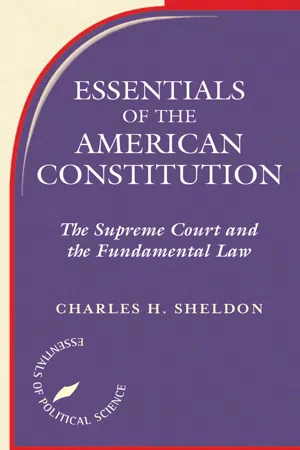
Essentials Of The American Constitution
About this book
Constitutional politics is the continuing search for equilibrium between the grants of power and the limits placed on that power. The Essentials of the American Constitution examines the five closely integrated components which make up the fundamental law: the Compact, separation of powers, federalism, representation, and the Bill of Rights. It is the interaction between these components that gives the Constitution its dynamism. Landmark decisions handed down by the U.S. Supreme Court involve two or more of these components. This book's unique approach shows how the components more often than not work together, one assisting another, one explaining another, or one reinforcing another. It gives a firm foundation for students wishing to take advanced courses in constitutional law or civil liberties and provides an overall view of the fundamental principle of the American Constitution.
1
Introduction
In his attempt to find reality and establish purpose, man seeks a sense of harmony, a sense which accords meaning and limits to existence. Pursuit of the harmonious, conscious or not, is pervasive, dominating serious human concerns.… Man orders his existence according to harmony discovered, the absence of total symmetry propelling him forward in quest of that not yet found. Within himself, man seeks stasis; in his art, proportion; in his science, equilibrium; in his mathematics, elegance; in his thought, symmetry; in his politics, balance.
* * *
He who finds balance seeks to preserve it; those who discover imbalance strive to transform the present condition.
—P. N. Goldstene, 19771
The human dynamic underlying the evolution of the U.S. Constitution is simply enough stated—the political struggle for balance.
The Constitution Defined
Edward S. Corwin, the dean of constitutional scholars, has viewed the American fundamental law as representing a balance between the Constitution as an instrument and the Constitution as a symbol. As instrument of governance, the Constitution defines governmental structures, designates who will carry on the public’s business, endows these officials with specific powers, and sets broadly defined collective goals. As symbol, the Constitution takes on an aura of sanctity and is thereby clothed in authority and legitimacy. Such an aura compels public observance and private respect. Ideally, there is little need to sanction public officials and for them to suffer critical attention from those outside government. According to Corwin:
The constitutional instrument exists to energize and canalize public power, [and] it is the function of the constitutional symbol to protect and tranquilize private interest or advantage against public power, which is envisaged as inherently suspect, however necessary it may be.2
The Constitution as instrument sets goals and provides the wherewithal to achieve those goals, however broadly defined. Thus, the Constitution looks to the future. “Things need to be done,” and humans are able to “shape things and events” through the instrument. From this perspective, the Constitution is “an instrument of popular power—sovereignty… for the achievement of progress.”3 The fundamental law, then, entails a conditional grant of power. If we were to look for indications of the Constitution as instrument, we would be wise to turn to the Preamble:
We the People of the United States, in Order to form a more perfect Union, establish Justice, ensure domestic Tranquility, provide for the common defence, promote the general Welfare, and secure the Blessings of Liberty to ourselves and our Posterity, do ordain and establish this Constitution for the United States of America.
The pursuit of these high-sounding goals requires the assignment of specific responsibilities such as those found in Article 1, section 8, which begins, “The Congress shall have Power” or Article 2, section 2: “The President shall be Commander in Chief” or Article 3, section 1: “The judicial Power of the United States, shall be vested in one supreme Court.”
The grant of instrumental power is never made without conditions. Specific limits are placed on provisions of the instrument to guard against abuses, reflecting the inherent distrust of power endemic to the American culture. For example, the First Amendment dictates that “Congress shall make no law” and the Fourteenth Amendment states that “[n]o state shall.”
Of course more is involved than merely stating the limits of power. Provisions of the instrument of power are narrowly delineated and are dispersed throughout the Constitution. This provides a means of achieving internal harmony or balance whereby power checks power. For example, Article 2, section 2, reads in part: The president “shall have Power, by and with the Advice and Consent of the Senate, to make Treaties, provided two-thirds of the Senators… concur,” and it further declares that the “President shall be Commander in Chief of the Army.” However, the commander is checked by what is given to him or her to command. Article 1, section 8, declares that Congress shall have power “[t]o raise and support Armies.”
Intentionally, only those powers assigned could be exercised by any particular branch. Because of the Constitution’s function as symbol, only occasionally is it necessary for those directly responsible for the instruments of power consciously to check themselves. Nonetheless, the Constitution in most respects provides an ideal and stable standard to which real governmental conduct can be compared.
As symbol, the Constitution is endowed with a fundamental character analogous to a constitutional “Ten Commandments.” Consequently, it is viewed as worthy of obedience and provides a decidedly moralistic but usually effective check on the instrument of power. Those responsible for carrying out the public’s business are constrained from exceeding their power. They feel compelled to observe the limits placed on what power their positions permit because of the basic or fundamental character attributed to the Constitution.
The Constitution is fundamental as a result of one symbolic and one actual incident. First, those responsible for endowing the Constitution with authority are those who ultimately are sovereign—namely, the people. Second, the Constitution’s legitimacy is accomplished by requiring an extraordinary and burdensome process to give it effect. The process must be more arduous than what is involved in ordinary legislation. Both fundamental endowments are articulated by Chief Justice John Marshall in Marbury v. Madison* (1803), where he said that the writing and ratifying of the Constitution were accomplished after “a very great exertion” and “the principles … so established are deemed fundamental” and “the authority from which they proceed is supreme.”4
The authority is announced in the Preamble to the Constitution, which begins with “We the people” and ends with “do ordain and establish this Constitution for the United States of America.” That authority is further confirmed in Article 5 of the Constitution. In order to amend the basic law, which is akin to the original task of drafting and approving the document, a formidable gauntlet must be overcome.
The Congress, whenever two-thirds of both Houses shall deem it necessary, shall propose Amendments to this Constitution, or, on the Application of the Legislatures of two-thirds of the several States, shall call a Convention for proposing Amendments, which, in either Case, shall be valid to all Intents and Purposes, as Part of this Constitution, when ratified by the Legislatures of three-fourths of the several States, or by Conventions in three-fourths thereof.
To accomplish the sanctity necessary to gain trust and to compel obedience, the Constitution as symbol looks to the past. Concepts which had “long antedated the rise of science,” and had resulted from the struggle to bring some dignity, “security and significance” to the human existence are said to be embodied in provisions of the Constitution. Because these concepts are universal aspirations based on a higher or natural law, they create objects worthy of obedience, limiting what those in power are rightfully able to do. For example, the symbolic nature of the Bill of Rights is evident as it does not grant rights but rather guarantees already existing rights. The Ninth Amendment exemplifies the symbolic significance of the Constitution: “The enumeration in the Constitution, of certain rights, shall not be construed to deny or disparage others retained by the people.”
The Constitution as instrument permits government to work toward the lofty goals enumerated in the Preamble. It is government in action, but within limits. The Constitution as symbol attaches fundamental and “higher law” significance to the organic law, assuring its worth and providing checks on the mundane day-to-day enactments and actions of public officials.5
The U.S. Constitution is written to make the details of the Constitution as instrument available to delineate governmental powers and to proclaim the principles of the Constitution as symbol. Again, the words of Chief Justice John Marshall recorded in Marbury v. Madison are instructive:
The powers of the legislature are defined and limited; and that these limits may not be mistaken, or not forgotten, the constitution is written. To what purpose are powers limited, and what purpose is that limitation committed to writing, if these limits may, at any time, be passed by those intended to be restrained?”6
Should restraints fail or necessary power be unexercised over an extended period of time, an imbalance is experienced and constitutional harmony is lost. The grants of power must not overwhelm the limits, for, given the nature of humans, the power will certainly be used for selfish and destructive ends. However, the limits must not be so narrow as to prevent the government from achieving the goals that necessitated the Constitution in the first place. The harmony between symbol and instrument is evident when government is acting within written confines, with authority and toward common goals.
The Necessity of a Constitution
Why are constitutions necessary? The necessity follows from certain assumptions about human nature accepted by eighteenth-century political thinkers and by the delegates to the Philadelphia Convention in 1787. By nature, humans possess both reason and passion. When possessed of power, humans have a tendency to revert to passions and abuse that power. The American radicals of the middle and late 1700s had a “paranoiac mistrust of power.” As Gordon Wood puts it, “Every accumulation of political power, however tiny and piecemeal, was seen as frighteningly tyrannical, viewed as some sinister plot to upset the delicately maintained relationships of power and esteem.”7
On the other hand, humans have, under certain conditions, the ability to exercise reason and to override their passions. The Constitution is designed to check the appetite for power among officials and to create the conditions for reason to prevail. Of course, not just any design will accomplish the goal.
The Constitution as a Machine
Eighteenth-century conceptions of political science entailed seeking to apply the laws of Newtonian physics to the concerns of humans. Consequently, the science of constitution-making required that the results should resemble an internally consistent, well-oiled, and functioning machine. The Founders believed that “the actions and affairs of men are subject to as regular and uniform laws, as other events [and that] the laws of Mechanics apply in Politics as well as in Philosophy.”8 Thus, a naturally balanced system was the goal sought by those who wrote the document over 200 years ago. The Constitution was envisaged as a mechanism in which each part contributed to the successful functioning of the whole. A breakdown within the system, or a change in the power or function of one part or structure, would change that of another and require an adjustment to regain a delicate balance or harmony needed for a smoothly working constitutional machine. However, not all would agree on the diagnosis or cure for a malfunction of the constitutional machine, leading to politics that are aimed at transforming or preserving the fundamental law or its applications.
Components of the Constitutional Mechanism
The components of the Constitution as an instrument through which the needs of unity, justice, tranquillity, defense, welfare, and liberty are to be met are separation of powers and federalism. Both institutional arrangements involve the exercise of power to achieve specific ends. The components of the Constitution as symbol, those that provide constitutional sanctity and authority, are the compact and the Bill of Rights. The component of representation bridges the instrument and the symbol aspects of the U.S. Constitution.
Within each of the components are built-in redundancies. For example, in federalism both state and national governments are responsible for governmental action. The Tenth Amendment recognizes the division of powers among the governmental units in these words: “The powers not delegated to the United States by the Constitution, nor prohibited by it to the States, are reserved to the States respectively, or to the people.” When power remains balanced as delineated in the Tenth Amendment, this constitutional component functions as the Founders hoped. However, the history of the politics of American federalism reflects an unremitting and unresolved struggle for power between the national government and states—or among the several states.
The separation of powers mechanism disperses governmental responsibilities among the three branches of government. As with federalism, competition for power among the three branches is inherent in political life as occupants of al...
Table of contents
- Cover
- Half Title
- Title
- Copyright
- Contents
- Author’s Preface
- Editor’s Preface
- 1 Introduction
- 2 The Politics of Judicial Review: Accountability Versus Independence
- 3 The Compact: “We the People do ordain and establish this Constitution for the United States of America”
- 4 Separation of Powers: Exclusive of Mixed?
- 5 Federalism: The Constitutional Division of Power
- 6 Representation
- 7 The Bill of Rights: What Belongs to the Individual and What Belongs to Society?
- 8 The Holistic Constitution
- The Constitution of the United States
- Table of Supreme Court Cases
- Index
Trusted by 375,005 students
Access to over 1.5 million titles for a fair monthly price.
Study more efficiently using our study tools.
Frequently asked questions
Yes, you can cancel anytime from the Subscription tab in your account settings on the Perlego website. Your subscription will stay active until the end of your current billing period. Learn how to cancel your subscription
No, books cannot be downloaded as external files, such as PDFs, for use outside of Perlego. However, you can download books within the Perlego app for offline reading on mobile or tablet. Learn how to download books offline
Perlego offers two plans: Essential and Complete
- Essential is ideal for learners and professionals who enjoy exploring a wide range of subjects. Access the Essential Library with 800,000+ trusted titles and best-sellers across business, personal growth, and the humanities. Includes unlimited reading time and Standard Read Aloud voice.
- Complete: Perfect for advanced learners and researchers needing full, unrestricted access. Unlock 1.5M+ books across hundreds of subjects, including academic and specialized titles. The Complete Plan also includes advanced features like Premium Read Aloud and Research Assistant.
We are an online textbook subscription service, where you can get access to an entire online library for less than the price of a single book per month. With over 1.5 million books across 990+ topics, we’ve got you covered! Learn about our mission
Look out for the read-aloud symbol on your next book to see if you can listen to it. The read-aloud tool reads text aloud for you, highlighting the text as it is being read. You can pause it, speed it up and slow it down. Learn more about Read Aloud
Yes! You can use the Perlego app on both iOS and Android devices to read anytime, anywhere — even offline. Perfect for commutes or when you’re on the go.
Please note we cannot support devices running on iOS 13 and Android 7 or earlier. Learn more about using the app
Please note we cannot support devices running on iOS 13 and Android 7 or earlier. Learn more about using the app
Yes, you can access Essentials Of The American Constitution by Stephen L Wasby,Charles H. Sheldon in PDF and/or ePUB format, as well as other popular books in Law & Civil Rights in Law. We have over 1.5 million books available in our catalogue for you to explore.