Until recently, religious institutions have been organized to suit the traditional American family, where the wife stayed at home, caring for children. Today, churches and synagogues are beginning to adapt to the reality of the American family: dual-career marriages, high levels of divorce, interfaith marriages, partnerships that may not be marriages. Religious organizations must serve families that don't fall into the Ozzie and Harriet mold.
The first group of papers in this edited volume documents changing trends in the connection between religion, work, and the family. In the second part of the book, we see how changing families and flexible congregations are experimenting with new forms of religious life.
eBook - ePub
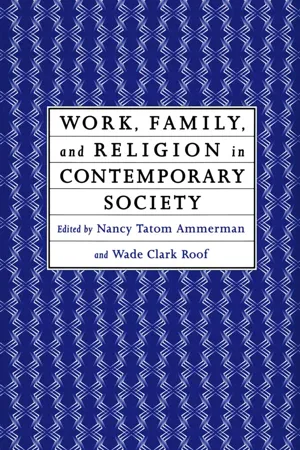
Work, Family and Religion in Contemporary Society
Remaking Our Lives
- 370 pages
- English
- ePUB (mobile friendly)
- Available on iOS & Android
eBook - ePub
Work, Family and Religion in Contemporary Society
Remaking Our Lives
About this book
Information
1
Introduction
Old Patterns, New Trends, Fragile Experiments
Nancy Tatom Ammerman and Wade Clark Roof
One of the promising developments of the early 1990s is the mounting chorus of voices in support of family issues—concerns such as child care, working parents, parental leave, and support services for families. This new consciousness about family needs has been fostered in part by high levels of divorce, domestic crisis and abuse, and teenage pregnancies, combined with a growing sense that even seemingly stable families face unprecedented difficulties. Striking evidence that a new consciousness was emerging came in 1991. A new alliance was formed, comprised of well-known liberals and New Right conservatives, who chose to overlook the issues on which they were divided in order to take a public stand on behalf of the family concerns where they were in agreement.1
This new concern for the American family is encouraging for several reasons. First, it suggests a new realism about families and their needs in the late twentieth century. While this does not mean an end to the “cultural wars,” particularly over controversial issues like abortion and homosexuality, it does signal a significant level of concern and agreement among Americans of opposing ideologies. Neither the pessimistic view that families are all falling apart nor the blind optimism that fails to see any problems is acceptable. The fact is that families, in one form or another, are central in the lives of Americans; people want to protect them. Surveys continue to show that the overwhelming majority of Americans continue to value what families can provide—love, emotional support, nurturance. Even when married people are asked if they would remarry their spouses, more than three-fourths say yes.2 The problems facing families today are real, but family life as such is not disappearing.
Second, a new image of family is emerging that is more flexible and more adaptable. Behind the new realism drawing together people of differing persuasions is a model of family that is appealing, in part, because it combines seemingly contradictory elements. Arlene Skolnick writes:
The New American Dream mixes the new cultural freedoms with many of the old wishes—marital and family happiness, economic security, home ownership, education of children. But the new dream is more demanding than the old, and even the basics—a secure job, a home, health care, education—are becoming more difficult to achieve. The new life course has more twists and turns than it did in the past; it offers greater opportunities for autonomy, but greater risks of loneliness. Further, even the middle class faces more travails than in the past: divorce, time pressures, and the dilemmas of raising children in a world that has grown more dangerous, competitive, and uncertain.3
The “new cultural freedoms” to which Skolnick refers are rooted in the experiences of the 1960s and 1970s. During those years of cultural upheaval, there were sweeping changes in marriage and family values. Women moved into the workplace, dual-career marriages became more common, and of course the sexual revolution led to changes in sexual mores, to the empowerment of women, and to new ways for men and women to relate to one another. For many, career took precedence over family, resulting in a “postponed generation” putting off marriage and children until later. Especially for a younger generation of Americans growing up at the time—the so-called baby-boomers—the new values were widely embraced. Terms like the “new morality” and “lifestyle” became a common part of the vocabulary among those for whom choice and self-expression were taken for granted. While much that is remembered about the 1960s and 1970s has long since passed, still many values from that period are now a permanent part of our culture—among others, greater tolerance of those who are different, concern for the individual, and gender equality.4 Now, in the 1990s, there is a trend away from the more extreme expressive individualism of that earlier era and toward greater attachment to family and to others. The “ethic of commitment” which Daniel Yankelovich foresaw a decade ago appears now to have come into its own—emphasizing a greater connectedness with people, institutions, places, nature.5
Why this shift today? A major reason is that many in the baby-boom generation are now rearing children—and thus are confronted with the responsibilities which come with parenthood. There is considerable awareness, too, that preoccupation with the self has its limits: genuine personal fulfillment lies in discovery of a vital balance between self and concern for others. That is, through their attachments to others and commitments to worthy causes, people find meaning and satisfaction in their own lives.
Yet as Skolnick points out, this is not a return to the old traditional values. The Ozzie and Harriet family of the 1950s is gone forever, now replaced by a wide array of many differing types of marital and parent-child arrangements, all recognized in a pluralistic society as deserving of being called “family.” It is a new era when women enjoy more freedom to choose whether to work or to stay at home as wives and mothers. Although women are still entering the labor force in greater numbers each year, the birthrate has actually begun to increase again, and child-centered values seem to be replacing adult-centered values. For increasing numbers of couples, there is shared responsibility at home and a redefinition of marriage and parenting. There appears to be a growing concern for finding fulfillment within the home and greater attention to “quality” of relationships and deeper personal values such as intimacy, warmth, and sharing.6
This new mix of values has its counterpart in the workplace. A recent book title describing today’s younger corporate executives—The New Individualists7—sums up what is happening in the workplace. Paul Leinberger and Bruce Tucker argue that the generation after the “organization man” is less conforming, and holds to a more psychologized conception of individualism—a change from a socially formed, highly internalized self to a more subjective, highly expressive self. Young executives, for example, look upon work as an opportunity to be creative, a place where they can develop their potential. Yet they also are concerned about family life, and how work and family can mesh together. They judge the merits of their work not just in terms of pay or how they “feel” about it, but also on the basis of whether it conflicts with family values. They like to “network,” because it offers a chance to cultivate social relationships—in keeping with similar values at home. Today’s corporate managers see themselves as embedded in relationships and commitments that make them who they are—and family is high on that list of relationships.
In the workplace generally, movement is toward more decentralized structures, greater participatory decision-making, the inclusion of women into leadership positions, more flexible hours and work rules, more leisure activities, facilities for physical exercise, child care and parental leaves. Family is no longer something left behind with a kiss at the door.
This does not mean, however, that women and men are now over-whelmingly in egalitarian marriages and satisfying careers. Most of the women who are in the paid labor force are in monotonous, low-wage, sometimes hazardous jobs. Many are heads of household, not providing a second paycheck. While increasing numbers of women may be working either for fulfillment or to pursue a career, that is clearly not the norm. Even when women work full-time, most still define their primary roles as wife and mother.
Their husbands often agree. Men still see home as the place where they get supported and nurtured. While they are at work, they think about family less than do women. And when they are at home, they do much less of the housework and child care than do women.8 And not surprisingly, working men are more satified with their marriage and family life than are working women. Whether the household is headed by a single man, a single woman, a two-paycheck couple, or a dual-career couple, there is still household labor to be done and the rewards of nurture and intimacy to be had. Who does what labor and who gets what reward, however, is very much up for grabs.
Whether out of “new freedoms” or out of economic necessity, the last generation has seen the balance between work and family life dramatically shifting. People have different sets of involvements, different schedules, different relationships, different resources. That shifting and complex network of activity and resources is spilling over into every other area of people’s lives. It is affecting the economy on both the employment and consumption ends—witness the appearance of “family friendliness” ratings of corporations and the growth of catalog shopping.
Likewise, the religious landscape is undergoing its own changes. The changing ethos of values and commitment and greater sense of choice that characterized family life have engulfed not just work but also religion. With this “new voluntarism” and a shifting from collective-expressive to individual-expressive values9, there is greater freedom to make religious decisions on the basis of personal preferences and needs. For some people, this new freedom leads to religious indifference and a secular outlook; for others, to “religion à la carte” and pastiche styles of belief and practice that draw from a variety of religious and spiritual resources; and for still others, it leads to a more conscious, personally responsible type of commitment to a church, synagogue or mosque.10 Greater choice need not undermine religious loyalties; it can actually enhance greater clarity of commitment.
As a result of greater choice, parishes and congregations themselves are taking on distinctive identities as they come to reflect the preferences of their members. Denominational labels may mean less in identifying a church or synagogue than the particular worship styles, programs, and mission activities created by those who have chosen it. And chief among the things that characterize congregations is the relationship they have developed with the families—of all shapes and sizes—that fill their pews. Congregations can take on a variety of family-related identities. They may become known as “traditional family” bastions, or places open to gay and lesbian persons, or supporters of women’s rights or great places for kids—or some combination thereof.
What is becoming increasingly clear is that the cultural trends we have described are influencing not just families, but the entire nexus of work, family, and religion. The links among all three institutions are in process of redefinition. To state this is not just to argue, as sociologists are prone to do, that the parts of a society are interrelated. Rather, it is to suggest that, in an age of greater choice and reorienting of self in relation to other attachments—to work, to religious community, to family—all become more fluid and adaptable.
This new context of work, family, and religion must be understood against the backdrop of broader changes that have structurally altered how these institutions relate to one another today. The old patterns have been described by cultural historians and sociologists as having divided life fairly neatly (at least for the middle class) into public and private spheres. Work, politics, and men belonged in the public sphere; home, faith, and women belonged in the private sphere.11 Functionalist sociologists like Talcott Parsons saw this division of labor as ingeneous—instrumental needs got taken care of in one place, expressive needs in another.12 For an economy and a government to run smoothly, homes and faith communities were needed to instill values in their individual worker-citizens, and to bind up the wounds of those injured by the calculations of the public arena.13 Social psychologists looked at what sorts of values were being taught by parents, and discovered that they did indeed serve the needs of the economy well. Working-class families were teaching their children to be disciplined and obedient, while middle class and professional families were encouraging autonomy and creativity.14
At least through the 1950s, churches themselves seemed to assume this social division of labor. A 1937 book called Family and Church15 exhorts pastors to help families to have healthy relationships and foster psychological well-being. It notes that work-re...
Table of contents
- Cover
- Half Title
- Title Page
- Copyright Page
- Table of Contents
- Acknowledgments
- 1 Introduction Old Patterns, New Trends, Fragile Experiments
- I Assessing the Trends
- II Exploring New Patterns
- Bibliography
- Index
- Contributors
Trusted by 375,005 students
Access to over 1.5 million titles for a fair monthly price.
Study more efficiently using our study tools.
Frequently asked questions
Yes, you can cancel anytime from the Subscription tab in your account settings on the Perlego website. Your subscription will stay active until the end of your current billing period. Learn how to cancel your subscription
No, books cannot be downloaded as external files, such as PDFs, for use outside of Perlego. However, you can download books within the Perlego app for offline reading on mobile or tablet. Learn how to download books offline
Perlego offers two plans: Essential and Complete
- Essential is ideal for learners and professionals who enjoy exploring a wide range of subjects. Access the Essential Library with 800,000+ trusted titles and best-sellers across business, personal growth, and the humanities. Includes unlimited reading time and Standard Read Aloud voice.
- Complete: Perfect for advanced learners and researchers needing full, unrestricted access. Unlock 1.5M+ books across hundreds of subjects, including academic and specialized titles. The Complete Plan also includes advanced features like Premium Read Aloud and Research Assistant.
We are an online textbook subscription service, where you can get access to an entire online library for less than the price of a single book per month. With over 1.5 million books across 990+ topics, we’ve got you covered! Learn about our mission
Look out for the read-aloud symbol on your next book to see if you can listen to it. The read-aloud tool reads text aloud for you, highlighting the text as it is being read. You can pause it, speed it up and slow it down. Learn more about Read Aloud
Yes! You can use the Perlego app on both iOS and Android devices to read anytime, anywhere — even offline. Perfect for commutes or when you’re on the go.
Please note we cannot support devices running on iOS 13 and Android 7 or earlier. Learn more about using the app
Please note we cannot support devices running on iOS 13 and Android 7 or earlier. Learn more about using the app
Yes, you can access Work, Family and Religion in Contemporary Society by Nancy Tatom Ammerman,Wade Clark Roof in PDF and/or ePUB format, as well as other popular books in Theology & Religion & Religion. We have over 1.5 million books available in our catalogue for you to explore.