- 186 pages
- English
- ePUB (mobile friendly)
- Available on iOS & Android
eBook - ePub
About this book
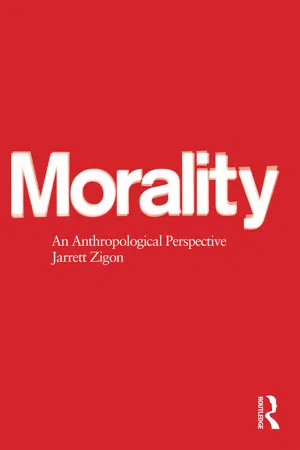
Morality: An Anthropological Perspective provides the first account of anthropological approaches to the question of morality. By considering how morality is viewed and enacted in different cultures, and how it is related to key social institutions such as religion, law, gender, sexuality and medical practice, Morality takes a closer look at some of the most central questions of the morality debates of our time. The book combines theory with practical case studies for student use. Drawing on anthropological, philosophical and general social scientific literature, the book will be useful for both undergraduate students and researchers. Accessibly written, Morality provides a unique and wide-ranging perspective on morality, and will be essential reading for those interested in this important contemporary debate.
Information
Part I
The Philosophical and Theoretical Foundations of the Anthropological Studies of Morality
-1-
The Philosophical and Theoretical Foundations of Social Scientific Studies of Morality – From Plato and Aristotle to Durkheim, Weber, and Foucault
In many ways the original question of philosophy is: what constitutes the moral sphere? Since Western philosophy’s origins in ancient Greece, morality has been a central concern of philosophers. Because philosophers have been struggling over questions such as what constitutes the moral, what is the good life, and, indeed, what is the good, for over 2,000 years, anthropologists of morality could benefit from a thorough understanding of this philosophical history. Due to limitations of space, however, this is not the place to introduce this history to anthropologists. Nevertheless, in the first section of this chapter I will provide a brief overview of the four main theories of moral philosophy. These overviews are in no way comprehensive and serve only as the most basic of introductions in order to provide a background for anthropologists who may not be familiar with these theories and their respective traditions. They also serve as a background for better understanding the context in which Durkheim and Weber’s social scientific theories of morality were created, as well as the ethical writings of Michel Foucault. I will turn to these theorists in the later sections of this chapter.
Philosophical Theories of Morality
Virtue Theory
If it is true that theories of morality reflect the sociohistorical context in which they are conceived, this is particularly so for virtue theories. To some extent this is the point of virtue theory. For unlike the other predominant moral philosophies we will discuss, virtue theory is specifically focused on individuals’ character and how this character fits best into a social context (Pence 2000: 256–7). While these theories often address the relation between virtues and society, they tend to have two major shortcomings. First, the society to which their authors tie the virtues is often an idealized or utopian society, and thus a society that does not, and indeed, most likely will never exist. Second, and perhaps closely related to the first and certainly true of all the moral philosophies we will discuss in this chapter, the authors seem to be unaware of their own sociohistorical assumptions of moral behavior and how this significantly influences their moral theories. Because of this unawareness, then, the virtues posited by these philosophers tend to be particularly esteemed virtues in their own societies, but written about as if they were only to be realized in a state of idealized social relations. It is for this reason that virtue theory must be considered with caution. For what at first glance may seem particularly appealing to anthropologists may in fact be so only because it is a reflection of our own closest held assumptions.
As its name suggests, virtue theory focuses on the description of particular virtues that are posited as characteristics of living a good life. Some of the virtues that have consistently been upheld by philosophers of this tradition are courage, temperance, wisdom, and justice. Since its beginnings in ancient Greece, virtue theory has generally claimed that these virtues become imbued in a person by two means. First, by means of rational decision-making. To act virtuously, so it is argued, is the most appropriate way to act in a given situation and this is obvious to any rationally thinking person. It is through the proper use of reason that one can act virtuously. But one is not always able to reason and think in the ethical moment. Oftentimes due to time constraints, one is unable to rationally consider the best course of action. It is for this reason that most virtue theorists argue for some kind of embodied virtuous disposition. In other words, the virtuous person is not the one who must always rationally consider the best way to act in each situation. Rather she is the person who already “knows” how to act in any situation she may encounter. This is so because she has already, through a lifetime of ethical training, acquired the virtuous dispositions that allow her to act ethically. That is, she can act virtuously because she has the embodied character of a virtuous person. Only after the fact, if need be, can she reflect on her actions and rationally know that she acted appropriately because it was the rational, that is, virtuous thing to do. In this way, then, to speak of embodied virtues is to speak of an embodied rationality.
Although virtue theory has its Western philosophical roots in the teachings of Socrates and the writings of Plato, it was Aristotle in his Nicomachean Ethics who is most closely associated with this ethical theory. Arguing against the ethical doctrine of Plato, which posited an abstract Form of the Good and Justice as the end of a virtuous life, Aristotle argued that what is virtuous can only be determined in specific situations. Because what might be considered courageous in one situation might be considered reckless or cowardice in another, individuals must exercise practical reason in order to discern the appropriate way to act in each situation. It is only after years of such discernment that one acquires the bodily dispositions of a virtuous person. For Aristotle, whether one acts virtuously in any given situation due to the use of practical reason or by means of an already acquired virtuous disposition, to act virtuously is always to act according to the mean. This is his famous doctrine of the mean. By this Aristotle meant that what counts as virtuous in any given situation
is the mean between two extremes of possible action. Thus, as already pointed out, to act courageously is to act according to the mean between recklessness and cowardice in any given situation. Again, what action constitutes this mean differs in each situation.
For centuries virtue theory fell out of favor in philosophical circles, but at the end of the twentieth century it has made a comeback. One of its main proponents is Alasdair MacIntyre. MacIntyre has taken up Aristotle’s notion of the good, which both define as “the goal, purpose, or aim to which something or somebody moves” (MacIntyre 1998[1966]: 57). While Aristotle focused on the means by which an individual could achieve the highest possible good for any human being, which he called eudaimonia often translated as happiness, MacIntyre focuses his attention on the ways in which individuals can achieve their own particular good within the context of their own lives. Because these lives are always lived within a particular community made up of even smaller groupings of peoples, MacIntyre argues that one’s life can only have meaning by means of actively participating in and cultivating the practices of these particular communities and groups. Thus, the good or the telos to be sought for each person depends upon the practices, communities, and traditions to which they belong. Therefore, the virtues that lead to the good life for a doctor are different than the virtues that lead to the good life for a plumber. Nevertheless, because each belong to the same greater community or society, they will still share some notions of which practices and how they are to be performed can help constitute the good life.
As will be seen, virtue theory is unique in the philosophical tradition in tying what counts as ethically good to a social context. As a theory, virtue theory appears promising for anthropological studies. And it is certainly true that several anthropologists have recently turned to some version of virtue theory to help explain the moral (e.g. Hirschkind 2001; Widlock 2004; Mahmood 2005). Nevertheless, the question is rarely asked if this is actually the way in which individuals either conceive of or perform their moral lives. Indeed, before so quickly adopting virtue theory for their own purposes, anthropologists need to consider if this theory adequately explains what we find in our research, or if it simply conforms to our own assumptions about the social nature of morality. As with all anthropological questions, this can only be answered through research.
Natural Law
Although often associated with Christian ethics and jurisprudence, natural law theory has its origins in the pre-Christian world of Stoic thought. Its clearest and certainly most influential proponent was the Roman lawyer Cicero. For Cicero, as with the other Stoics, the natural law unifies all being – from the lowest animals to the gods. Moreover, “since there is nothing better than reason, and it is found both in humans and in god. . . we humans must be considered to be closely allied to gods by law” (Cicero 1999: 113). The natural law, then, is manifest in human nature as reason. The natural law for humans, however, is not simply any use of reason, for reason can just as well be put toward evil ends, but true “law is right reason, consonant with nature, spread through all people” (Cicero 1999: 71). Thus, natural law theory unites all of humanity as moral beings through the right use of reason.
If Cicero is the most important Stoic natural lawyer, then certainly St. Thomas Aquinas had the most influence on natural law theory in general. By combining Christian theology with the Roman legal tradition – particularly the natural law tradition of the Stoics – and the philosophy of Aristotle, Aquinas provided a philosophical foundation for natural law theory. The result was not only the foundations of a rationalized Christian ethics, but also the basis for the eventual secularization of the natural law tradition. I will here briefly outline the main principles of Aquinas’s theory.
According to Aquinas there are four manifestations of law. These four laws are, as is consistent with Aquinas’s more general theory, unified and interrelated. For it is the eternal law of God that orders and is imprinted upon all of being, and therefore, is the principle law of all creation. Human beings as rational creatures “are under divine providence in a more excellent way than the others since by providing for themselves and others they share in the action of providence themselves” (Aquinas 1988: 46). This rational participation in the eternal law is what Aquinas calls the natural law. For Aquinas, though, this rational participation is limited by human nature. Therefore, the natural law is the eternal law to the extent that it is within the nature of humans to participate in it. The third kind of law is in turn derived from the natural law – this is human law. Human laws are those laws which accord with natural law and are created to govern human communities. Any law that is not arrived at by right reason and does not accord with the natural law is not human law but a corruption of law. Lastly there is divine law. Divine law is necessary because it is beyond the capacity of human nature and natural law to guide humankind to its ultimate end, that is, to eternal bliss. Therefore, revealed divine law is necessary for this achievement.
What concerns us here, however, is Aquinas’s notion of natural law. As was already said, natural law exists because of the imprint of the eternal law on all human beings equally. As created beings in the world, humans are subject to the same law of the order of being as all others. This law, to simplify just a bit, can be narrowed to the “natural inclination [of each being] to their proper actions and ends” (Aquinas 1988: 46). The unique rational capacity, at least unique in this world, of humans allows them a privileged access to this law and the ability to know and strive to reach their end. The natural end for humans is happiness through the exercise of the virtues. However, this is not happiness in a hedonistic sense, for when Aquinas says happiness he simply means, as did Aristotle, the ultimate end. With this use of happiness Aquinas suggests along with Aristotle that we fully realize our humanity not through the pleasures of this world, but through the rational accumulation of virtuous dispositions.
The first precept of the natural law is that “good is to be done and pursued, and evil is to be avoided” (Aquinas 1988: 49). This is indeed a vague and general precept that raises many questions for moderns on the nature of good and evil. But Aquinas believed that it was proper to be so. For the “precepts of the natural law are related to the practical reason as the first principles of [logical] demonstration are related to the speculative reason” (1988: 48). It seems that he envisions moral human action as a deduction from first principles to the specifics of the situation.
Aquinas, then, presents a theory of natural law that is not a simple rule- or law-based system. Similar to the virtuous person of Aristotle, the acting individual in each case must discover how best to implement the natural law in the moment. It is through the right use of reason that Aquinas and most natural lawyers argue this is to be done. Because natural law is shared by all persons as rational beings, this theory unites all humans in their ability to be moral. But its influence goes further. Because all persons are said to be endowed with this natural capacity, so too are they endowed with certain rights. It is this notion of rights as a necessary consequence of natural law that has been most influential not only in latter day moral philosophy, but also in national and international politics.
Deontology and Kant
Unlike the other theories we are discussing, all of which to some extent are concerned with the consequences or the ends of human action and behavior, deontological theories of morality are not. Taking its name from the Greek deon, or duty, deontology focuses on a rather narrowly focused set of rules, laws, or constraints, which all persons are obliged to follow. Deontological theories, then, are prescriptive. The philosophers who espouse this position argue that humans already know which acts are morally wrong, and thus are obliged not to make these transgressions. Notice, however, that this position is not concerned with the consequences of acts. Thus, for example, we already know that it is morally wrong to intentionally tell a lie. Therefore, we can never do so even if by telling this lie we can relieve the suffering of the person to whom we lie, or to be a bit more provocative, if we could save the lives of the person to whom we lie and his family. In other words, for a deontologist it is morally wrong to tell a lie even if this lie could save the lives of an entire family, but it is morally correct to tell the truth even when we know beforehand that this lie will lead to the death of that family. It is for this seeming unconcern with consequences, and what might be called situational sensitivity, that has led many to critique deontological theories of morality. Yet, deontology remains one of the dominant moral theories in contemporary philosophy, and as we saw in the introduction, the notion of rules and codes that come from deontology have been very influential on anthropological views of morality. This is so mainly because of the overwhelming importance of Immanuel Kant to modern philosophy and his contribution to moral theory.
Kant argues that the failure of past moral philosophers has been a result of searching for moral principles in experience, and as a result, propagating false foundations for morality. Kant sees propositions such as moral sentiment, happiness, and “the ends justify the means” as problematic because they are based on experience and therefore conditional. Kant believes that in order to secure morality against such conditional foundations it must have an a priori source that renders it universal and necessary. By universal and necessary it is meant that morality must hold true for all humans as rational beings at all times and places. It is for this reason that an a priori morality often dictates an action that is counter to the inclinations. For the inclinations are conditional and drive the will to act according to the particular situation of the moment. Whereas, Kant argues, a universally valid moral law must be followed in every instance regardless of feeling, inclination, context, or consequence.
According to Kant, then, morality is only possible when the will determines action in accordance with the moral law. Since the will is reason in its practical use, the will is properly thought of as self-determined when it follows this law. But how is it possible that the will can determine itself, and indeed must do so in order to make morality possible? Morality is possible because all rational beings through the faculty of understanding are endowed with a conception of law. This law properly understood is the law of nature, which is the understanding’s ordering of sensibility. In other words, it is this ordering of sense data that makes experience possible. It is because of the understanding, therefore, that rational beings have an a priori notion of law in general. That is to say, reason is endowed with the form of law, such that, all rational beings are able to conceive of the formula of a possible law. In other words, as endowed with the conception of the form of law in general, rational beings for practical purposes may consider themselves lawmakers in their ability to fit their subjective maxims to the form of law.
Since humans are impure rational beings, they will often act according to subjective maxims that are conditional. It is for this reason that they must be commanded to follow the law. This command, which takes the form of a categorical imperative, is not the moral law itself, but merely indicates the conception of the form of law. This conception allows the will to act according to the law as if it knew the law in itself. But reason does not give the moral law a definite content; for the moral law has no referent in the sensible world, thus, it may never be known in experience. Reason simply gives the formula for the form of law in general by which the will may conceive of a possible moral law. This formula is the categorical imperative, of which there is only one, although it has several formulations. The categorical imperative is: “Act only on that maxim whereby thou canst at the same time will that it should become a universal law” (Kant 1949: 38).
What does this imperative mean? Simply put, a will must consider its maxim as if it were a law of nature. That is, confirm the maxim’s compatibility with the form of law. Such a maxim could actually become a law of nature if the will had the ability to make it so. According to Kant the simplest way to decide if a maxim could become a law of nature is by testing it against the law of contradiction. No law of nature can contradict itself; therefore, neither can any maxim that a will considers a moral law. An example of a maxim that may be tested by the form of law is the following: to make a promise I know that I will not be able to keep. This maxim is quickly discovered as an immoral act when I attempt to consider it as a universal law of nature for all rational beings. For if it were the case that to make a lying promise was a universal law of nature, this would simply result in the absolute dissolution of all promises; since if all promises were lies, there would in fact be no promises at all. It is therefore evident that my maxim, that I may make a lying promise, could never become a law of nature because it breaks the law of contradiction. Thus, this maxim will never produce a moral act. The categorical imperative, therefore, commands the formula with which all subjective maxims must be tested. This test determines whether the subjective maxim conforms to the form of law, that is, a maxim must be capable of being conceived of as a law of nature in order for it to have validity as a moral act. It is in this way that Kant speaks of moral agents as self-legislating and autonomous.
But what is the motivation to act according to this form of law no matter the consequences? Kant claims that respect is the only proper motivation for morality. Respect, so says Kant, is a self-wrought, rational feeling that all persons have only for the moral law. But it is odd that Kant, who so meticulously constructs a moral theory founded on rational nature, would have its proper employment depend upon a feeling. Kant claims, however, that respect is not a feeling of the same kind as the feelings of inclination or even moral sentiment. It is properly understood as an a priori and rational feeling. The feeling of respect is brought on by the recognition by an individual that his will is subject to something beyond the conditional inclinations of his sensibility. This self-wrought feeling is, simply put, respect for the moral law. Respect comes about, however, through the recognition of the subordination of the will to a law. By means of this recognition self-conceit, or self-interest, “breaks down” and becomes humiliated (Kant 1996: 94). As such, the feeling of respect more closely resembles pain than pleasure. In this sense, it ...
Table of contents
- Cover
- Half Title
- Title
- Copyright
- Contents
- Introduction
- Part I The Philosophical and Theoretical Foundations of the Anthropological Studies of Morality
- Part II Religion and Law
- Part III Sexuality, Gender, and Health
- Part IV Language, Narrative, and Discourse
- Part V Closing
- References
- Index
Trusted by 375,005 students
Access to over 1.5 million titles for a fair monthly price.
Study more efficiently using our study tools.
Frequently asked questions
Yes, you can cancel anytime from the Subscription tab in your account settings on the Perlego website. Your subscription will stay active until the end of your current billing period. Learn how to cancel your subscription
No, books cannot be downloaded as external files, such as PDFs, for use outside of Perlego. However, you can download books within the Perlego app for offline reading on mobile or tablet. Learn how to download books offline
Perlego offers two plans: Essential and Complete
- Essential is ideal for learners and professionals who enjoy exploring a wide range of subjects. Access the Essential Library with 800,000+ trusted titles and best-sellers across business, personal growth, and the humanities. Includes unlimited reading time and Standard Read Aloud voice.
- Complete: Perfect for advanced learners and researchers needing full, unrestricted access. Unlock 1.5M+ books across hundreds of subjects, including academic and specialized titles. The Complete Plan also includes advanced features like Premium Read Aloud and Research Assistant.
We are an online textbook subscription service, where you can get access to an entire online library for less than the price of a single book per month. With over 1.5 million books across 990+ topics, we’ve got you covered! Learn about our mission
Look out for the read-aloud symbol on your next book to see if you can listen to it. The read-aloud tool reads text aloud for you, highlighting the text as it is being read. You can pause it, speed it up and slow it down. Learn more about Read Aloud
Yes! You can use the Perlego app on both iOS and Android devices to read anytime, anywhere — even offline. Perfect for commutes or when you’re on the go.
Please note we cannot support devices running on iOS 13 and Android 7 or earlier. Learn more about using the app
Please note we cannot support devices running on iOS 13 and Android 7 or earlier. Learn more about using the app
Yes, you can access Morality by Jarrett Zigon in PDF and/or ePUB format, as well as other popular books in Social Sciences & Ethics & Moral Philosophy. We have over 1.5 million books available in our catalogue for you to explore.