- 184 pages
- English
- ePUB (mobile friendly)
- Available on iOS & Android
eBook - ePub
About this book
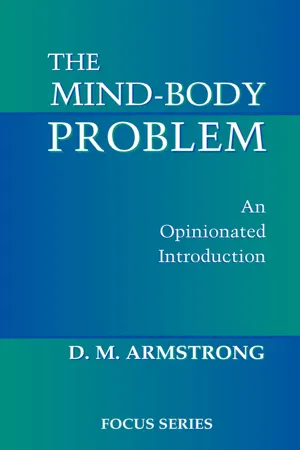
The relation of mind to body has been argued about by philosophers for centuries. The Mind-Body Problem: An Opinionated Introduction presents the problem as a debate between materialists about the mind and their opponents. After examining the views of Descartes, Hume, and Thomas Huxley the debate is traced through the twentieth century to present day. The emphasis is always on the arguments used and the way one position develops from another. By the end of the book the reader is afforded both a grasp of the state of the controversy and how we got there.
Information
Chapter One
Introduction
This chapter does three things. First (1.1), it sets out the general principles that I have tried to observe in writing the book. Second (1.2), it gives a brief summary of each further chapter. Third (1.3), it makes a suggestion, based on my own practice, to anybody who considers using the book as the basis for lectures and examinations.
1.1. General principles
The mind-body problem is the problem of what the mind is, what the body is, and, especially, what relation they stand in to each other. This book is based upon lectures that I gave for many years at Sydney University It is not intended for students who have not yet done any philosophy For North American students an introductory philosophy course is a desirable preliminary For British and Australasian students, it is probably best as a second or third year course.
The book has three further features: It is in some degree historical; it is dialectical; and it is opinionated. Let me explain.
First, though historical, it is not a work of scholarship. It does not pretend to be a history of the mind-body problem. But when we have a problem, either intellectual or practical, it is often immensely valuable to understand something oí the history of the problem. How did we get into this mess? It usually gives a better grasp of the tangle to see how it got to be that way, and seeing this is likely to help in solving the problem. And with the mind-body problem we need all the help we can get. Many contemporary texts in the philosophy of mind are so anxious to introduce the student to the very latest ideas and arguments that the wood gets lost in the examination of tree after contemporary tree. An approach that is at least partly historical should help to see the wood again.
So I start with Descartes in the seventeenth century, who set the terms of the debate for nearly three centuries and still influences it today I go on to David Hume's critique of Descartes in the next century and what may be thought of as Thomas Huxley's development of Hume's position in the nineteenth century Then we are ready to move to Gilbert Ryle's quasi-Behaviourism in the late 1940s, to the Identity theory of U. T. Place and J.J.C. Smart that began as a critique of Ryle, and then on to the successors to the Identity theory. These successor positions are the ones that are dominant today. But the story oí how these positions were reached should make us understand them better.
Second, this more or less historical examination of the problem is dialectical. I mean by this that the emphasis will be on the way that the position of one philosopher, or group of philosophers, developed out of a wrestling with, or an examination of, a position taken earlier. We will be following the story, or a significant part of the story, of the running discussion about the mind-body relation that has gone on among philosophers from Descartes to the present day. The emphasis will be continually on the arguments that were used. I sum this up by saying that the treatment will be dialectical.
Finally, the book will be opinionated. It will argue for a certain point of view, in particular for a Materialist solution to the mind-body problem. I do not do this because I wish to be dogmatic. Philosophy is difficult; the mind-body problem is particularly difficult, and no philosopher (or anybody else) should claim to know the truth about this matter. It is also true, though, that with out a point of view it seems to be impossible to survey and to organize any illuminating discussion. The attempt to stand above the battle, as attractive as it may sound in theory, does not seem to be helpful. Bias seems to be inevitable in presenting arguments about such a deep and fundamental matter. Indeed, without a point of view, a bias, a philosopher is nothing.
What can we do about bias, then? One thing that we can do is to be up-front and declare our bias. 1 do this by saying that I lean rather strongly toward a Materialist account of the mental. I see the story as a move from Descartes' spiritualist account of the mind to a much more plausible identification of mind with the physical brain. A second thing that we can try to do about bias is much more difficult. We must search out what we take to be the strongest objections to the position we wish to take, state them as fairly as we can, and answer them as plausibly as we can. Philosophers regularly show their deepest worth not so much in advancing penetrating arguments against opponents (where a lot of the fun is), but rather in appreciating which arguments against their position are the arguments that must be answered, and in producing answers of weight and substance to these arguments.
The last three chapters of the book will be devoted, therefore, to what I take to be the main objections to Materialist theories of the mind. I will consider in turn whether three traditional objections to Materialism—consciousness, the sensible qualities, and the phenomenon that philosophers call 'intentionality'—should make us embrace an anti-Materialism about the mind.
1.2. An overview of later chapters
Now for a quick account of the eleven chapters to come. It may help to orient the reader by laying out the bare bones of the story.
Cartesian Dualism. I begin, as advertized, with Descartes. He held a two-substance theory. The mind is a spiritual, immaterial, substance. The body is a material substance, working according to physical laws. A human being is some intimate, though rather mysterious, union of the two substances. This sort of theory is now called Cartesian Dualism, after Descartes. (You have to be quite an important person to get your own adjective like this!)
Bundle Dualism. In subsequent philosophical reflection, after Descartes, both spiritual and material substance came under attack. For our purposes, it is the attack on spiritual substance that is of special importance. The great attack on spiritual substance was that launched by the sceptical Scotsman: David Hume. He accepts Descartes' view that the mental is immaterial. But he dissolves the spiritual substance into what he calls 'a bundle of perceptions'. For Hume, the mind is not a single immaterial thing, as it is for Descartes, but, rather, a bundle of little immaterial things.
Epiphenomenalism. Descartes believes in mind-body interaction. For him, the body acts on the spiritual substance, and the spiritual substance acts on the body. He concedes that this interaction is mysterious, but says that one cannot deny that it happens. Hume, similarly, accepts interaction between the 'bundle of perceptions' and the body. However, later thinkers became increasingly worried about how this interaction is possible. In particular, they worried about how the immaterial mind could act on the material body.
Suppose, then, that (1) you dissolve the mind into a bundle of non-material phenomena; but (2) you deny that this bundle can act on the body, in particular, you deny that it can act on the brain. You have arrived at the position now known as Epiphenomenalism. This position was put forward in the nineteenth century by Thomas Huxley, best known as the defender of, and propagandist for, Charles Darwin. We will look at Huxley's Epiphenomenalism.
Ryle. Epiphenomenalism is Dualism rather near the end of its tether. Mind and body are still conceived of as two quite different sorts of realm, but the mental realm is both dissolved into a mere bundle of perceptions and, still worse, made causally impotent with respect to the body. The question then arises whether the nonphysical mental realm can be swept away altogether. The incredible success of the physical sciences makes the idea of a purely physicalist scheme of things look, rather attractive.
In psychology, this drive towards the physical gives rise, in the 1920s, to the Behaviourism of J. B. Watson and others. All there really is to the mind are the physical actions of human beings. In philosophy also, various thinkers, in particular Ludwig Wittgenstein, tried to get away from a two-realm view. The most accessible of these philosophers is Gilbert Ryle in his book The Concept of Mind (1949). We will examine his position.
The Identity theory. Many philosophers, however, were dissatisfied with the Behaviourist and Rylean denial of two realms. They argued that when we consider such things as our perceptions and, more generally, consciousness, then we are forced to admit an inner realm of the mental. The question then arose, for scientifically oriented philosophers, how it is possible to reconcile the existence of inner mental phenomena with Materialism. From these two intellectual pressures arose the Identity theory. Perception and consciousness exist—they cannot be dissolved into behaviour—but, the Identity theorists said, they are not processes embodied in a spiritual substance or anything like that. They are simply physical processes in the brain. The Identity theory was put forward by Herbert Feigl, U. T. Place, and J.J.C. Smart. We will look at the now classic, and widely anthologized, articles "Is Consciousness a Brain Process?" (Place, 1956) and "Sensations and Brain Processes" (Smart 1959).
The Causal theory. Place and Smart continued to go a long way with Ryle. Although putting forward a brain process theory of perceptions and consciousness, they accepted what Ryle had to say about other aspects oí the mind. In effect, they remained half-Behaviourists.
Some philosophers, in particular David Lewis and D. M. Arm-strong1, thought that this was an unsatisfactory compromise. If you are prepared to identify perceptions and consciousness with brain processes, then why not go the whole way and identify all mental processes, events, and states with brain processes, events, and states? Lewis and Armstrong suggest that we do this by giving a causal analysis of all mental concepts. In Lewis's phrase, the concept of the mental is that which plays a certain causal role. For instance, a purpose to get a beer from the fridge can be seen as an inner cause that, in appropriate conditions, would bring about behaviour that did the job. It is then argued (a second step) that what in fact plays this causal role are physical processes, and such, in the brain.
Elimmativism. A still more radically Materialist view is put forward by Paul Feyerabend and Richard Rorty. In a way, they agree with anti-Materialists, such as Descartes, about the mind. Our notion of the mental, they think, is indeed the notion of something non-physical. But as convinced physicalists, they then argue: So much the worse for the mental. What contemporary science teaches us, they think, is that there are no minds, nor anything mental at all. There are only physical processes in the brain. Later Eliminitavists, in particular Paul and Patricia Churchland, do not take quite this line. But they agree in thinking that the existence of the mental is a mere folk theory that should be replaced with a neurophysiological account of the workings of the brain.
Functionalism. Functionalism is the more or less prevailing orthodoxy about the mind-body problem among analytic philosophers today Early figures were Hilary Putnam and Jerry Fodor, and the latter became a sort of high priest of Functionalism. The Causal theory of Lewis and Armstrong can also be accounted a variety of Functionalism. Mental processes, and such, are to be defined in terms of the function they serve, but different ways of spelling out this notion of function are to be found: causal function, evolutionary function, computing function, function as in an organizational flowchart. It is generally assumed, in addition, that the actual entities that carry out the function are material processes in the brain.
Objections to Materialism. Materialist theories of the mind do not have it all their own way in contemporary analytic philosophy There are three main lines of attack made on Materialism, although they tend to get mixed up with each other and need careful sorting out.
(1) Consciousness. The first objection to Materialism is that it cannot account for the consciousness that each one of us has both of the world (which includes our own body) and, still more, of the workings of our own mind. In Chapter 10, I make an attempt to give an account of consciousness that is at least compatible with Materialism.
(2) The sensible qualities. We experience the world as involving various qualities. Some oi these qualities—for instance, seen colour, heard sound, tastes, smells, felt heat, the different qualities that we associate with our different bodily sensations and mental images, also perhaps the qualities of our emotions—are qualities that are not easy to fit into a scientific worldview. Yet we cannot deny their existence; so again we have reason to think that Materialism is seriously incomplete. This objection seems more difficult for the Materialist to deal with than the objection concerning consciousness. I will make an attempt, nevertheless, to sketch a Materialist account of the sensible qualities.
(3) Intentionality. Many, perhaps all, mental processes, events, and states have a property that philosophers, using a term derived from the medieval philosophers, call 'intentionality'. (It has nothing special to do with intentions, though intentions do have intentionality.) It is the way that mental things point beyond themselves to other things that need not be mental at all, and, amazingly, need not even exist. Suppose that I think of a friend who lives far away. It is him I am thinking of. But how could a mere brain process reach out in this way? I can also think of an imaginary playmate I had as a young child. How can a brain process thus point to what does not even exist? For the Materialist, this is probably the hardest problem of all about the mind. I will argue that we can see the beginnings of an account of intentionality that is compatible with Materialism, but I admit that much work remains to be done.
1.3. A note to instructors
Persons considering using this book in teaching may be interested in my own procedures when giving the lectures on which this book is based. I asked as work for the course one essay, and an examination where three questions had to be answered. The essay was supposed to deal with the main themes of what are now the chapters from Chapter 2 to the end. Which chapter was selected was up to the student. The examination contained just one question, of a simple and direct nature, on each topic. Students could pick any three questions, with the exception of the question that covered the chapter that their essay had dealt with. I advised the students of all this from the beginning. They thus had to come to definite terms with the materials in four of the eleven chapters.
I offer a list of readings and references, sometimes with some comment, at the end of each chapter; they are thus readily available for essays and for preparations for examinations.
Notes
1.1 say 'Armstrong' here rather than 'I' to try to be more objective!
Readings and references
Braddon-Mitchell, David, and Frank Jackson. 1996. Philosophy of Mind and Cognition. Oxford: Blackwell. This would make a useful companion
to the present volume. Its approach is not historical, and it takes up certain matters, such as the use of the methodology of possible worlds in the philosophy of mind, and the theory of reference in semantics, that are not dealt with here. There are useful guides to reading, and a glossary of notions is provided.
Campbell, Keith. 1984. Body and Mind. 2d ed. Indiana: University of Notre Dame Press. Perhaps thè clearest introduction to the mind-body problem ever written. Although published some years ago, it is still useful today. It is also quite brief. The second edition added a whole new chapter on Fun...
Table of contents
- Cover
- Half Title
- Title
- Copyright
- Dedication
- Contents
- List of Tables and Figures
- Preface
- 1 Introduction
- 2 Descartes' Dualism
- 3 Hume's Bundle Dualism
- 4 T. H. Huxley's Epiphenomenalism
- 5 Ryle's Rejection of Two Realms
- 6 The Identity Theory
- 7 The Causal Theory—Armstrong and Lewis
- 8 The Eliminativist Theory
- 9 Functionalism
- 10 Consciousness
- 11 The Sensible Qualities
- 12 Intentionality
- Appendix: "On the Hypothesis That Animals Are Automata, and Its History" by Thomas Huxley
- Index
Trusted by 375,005 students
Access to over 1.5 million titles for a fair monthly price.
Study more efficiently using our study tools.
Frequently asked questions
Yes, you can cancel anytime from the Subscription tab in your account settings on the Perlego website. Your subscription will stay active until the end of your current billing period. Learn how to cancel your subscription
No, books cannot be downloaded as external files, such as PDFs, for use outside of Perlego. However, you can download books within the Perlego app for offline reading on mobile or tablet. Learn how to download books offline
Perlego offers two plans: Essential and Complete
- Essential is ideal for learners and professionals who enjoy exploring a wide range of subjects. Access the Essential Library with 800,000+ trusted titles and best-sellers across business, personal growth, and the humanities. Includes unlimited reading time and Standard Read Aloud voice.
- Complete: Perfect for advanced learners and researchers needing full, unrestricted access. Unlock 1.5M+ books across hundreds of subjects, including academic and specialized titles. The Complete Plan also includes advanced features like Premium Read Aloud and Research Assistant.
We are an online textbook subscription service, where you can get access to an entire online library for less than the price of a single book per month. With over 1.5 million books across 990+ topics, we’ve got you covered! Learn about our mission
Look out for the read-aloud symbol on your next book to see if you can listen to it. The read-aloud tool reads text aloud for you, highlighting the text as it is being read. You can pause it, speed it up and slow it down. Learn more about Read Aloud
Yes! You can use the Perlego app on both iOS and Android devices to read anytime, anywhere — even offline. Perfect for commutes or when you’re on the go.
Please note we cannot support devices running on iOS 13 and Android 7 or earlier. Learn more about using the app
Please note we cannot support devices running on iOS 13 and Android 7 or earlier. Learn more about using the app
Yes, you can access The Mind-body Problem by D. M. Armstrong in PDF and/or ePUB format, as well as other popular books in Philosophy & Mind & Body in Philosophy. We have over 1.5 million books available in our catalogue for you to explore.