eBook - ePub
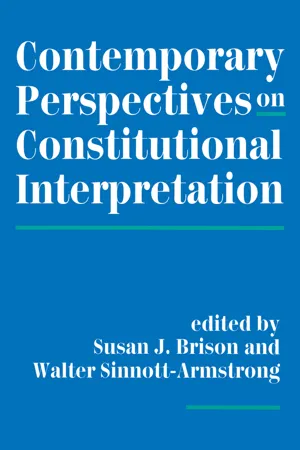
Contemporary Perspectives On Constitutional Interpretation
- 266 pages
- English
- ePUB (mobile friendly)
- Available on iOS & Android
eBook - ePub
Contemporary Perspectives On Constitutional Interpretation
About this book
Current controversies over abortion, affirmative action, school prayer, hate speech, and other issues have sparked considerable public debate about how the U.S. Constitution should be interpreted. Such controversies, along with the changing composition of an often deeply divided Supreme Court, have led to a resurgence of interest in theories of constitutional interpretation. This anthology, edited by Susan J. Brison and Walter Sinnott-Armstrong, presents some of the most exciting and influential contemporary work in this area. Written by ten of the country's most prominent legal scholars, the selections represent a wide variety of interpretive approaches, reflecting different political orientations from the far right to the far left. These theorists have drawn on a variety of other disciplines, including literature, economics, history, philosophy, and politics, and have in turn influenced these fields. The selections were chosen for their accessibility, originality, variety, and importance. Together they provide an excellent introduction to constitutional interpretation as well as a valuable collection for experienced scholars in the field.
1
The Nature of Constitutional Interpretation
What is constitutional interpretation? It might seem that this question must have a single answer if different theories of constitutional interpretation are to be about a single topic. However, in this volume, Frederick Schauer argues that what counts as an interpretation—and even what counts as the Constitution—will vary from theory to theory, depending on which kinds of reasons are recognized by the theory and which cases are hard cases according to the theory.
Schauer argues that there is also no single answer to the question, How should the Constitution be interpreted? Instead of advocating a single method of constitutional interpretation, Schauer suggests that different methods are appropriate on different occasions. The Constitution is interpreted not only by Supreme Court justices but also by lower court judges, by attorneys-general who decide which cases to prosecute, by police officers who decide when to give Miranda warnings, and by town clerks who decide whether to issue parade permits. These different interpreters face different pressures, possess different information, undergo different training, and have different political views. Consequently, Schauer argues, the best results will be reached more often if different methods are used at different times by different people. As he puts it, constitutional theory should be "interpreter-relative."
Schauer is not saying that interpreters should use whichever method seems right to them at the time. Instead, there is supposed to be an underlying rationale that determines which methods are appropriate in which contexts. This general criterion of adequacy needs to be spelled out precisely and justified fully in order to be useful in resolving controversies, but the formulation and defense of such a criterion will be a very difficult task. However this fundamental problem is solved in the end, Schauer's approach teaches us that we need to look closely at the details of the contexts in which the Constitution is interpreted.
W. S-A.
The Occasions of Constitutional Interpretation
Frederick Schauer
At first glance the various theories of constitutional interpretation appear quite distinct. Some assert that the Constitution should be interpreted to reflect the original intentions of the framers, while others contend that such intentions are largely irrelevant. Some insist that majoritarian democracy should be the guiding principle of constitutional interpretation, while others reject any pre-occupation with the "counter-majoritarian difficulty." Some view the task of constitutional interpretation as almost at one with moral philosophy, while others believe that the words of the text are the recurring constraint.
Spanning the diversity among the various theories, however, some constants appear. And among the most constant of these constants is a preoccupation with the United States Supreme Court. For the past several generations, the voice of constitutional theory has focused on urging a majority of the members of the Supreme Court to adopt some particular interpretive methodology. This focus is by no means inappropriate; indeed, it remains appropriate despite the unlikelihood that current or foreseeable Justices of the Supreme Court will adopt the prescriptions offered by academic constitutional theorists. If the enterprise of academic constitutional law in general—and constitutional theory in particular—serves as a shadow Supreme Court,1 then any disjunction between what constitutional theorists offer and what the Supreme Court is likely to accept is largely irrelevant.
Even within the voice of constitutional prescription, however, there remains an odd preoccupation with the Supreme Court. As long as all judges and all officials take an oath to support the Constitution,2 there is every reason to believe that such officials also confront interpretive problems. Are these problems the same, however, when the domain of interpretation shifts from the Supreme Court to other venues of constitutional interpretation? If interpretation is an exercise in ideal theory, pursuant to which there is one best interpretation for any interpretive problem, then the answer is "yes." But constitutional interpretation differs from many other interpretive exercises, with the difference flowing from the fact that constitutional interpretation necessarily implicates the very questions of power allocation that much of ideal theory routinely ignores. And because one of these institutions whose power is at issue is the judiciary, a court interpreting the Constitution is necessarily claiming its own interpretive authority and simultaneously engaging in substantive interpretations pursuant to that authority.3 Because of this interpreter-dependent presupposition in any act of constitutional interpretation, it is mistaken to assume that Supreme Court-centered accounts of the principles of constitutional interpretation are necessarily transferable to the interpretive tasks of other officials.
One of the inquiries falling under the heading of "the occasions of constitutional interpretation," therefore, is an inquiry into the appropriate principles of constitutional interpretation for officials other than Supreme Court Justices. I will spend some time with that issue here. I will also attend to a second and closely related inquiry, one faced by all constitutional interpreters from Supreme Court Justices to the cop on the beat—and one logically prior to any question of how the Constitution should be interpreted—of determining just when a situation requires an act of interpretation at all. As I will show, different interpretive theories generate different interpretive occasions. The interpretive occasions to which interpretive theories are designed to respond are accordingly themselves dependent upon the selection of one interpretive theory rather than another. Theories of interpretation, therefore, including theories of constitutional interpretation, purport not only to give us the answers to interpretive questions, but also to tell us when we have an interpretive question in the first place.
I
Must constitutional theories be indifferent to the identity of the decision-maker? Traditionally the answer to this question has been "yes," for little else could explain the virtual exclusivity with which constitutional theorists have focused on the Supreme Court. So let us distinguish between two types of constitutional theory, the interpreter-indifferent and the interpreter-relative.
According to interpreter-indifference there is, in theory, a correct interpretive method, and, consequentially, correct interpretive outcomes. The interpreter, therefore, must locate the correct interpretive method and then employ it to generate the correct answer. Now this description of interpreter-indifference is simply a construct, which of course does not presuppose that all people will agree on a correct interpretive method or even on the results generated by methods on which they do agree.4 For my purposes, however, the importance of the construct lies in what it does not include. Specifically, it does not make reference to the identity of the interpreter or to the role the interpreter occupies. If, for example, New York Times Co. v. United States,5 the case of the Pentagon Papers, is a correct interpretation of the First Amendment, then the lower court judges in that case should have reached the same result even before the Supreme Court decided the case. Additionally, if the correctness of the result was ontologically antecedent to the Supreme Court decision, then the United States Attorney who prosecuted the case and the Attorney General (and President) who authorized the prosecution acted unconstitutionally as well.6 Moreover, and central to my inquiry, interpreter-indifference dictates that the same account of and instructions for constitutional interpretation apply to all of these officials. If I am asked to "give" a theory of constitutional interpretation, I need not ask "Who wants to know?" Similarly, an official need not revise her constitutional theory as she changes positions or roles. The task of the municipal official determining whether the First Amendment requires her to issue a parade permit which she would not otherwise issue is no different, in theory, from the task of the Supreme Court in determining whether the official acted unconstitutionally in denying the permit.
Interpreter-indifference meshes well with the traditions of many domains of philosophical inquiry. Most philosophers treat questions of epistemology, metaphysics, and logic as questions that have, in theory, objective answers not varying with the identity or role of the philosopher. Whatever the answer to a question of metaphysics or logic, those who offer it presuppose that it does not depend on the identity or role of the particular individual who poses or confronts the question.7
Turning from epistemology, metaphysics, and logic to ethics, however, the presuppositions of interpreter-indifference become more problematic, for it is not self-evident that the demands of morality are independent of identity or role. We may, for example, have special moral obligations to those closest to us. The answer to the question, "Should Joan relieve Bob's distress or Ann's distress, if Joan can only relieve the distress of one of them?" may not turn on some universal distress-relieving potential that happens at the moment to be borne by Joan. The answer, rather, may depend on whether Joan has some special relation- ship with either Ann or Bob. According to one philosophical tradition, therefore, ethics requires partiality, such that the answers to moral questions vary with the particular relationships of the individuals involved.8 Similarly, while the issues remain deeply contested, the demands of morality may also vary with the role the decision-maker occupies. If some roles impose obligations not imposed by others, while different roles preclude their occupiers from taking into account everything taken into account by others, then the question of what to do depends in part on who it is who is doing the doing.9
Although interpreter-relativity bears some relationship to positions of agent-partiality and role-relativity, and interpreter-indifference bears an affinity with their negations, my goal here is not to resolve, nor even directly to address, broad questions about agent-relativity and role-morality in ethical theory. Rather, having identified the issues, I will discuss them in the context of interpretive problems, particularly the interpretive problems that confront constitutional decision-makers.
How does a constitutional decision differ from a decision simpliciter? Although constitutions do many things, one thing that all of them do is decide who makes what decisions. If the all-things-considered Tightness of an act were a sufficient condition for its constitutionality, and if the all-things-considered wrongness of an act were a sufficient condition for its unconstitutionality, then constitutionality would be redundant, and there would be little point in having notions of constitutionality and unconstitutionality at all. A non-redundant conception of constitutionality, therefore, presupposes the possibility of decisions tha...
Table of contents
- Cover
- Half Title
- Title
- Copyright
- Dedication
- Contents
- Acknowledgments
- Credits
- A Philosophical Introduction to Constitutional Interpretation
- 1 The Nature of Constitutional Interpretation
- 2 Originalism
- 3 Common Law Method
- 4 Pragmatism
- 5 Law as Integrity
- 6 Critical Race Theory
- 7 Feminist Legal Theory
- 8 Deconstruction
- 9 Critical Legal Studies
- 10 Scepticism
- Suggestions for Further Reading
- About the Book and Editors
- About the Contributors
- List of Cases Cited
Trusted by 375,005 students
Access to over 1.5 million titles for a fair monthly price.
Study more efficiently using our study tools.
Frequently asked questions
Yes, you can cancel anytime from the Subscription tab in your account settings on the Perlego website. Your subscription will stay active until the end of your current billing period. Learn how to cancel your subscription
No, books cannot be downloaded as external files, such as PDFs, for use outside of Perlego. However, you can download books within the Perlego app for offline reading on mobile or tablet. Learn how to download books offline
Perlego offers two plans: Essential and Complete
- Essential is ideal for learners and professionals who enjoy exploring a wide range of subjects. Access the Essential Library with 800,000+ trusted titles and best-sellers across business, personal growth, and the humanities. Includes unlimited reading time and Standard Read Aloud voice.
- Complete: Perfect for advanced learners and researchers needing full, unrestricted access. Unlock 1.5M+ books across hundreds of subjects, including academic and specialized titles. The Complete Plan also includes advanced features like Premium Read Aloud and Research Assistant.
We are an online textbook subscription service, where you can get access to an entire online library for less than the price of a single book per month. With over 1.5 million books across 990+ topics, we’ve got you covered! Learn about our mission
Look out for the read-aloud symbol on your next book to see if you can listen to it. The read-aloud tool reads text aloud for you, highlighting the text as it is being read. You can pause it, speed it up and slow it down. Learn more about Read Aloud
Yes! You can use the Perlego app on both iOS and Android devices to read anytime, anywhere — even offline. Perfect for commutes or when you’re on the go.
Please note we cannot support devices running on iOS 13 and Android 7 or earlier. Learn more about using the app
Please note we cannot support devices running on iOS 13 and Android 7 or earlier. Learn more about using the app
Yes, you can access Contemporary Perspectives On Constitutional Interpretation by Susan J Brison,Walter Sinnott-Armstrong in PDF and/or ePUB format, as well as other popular books in Law & Jurisprudence. We have over 1.5 million books available in our catalogue for you to explore.