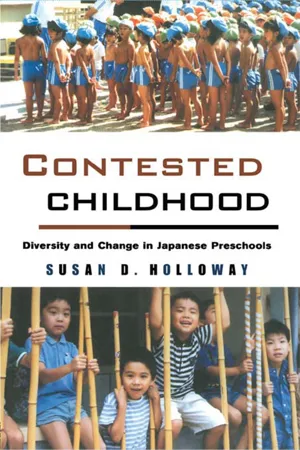
In Contested Childhood, Holloway, an educational and developmental psychologist, examines the Japanese preschool and identifies the cultural models that guide Japanese child-rearing as being contentious and fragmented. She looks at the societal, religious and economic factors that shape various preschool programs and shows how culture influences child-rearing beliefs and practices.
- 272 pages
- English
- ePUB (mobile friendly)
- Available on iOS & Android
eBook - ePub
About this book
Information
1
CONTESTED CULTURAL MODELS OF SCHOOLING
The classroom at the Wakaba Preschool fills with the noise of 40 four-year-olds preparing for lunch. They talk animatedly as they put away their reading materials and wash their hands. With no direction from the teacher, they scrub down their desks and place them in groups of four. An aide staggers in with heavy plastic bins filled with food. The children give a cheer: it’s McDonalds! The teacher plays a chord on the piano. The children scramble to their seats while a representative from each group fetches a paper bag containing the group’s food. Each child spreads out a cloth napkin from home for a place mat, and places a hamburger carefully in the middle, with a drink at the top right corner. The group’s representative puts out two small containers of french fries at the end of each table. The teacher begins to play a familiar song, and the children sing along without glancing at the food in front of them. A second song follows, this time with hand movements to accompany the lyrics. The teacher plays a chord and the children close their eyes, hands pressed together in prayer. “We will keep our feet together, we will sit up straight, we will eat everything,” they say in unison. Then, “Itadakimasu—I gratefully take this food.” At another chord they begin to eat, passing the french fries politely to their table mates, with no squabbles.
What does this scene reveal about cultural norms in Japanese preschools? At first glance, this scene in the classroom may seem “very Japanese.” The children take responsibility for cleaning the classroom and serving the food. They work well together in a large group with little guidance from the teacher. They are polite, controlling their impulse to dive into the meal, and share with their classmates. Is there nothing Western in this scene besides the consumption of food from McDonalds? In fact, many features of the program are appropriated from Western sources. The large class size, which seems to epitomize “group-oriented” Japan, is a product of the Western restructuring of education subsequent to World War II. Before the war, small groups of children were educated under the guidance of a single teacher, who did not teach the class as a whole but, rather, supervised the students as they memorized and discussed important texts (Sato, 1998). And while preschool attendance is now virtually universal in Japan—far surpassing the rate of attendance in the U.S.—the notion of formal schooling for young children was introduced in the late 1800s by Japanese educators returning from study tours in Europe and the U.S., and by American missionaries, who established some of the first Japanese preschools. Many aspects of the preschool institution—including McDonalds—have been appropriated by the Japanese and given a purpose that is consistent with Japanese cultural values and the goals of each particular preschool director.
The preschool is a core institution in Japan, viewed as providing essential experiences that enable young children to obtain social and intellectual skills needed to function successfully in Japanese society. As such, it serves a conservative cultural function—both preserving and transmitting Japanese social values to the younger generation. Yet, as the lunch scene at Wakaba Preschool reveals, preschools are far from static. They do not merely reproduce a uniform cultural script; rather, each preschool is a vibrant, dynamic system whose participants engage in an ongoing, active process of perceiving, interpreting, and synthesizing beliefs and practices available in their cultural milieu. Although aspects of the Western preschool form the underpinning of its Japanese counterpart, these borrowed practices are afforded new meaning and are juxtaposed with other cultural elements, resulting in a setting whose connections to the Western prototype are often tenuous.
And this dynamic process of meaning-making also results in transformation of values and practices that are indigenous to Japan. In fact, what is “traditional” in Japan is not at all clear to the Japanese themselves. Many Japanese adults experience a deep nostalgia for the past, yet they disagree as to the distinctive qualities that made “old Japan” unique. In the process of attempting to recreate the “essential Japanese,” they engage in a creative appropriation of beliefs and practices, resulting in a newly crafted set of cultural models deemed “traditional” (Tobin, 1992a). This activity is pursued most urgently by Japanese conservatives, who have the most faith that the old ways can be resurrected and reinvigorated.
Not only does the dynamic appropriation of symbols, beliefs, and behaviors result in historical change, it also results in considerable variation across institutions at any one point in time. The structured curriculum and strict discipline at Wakaba Preschool distinguish it clearly from the preschools described in previous work on Japan, where free play dominates the schedule and permissive teachers condone rowdy, boisterous behavior (Lewis, 1995; Peak, 1991). Yet each can be said to represent cultural values accepted by some members of modern Japanese society. The director of Wakaba, Mr. Waseda, argues that his curriculum encourages the development of traditional Japanese values such as diligence and self-sacrifice. Mr. Waseda argues that, while preschools that emphasize free play may now be “typical” in Japan, they have been too quick to incorporate Western values such as individualism and materialism.
MOVING BEYOND ONE-DIMENSIONAL PORTRAITS OF JAPANESE SOCIETY
In much of the work on education and child rearing in Japan, little emphasis has been placed on capturing the variation—and accompanying tensions and conflict—that characterize this society. Past studies have focused on identifying a canonical set of beliefs and practices that are endorsed and practiced by all but the most deviant members of society. In this book I am attempting to do something different. Since my first visit to Japan in 1980 as a graduate student, I have been more interested in the wide variation in behaviors deemed acceptable within Japan than in general contrasts between Japan and the United States. During that first trip, my naïve stereotypes were constantly challenged; for every person I encountered who displayed behavior consistent with the “typical” Japanese, I would meet two others who seemed to have completely missed these defining cultural directives. Yes, I did see Japanese businessmen running down the subway platform, as depicted in the famous Time magazine article on the Japanese work ethic, but I also encountered plenty of people who were quite relaxed, like the owner of a bed and breakfast establishment in Tokyo who preferred to lie on the tatami mat floor watching soap operas on television than straighten up the cluttered rooms in her home. And how could I reconcile the many descriptions of Japanese parents as invariably sweet and supportive with the father I saw fiercely hitting his young son on the head with an umbrella, as the mother looked on? Were these merely exceptions to the rule, or were the images I initially took to Japan far too simplified to convey the depth and nuances of this complex society?
While I continued to visit and write about Japan for the next decade, I did not have an opportunity to address this issue of diversity formally until 1993, when I spent six months in the Kansai area researching the experience of young children in preschools and childcare centers. My goal was to capture the variability that exists in the way Japanese children are cared for—without falling into a morass of noncohering details that pertain only to individual cases! During my stay, I spent a great deal of time in 32 preschools and child-care centers, observing in classrooms and interviewing directors and teachers about their educational philosophy and practices. I visited each school for a full day, then spent one week at each of three selected sites. The data obtained during that visit constitute the core of this book.
My theoretical framework for illuminating diversity, change, and contestation is drawn from recent work in cultural psychology. This emerging field builds upon insights from anthropology and cognitive science as well as social and developmental psychology. Its practitioners tend to look at a particular milieu as affording a variety of available pathways or cultural models. Cultural models refer both to people’s beliefs—including ideas about how things work as well as how they should work—and the scripts or behavior sequences that they use to deal with routine situations (for a full discussion of this approach, see D’Andrade, 1992; Geertz, 1983; Holland et al., 1998; Holloway et al., 1997; Quinn & Holland, 1987; Shore, 1996). While cultural models are sometimes held by all members of broad social categories such as nation, gender, or social class, they are also formulated within more narrowly bounded social settings, including, for example, neighborhood or occupational niche.
When it comes to educating and rearing children, a number of cultural models are usually deemed acceptable in any given community. However, this cultural “pool” of beliefs and practices may contain elements that are in tension or even in fundamental conflict with each other (Kojima, 1986b, 1988). Because of their own experiences, social positions, and personalities, individuals within a community may appropriate particular cultural elements and synthesize them in a way that leads to disagreement with others in the community. Unlike parents, who often enact cultural models of child rearing without conscious reflection, teachers and preschool directors are typically aware of various theories and alternative strategies when it comes to educating children.
To thoughtful educators, the business of teaching young children turns quickly into an exploration of the type of human being that one hopes to create or at least to participate in creating. The goals and visions of educators are shaped by the cultural models available to them in their society. As Shore (1996) points out, cultural models provide us with a set of heuristics for conceptualizing and resolving these fundamental questions:
Culture provides us with rhetorical strategies for making [ethical] choices in the form of clichés, proverbs, heroic models in myth, and other such cultural resources that help provide partial and temporary resolutions to what may be ultimately irresolvable predicaments. In this view, cultural systems do not invent values so much as they orchestrate rhetorical strategies, organizing the perception of valueladen situations with standardized and culturally acceptable formulations—what we call cultural models. (p. 304)
Much writing by American scholars and journalists on Japanese education and child rearing has failed to consider the varied and dynamic cultural models that characterize Japanese society and its institutions. Part of this is because Japan has remained ethnically and linguistically homogeneous, and its social class differences are less pronounced than in the United States and many other Western countries. Additionally, many Americans seem to have bought into the notion, also perpetuated by some Japanese, of Japan as the “unknown and unknowable.” When a society is viewed as different from one’s own, the tendency is to essentialize and exoticize it—to define it as possessing unique and static characteristics that give it its distinctive identity. Western writing not only essentializes Japan but adds a moral evaluation of the resulting portrait. Whether the spin is negative or positive depends on the writer’s purpose as well as the political and economic climate of the times. For much of the period subsequent to World War II, the media characterization of Japan was negative (Zipangu, 1998). But along with Japan’s rising economic power came more flattering portraits touting the Japanese work ethic, cooperative skills, self-discipline, and the like. As the economy began to slow down, the tide agai...
Table of contents
- Cover
- Half Title
- Title Page
- Copyright Page
- Dedication
- CONTENTS
- ACKNOWLEDGMENTS
- 1. Contested Cultural Models of Schooling
- 2. Caring for Young Children in Japan
- 3. Relationship-Oriented Preschools: Fun and Friends
- 4. Role-Oriented Preschools: Sweetness and the Whip
- 5. Child-Oriented Preschools: Strong Individuals, Good Groups
- 6. Preschools and Social Class: Early Experiences in a Stratified Society
- 7. Shinto, Buddhist, and Christian Preschools
- 8. The Slow Demise of Public Preschools
- 9. “Finding Our Way”
- NOTES
- REFERENCES
- INDEX
Trusted by 375,005 students
Access to over 1.5 million titles for a fair monthly price.
Study more efficiently using our study tools.
Frequently asked questions
Yes, you can cancel anytime from the Subscription tab in your account settings on the Perlego website. Your subscription will stay active until the end of your current billing period. Learn how to cancel your subscription
No, books cannot be downloaded as external files, such as PDFs, for use outside of Perlego. However, you can download books within the Perlego app for offline reading on mobile or tablet. Learn how to download books offline
Perlego offers two plans: Essential and Complete
- Essential is ideal for learners and professionals who enjoy exploring a wide range of subjects. Access the Essential Library with 800,000+ trusted titles and best-sellers across business, personal growth, and the humanities. Includes unlimited reading time and Standard Read Aloud voice.
- Complete: Perfect for advanced learners and researchers needing full, unrestricted access. Unlock 1.5M+ books across hundreds of subjects, including academic and specialized titles. The Complete Plan also includes advanced features like Premium Read Aloud and Research Assistant.
We are an online textbook subscription service, where you can get access to an entire online library for less than the price of a single book per month. With over 1.5 million books across 990+ topics, we’ve got you covered! Learn about our mission
Look out for the read-aloud symbol on your next book to see if you can listen to it. The read-aloud tool reads text aloud for you, highlighting the text as it is being read. You can pause it, speed it up and slow it down. Learn more about Read Aloud
Yes! You can use the Perlego app on both iOS and Android devices to read anytime, anywhere — even offline. Perfect for commutes or when you’re on the go.
Please note we cannot support devices running on iOS 13 and Android 7 or earlier. Learn more about using the app
Please note we cannot support devices running on iOS 13 and Android 7 or earlier. Learn more about using the app
Yes, you can access Contested Childhood by Susan D. Holloway in PDF and/or ePUB format, as well as other popular books in Didattica & Didattica generale. We have over 1.5 million books available in our catalogue for you to explore.