eBook - ePub
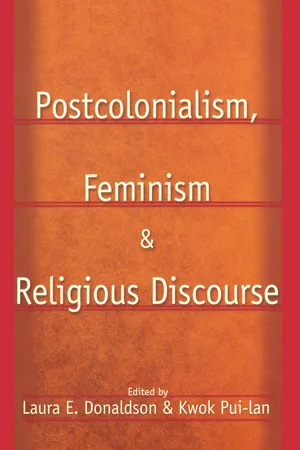
Postcolonialism, Feminism and Religious Discourse
- 208 pages
- English
- ePUB (mobile friendly)
- Available on iOS & Android
eBook - ePub
Postcolonialism, Feminism and Religious Discourse
About this book
Contributors examine white feminist theology's misappropriations of Native North American women, Chinese footbinding, and veiling by Muslim women, as well as the Jewish emancipation in France, the symbolic dismemberment of black women by rap and sermons, and the potential to rewrite and reclaim canonical stories.
Information
Challenging Feminist Religious Discourse
1
The Breasts of Columbus
A Political Anatomy of Postcolonialism and Feminist Religious Discourse
I do not hold that the earthly Paradise has the form of a rugged mountain, as it is shown in pictures, but that it lies at the summit of what I have described as the stalk of the pear.
—Christopher Columbus, Log, Third Voyage
Whether they are large and plump, small and flat, or positively undulating, womens breasts embody sexual difference in the identity discourses of the West; however, the meaning these discourses generate about breasts is radically divergent. On the one hand, the socialization of women as objects of the male gaze has induced many to spend millions of dollars enlarging, sometimes reducing, but always disciplining their breasts through the rigors of plastic surgery. In contrast, feminists such as Hélène Cixous suggest that a womans breasts (along with her other reproductive organs) defy the centralized phallicism of men and engender an alternative libidinal organization as well as a distinctly feminine way of knowing. However, we should also remember that breasts possess a colonial history and that the female mammary glands constitute a significant part of imperialism’s political anatomy.1
Who can forget, for example, the recent struggle of indigenous people for the hills of Welatye Therre, or “Two Breasts,” where Australian aboriginal women have danced and sung for thousands of years?2 Both the songs associated with the site and its sacred objects nurture the dissemination of women’s knowledge. As one Arrernte woman declared: “Like you’ve got women’s liberation, for hundreds of years we’ve had ceremonies which control our conduct, how we behave and act and how we control our sexual lives. … They give spiritual and emotional health to Aboriginal women.”3 Specific knowledge about the Welatye Therre is forbidden to non-Native outsiders as well as to aboriginal men, yet the Arrernte women who claim this place were forced to disclose its significance (and thus risk its sacredness) to protect it from flooding by a proposed hydroelectric dam. After an effective and vigorous opposition campaign they defeated the dam proposal, and the “Two Breasts” of Arrernte culture continue to nurture their people.
The breasts of “Sheba,” which come to life in the pages of H. Rider Haggard’s novel King Solomons Mines, exist as perhaps the most (in)famous European counterpart to the Welatye Therre. In Haggard’s nineteenth-century adventure tale, a mercenary Portuguese trader named Jose da Silvestre ironically draws a map to the chamber containing the riches of King Solomon while he is starving to death on the “nipple” of “Sheba’s Breasts”—the name of an African mountain that rightly refuses to nurse such a destructive child. Described by Malek Alloula as the half-aesthetic concept of the “Moorish bosom,” the specter of the colonized’s dark, seductive breasts (even such topographical ones as Sheba’s) both titillated and haunted the European social imaginary during the centuries of conquest. In his analysis of suberotic breast images in The Colonial Harem, Alloula documents their circulation through the postcards that French colonists in Algeria sent home to the mother country. These postcards function as a virtual “anthology of breasts” whose diversity ultimately reveals a pattern of sameness: “Generally topped off with a smiling or dreamy face, this Moorish bosom, which expresses an obvious invitation, will … be offered to view, without any envelope to ensure the intimacy of a private correspondance [sic]”4
Perhaps the most haunting chronicler of the postcolonial breast is the West Bengali writer and activist Mahasweta Devi, whose collection Breast Stories (1998) explores in literary form many of the questions I will raise here. Breast Stories includes, for example, the story of Draupadi, a tribal woman who leads a resistance movement on behalf of her people, and Senanayak, the police chief who pursues her, and in whom Gayatri Chakravorty Spivak finds a cautionary tale of the expert on Third World resistance literature nourished by First World societies. Devi also introduces her readers to Jashoda, a lower-caste woman who becomes a professional wet nurse (through the practice of suckling) to her masters sons, and Gangor, another tribal woman and nursing mother who works as a migrant laborer. Gangor’s breasts become objects of obsession and oppression through the circulation of an ill-advised photograph. According to Spivak, who translated and introduced Devi’s collection:
The breast is not a symbol in these stories. In “Draupadi,” what is represented is an erotic object transformed into an object of torture and revenge where the line between (hetero) sexuality and gender violence begins to waver.5 In “Breast Giver” [Jashodas story], it is a survival object transformed into a commodity, making visible the indeterminacy between filial piety and gender violence, between house and temple, between domination and exploitation. … In “Behind the Bodice” [Gangor’s story], [Devi] bitterly decries the supposed “normality” of sexuality as male violence.6
This confluence of colonialism and patriarchy so brilliantly explored by Devi also conjures the colonial breasts of most immediate concern to this essay: those fantasized by Columbus, whose voyages in search of the East convinced him that the world was not round, but rather, pear-shaped and topped by a protuberance much like a woman’s nipple.
The “nipple” envisioned by Columbus was none other than Guanahani, the land of the Taino, which the Spanish renamed San Salvador. Feminist critic Anne McClintock identifies Columbus’ breast fantasies as a genre of “porno-tropics” that draws on “a long tradition of male travel as an erotics of ravishment” for its content.7 For example, earlier travelers’ tales had regaled their European readers with stories of men’s breasts flowing with milk and militarized Amazonian women lopping theirs off.8 To readers satiated with such exoticized sexualities, the mammillary imaginings of Rider Haggard and Columbus must have seemed quite tame. In her essay, “The Breast, the Apocalypse, and the Colonial Journey” (later revised as the chapter “De/colon/izing Spaces” in Apocalypse Now and Then), Catherine Keller offers her own engagement with the breasts of Columbus as well as the only explicit engagement by a Euro-American feminist theologian with the 1992 quincentennial.
Keller describes this essay as contributing “a Euroamerican feminist fragment to the postcolonial project” and articulates its goal as decolonizing the “androcentric” minds whose visions of imperialism were so heavily influenced by the “mammillary trope.”9 To this end, she examines the “gender codes” structuring the colonial enterprise and, more particularly, the gender codes that coalesced not only in Christopher Columbus’ apocalyptic discourse but in all speculations about the end of the world.10 For Keller, androcentric myths of the holy warrior, an appeal to male-on-male violence, and a rejection of the feminized and sexualized body link both Revelation’s New Jerusalem and the New World’s Terra Incognita.11 While Columbus’ attempts to formulate an individual politics were ultimately negligible, Keller asserts that his personal apocalyptic beliefs nevertheless transformed “the collective mythic structures of the Western world.”12 This claim tends to exaggerate the sociopolitical importance of apocalypse in fourteenth and fifteenth-century Europe, however, since one could argue that a 1366 amendment by the Priors of Florence to the laws governing the import and sale of “infidel” slaves had an even greater impact on the agendas of conquest.
In this decision, the Holy Roman Church defined the word infidel so that it encompassed anyone born a non-Christian, regardless of any subsequent conversion they might have experienced. From this moment forward, racial and ethnic origin rather than religious difference became the foundation of slavery—an evolving context of discrimination that nurtured the notion of non-Europeans as separate, distinct, and inferior “races.”13 This semantic and theological redefinition of the infidel also influenced the belief that God created American Indians for the specific purpose of becoming slaves to European Christians. Overestimating the influence of apocalyptic thought consequently deflects our attention away from equally important attitudes and policies, along with the complicity of the institutional Church in facilitating the emergence of both colonialism and white supremacy. Despite this tenuous interpretation of Columbian apocalypticism, projects with Keller’s twin foci are long overdue: contemporary postcolonial theory consistently subsumes the particularity of women’s estates under its appeals to an homogenous category called “the colonized,”14 and it has largely overlooked the collusion of colonialist as well as indigenous patriarchies. Gayatri Chakravorty Spivak cautions us about correcting this neglect with an uncritical flight into the realm of the postcolonial, however: “Much so-called cross-cultural disciplinary practice, even when ‘feminist,’ reproduces and forecloses colonialist structures: sanctioned ignorance, and a refusal of subject-status and therefore human-ness [for the subaltern].”15 In other words, despite the cognitive commitments to antiracism and decolonization of many Euro-American feminists, the structures of thought and research methods organizing their scholarship continue to thwart the progressive goals they espouse. Spivak’s emphasis upon the reproduction of two particular “colonialist structures”— sanctioned ignorance and the refusal of subject status to the oppressed— constitutes a starting point for examining this question, since both foreground questions of how scholars produce knowledge rather than personal culpability. My hope is that this exploration of postcolonialism and feminist religious discourse will shift the dialogue among women of the Third and Fourth Worlds and those of the First from a moral to an epistemological paradigm. As Keller herself has noted, blaming or denouncing each other may correct a situation by achieving a “behavior-modifying shame” and an institution-shifting conscience,” but it will never heal the “systemic complex which provoked it.”16 The epistemological shift I am suggesting begins, but certainly does not end, this process of healing.
On Not Sanctioning Ignorance
The whites told only one side. Told it to please themselves. Told much that is not true.
—Yellow Wolf, Nez Percé, c. 1877
Although apocalypse functions as the hinge upon which issues of knowledge turn in this essay, I want to begin my discussion not with a state of knowing, but rather, with the exigencies of “sanctioned ignorance,” or the way in which certain forms of not-knowing are both legitimated and rewarded in the Euro-American academy. Spivak, who coined the notion of sanctioned ignorance, has a specific definition in mind: the ways in which intellectual practices of “Third Worldism” mask urgent problems such as the globalization of transnational monopoly capitalism and the renewed vigor of neocolonialism. She notes, for example, that “our own mania for ‘third world literature’ anthologies, when the teacher or critic often has no sense of the original languages, of the subject-constitution of the social and gendered agents in question (and when therefore the student cannot sense this as a loss), participates more in the logic of translation-as-violation” than in any emancipatory enterprise.17 Sanctioned ignorance is obviously more complex than any individual’s moral intention, as this illustration demonstrates. In the case of scholarship on Native peoples or feminist responses to the quincentennial of Columbus’ voyage to America, sanctioned ignorance most often emerges through an inter-textual chain of information retrieval: those who have no firsthand knowledge cite highly touted sources—virtually all of them non-Native—to produce authoritative, but often highly inaccurate, accounts of indigenous experience. Since those citing do not necessarily “know” the violations their sources effect, they certainly cannot convey to their readers/students any sense of loss (or outrage, perhaps a more appropriate response). And Kellers production of knowledge about the relation between American Indians and apocalypticism provides a model of how, even with an explicit commitment to decolonization, one can become caught in this conundrum.
In Apocalypse Now and Then, Keller rightly insists that no one should construct a counter-apocalyptic conception of community solely on the basis of white European sources. This statement occurs in her use of the Muscogee (Creek) “Red Stick War” as a illustrative example of certain characteristics exhibited by apocalyptic millennial movements. Indeed, Keller articulates her argument by constructing a homology between the Red Stick War and its alleged European ancestors: “The analogies of the Red Stick revolt to the European precedents [Thomas Münzer, the Münster Anabaptists, and Gerald Winstanley’s Diggers] expose a pattern of community desperately attempting to redeem an original identity—whether of the first church or of tribal tradition—by a purifying violence that willy-nilly results in group martyrdom.”18 She thus presents Muscogee millenarianism as exhibiting the same violent propensity for revolutionary purification and homogenization m...
Table of contents
- Cover
- Half Title
- Title
- Copyright
- Contents
- Dedication
- Acknowledgments
- Introduction
- Part One: Challenging Feminist Religious Discourse
- Part Two: Rethinking Texts and Traditions
- Selected Bibliography
- Contributors
- Index
Trusted by 375,005 students
Access to over 1.5 million titles for a fair monthly price.
Study more efficiently using our study tools.
Frequently asked questions
Yes, you can cancel anytime from the Subscription tab in your account settings on the Perlego website. Your subscription will stay active until the end of your current billing period. Learn how to cancel your subscription
No, books cannot be downloaded as external files, such as PDFs, for use outside of Perlego. However, you can download books within the Perlego app for offline reading on mobile or tablet. Learn how to download books offline
Perlego offers two plans: Essential and Complete
- Essential is ideal for learners and professionals who enjoy exploring a wide range of subjects. Access the Essential Library with 800,000+ trusted titles and best-sellers across business, personal growth, and the humanities. Includes unlimited reading time and Standard Read Aloud voice.
- Complete: Perfect for advanced learners and researchers needing full, unrestricted access. Unlock 1.5M+ books across hundreds of subjects, including academic and specialized titles. The Complete Plan also includes advanced features like Premium Read Aloud and Research Assistant.
We are an online textbook subscription service, where you can get access to an entire online library for less than the price of a single book per month. With over 1.5 million books across 990+ topics, we’ve got you covered! Learn about our mission
Look out for the read-aloud symbol on your next book to see if you can listen to it. The read-aloud tool reads text aloud for you, highlighting the text as it is being read. You can pause it, speed it up and slow it down. Learn more about Read Aloud
Yes! You can use the Perlego app on both iOS and Android devices to read anytime, anywhere — even offline. Perfect for commutes or when you’re on the go.
Please note we cannot support devices running on iOS 13 and Android 7 or earlier. Learn more about using the app
Please note we cannot support devices running on iOS 13 and Android 7 or earlier. Learn more about using the app
Yes, you can access Postcolonialism, Feminism and Religious Discourse by Kwok Pui-Lan, Laura E. Donaldson, Kwok Pui-Lan,Laura E. Donaldson in PDF and/or ePUB format, as well as other popular books in Theology & Religion & Comparative Religion. We have over 1.5 million books available in our catalogue for you to explore.